
Key Takeaways
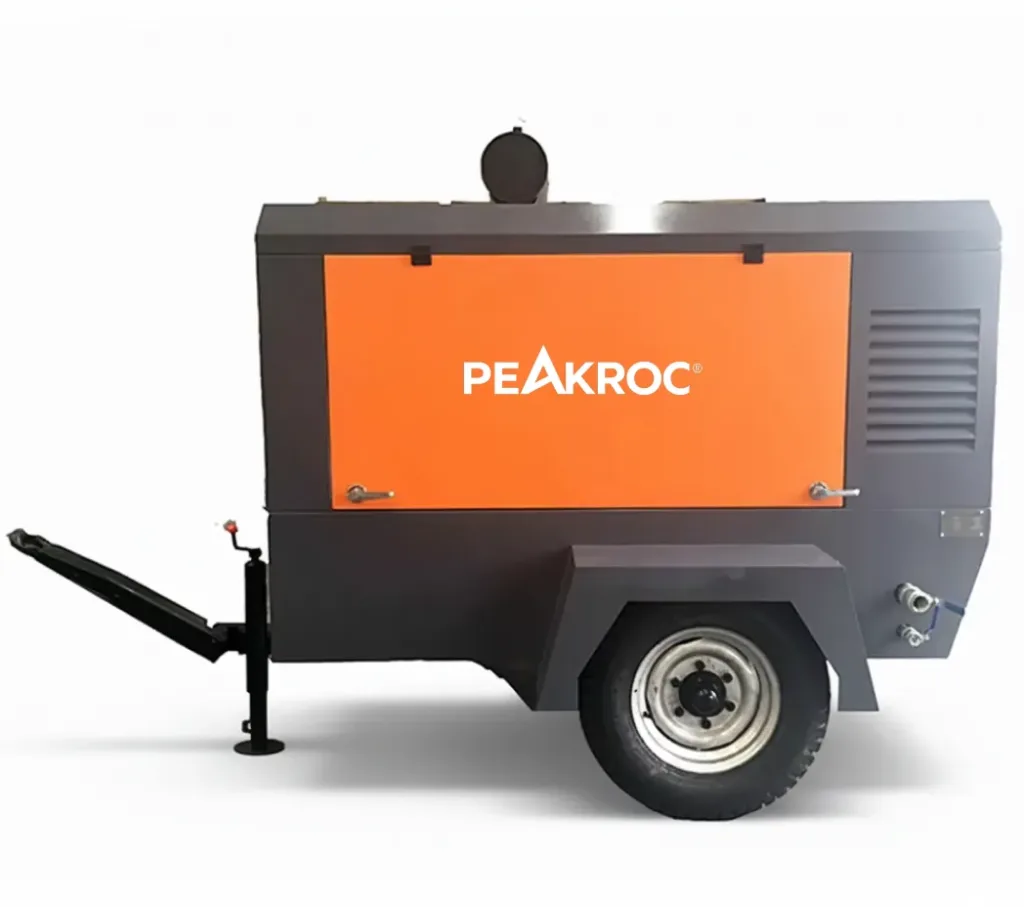
An off-road diesel air compressor is designed for jobsites where compressed air is needed far from stable electricity. It is a self-contained machine that combines a diesel engine, rotary screw air end, cooling system, fuel system, control panel, safety devices, and a rugged mobile chassis. The compressor can be trailer-mounted, skid-mounted, or truck-mounted depending on how the project moves.
For remote job sites, the selection question is not simply “How much pressure can the compressor produce?” The real question is: Can the compressor deliver the required airflow and pressure at the tool, hammer, nozzle, or pipeline connection after real-world losses?
This article focuses on practical selection for construction, mining, drilling, pipeline work, quarrying, sandblasting, municipal utilities, and field maintenance. It explains how to choose CFM or m³/min, pressure class, engine platform, chassis configuration, and air-treatment options without oversizing the machine or buying a compressor that cannot keep up.
Peakroc® supplies portable diesel screw air compressors for construction, mining, drilling, quarrying, pipeline work, and remote industrial sites. Buyers can also review Peakroc’s guide on how to choose a portable diesel air compressor, compare stationary vs. portable compressors for factory and municipal applications, or learn why 25 bar portable diesel compressors are widely used for deep borehole drilling.
What Is an Off-Road Diesel Air Compressor?
An off-road diesel air compressor is a portable compressed-air system built for rough outdoor environments. It does not rely on grid electricity. Instead, a diesel engine drives the compressor air end and delivers compressed air to tools or equipment through outlet valves and hoses.
Most professional off-road diesel compressors use rotary screw technology. A rotary screw air end provides continuous airflow and is better suited to long-duty operation than small piston compressors. This matters because remote construction, quarrying, and drilling projects often require the compressor to run for full shifts under high load.
A complete off-road diesel compressor typically includes four major systems: a diesel engine, a rotary screw air end, cooling and filtration systems, and a heavy-duty mobile frame. These systems must work together. A strong engine is not enough if the air end is undersized. A high-flow air end is not enough if the cooler cannot handle heat. A good compressor package must be engineered as a complete field machine.
The purpose of this machine is simple: deliver reliable air where fixed infrastructure cannot reach.
Why Remote Job Sites Need a Diesel Compressor
Remote job sites create problems that factory compressors never face. The work may be located on a quarry bench, water well drilling pad, mountain road, pipeline route, mine access track, rural bridge repair site, municipal utility trench, or disaster recovery zone. Electrical supply may be unavailable, temporary, unstable, or too expensive to install.
A diesel compressor solves this problem by bringing the power source with the air supply. As long as the crew can bring fuel, perform basic maintenance, and position the machine safely, compressed air is available.
Remote sites usually need compressed air for four practical reasons:
- Powering pneumatic tools such as breakers, chipping hammers, drills, impact tools, and cleaning lances.
- Supporting drilling operations including quarry drilling, water well drilling, exploration drilling, and DTH hammer work.
- Handling field processes such as sandblasting, pipeline testing, pigging, drying, and utility work.
- Providing emergency or temporary air when fixed systems are unavailable or the job moves too often for permanent piping.
A portable diesel compressor is not just a machine; it is a mobile utility source. On many remote jobs, if the compressor stops, the crew stops.
How the Compressor Works
The diesel engine starts and produces rotational power. This power drives the rotary screw air end. The screw rotors draw in ambient air, reduce the air volume, and raise the pressure. In oil-injected screw compressors, oil is used to lubricate, seal, and cool the compression process. The compressed air then passes through separation and cooling stages before being delivered to the outlet valves.
The basic process includes:
- Intake: air enters through filters.
- Compression: the screw air end increases air pressure.
- Cooling and separation: heat is removed and oil is separated from the air.
- Delivery: compressed air flows through hoses to tools, rigs, nozzles, or process equipment.
This continuous airflow is the reason rotary screw compressors dominate professional diesel compressor applications above small intermittent-duty jobs. They provide stable air for tools and drilling systems that cannot wait for a storage tank to recover.
CFM and m³/min: The First Sizing Decision
Airflow is the first number buyers should calculate. It is commonly measured in CFM or m³/min. Pressure tells you how much force the air has, but airflow tells you whether the compressor can keep supplying that force while the tool is working.
A compressor can have the correct pressure but still fail if the airflow is too low. For example, a breaker, sandblasting nozzle, or DTH hammer may start properly, but once it runs continuously, pressure drops and productivity falls.
A practical selection method is:
- Add the air demand of all tools or equipment that may run at the same time.
- Include a reserve margin for hose loss, leakage, tool wear, altitude, and future demand.
- Check that the compressor delivers the required airflow at the actual working pressure.
For construction crews, tool use may be intermittent. A simultaneous-use factor can be applied when not every tool runs at full demand all the time. For drilling, assume continuous demand. A DTH hammer does not operate efficiently if the air supply drops below requirement.
Pressure Class: Match the Work, Not the Biggest Number
Pressure is usually measured in bar or PSI. Selecting the right pressure class is critical because pressure affects tool performance, fuel consumption, air end design, and overall machine cost.
For general construction, road repair, and utility work, 7–10 bar is often enough. These jobs typically involve breakers, chipping tools, pneumatic drills, cleaning air, and compact tools. Buying a 25 bar compressor for this work usually wastes money and fuel.
For quarry drilling, shallow boreholes, and some mining work, 10–14 bar may be more appropriate. For DTH drilling, deep water wells, reverse circulation exploration, and harder formations, 18–25 bar is commonly required. For ultra-deep boreholes, geothermal work, and large-diameter hard-rock drilling, 30–35 bar may be necessary.
A useful way to think about pressure classes:
| Pressure Class | Typical Use | Selection Note |
|---|---|---|
| 7–10 bar | Construction tools, road repair, utility work, sandblasting | Best for general pneumatic tools |
| 10–14 bar | Quarry drilling, shallow boreholes, medium-pressure site work | Useful when tools need more pressure margin |
| 18–25 bar | DTH drilling, deep water wells, RC exploration, blast holes | Requires correct hammer and hose matching |
| 30–35 bar | Ultra-deep drilling, geothermal, large-diameter hard rock | Only choose when the process truly requires it |
The most expensive mistake is buying pressure you do not need. The second most expensive mistake is buying a compressor that cannot deliver pressure at the actual point of use.
Chassis and Off-Road Mobility
For remote job sites, chassis design is not a small detail. A compressor that performs well on a paved road may fail quickly on quarry tracks, mine roads, pipeline corridors, or drilling access roads.
The chassis must match the terrain. Buyers should evaluate tire size, axle rating, suspension, ground clearance, tow bar strength, braking system, lifting points, and frame durability. If the site has mud, rocks, steep grades, or poor access roads, a standard light trailer may not be enough.
There are three common mounting styles.
| Mounting Type | Best For | Main Advantage |
|---|---|---|
| Trailer-mounted | Construction, drilling, rental, road work, pipeline routes | Easy towing between sites |
| Skid-mounted | Semi-fixed mine, quarry, or industrial support | Compact and stable installation |
| Truck-mounted | Municipal utilities, emergency response, field service | Fast relocation and reduced ground setup |
Trailer-mounted compressors are the most common because they are flexible. Skid-mounted units are better when the compressor stays in one area for a longer period. Truck-mounted compressors work well for mobile service teams that move many times in one day.
Application 1: Remote Construction and Road Repair
Construction crews use off-road diesel compressors for pneumatic breakers, chipping hammers, compact drills, blow lances, cleaning tools, and temporary air supply. In rural road repair, bridge maintenance, utility trenching, and concrete demolition, grid power is often unavailable or inconvenient.
A typical construction compressor should be selected by the number of tools, hose length, and working pattern. A crew using one breaker needs a very different compressor from a crew using two breakers, a chipping hammer, and a cleaning line at the same time.
For most construction work, the key requirements are:
- 7–10 bar working pressure.
- Enough airflow for peak simultaneous tool use.
- Strong towing and simple daily maintenance.
- Good fuel efficiency for shift-based operation.
Construction buyers should avoid overbuying high-pressure drilling compressors unless drilling is a regular part of the work. A purpose-built lower-pressure machine will usually be more efficient for tools and road repair.
Application 2: Mining and Quarrying
Mines and quarries are hard on equipment. Dust, vibration, heat, uneven roads, and continuous operation all affect compressor reliability. An off-road diesel compressor may support drilling, rock breaking, bench cleaning, maintenance tools, and temporary production air.
For quarry drilling and mining support, pressure and airflow must be matched to the drill method. If the compressor is used for DTH drilling, it must provide enough air to power the hammer and remove cuttings from the hole. If airflow is insufficient, penetration rate drops and the hole may not clear properly.
A good mining or quarry compressor should have strong filtration, large cooling capacity, reinforced chassis components, easy service access, and reliable engine support. In dusty conditions, radiator cleaning and air filter maintenance become part of daily productivity.
Application 3: Water Well, Exploration, and DTH Drilling
Drilling is one of the most demanding applications for portable diesel compressors. Unlike construction tools, drilling often requires continuous high-load operation. The compressor must provide the correct pressure and airflow for the hammer, hole diameter, depth, formation hardness, and cuttings removal.
For DTH work, pressure alone is not enough. A compressor rated at 25 bar may still underperform if hose losses, altitude, heat, or undersized air lines reduce delivered pressure and flow at the hammer.
When sizing a drilling compressor, start with the hammer manufacturer’s air consumption requirement. Then add margin for depth, hose losses, altitude, and hot ambient temperature. For separated rig setups, longer hoses can create meaningful pressure loss. Integrated systems reduce hose length but reduce flexibility.
This is why drilling buyers should not choose a compressor based only on “bar” or “CFM.” The correct choice depends on delivered air at the hammer under real field conditions.
Application 4: Pipeline, Municipal, and Emergency Work
Pipeline contractors use diesel compressors for pressure testing, pigging, drying, cleaning, and commissioning. These projects often move along long routes, so the compressor must be mobile and capable of long continuous operation.
Municipal crews use diesel compressors for road repair, water main repair, sewer maintenance, fiber optic cable blowing, valve actuation, and storm recovery. Emergency response teams may also use mobile compressed air for rescue tools, temporary service air, or infrastructure repair after floods, storms, or power outages.
These users usually value simple controls, fast startup, towing reliability, and service access. The compressor may not always need the highest pressure, but it must be ready to work when the crew arrives.
Engine, Fuel, and Field Reliability
The diesel engine is one of the most important parts of an off-road compressor. Remote sites cannot afford long downtime caused by poor fuel tolerance, weak cooling, or unavailable spare parts.
Buyers should evaluate engine brand, horsepower, torque reserve, fuel consumption, emission requirements, service network, and parts availability. A cheaper engine may reduce purchase price but create problems later if filters, injectors, sensors, or service support are difficult to source.
Fuel quality also matters. Remote jobs may rely on fuel stored in drums or field tanks. Water or contamination in fuel can damage injectors and cause unstable operation. A good fuel-water separator and regular fuel-system maintenance are essential.
Heat, Dust, Altitude, and Weather
Remote job sites are rarely ideal. High temperature increases cooling load. Dust blocks filters and radiators. High altitude reduces engine power and effective air density. Humidity increases condensate in air lines. Rain and mud create corrosion and access problems.
Before selecting a compressor, check four site conditions:
- Maximum ambient temperature.
- Altitude above sea level.
- Dust and humidity level.
- Distance from service support.
Cooling capacity and filtration should be selected according to the environment, not just the catalog. A compressor that performs well in mild weather may overheat in a quarry or desert drilling project.
Air Quality and Moisture Control
Not every remote job requires the same air quality. Pneumatic breakers and general tools may tolerate basic moisture separation. Sandblasting, coating preparation, pipeline drying, instrumentation, and some industrial processes require cleaner and drier air.
Moisture in compressed air can cause corrosion, abrasive clogging, poor blasting consistency, flash rust, and tool wear. Depending on the job, the compressor package may need an aftercooler, water separator, receiver tank, refrigerated dryer, desiccant dryer, or coalescing filters.
Air-treatment equipment creates pressure drop. This means the compressor must be sized for the full system, not just the tool. A dryer or filter package can reduce pressure at the point of use if the system is not designed properly.
Safety for Pneumatic Tools and Hoses
Compressed air stores energy, and hose failure can be dangerous. Remote jobs often use long hoses across rough ground, so safety devices are important.
Operators should secure pneumatic tools to hoses with positive locking methods, use hose restraints where required, check fittings before operation, and depressurize lines before disconnecting. Large hoses need correct pressure ratings and protection against whipping if a coupling fails.
Compressed air should not be used casually on the body or clothing. For cleaning tasks, operators should use proper nozzles, guarding, and personal protective equipment. Safety should be treated as part of compressor selection because hose size, outlet design, pressure class, and tool connection all affect risk.
Maintenance and Troubleshooting
Remote jobsites require preventive maintenance. A small problem that is easy to fix in a workshop can stop a job for days if the site is far from technicians and spare parts.
Daily checks should include engine oil, compressor oil, coolant, fuel-water separator, air filters, radiator cleanliness, hoses, outlet valves, tires, trailer lights, warning indicators, and visible leaks.
Common symptoms include low pressure, overheating, excessive oil carryover, hard starting, moisture in air lines, unstable loading, or abnormal noise. The causes are often basic: blocked filters, dirty coolers, air leaks, worn separator elements, poor fuel, undersized hoses, or incorrect pressure settings.
A practical troubleshooting sequence is to check fuel, oil, coolant, filters, air leaks, operating temperature, and hose restrictions first. If the issue continues, a trained technician should inspect the machine.
Peakroc® Off-Road Diesel Compressor Solutions
Peakroc® offers portable diesel screw compressors for construction, mining, quarrying, drilling, sandblasting, pipeline work, municipal maintenance, and remote industrial applications.
The Peakroc® PRMD series covers low-pressure, medium-pressure, and high-pressure compressor needs. Contractors can choose compact units for road repair and pneumatic tools, medium-flow machines for quarry and construction crews, or high-pressure units for DTH drilling and deep borehole work.
Peakroc® can support pressure and airflow calculation, engine and air end matching, trailer or skid configuration, cooling and filtration planning, and air-treatment selection.
The goal is not to recommend the largest compressor. The goal is to match the compressor to the real job: tools, pressure, airflow, terrain, duty cycle, climate, fuel availability, and service conditions.
Final Recommendation
An off-road diesel air compressor is the right choice when compressed air is needed in remote, rough, or off-grid locations. It provides independent diesel power, mobile deployment, rugged construction, and high-output compressed air for demanding field applications.
For construction and road repair, choose a machine that matches tool airflow at 7–10 bar. For quarry work and shallow drilling, evaluate medium pressure and strong dust protection. For DTH drilling and deep boreholes, size the compressor by hammer air demand, hole depth, delivered pressure, and cuttings removal. For pipeline and municipal work, prioritize mobility, runtime, simple operation, and service access.
The best compressor is not the one with the highest pressure or the largest engine. It is the machine that delivers the required air at the point of use, survives the terrain, and keeps the crew working without avoidable downtime.
FAQ
1. What is an off-road diesel air compressor?
An off-road diesel air compressor is a portable compressor powered by a diesel engine and built for remote, rough, or off-grid jobsites. It supplies compressed air for tools, drilling, sandblasting, pipeline work, municipal utilities, and emergency applications.
2. Why choose diesel instead of electric for remote jobsites?
Diesel compressors are self-contained and do not require grid electricity. They are better for remote construction, mining, drilling, pipeline, and emergency work where power supply is unavailable or unreliable.
3. How do I choose the right CFM or m³/min?
Add the air demand of all tools or equipment that may operate at the same time, then include a reserve margin for hose loss, leakage, altitude, tool wear, and future demand.
4. What pressure range should I choose?
General construction tools often use 7–10 bar. Quarry drilling and medium-pressure work may need 10–14 bar. DTH drilling, deep boreholes, and some pipeline applications may require 20–35 bar or higher.
5. What chassis is best for remote job sites?
Trailer-mounted compressors are best for flexible towing between sites. Skid-mounted units suit semi-fixed work areas. Truck-mounted compressors are useful for municipal, utility, and emergency crews that need fast relocation.
6. Can one compressor handle construction and drilling?
Only if the pressure and airflow requirements match. A 10 bar construction compressor cannot run a DTH hammer that requires 25 bar. In many cases, separate purpose-matched compressors are more efficient than one oversized compromise machine.
7. What maintenance is important for remote work?
Important checks include engine oil, compressor oil, coolant, fuel filters, air filters, radiator cleanliness, hoses, tires, trailer lights, safety devices, and warning systems. Dusty and hot sites require more frequent inspection.
8. Does Peakroc® supply off-road diesel compressors?
Yes. Peakroc® supplies portable, towable, and customized diesel screw compressors for remote construction, mining, quarrying, drilling, sandblasting, pipeline work, municipal maintenance, and industrial applications.
Author

Mark Chen – Senior Mechanical Engineer, Peakroc®
Mark Chen is a senior mechanical engineer at Peakroc®, specializing in compressed air systems and drilling equipment for mining and construction applications. With over 15 years of field experience, he has led multiple projects on optimizing air delivery efficiency, equipment durability, and energy consumption.