
Key Takeaways
A Cummins engine air compressor is a diesel-driven compressed-air system that uses a Cummins engine as the power source for the compressor air end. In heavy-duty portable compressors, the engine is usually matched with a rotary screw air end to provide continuous airflow for drilling, mining, construction, quarrying, sandblasting, pipeline work, and remote industrial applications.
For buyers, the Cummins name matters because the engine is not just a component. It directly affects torque response, fuel consumption, cooling stability, service access, spare-parts availability, emission compliance, and total operating cost.
However, a Cummins engine alone does not make a compressor suitable for every job. The complete compressor package must be correctly matched to:
- Required pressure
- Required airflow
- Air end capacity
- Duty cycle
- Engine power and torque reserve
- Cooling system
- Fuel quality
- Ambient temperature and altitude
- Application type
- Maintenance support
Peakroc® supplies portable and towable air compressors powered by Cummins engines for construction, mining, drilling, tunneling, quarrying, sandblasting, and remote industrial use. Buyers can also review the Peakroc® 850 CFM 25 bar Cummins-powered compressor, explore high-pressure portable air compressor solutions, or submit project information through the compressor selection service.
What Is a Cummins Engine Air Compressor?
A Cummins engine air compressor is usually a diesel portable or stationary compressor package in which a Cummins diesel engine powers the compressor air end. In most heavy-duty mobile applications, this air end is a rotary screw compressor because screw compressors can provide stable airflow for long working hours.
A complete diesel screw compressor includes:
- Cummins diesel engine
- Rotary screw air end
- Air intake system
- Fuel system
- Cooling system
- Air/oil separator
- Compressor oil circuit
- Control panel
- Safety shutdown system
- Fuel tank
- Canopy or enclosure
- Trailer, skid, or frame
The engine converts diesel fuel into mechanical power. That power drives the compressor air end, which compresses atmospheric air and delivers it at the required pressure and airflow. The compressed air then powers tools or processes such as DTH drilling, pneumatic breaking, sandblasting, pipeline testing, or mining operations.
In field applications, the relationship between the engine and the air end is critical. The engine must hold speed and torque when the air end loads suddenly. If the engine response is weak, airflow may drop, discharge temperature may rise, fuel burn may increase, and tool performance may become unstable.
Why Cummins Engines Are Used in Air Compressors
Cummins engines are widely selected for industrial compressor packages because they are built for heavy-duty power, long operating hours, and global serviceability.
For compressor manufacturers, engine selection is not only about horsepower. The engine must fit the compressor’s working pattern. Portable compressors often run for long shifts at high load, especially in drilling and mining. In these conditions, the engine must maintain stable output under changing air demand.
Cummins engines are valued for:
- Broad power range
- Strong torque output
- Heavy-duty industrial design
- Global parts and service support
- Application engineering experience
- Compatibility with demanding off-road equipment
- Proven use in compressor, construction, mining, and drilling machinery
A correctly matched Cummins engine can help the compressor maintain stable pressure and airflow under field conditions. This is especially important when air demand changes quickly, such as when a DTH hammer hits a harder rock layer, a blasting nozzle wears larger, or multiple pneumatic tools operate together.
Cummins Engine and Rotary Screw Compressor Matching
In a diesel screw compressor, the engine and air end must be treated as one working system.
The air end requires a specific power input to produce a certain volume of air at a certain pressure. The higher the pressure and airflow, the greater the engine power required.
For example, a 7–10 bar compressor for construction tools may need moderate engine power. A 25 bar or 35 bar compressor for DTH drilling requires much higher engine output because the air end must compress air to a much higher pressure.
The engine should provide enough power with reserve, but it should not be oversized without reason. Oversizing can increase fuel consumption, purchase cost, and machine weight. Undersizing can cause poor loading response, overheating, pressure instability, and reduced productivity.
A good compressor design considers:
- Air end displacement
- Working pressure
- Required free air delivery
- Engine rated power
- Torque curve
- Cooling capacity
- Altitude derating
- Fuel consumption
- Emissions requirement
- Operating temperature range
This is why a “Cummins engine compressor” should not be selected by engine brand alone. The complete package must be engineered for the application.
Main Applications of Cummins Engine Air Compressors
Mining and Quarrying
Mining and quarrying are among the most demanding applications for diesel air compressors. These sites often require mobile compressed air for drilling, blasting support, pneumatic tools, maintenance, dust removal, and equipment servicing.
A Cummins-powered compressor is useful in mines and quarries because these environments require long working hours, high reliability, and stable power in dusty, hot, and remote conditions.
For quarry drilling, a medium- or high-pressure compressor may be required depending on hole diameter, rock hardness, and drill method. For maintenance, lower-pressure units may be sufficient for pneumatic tools and cleaning.
Key compressor requirements include:
- Rugged canopy
- Strong dust filtration
- Reliable cooling
- High fuel autonomy
- Heavy-duty chassis
- Fast service access
- Stable pressure under continuous load
Water Well Drilling
Water well drilling often takes place in remote areas where electrical power is unavailable. Diesel compressors powered by Cummins engines are widely used because they can operate independently and move from one borehole to another.
For DTH water well drilling, the compressor must deliver enough pressure to drive the hammer and enough airflow to lift cuttings from the borehole. As drilling depth increases, both pressure and airflow become more important.
A typical high-pressure drilling compressor may operate at 20 bar, 25 bar, or even higher. For deeper or harder formations, 35 bar units may be selected.
In this application, a strong engine platform helps maintain compressor performance during long shifts and variable formation conditions.
Mineral Exploration and Reverse Circulation Drilling
Mineral exploration often uses compressed air to drive drilling tools and bring samples to the surface. In reverse circulation drilling, stable airflow is essential for sample return and hole cleaning.
A Cummins engine compressor can support exploration contractors who work in remote regions with difficult access, high dust, high temperature, and long working hours.
For exploration contractors, the important selection factors include:
- Airflow at working pressure
- Fuel consumption
- Engine torque response
- Cooling system capacity
- Trailer strength
- Service network
- Spare parts supply
- Compressor control system
Poor compressor sizing can reduce sample quality, slow penetration rate, and increase downtime.
Construction and Road Work
Construction sites use diesel compressors for jackhammers, chipping hammers, compact drills, trenching, surface cleaning, and general pneumatic tools.
For these tasks, a Cummins engine compressor may operate at 7–10 bar. The machine does not need the same pressure as a drilling compressor, but it still needs stable airflow and strong field reliability.
Trailer-mounted units are common because they can move between road repair areas, utility projects, bridges, tunnels, and civil engineering sites.
A construction compressor should be selected based on tool air demand, number of operators, hose length, duty cycle, and fuel cost.
Sandblasting and Surface Preparation
Sandblasting requires large volumes of air at stable pressure. The compressor must be sized according to nozzle diameter, number of blasting operators, hose length, pressure at the nozzle, and expected nozzle wear.
A Cummins-powered compressor is a strong choice for bridge maintenance, shipyards, tank cleaning, pipeline coating preparation, concrete surface cleaning, and steel structure work.
For blasting, air treatment is just as important as the compressor itself. Wet air can cause abrasive clogging, inconsistent blasting, flash rust, and coating defects. Aftercoolers, water separators, and filters may be required.
Pipeline Testing, Cleaning, and Drying
Pipeline contractors use diesel compressors for pressure testing, pigging, drying, cleaning, and commissioning.
These projects often take place along long routes where power supply is not available. Trailer-mounted Cummins engine compressors are suitable because they can be moved along the pipeline and run continuously.
Pipeline work may require high airflow, stable pressure, good fuel autonomy, and safe operating procedures. The correct compressor depends on pipeline diameter, length, test pressure, drying standard, and project schedule.
Benefits of a Cummins Engine Air Compressor
Strong Field Reliability
A diesel air compressor used in drilling, mining, or construction must work in dust, heat, vibration, and remote conditions. Cummins engines are commonly selected because they are built for industrial-duty cycles and field service.
Reliability is not only about avoiding breakdowns. It also means stable pressure, stable airflow, predictable fuel use, and fewer unexpected shutdowns.
Better Torque Response
A compressor air end can load quickly. When drilling conditions change or multiple tools open at once, engine torque demand rises. A strong torque curve helps the engine maintain rpm and prevents airflow drop.
This is especially important in DTH drilling, where weak airflow can reduce hammer performance and cuttings removal.
Global Service and Parts Support
For contractors working across different countries, engine service support matters. A compressor may be sold in one country, shipped to another, and used in remote regions for years.
A widely supported engine platform can reduce parts waiting time and simplify maintenance planning.
Suitable for Heavy-Duty Applications
Cummins engines are used in many off-highway and industrial machines. For air compressor packages, this makes them suitable for tough applications where the machine runs for long shifts and must survive transport, dust, heat, and heavy load.
Easier Fleet Standardization
For rental fleets and drilling contractors, using compressors with the same engine brand can simplify spare-parts stock, mechanic training, diagnostics, and maintenance schedules.
How to Choose a Cummins Engine Air Compressor
Step 1: Define the Application
Start by identifying the real job. A road repair compressor and a water well drilling compressor are very different, even if both use Cummins engines.
Common applications include:
- General construction
- Road repair
- Sandblasting
- Mining
- Quarry drilling
- Water well drilling
- Geothermal drilling
- Pipeline testing
- Industrial backup air
The application determines the required pressure and airflow.
Step 2: Confirm Required Pressure
Pressure is usually measured in bar or PSI.
General construction tools often use around 7–10 bar. Sandblasting may use similar pressure but needs much higher airflow. DTH drilling may require 20–35 bar depending on hole depth, hammer size, and formation.
Choosing too much pressure increases cost and fuel consumption. Choosing too little pressure reduces productivity and may stop the tool from working correctly.
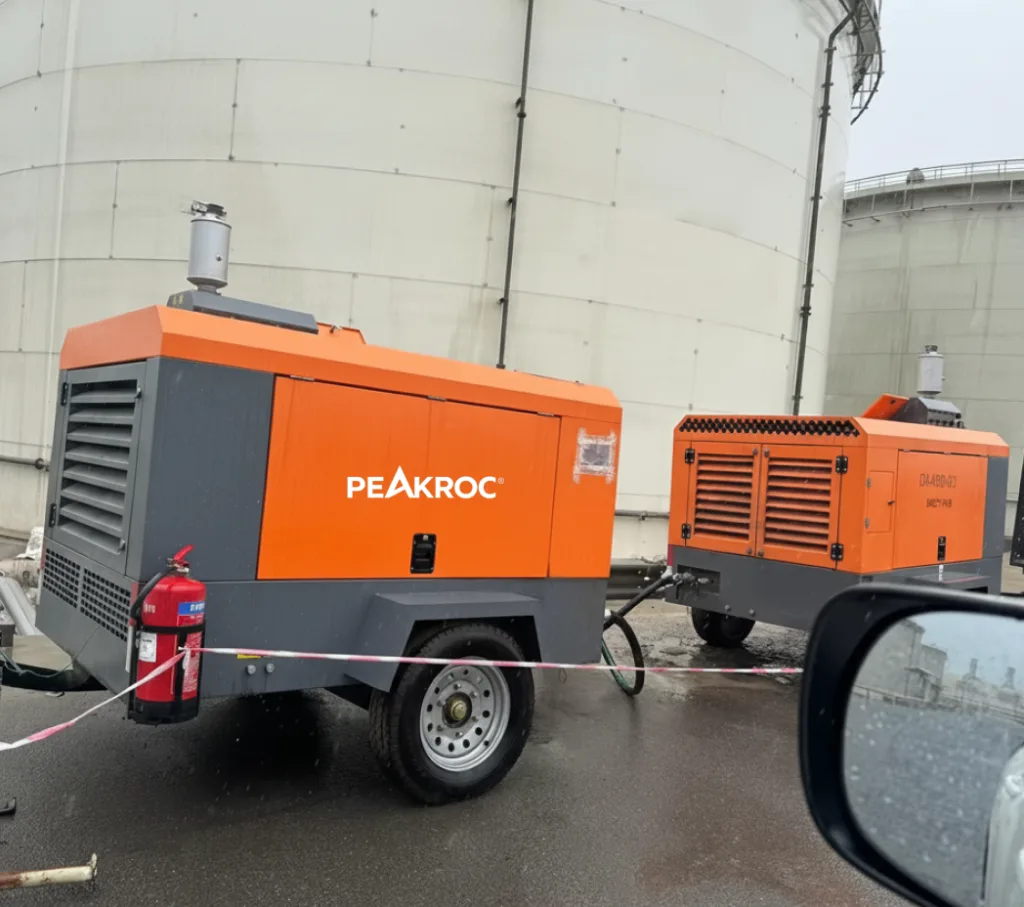
Step 3: Calculate Airflow
Airflow is usually measured in CFM or m³/min. It determines whether the compressor can maintain pressure while the tool is operating.
For pneumatic tools, add the airflow demand of all tools that may operate at the same time. For drilling, consider hammer size, hole diameter, depth, cuttings removal, and altitude. For blasting, calculate based on nozzle size and expected wear.
Always check airflow at the required working pressure.
Step 4: Match Engine Power to Air End Load
The engine must provide enough power for the compressor air end at full load. A good design includes reserve for hot weather, altitude, dust, fuel quality, and continuous operation.
For high-pressure compressors, engine torque and cooling capacity are especially important.
Step 5: Evaluate Fuel Consumption
Fuel cost can become one of the largest operating expenses over the life of the compressor.
Buyers should compare fuel consumption at full load and typical working load. A cheaper compressor with poor fuel efficiency may cost more over several years.
Step 6: Consider the Operating Environment
Hot climates, high altitude, dusty roads, humid conditions, and poor fuel quality all affect performance.
A compressor used in desert drilling needs strong filtration and cooling. A compressor used in tropical environments may need better moisture control. A unit working at high altitude may need engine derating considered in the sizing process.
Step 7: Check Maintenance Access
A good compressor should be easy to service. Filters, coolers, belts, batteries, drains, and inspection points should be accessible.
Maintenance planning should include:
- Engine oil
- Compressor oil
- Fuel filters
- Air filters
- Oil separator
- Coolant
- Radiator cleaning
- Hose and coupling checks
- Control system inspection
- Safety shutdown testing
Cummins Engine Air Compressor vs. Generic Diesel Compressor
| Factor | Cummins Engine Air Compressor | Generic Diesel Compressor |
|---|---|---|
| Engine support | Strong global service network | Varies by engine brand |
| Application engineering | Often better matched for industrial duty | Depends on manufacturer |
| Parts availability | Usually stronger in many regions | May be limited |
| Resale value | Often higher due to engine recognition | Usually depends on local market |
| Heavy-duty confidence | Strong for mining, drilling, and construction | Must be verified carefully |
| Purchase cost | Usually higher | May be lower initially |
A generic diesel compressor may be acceptable for light-duty or budget-sensitive applications. However, for remote drilling, mining, high-pressure work, and rental fleet use, engine support and long-term reliability can matter more than initial price.
Common Selection Mistakes
Choosing by Engine Brand Alone
A Cummins engine is a strong starting point, but the complete compressor design matters. Air end quality, separator design, cooling system, control logic, canopy design, and chassis strength all affect performance.
Ignoring Airflow
Many buyers focus on pressure but forget airflow. A compressor with the correct pressure but insufficient CFM will not perform well.
Oversizing the Compressor
Bigger is not always better. An oversized compressor can increase fuel consumption, transport cost, and purchase price without improving productivity.
Underestimating Heat and Dust
Compressors working in mines, quarries, and drilling sites need strong cooling and filtration. A unit that performs well in mild factory conditions may struggle outdoors.
Ignoring Service Support
Before buying, confirm whether engine parts, compressor parts, filters, oil, service technicians, and diagnostic tools are available in the destination market.
Practical Application Examples
Deep Water Well Drilling
A drilling contractor working with 4.5-inch to 6-inch DTH hammers may choose a high-pressure Cummins-powered compressor in the 20–25 bar range. The compressor must provide enough airflow to clean the hole and enough pressure to drive the hammer. Engine torque reserve and fuel autonomy are important because the machine may run all day in remote locations.
Quarry Pre-Splitting
A quarry operator drilling controlled blast holes needs stable airflow and strong mobility. A Cummins engine compressor can move between benches and support drilling in hard rock. Cooling, dust filtration, and chassis strength are important.
Construction Road Repair
A road repair crew using pneumatic breakers may not need high pressure. A 7–10 bar Cummins-powered compressor with suitable airflow can provide reliable air for breakers, chipping tools, and cleaning. Fuel economy, easy towing, and simple operation are priorities.
Sandblasting Contractor
A blasting contractor should select the compressor based on nozzle size, hose length, pressure at the nozzle, and air-treatment requirements. A Cummins-powered unit provides the engine reliability needed for long outdoor blasting shifts, but dry air equipment may also be required.
Pipeline Contractor
Pipeline cleaning and testing may require long continuous running. The compressor should be sized for pipeline volume, target pressure, drying requirements, and safety procedures. Fuel tank size and service access can be as important as pressure.
Peakroc® Cummins Engine Air Compressor Solutions
Peakroc® offers a broad range of Cummins-powered portable diesel screw compressors for construction, mining, quarrying, tunneling, sandblasting, water well drilling, geothermal drilling, and pipeline projects.
Peakroc® models include low-pressure compressors for construction and maintenance, medium-pressure units for mining and quarry work, and high-pressure machines for DTH drilling and deep borehole applications.
Peakroc® can help customers compare:
- Pressure class
- Airflow requirement
- Cummins engine power
- Air end configuration
- Cooling system
- Fuel tank capacity
- Trailer or skid design
- Aftercooler and separator package
- Emissions requirement
- Spare-parts support
The goal is not simply to choose the biggest engine or highest pressure. The right machine should match the real tool, hole, nozzle, pipeline, or jobsite requirement.
Final Recommendation
A Cummins engine air compressor is a strong choice for contractors and drilling teams that need dependable compressed air in demanding environments.
Its main advantages are engine reliability, torque response, service support, durability, and suitability for remote work. These strengths are especially valuable in mining, drilling, quarrying, construction, sandblasting, pipeline work, and other off-grid industrial jobs.
However, buyers should evaluate the whole compressor package. The engine, air end, cooling system, control system, separator, trailer, fuel system, and service support must all be matched to the application.
For general construction, a 7–10 bar unit may be enough. For sandblasting, airflow and dry air are critical. For DTH drilling, high pressure and strong cuttings removal become essential. For remote work, fuel autonomy and serviceability matter most.
Peakroc® can help buyers select a Cummins-powered portable diesel air compressor according to pressure, airflow, duty cycle, application, environment, and long-term operating cost.
FAQ
1. What is a Cummins engine air compressor?
A Cummins engine air compressor is a diesel-powered compressed-air system that uses a Cummins engine to drive the compressor air end. It is commonly used for construction, mining, drilling, sandblasting, quarrying, and remote industrial applications.
2. Why choose a Cummins engine for an air compressor?
Cummins engines are widely used because they offer strong industrial reliability, good torque response, global service support, and suitability for heavy-duty compressor applications.
3. Is a Cummins engine air compressor suitable for drilling?
Yes. Cummins-powered portable compressors are widely used for water well drilling, quarry drilling, mineral exploration, and DTH drilling when the pressure and airflow are correctly matched to the hammer and hole depth.
4. What pressure should I choose?
The required pressure depends on the application. Construction tools often use 7–10 bar, while DTH drilling and deep borehole work may require 20–35 bar or higher.
5. How do I choose the right airflow?
Add the air consumption of all tools operating at the same time. For drilling, consider hammer size, hole diameter, hole depth, cuttings removal, altitude, and reserve margin.
6. Is a Cummins engine compressor better than an electric compressor?
It depends on the jobsite. A Cummins diesel compressor is better for remote and mobile sites without reliable power. Electric compressors are better for powered sites where lower noise and zero local exhaust are priorities.
7. Does a Cummins engine compressor need special maintenance?
It needs regular engine and compressor maintenance, including oil, filters, coolant, separator elements, fuel system checks, cooler cleaning, and safety shutdown inspection.
8. Can a Cummins engine air compressor be used for sandblasting?
Yes, if it provides enough airflow and pressure for the blasting nozzle. Moisture control equipment such as an aftercooler and water separator may also be required.
9. What should buyers compare before purchasing?
Buyers should compare pressure, airflow, engine model, fuel consumption, air end quality, cooling capacity, trailer design, emissions compliance, air-treatment options, service support, and spare-parts availability.
10. Does Peakroc® supply Cummins engine air compressors?
Yes. Peakroc® supplies Cummins-powered portable diesel screw compressors for construction, mining, drilling, quarrying, sandblasting, pipeline work, and industrial applications.
Author

Mark Chen – Senior Mechanical Engineer, Peakroc®
Mark Chen is a senior mechanical engineer at Peakroc®, specializing in compressed air systems and drilling equipment for mining and construction applications. With over 15 years of field experience, he has led multiple projects on optimizing air delivery efficiency, equipment durability, and energy consumption.