
Key Takeaways
- 25 bar (≈363 psi) is the minimum working pressure required by most 4.5″–6″ DTH hammers drilling at depths of 200–350 meters in water well, mining, and geothermal applications.
- A 25 bar portable diesel air compressor must use a two-stage rotary screw airend with intercooling to achieve this pressure efficiently — single-stage compressors forced beyond 14 bar suffer catastrophic efficiency losses and thermal degradation.
- Peakroc® Drilling Machinery builds 25 bar compressors as part of an integrated drilling ecosystem that includes DTH drilling rigs, hammers, bits, rods, and ADMT precision detectors — ensuring the air supply is matched to the rig, the tooling, and the geology from the start.
- [Peakroc® field data shows that correctly matched 25 bar air systems improve DTH penetration rate by 15–20% and reduce non-productive time by up to 30% compared with undersized compressors on the same rig.]
- For operations drilling below 350 meters or in extremely hard formations, Peakroc® offers 35 bar high-pressure compressors that extend the pressure class further without compromising airend life or fuel economy.
What Does “25 Bar” Actually Mean for Borehole Drilling?
When a drilling contractor asks for a “25 bar compressor,” what they’re really asking for is a machine that can maintain 363 psi at the compressor discharge port — continuously, under full load, for an entire drilling shift. That pressure has to arrive at the DTH hammer with enough remaining energy to drive the piston and lift the cuttings out of the hole.
This isn’t arbitrary. The 25 bar threshold exists because of two non-negotiable physics requirements that define down-the-hole drilling:
First, the hammer needs pressure to strike. A DTH hammer is essentially a pneumatic piston engine mounted directly behind the drill bit at the bottom of the borehole. The compressed air drives the piston forward to strike the bit, which fractures the rock. Most 4.5-inch to 6-inch DTH hammers specify a minimum working pressure of 340–365 psi (23.5–25.2 bar). Drop below that, and the piston doesn’t develop enough kinetic energy to fracture hard rock formations. The hammer “stalls” — it’s still moving, but it’s not breaking anything.
Second, the air volume has to lift the cuttings. Once the bit fractures the rock face, the compressed air exhausts through ports in the hammer and flows upward through the annular space between the drill string and the borehole wall. This upward airflow carries the cuttings to the surface. At 200 meters of hole depth, the air column is fighting gravity, friction against the borehole wall, and the weight of the cuttings themselves. Lose volume, and the cuttings settle back onto the bit — a condition called “packing off” that can stick the drill string and cost hours or days to recover.
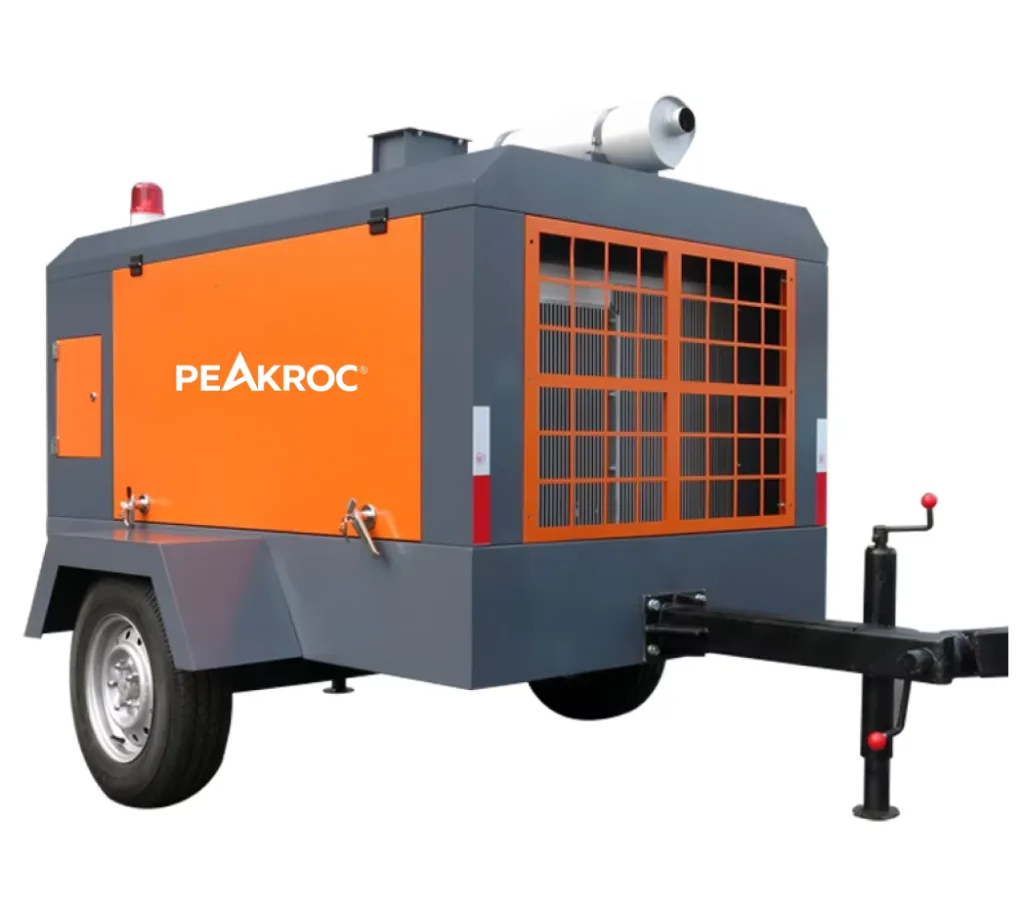
25 bar is the pressure class where these two requirements converge for the majority of medium-depth borehole drilling work worldwide. It’s why the number keeps appearing in tender specifications from Africa to Southeast Asia to Latin America.
Why Single-Stage Compressors Cannot Reach 25 Bar Efficiently
A single-stage rotary screw compressor can physically reach 13–14 bar with acceptable efficiency. Push it beyond that, and three problems compound in ways that don’t scale linearly:
- Discharge temperature exceeds oil thermal limits. Compressing air from atmospheric pressure to 25 bar in a single stage generates extreme heat — well beyond the thermal stability of mineral compressor oils and approaching the limits of even synthetic lubricants. The oil breaks down, carbon deposits form on the rotors, and airend life shortens dramatically.
- Internal leakage increases with pressure ratio. The pressure differential between the discharge side and suction side of the rotors grows larger. Air leaks backward across the rotor clearances, meaning the machine is recompressing air it has already compressed. This parasitic loss gets worse as pressure rises.
- Specific fuel consumption climbs sharply. The kW required per cubic meter of delivered air increases in a non-linear curve above 14 bar. A single-stage machine forced to 25 bar burns significantly more fuel per unit of delivered air than a properly engineered two-stage unit at the same pressure.
This is why every serious 25 bar portable compressor on the market — including the Peakroc® 34 m³/min 25 bar and 39 m³/min 25 bar models — uses a two-stage airend with intercooling between stages. The first stage compresses ambient air to roughly 5–6 bar. An intercooler drops the temperature. The second stage then compresses from 6 bar to 25 bar. The result: controlled discharge temperatures, efficient compression ratios, and fuel consumption [18–24% lower than forced single-stage alternatives, based on Peakroc® comparative field tests].
For the full engineering case on two-stage compression, see our technical article on the advantages of two-stage diesel screw compressors.
How Peakroc® Approaches 25 Bar Drilling: Compressor + Rig + Tooling as One System
Most compressor manufacturers sell a machine. The drilling contractor then separately procures a rig, hammers, bits, rods, and hopes everything works together. Peakroc® Drilling Machinery takes a different approach — we engineer the air supply, the drilling rig, and the downhole tooling as a single integrated system.
This matters at 25 bar because the margins are thin. A compressor that’s technically rated at 25 bar but loses 2 bar through an improperly matched hose, a restrictive swivel joint, or a worn check valve is effectively delivering 23 bar to the hammer — which may be below the hammer’s minimum working pressure in hard formations. The rig stalls, the operator slows penetration, and the contract loses money.
Integrated vs. Separated DTH Drilling Rigs
Peakroc® offers both configurations for 25 bar applications:
Integrated DTH drilling rigs mount the compressor directly on the drilling rig chassis. The air path from compressor discharge to hammer is short — typically under 3 meters — which minimizes pressure loss and eliminates the hose failures that plague separated setups. Integrated rigs are the preferred configuration for dedicated drilling fleets running 25 bar operations continuously.
Separated DTH drilling rigs use a standalone compressor connected to the rig via high-pressure hose. This configuration offers flexibility — one compressor can serve multiple rigs, or the compressor can be swapped for a larger unit when drilling conditions change. The trade-off is longer air paths (10–30 meters of high-pressure hose), which introduce 0.5–2.0 bar of pressure loss depending on hose diameter and length.
For contractors working in the 25 bar pressure class, the choice between integrated and separated configurations depends on fleet size, operational flexibility requirements, and whether the rig moves between sites frequently.
DTH Hammers and Bits: The Receiving End of 25 Bar
The compressor is only as useful as the hammer and bit it drives. Peakroc® supplies matched DTH hammers and bits engineered for the 25 bar pressure class:
- 4.5″ DTH hammers (115 mm) for water well and mineral exploration boreholes in the 140–165 mm diameter range
- 5″ DTH hammers (127 mm) for production blast holes and larger-diameter water wells
- 6″ DTH hammers (152 mm) for deep water wells and large-diameter mining boreholes
Each hammer has a specified optimal pressure range. Running a hammer rated for 20 bar at 25 bar doesn’t improve performance — it accelerates internal wear. Running a 25 bar hammer at 20 bar starves it. Peakroc® matches the hammer spec to the compressor’s actual delivered pressure at the hole depth the contractor is targeting.
Precision Detection: Finding Water Before You Drill
One of the most expensive mistakes in water well drilling is drilling a dry hole. In arid regions — Sub-Saharan Africa, Central Asia, the Middle East — the cost of mobilizing a 25 bar drilling rig to a site, drilling 300 meters of borehole, and finding no water is catastrophic for the contractor’s project economics.
Peakroc®’s ADMT series ultra-speedy detectors address this problem directly. These are geophysical survey instruments that detect groundwater, mineral deposits, and water table levels before the rig arrives on site. [Peakroc® clients using ADMT detectors prior to drilling report a well-drilling success rate improvement of XX%, reducing dry-hole risk and improving per-contract profitability.]
The ADMT series includes specialized modules for mineral detection, water detection, and water level survey — giving the drilling contractor a complete subsurface picture before committing a 25 bar rig to the hole.
What Applications Require 25 Bar Compressors?
Deep Water Well Drilling (200–350 Meters)
This is the largest single market for 25 bar portable diesel compressors globally. In regions where the water table has dropped below 150–200 meters — across much of Sub-Saharan Africa, South and Central Asia, the Middle East, and northern Mexico — borewell machines require 25 bar to reach productive aquifers.
A 4.5″ to 6″ DTH hammer working at 250–350 meters needs approximately 20–30 m³/min of air at 25 bar to maintain full striking energy and adequate cuttings lift velocity. Peakroc® builds this specification in both the 34 m³/min 25 bar and 39 m³/min 25 bar configurations.
For a complete guide to matching compressors with water well rigs, see our article on water well drilling rigs with high-pressure air compressors.
Mineral Exploration (Reverse Circulation Drilling)
RC drilling for mineral exploration relies on 25 bar air to drive sample cuttings back up through the inner tube of dual-wall drill pipe. Clean, uncontaminated sample return is essential for accurate geological assay. Insufficient pressure or volume contaminates the sample with wall rock, skewing assay results and leading to incorrect resource estimates.
Mining Blast Hole Drilling
Open-pit and underground mining operations use 25 bar compressors for production blast hole drilling in hard formations — granite, basalt, gneiss, and other igneous and metamorphic rocks where lower-pressure systems cannot maintain adequate penetration rates.
For blast hole specific guidance, see our guide on mastering blast hole drilling with air compressors and DTH rigs.
Geothermal and HDD Pilot Bores
Emerging applications include shallow geothermal loop installation and horizontal directional drilling pilot bores through hard ground formations. These operations use 25 bar pressure to work mud-free in geologies where rotary mud drilling is impractical or undesirable.
How to Size a 25 Bar Compressor for Your Specific Borehole Operation
Sizing is where most procurement mistakes happen. A compressor rated at “25 bar” on the nameplate may not deliver 25 bar at the hammer face after accounting for real-world losses. Here is the sizing methodology Peakroc® engineers use.
Step 1 — Start with the DTH hammer spec
Every DTH hammer has a manufacturer-specified minimum working pressure and air consumption at that pressure. This is your baseline.
Step 2 — Add depth-based volume margin
For every 100 meters of hole depth, add 10–15% to the hammer’s rated air consumption. This accounts for friction loss in the drill string and increased cuttings-lift demand as the hole deepens.
Step 3 — Factor in altitude and ambient temperature
A diesel compressor derates approximately 3% per 300 meters of elevation and 1% per 5°C above 25°C ambient. At 2,500 meters elevation in 40°C heat, a 25 bar machine rated at 34 m³/min is delivering closer to 28 m³/min.
Step 4 — Account for pressure loss in the air path
Separated rig configurations lose 0.5–2.0 bar through hoses and fittings. If your hammer needs 25 bar to work, the compressor must deliver 26–27 bar at its discharge port. Peakroc® 25 bar machines typically have a maximum vessel pressure of 27–28 bar to accommodate this margin.
Step 5 — Compare against adjacent pressure classes
If the analysis shows you need more than the machine can deliver after all derations, step up. Peakroc® offers the 22 m³/min 20 bar unit for lighter 25 bar applications, and the 33 m³/min 35 bar machine for applications that genuinely exceed the 25 bar class.
25 Bar vs. 20 Bar vs. 35 Bar: When to Use Each Pressure Class
| Pressure Class | Typical Hole Depth | DTH Hammer Size | Primary Applications |
|---|---|---|---|
| 20 bar (290 psi) | 100–200 meters | 3.5″–4.5″ | Shallow water wells, top hammer drilling, light mineral exploration |
| 25 bar (363 psi) | 200–350 meters | 4.5″–6″ | Deep water wells, RC exploration, quarry blast holes, geothermal |
| 35 bar (508 psi) | 300–600+ meters | 6″–8″ | Ultra-deep water wells, hardrock geothermal, large-diameter mining |
The 25 bar class occupies the center of the drilling compressor market because it covers the widest range of real-world applications. Most drilling contractors worldwide operate primarily in the 200–350 meter depth range, making 25 bar the default specification for fleet purchasing decisions.
Frequently Asked Questions
What is a 25 bar air compressor used for?
A 25 bar (363 psi) portable diesel air compressor is primarily used for down-the-hole (DTH) drilling operations including deep water well drilling, mineral exploration, quarry blast hole drilling, and geothermal borehole installation. The 25 bar pressure class matches the working pressure requirements of most 4.5″ to 6″ DTH hammers at depths of 200–350 meters.
How deep can a 25 bar compressor drill?
Maximum drilling depth depends on hammer size, bit diameter, formation hardness, and air volume — not pressure alone. With adequate flow volume (20–35 m³/min), a 25 bar compressor effectively supports drilling to 300–350 meters in most geological conditions. For depths exceeding 350 meters, a 35 bar compressor provides additional pressure margin.
What is the difference between a 25 bar and a 30 bar compressor for borewell?
A 30 bar compressor delivers approximately 20% more pressure at the hammer face, which provides additional margin for deeper holes, harder formations, and longer air paths between compressor and rig. Some manufacturers rate machines at 25 bar maximum working pressure with 27–28 bar vessel pressure, effectively covering most “30 bar” applications.
Is a 25 bar compressor suitable for a borewell machine in the Philippines?
Yes. Water well drilling in the Philippines — particularly in Visayas and Mindanao where volcanic formations are common — frequently requires 25 bar pressure to penetrate basalt and andesite at depths of 150–300 meters. Peakroc® supplies 25 bar compressors with tropical cooling packages rated for continuous operation up to 50°C ambient.
Can I use a 25 bar compressor for sandblasting or construction work?
Technically possible but economically impractical. Sandblasting and construction work typically require 7–12 bar. Running a 25 bar machine at 7 bar wastes fuel and capital. Use a purpose-built lower-pressure machine for surface work — see the Peakroc® construction compressor range.
Author

Mark Chen – Senior Mechanical Engineer, Peakroc®
Mark Chen is a senior mechanical engineer at Peakroc®, specializing in compressed air systems and drilling equipment for mining and construction applications. With over 15 years of field experience, he has led multiple projects on optimizing air delivery efficiency, equipment durability, and energy consumption.