
Key Takeaways
- Stationary air compressors are the correct choice for fixed-location factories, processing plants, and manufacturing facilities that need continuous, high-volume compressed air at a single point of use — 24 hours a day, 365 days a year.
- Portable diesel air compressors are the correct choice for municipal infrastructure projects, construction sites, remote operations, and any application where compressed air is needed at changing locations or where grid power is unavailable.
- Many operations need both — a stationary compressor for the main plant and a portable diesel unit for field maintenance, outage support, pipeline work, or expansion projects.
- The decision is not “which is better” — it’s “where does the air need to be, for how long, and is there reliable power?” Answer those three questions and the choice makes itself.
- Peakroc® Machinery builds portable diesel screw air compressors for the applications where mobility, diesel independence, and field-ready reliability matter — municipal utilities, water infrastructure, road construction, mining, and drilling operations.
What Is a Stationary Air Compressor?
A stationary air compressor is a permanently installed machine — typically electric-driven — that supplies compressed air to a fixed piping network inside a factory, manufacturing plant, or processing facility. The compressor sits in a dedicated compressor room, connected to air receivers, dryers, filters, and a distribution system that delivers air throughout the facility.
Stationary compressors range from small workshop units (5–15 kW) to massive industrial machines (250–500+ kW). They run on three-phase electricity, operate at high duty cycles, and are designed for years of continuous service without relocation.
Common types include oil-injected rotary screw compressors (the dominant industrial technology), oil-free screw compressors (for pharmaceutical, food processing, and electronics), centrifugal compressors (for very large volume demands), and reciprocating piston compressors (for intermittent or very high pressure applications).
Where stationary compressors excel
- Fixed manufacturing operations — automotive assembly, metalworking, plastics molding, food packaging, pharmaceutical production
- Continuous process industries — cement, glass, chemical, petrochemical
- Large-volume central air systems — where a single compressor room supplies an entire factory through a permanent piping grid
- Applications requiring extremely clean air — ISO 8573-1 Class 0 or Class 1 air quality for sensitive processes
What Is a Portable Diesel Air Compressor?
A portable diesel air compressor is a self-contained, trailer-mounted or skid-mounted unit that uses a diesel engine to drive a rotary screw airend. It produces compressed air anywhere — no grid power, no piping, no compressor room. Fuel goes in, compressed air comes out.
These machines range from compact 5 m³/min (185 CFM) units for a single jackhammer to heavy 45 m³/min (1,600 CFM) machines for large-scale mining and drilling. They’re built to move — between construction sites, along pipeline corridors, from one well pad to the next.
Where portable compressors excel
- Municipal and civil infrastructure — road construction, bridge maintenance, water main repair, sewer rehabilitation, utility trenching
- Remote operations without grid power — rural water well drilling, mine sites, offshore support, disaster response
- Multiple job sites — contractors who work at a different location every week or month
- Temporary or surge demand — factory shutdowns, turnarounds, expansion projects where the permanent compressor can’t keep up
- Outdoor and field applications — sandblasting, pipeline pressure testing, concrete breaking, quarry drilling
Head-to-Head Comparison
| Factor | Stationary Compressor | Portable Diesel Compressor |
|---|---|---|
| Power source | Electric (three-phase grid) | Diesel engine (self-contained) |
| Location | Fixed — compressor room | Mobile — trailer or skid |
| Relocation | Impractical once installed | Built for towing and repositioning |
| Typical duty cycle | 24/7 continuous in many facilities | Shift-based (8–12 hours per day typical) |
| Air quality options | Full range including oil-free, Class 0 | Oil-injected standard; adequate for most industrial and construction use |
| Noise level | Low (indoor installation, sound enclosure) | Higher (outdoor operation, canopy-attenuated) |
| Energy efficiency | Higher (electric motors, VSD options, heat recovery) | Lower per unit of air (diesel combustion inherent losses) |
| Operating cost per m³ of air | Lower (electricity cheaper than diesel in most markets) | Higher (diesel fuel cost) |
| Capital cost | Higher (machine + installation + piping + dryers + filters) | Lower (machine only, no installation) |
| Setup time | Days to weeks (installation, piping, electrical) | Minutes (tow to site, connect hose, start) |
| Maintenance access | Controlled environment, scheduled downtime | Field conditions, potentially remote |
| Grid dependency | Yes — no power, no air | None — runs anywhere with diesel |
Neither type is universally “better.” The table makes the deciding factor obvious: if the air demand is at a fixed location with grid power, stationary wins on efficiency and cost per cubic meter. If the air demand moves, lacks grid power, or is temporary, portable diesel wins on flexibility and speed of deployment.
Municipal and Civil Infrastructure: Why Portable Often Wins
Municipal projects are one of the largest markets for portable diesel air compressors — and one where the stationary-vs-portable decision is most often made incorrectly.
Consider a typical municipal water authority. They have a pump station with a stationary compressor for instrument air. That compressor serves the station fine. But when a crew needs to repair a 6-inch water main three kilometers away, or when they’re rehabilitating a sewer line across town, or when road crews are breaking concrete on a bridge deck, the stationary compressor is irrelevant. The work is happening at multiple changing locations, outdoors, without grid power.
This is the portable diesel compressor’s native environment. A 7.5 m³/min 7 bar road maintenance compressor tows behind a service truck, sets up in minutes, runs the breakers and pneumatic tools for the day’s work, and moves to the next site tomorrow.
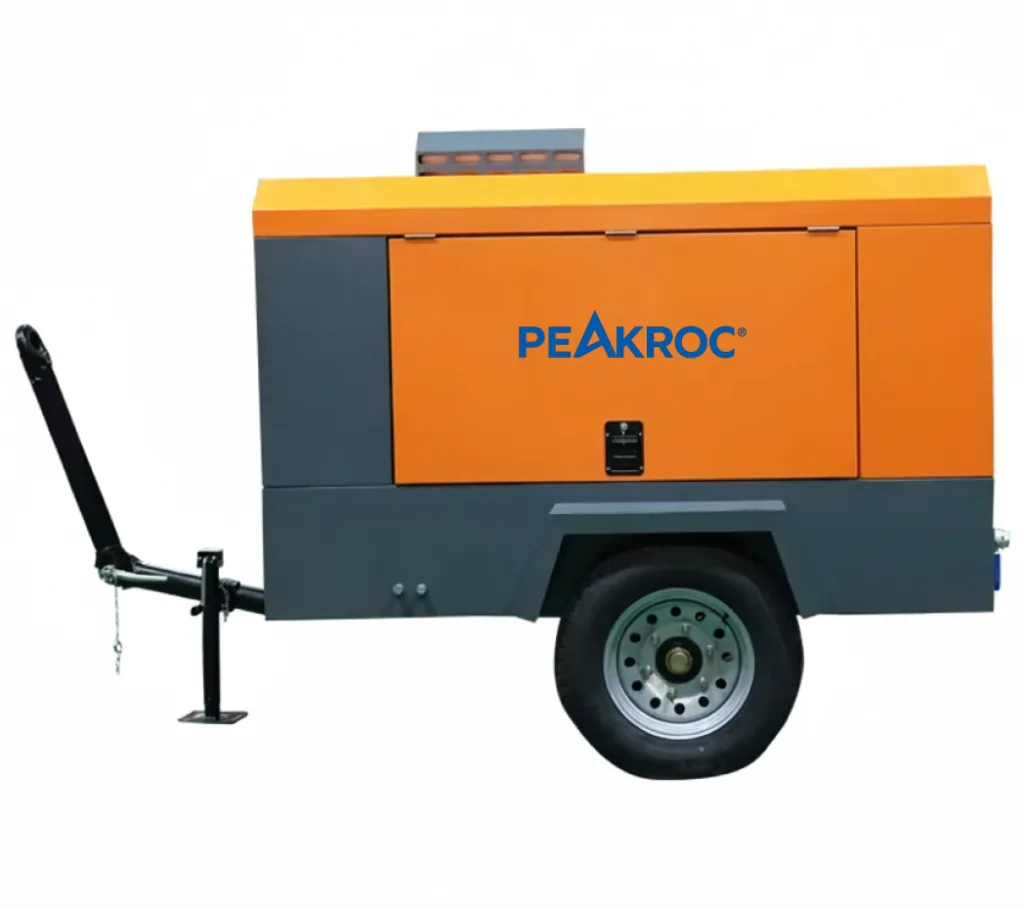
Municipal applications for portable diesel compressors include road and sidewalk demolition and repair, water main installation and repair, sewer line rehabilitation, bridge and overpass maintenance, utility trenching and backfill compaction, street furniture and infrastructure sandblasting, and emergency response after storm or flood damage.
Factory and Industrial Applications: When Portable Supplements Stationary
Factories are stationary compressor territory. But smart plant engineers keep a portable diesel unit in the fleet for specific situations where the stationary system can’t reach or can’t cope.
Planned shutdowns and turnarounds
When the main compressor goes down for major maintenance — airend overhaul, motor replacement, control system upgrade — the plant still needs air for critical systems. A portable diesel compressor parked outside the compressor room, connected to the distribution header via a temporary hose, provides bridge air during the outage. A 10 m³/min unit can keep essential pneumatic systems running while the primary machine is offline.
Expansion and construction phases
When a factory is expanding — new production lines, warehouse additions, yard extensions — the permanent compressed air system isn’t yet extended to the new area. A portable diesel compressor provides construction air during the build phase and supplements the permanent system during commissioning.
Outdoor yard and perimeter work
Many industrial facilities have outdoor operations — pipe yards, lay-down areas, loading docks, tank farms — where running permanent piping from the compressor room is impractical or cost-prohibitive. A portable unit stationed in the yard provides local air exactly where and when it’s needed.
Emergency and backup
Power outages, compressor failures, and natural disasters don’t wait for scheduled maintenance windows. A portable diesel compressor provides emergency air supply independent of the grid. For facilities where compressed air loss means production loss, having a portable backup on site is insurance that pays for itself on the first event.
The “Both” Solution: Stationary + Portable Fleet Strategy
The most operationally mature organizations don’t ask “stationary or portable?” — they deploy both, each in its correct role.
A typical fleet strategy looks like this:
Stationary compressor(s) handle the permanent, base-load air demand at the main facility. These run on electricity, operate at maximum efficiency, and feed the permanent piping grid.
Portable diesel compressor(s) handle everything that moves, everything temporary, and everything the stationary system can’t reach. They deploy to field sites, provide backup during outages, and support construction and expansion work.
For organizations operating multiple sites — municipal authorities, mining companies, utility contractors, construction firms — the portable fleet is the primary asset. Each project site gets a matched portable compressor that arrives with the crew and leaves when the job is done.
How to Decide: Three Questions That Make the Choice
Before comparing models, answer these three questions:
1. Where does the air need to be?
If the answer is “always in the same building,” you need a stationary compressor. If the answer is “different locations on different days” or “outdoors at a construction site,” you need a portable diesel unit.
2. For how long?
If the answer is “permanently — for years,” install a stationary system. If the answer is “for the duration of this project” or “a few hours per day at various spots,” a portable unit avoids the cost and complexity of permanent installation.
3. Is there reliable three-phase power?
If yes, a stationary electric compressor will be more efficient. If no — remote site, outdoor location, developing area with unreliable grid — diesel is the only practical option.
Frequently Asked Questions
Can a portable diesel compressor replace a stationary compressor in a factory?
For temporary periods — during maintenance, expansion, or emergency — yes. Long-term replacement is not recommended because diesel fuel costs significantly more per cubic meter of air than electricity, and the portable unit lacks the air treatment (drying, filtering) that most factory processes require. The portable unit is a supplement and backup, not a permanent replacement.
What size portable compressor do I need for municipal road work?
Most municipal road crews running 2–3 jackhammers and pneumatic tools need a 7–10 m³/min (250–350 CFM) compressor at 7–8 bar. For larger crews or simultaneous sandblasting, step up to 12–17 m³/min. Our guide on portable compressors for jackhammers covers the sizing in detail.
Are portable diesel compressors noisier than stationary units?
Yes — portable units operate outdoors with diesel engines, which are inherently louder than electric motors in enclosed compressor rooms. Modern portable screw compressors like the Peakroc® range are canopy-attenuated to 66–78 dB(A) at 7 meters, which meets most municipal noise ordinances for daytime construction work.
How much does it cost to run a portable diesel compressor vs. a stationary electric one?
As a rough comparison: a 10 m³/min diesel compressor burns approximately 15–20 liters of fuel per hour at full load. At $1.20/liter, that’s $18–24/hour. A comparable 75 kW electric stationary compressor consumes approximately 75 kWh per hour. At $0.10/kWh, that’s $7.50/hour. Electricity is typically 2–3 times cheaper per cubic meter of air delivered — which is why stationary electric compressors are always preferred when grid power is available and the installation is permanent.
Author

Mark Chen – Senior Mechanical Engineer, Peakroc®
Mark Chen is a senior mechanical engineer at Peakroc®, specializing in compressed air systems and drilling equipment for mining and construction applications. With over 15 years of field experience, he has led multiple projects on optimizing air delivery efficiency, equipment durability, and energy consumption.