
Key Takeaways
A trailer mounted diesel air compressor is a mobile compressed-air system designed for jobsites where reliable air power is needed but fixed electrical infrastructure is unavailable, inconvenient, or too far from the working area.
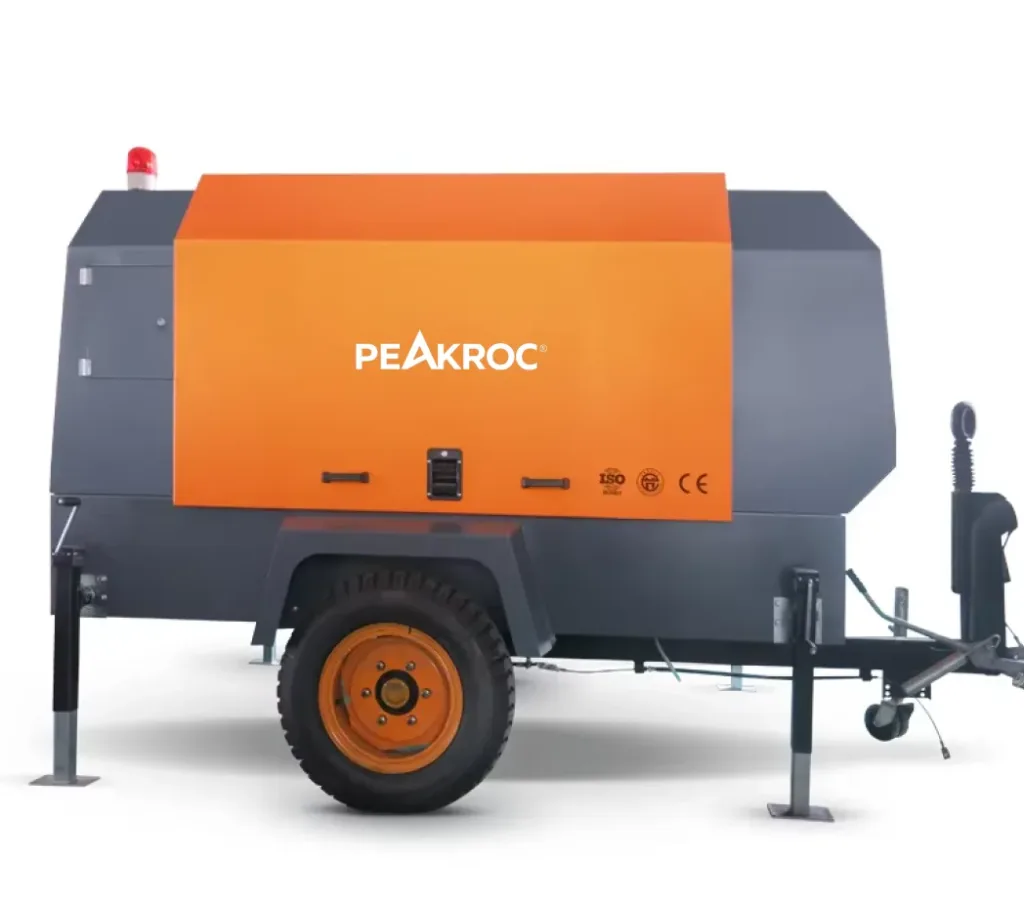
Unlike stationary electric compressors, trailer mounted diesel units combine a diesel engine, rotary screw air end, fuel tank, cooling system, control panel, air receiver or separator system, canopy, axle, tires, tow bar, and road-ready chassis into one mobile package. The result is a self-contained compressed-air source that can be towed between construction sites, mines, quarries, road repair zones, drilling pads, and remote industrial projects.
This type of compressor is widely used for:
- Road repair and concrete breaking
- Pneumatic tools and jackhammers
- Construction site maintenance
- Sandblasting and surface preparation
- Water well and geothermal drilling
- Mining and quarry drilling
- Pipeline testing, cleaning, and drying
- Cable blowing and utility work
- Emergency backup compressed air
Peakroc® supplies portable and towable air compressors for construction, mining, drilling, and industrial projects. Buyers can also compare models through the compressor selection page, review portable diesel compressor buying guidance, and explore high-pressure diesel compressor solutions for DTH drilling and deep borehole applications.
What Is a Trailer Mounted Diesel Air Compressor?
A trailer mounted diesel air compressor is a portable compressor installed on a towable chassis. The trailer frame allows the machine to be moved by pickup truck, service vehicle, drilling rig, or site transport equipment.
Most professional units use an oil-injected rotary screw air end because screw technology is well suited for continuous airflow. Compared with small piston compressors, rotary screw compressors deliver smoother air output, better duty-cycle capability, and stronger performance for long working hours.
The diesel engine drives the compressor directly or through a belt or coupling system. Air enters through filters, is compressed inside the screw air end, separated from oil, cooled, regulated, and delivered through outlet valves to tools or equipment.
A typical trailer mounted diesel compressor includes:
- Diesel engine
- Rotary screw air end
- Fuel tank
- Air/oil separator
- Cooling system
- Engine and compressor filters
- Control panel
- Safety shutdown protection
- Sound-attenuated canopy
- Towable undercarriage
- Outlet valves and pressure regulation
The main advantage is independence. The machine can operate wherever diesel fuel is available, making it ideal for remote and changing worksites.
Why Trailer Mounted Diesel Compressors Are Popular
Compressed air is flexible, safe for many harsh environments, and able to power tools without exposing operators to electrical hazards at the tool itself. On construction and mining sites, pneumatic tools are often preferred because they are rugged, simple, and able to work in dust, vibration, moisture, and rough handling.
A trailer mounted diesel compressor adds mobility to this advantage. Instead of installing a fixed air line or moving heavy electric infrastructure, the contractor can tow the air source directly to the working area.
This mobility reduces setup time and helps crews respond quickly to changing jobsite conditions.
A trailer mounted compressor is especially valuable when:
- The work front moves frequently
- The site has no reliable power supply
- Tools are used far from a permanent compressor room
- Multiple crews need air in different locations
- The project is temporary
- Compressed air demand is high and continuous
- Road access is available for towing
For rental companies, trailer mounted compressors are also practical because they can be delivered to different customers and used across many industries.
Main Applications
Construction and Road Repair
Construction is one of the most common markets for trailer mounted diesel compressors. Road repair crews use them to power breakers, chipping hammers, compact drills, blow lances, and cleaning tools.
For concrete breaking, asphalt cutting support, trench opening, bridge deck repair, curb work, and utility excavation, a towable compressor allows fast deployment without waiting for site electricity.
A 7–10 bar unit is often suitable for general pneumatic tools. Larger airflow is required when multiple breakers or tools operate at the same time.
The key selection point is not only pressure. The compressor must provide enough airflow to maintain tool performance under load. A breaker may appear to work at first but lose impact energy if the compressor cannot maintain sufficient CFM or m³/min.
Mining and Quarrying
Mines and quarries often require mobile compressed air for drilling, dust cleaning, pump support, maintenance tools, and temporary production tasks.
For quarry work, compressors may be moved between benches, blast-hole drilling areas, crushing zones, and maintenance yards. Diesel power is useful because the worksite may be spread across a large area where electrical connection points are limited.
Low- and medium-pressure units can support general pneumatic tools and maintenance work. High-pressure units are required for DTH drilling, blasthole drilling, and deeper boreholes.
For mining and quarry drilling, airflow must be matched to the hammer size, hole diameter, depth, and required cuttings removal. If airflow is too low, drilling speed drops and holes may become unstable.
Water Well and Geothermal Drilling
Trailer mounted diesel compressors are widely used in water well drilling, geothermal exploration, and ground engineering. These applications often take place in rural or remote locations where grid power is unavailable.
For shallow drilling, a lower-pressure unit may be sufficient. For deeper wells or harder formations, high-pressure compressors above 14 bar, 20 bar, 25 bar, or even 35 bar may be required.
The compressor must provide enough pressure to drive the DTH hammer and enough airflow to lift cuttings out of the borehole.
A trailer chassis makes relocation easier when the drilling contractor moves from one borehole to another. Fuel autonomy, cooling performance, dust filtration, and engine reliability become critical in these applications.
Sandblasting and Surface Preparation
Sandblasting requires stable airflow, dry air, and adequate pressure at the nozzle. A trailer mounted diesel compressor is a common choice for bridge maintenance, shipyard repair, steel structure preparation, tank cleaning, pipeline work, and concrete surface cleaning.
The air demand of blasting depends heavily on nozzle size. As the nozzle wears, air consumption increases. A compressor that is correctly sized at the beginning of a project may become overloaded if nozzle wear is not monitored.
Moisture control is also important. Wet compressed air can cause abrasive clogging, inconsistent blasting, flash rust, and poor coating performance. For blasting applications, an aftercooler, water separator, and suitable filtration are often recommended.
Pipeline Testing, Cleaning, and Drying
Pipeline projects often take place across long distances, remote terrain, and temporary work zones. Trailer mounted compressors provide the mobility needed for pipeline pressure testing, cleaning, pigging, drying, and commissioning.
Depending on the pipeline size and test requirements, these jobs may require high airflow, medium-to-high pressure, and long continuous operation.
The compressor must be selected according to pipeline volume, required test pressure, drying procedure, ambient conditions, and safety standards.
Utility and Cable Blowing Work
Compressed air is often used for cable blowing, conduit cleaning, fiber installation, and utility support. These applications may require clean, dry, stable air and controlled pressure.
For urban utility work, a compact trailer compressor with low noise, easy towing, and simple controls is valuable. For rural utility projects, fuel autonomy and rugged construction become more important.
Benefits of Trailer Mounted Diesel Air Compressors
Strong Mobility
The main benefit is mobility. A towable compressor can be moved between job areas without heavy lifting equipment. For contractors working across multiple sites, this saves time and increases utilization.
Independent Power Supply
Diesel compressors do not depend on grid power. This makes them suitable for remote areas, early-stage construction sites, mining benches, pipeline routes, and emergency repair jobs.
Continuous-Duty Performance
Industrial rotary screw compressors are designed for long operating hours. They can power pneumatic tools continuously, unlike small tank-based compressors that may need time to recover pressure.
Wide Pressure and Airflow Range
Trailer mounted diesel compressors are available from small 185 CFM class machines for jackhammers to large high-pressure units for drilling and mining. This allows buyers to match the machine to specific applications.
Rugged Outdoor Design
A good trailer mounted unit is built for dust, heat, rain, vibration, towing, and rough jobsite handling. Heavy-duty canopies, filtration systems, radiators, and undercarriages all contribute to field reliability.
Flexible Rental and Fleet Use
Rental companies value trailer mounted compressors because they can serve different industries with the same fleet. One machine may be rented for construction one month and surface preparation the next, provided the pressure and airflow fit the application.
Key Specifications Buyers Should Understand
Airflow: CFM or m³/min
Airflow measures how much air the compressor can deliver. It is usually expressed as CFM or m³/min.
This is often the most important specification. Tools consume air continuously. If the compressor cannot supply enough volume, pressure will drop and productivity will fall.
To size airflow, add the air demand of all tools that may run at the same time, then include reserve capacity for leakage, hose loss, altitude, and future needs.
Pressure: PSI or Bar
Pressure measures the force of the compressed air. It is usually expressed in PSI or bar.
General construction tools may operate around 7–10 bar. Sandblasting commonly uses a similar pressure range but may require high airflow. DTH drilling and deep borehole work require much higher pressure.
Choosing too much pressure increases cost and fuel use. Choosing too little pressure reduces tool performance.
Diesel Engine Platform
The diesel engine should match the compressor load. Buyers should consider engine brand, horsepower, emissions compliance, fuel consumption, service availability, and local parts support.
An undersized engine may overheat or struggle at full load. An oversized engine can increase cost and fuel consumption.
Fuel Tank and Runtime
Fuel autonomy matters on remote sites. A compressor that can work through a full shift without refueling reduces downtime and improves productivity.
Runtime depends on tank size, load percentage, engine efficiency, and operating conditions.
Trailer and Undercarriage
A trailer mounted compressor should be easy and safe to tow. Buyers should check axle configuration, tire size, braking system, road lighting, tow bar type, ground clearance, lifting points, and tie-down points.
For rough mining or quarry roads, a stronger undercarriage may be required.
Cooling and Filtration
Dusty and hot environments require strong cooling and filtration. Blocked radiators and dirty air filters are common causes of compressor shutdown.
For mines, quarries, deserts, and tropical conditions, buyers should ask about radiator capacity, fan design, dust filtration, and maintenance intervals.
Noise Level
Urban construction, night work, and work near residential areas may require sound-attenuated canopies. Noise should be checked based on real measurement distance and operating load.
A quieter unit improves communication and reduces worker fatigue.
How to Choose the Right Trailer Mounted Diesel Compressor
Step 1: Define the Application
Start with the job, not the compressor. Identify whether the machine will be used for construction tools, drilling, sandblasting, pipeline work, mining, quarrying, or general maintenance.
Each application has a different pressure and airflow requirement.
Step 2: List the Tools and Equipment
Write down every tool that may run at the same time. Include breakers, drills, blasting nozzles, pneumatic pumps, cleaning guns, or other equipment.
Check each tool’s required pressure and air consumption.
Step 3: Calculate Total Air Demand
Add the airflow of all simultaneously operating tools. Then add a reserve margin. In many field situations, a 15–25% margin helps cover leakage, hose loss, and tool wear.
For drilling and blasting, the reserve may need to be larger because performance depends strongly on stable airflow.
Step 4: Consider Hose Length and Pressure Loss
Long hoses, undersized couplings, worn fittings, manifolds, and filters create pressure drop. The compressor outlet pressure is not always the same as the pressure at the tool.
A slightly higher pressure class may be useful when hoses are long, but the tool’s maximum safe working pressure must not be exceeded.
Step 5: Check the Operating Environment
High ambient temperature, high altitude, humidity, dust, and poor ventilation all affect compressor performance.
At high altitude, diesel engines may lose power and compressors may deliver less effective air mass. In hot conditions, cooling capacity becomes critical.
Step 6: Review Maintenance and Support
A compressor should be easy to service. Filters, oil drains, belts, batteries, coolers, and engine components should be accessible.
Buyers should also check spare parts, service manuals, local technical support, and warranty conditions.
Step 7: Match Mobility Requirements
Not every trailer is suitable for every site. Road construction may require highway towing. Mining may require rough-road capability. Rental fleets may need durable chassis and simple operator controls.
The trailer design should match the real transport conditions.
Trailer Mounted vs. Skid-Mounted Compressors
| Factor | Trailer Mounted Diesel Compressor | Skid-Mounted Diesel Compressor |
|---|---|---|
| Mobility | Easy towing between sites | Requires truck, crane, or forklift |
| Best Use | Construction, roadwork, rental, drilling mobility | Fixed or semi-fixed industrial sites |
| Setup Speed | Fast positioning and relocation | Slower relocation |
| Footprint | Longer due to trailer frame | Compact base layout |
| Transport | Road-towable when configured properly | Truck-mounted transport |
| Jobsite Flexibility | High | Medium |
Trailer mounted compressors are better when the machine moves frequently. Skid-mounted compressors are better when the unit stays in one place for longer periods or is integrated into a larger equipment package.
Maintenance and Safety Considerations
Routine maintenance is essential because trailer mounted diesel compressors often work in harsh environments.
Daily checks should include:
- Engine oil level
- Compressor oil level
- Coolant level
- Fuel-water separator
- Air filters
- Radiator and cooler cleanliness
- Hoses and outlet valves
- Tire pressure and trailer lights
- Couplings and safety devices
- Warning indicators and emergency stop
Safety is equally important. Pneumatic tools should be secured to hoses by reliable connectors or positive locking devices. Large hoses should include safety devices that reduce pressure if a hose fails. Operators should never use compressed air on the body or clothing. Eye, hearing, hand, foot, and respiratory protection should be selected according to the task.
For blasting, drilling, and pipeline testing, site-specific procedures are required because stored compressed energy can create serious hazards.
Common Selection Mistakes
The first mistake is choosing only by price. A cheaper compressor may cost more over time if it consumes more fuel, lacks parts support, or cannot maintain pressure under load.
The second mistake is choosing only by pressure. Airflow is just as important. A compressor with the correct pressure but insufficient CFM will not perform properly.
The third mistake is oversizing. A larger machine may increase fuel cost, towing weight, and maintenance without improving productivity.
The fourth mistake is ignoring air quality. Sandblasting, pipeline drying, and some industrial tasks need drier and cleaner air than basic pneumatic tools.
The fifth mistake is forgetting the trailer. Tires, brakes, towing points, suspension, road lights, and ground clearance directly affect usability.
Practical Application Examples
Road Repair Contractor
A crew using one or two pneumatic breakers may choose a low-pressure, medium-flow trailer compressor. The priority is towing convenience, fuel economy, easy maintenance, and stable airflow for impact tools.
Sandblasting Contractor
A surface preparation crew should size the compressor based on nozzle diameter, expected nozzle wear, required pressure at the nozzle, hose length, and moisture-control requirements. An aftercooler and separator may be necessary.
Water Well Drilling Contractor
A drilling contractor may require a high-pressure trailer compressor, especially for DTH hammer drilling. The compressor must match hammer size, hole diameter, depth, formation hardness, and cuttings removal requirement.
Quarry Operator
A quarry may use medium- or high-pressure compressors for drilling, dust cleaning, and maintenance. Durability, cooling, dust filtration, and rough-road mobility are important.
Pipeline Contractor
Pipeline cleaning or testing may require high airflow and stable pressure for long periods. Fuel tank size, continuous-duty reliability, and safety controls become critical.
Peakroc® Trailer Mounted Diesel Air Compressor Solutions
Peakroc® provides portable diesel screw compressors for construction, drilling, mining, quarrying, sandblasting, road repair, pipeline work, and industrial maintenance.
The Peakroc® PRMD series covers a broad airflow and pressure range, making it possible to match machines to light pneumatic tools, medium construction work, sandblasting, pipeline testing, DTH drilling, and deep borehole projects.
Peakroc® can support customers with:
- Pressure and airflow calculation
- Diesel engine selection
- Rotary screw air end configuration
- Trailer chassis design
- Cooling and filtration options
- Aftercooler and moisture-separation package
- Spare-parts planning
- Export and delivery support
For buyers comparing brands, the right decision should be based on total jobsite value: stable air delivery, fuel consumption, serviceability, parts support, towing durability, and the ability to match the compressor to the actual application.
Final Recommendation
A trailer mounted diesel air compressor is one of the most versatile compressed-air solutions for construction, mining, drilling, road repair, sandblasting, pipeline work, and remote industrial sites.
Its core strengths are mobility, independent diesel power, continuous-duty airflow, and the ability to support demanding pneumatic tools without fixed electrical infrastructure.
The best compressor should be selected according to application, pressure, airflow, tool demand, hose length, duty cycle, fuel autonomy, site conditions, trailer design, maintenance access, and parts support.
For general construction, a lower-pressure towable screw compressor may be enough. For sandblasting, airflow and dry air become critical. For DTH drilling and deep borehole work, high pressure and high airflow are essential.
Peakroc® can help contractors, rental companies, distributors, and drilling teams choose a trailer mounted diesel air compressor that fits the real jobsite—not just the specification sheet.
FAQ
1. What is a trailer mounted diesel air compressor?
A trailer mounted diesel air compressor is a portable compressor installed on a towable chassis and powered by a diesel engine. It provides compressed air for pneumatic tools, drilling, sandblasting, pipeline work, and remote jobsites.
2. What is the difference between trailer mounted and skid-mounted compressors?
A trailer mounted compressor can be towed between jobsites, while a skid-mounted compressor usually requires a truck, crane, or forklift for relocation. Trailer units are better for frequent movement, while skid units suit fixed or semi-fixed installations.
3. What applications use trailer mounted diesel compressors?
Common applications include construction, road repair, concrete breaking, mining, quarrying, water well drilling, sandblasting, pipeline testing, utility work, cable blowing, and emergency backup air supply.
4. How do I choose the right CFM for a diesel air compressor?
Add the air consumption of all tools or equipment that may operate at the same time, then include a reserve margin for leakage, hose loss, altitude, tool wear, and future needs.
5. What pressure should I choose?
Pressure depends on the application. General construction tools often use 7–10 bar, while DTH drilling and deep borehole work may require 14–35 bar or higher. Always match pressure to the tool or drilling system requirement.
6. Is a rotary screw compressor better than a piston compressor for trailer mounting?
For continuous professional jobsites, rotary screw compressors are usually better because they provide stable airflow, higher duty-cycle capability, and better performance for multiple tools. Piston compressors are better for smaller or intermittent tasks.
7. Why choose diesel instead of electric?
Diesel compressors are self-contained and can work in remote areas without electrical infrastructure. They are ideal for roadwork, mining, drilling, pipeline work, and temporary jobsites where mobility is important.
8. Does a trailer mounted compressor need an aftercooler?
Not always. An aftercooler is useful when moisture control matters, such as sandblasting, pipeline drying, long hose runs, humid environments, or applications requiring cleaner and drier air.
9. What maintenance is required?
Routine maintenance includes checking engine oil, compressor oil, coolant, fuel filters, air filters, separator elements, hoses, couplings, tires, trailer lights, radiator cleanliness, and safety shutdown systems.
10. Does Peakroc® supply trailer mounted diesel air compressors?
Yes. Peakroc® supplies trailer mounted and portable diesel screw compressors for construction, mining, drilling, quarrying, sandblasting, road repair, pipeline work, and industrial applications.
Author

Mark Chen – Senior Mechanical Engineer, Peakroc®
Mark Chen is a senior mechanical engineer at Peakroc®, specializing in compressed air systems and drilling equipment for mining and construction applications. With over 15 years of field experience, he has led multiple projects on optimizing air delivery efficiency, equipment durability, and energy consumption.