
Key Takeaways
- A refrigerated dryer is normally the first technology to evaluate when general industrial air only requires a pressure dew point around +3°C to +10°C and downstream piping remains safely above that temperature.
- A regenerative desiccant dryer becomes more appropriate when the process requires −20°C, −40°C, or lower PDP, particularly for instrument air, outdoor winter piping, pipeline drying, and moisture-sensitive production.
- Dryer capacity should be selected from actual CFM/FAD, inlet pressure, inlet temperature, ambient temperature, required PDP, and peak flow, not from compressor motor kW alone.
- Heatless desiccant dryers can consume a significant percentage of compressed air for regeneration, while heated and other regeneration technologies reduce purge demand. Purge loss must be included in compressor sizing and lifecycle cost.
- Dryer and filter pressure drop creates a permanent energy penalty if the compressor discharge pressure has to be increased to compensate.
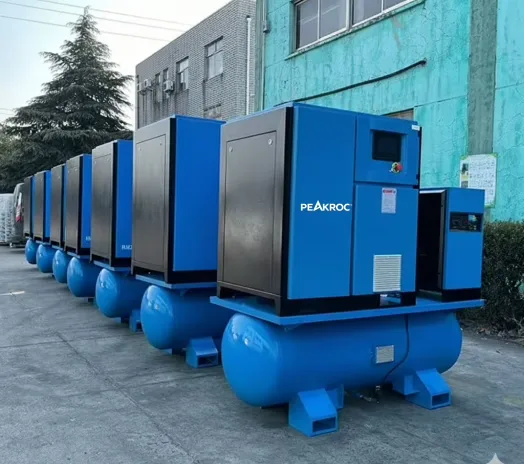
- Peakroc® users requiring integrated drying for laser cutting can review the 16–20 bar integrated compressor, receiver, refrigerated dryer and filtration system, while field users can refer to the sandblasting and spray-painting compressed-air sizing guide.
Why Compressed Air Needs Drying
Atmospheric air always contains water vapor.
Compression does not remove that water. It concentrates it.
When hot compressed air leaves the compressor and passes through an aftercooler, receiver or distribution system, its temperature falls. Part of the water vapor then condenses into liquid water.
Industry technical guidance gives a useful scale example: under warm and humid conditions, a 500 SCFM compressed-air system operating through a full shift can generate tens of gallons of condensate.
That moisture can lead to corrosion, stuck pneumatic valves, instrument faults, coating defects, wet abrasive, product contamination and freezing in exposed piping.
An aftercooler and moisture separator remove bulk liquid water.
A dryer goes further by reducing the water vapor that remains in the compressed air.
This distinction matters because a normal particulate or coalescing filter does not significantly reduce vapor-phase moisture or pressure dew point. CAGI specifically identifies the belief that filters can replace dryers as a compressed-air-system misconception.
Pressure Dew Point Should Drive Dryer Selection
Pressure dew point, or PDP, is the temperature at which water vapor begins to condense while the air remains under pressure.
If the compressed air has a +3°C PDP, downstream piping should remain above roughly +3°C if condensation is to be avoided.
If the air has a −40°C PDP, it can cool much further before water vapor begins to condense.
ISO 8573-1:2010 remains the currently published international standard defining compressed-air purity classes for particles, water and oil, although a future revision is now under development.
Commonly referenced water classes include:
| ISO water class | Maximum pressure dew point |
|---|---|
| Class 1 | −70°C |
| Class 2 | −40°C |
| Class 3 | −20°C |
| Class 4 | +3°C |
| Class 5 | +7°C |
| Class 6 | +10°C |
This creates a much better purchasing specification than simply writing:
“We need dry compressed air.”
A stronger RFQ states the required particle, water and oil classes at the point of use.
How a Refrigerated Air Dryer Works
A refrigerated dryer removes moisture by lowering the compressed-air temperature.
Incoming compressed air passes through a refrigeration heat exchanger. As the temperature drops, water vapor condenses into liquid droplets. A separator and drain then remove that liquid.
Industry guidance commonly places conventional refrigerated-dryer outlet dew points in the low positive Celsius range, with operating temperatures close to but safely above the freezing point of water.
Many designs then reheat the dried air before it leaves the dryer.
Reheating does not put moisture back into the air. It simply raises the outlet temperature and reduces condensation on downstream pipe surfaces.
For general industrial plant air, refrigerated drying is attractive because it combines:
moderate dryness + comparatively simple operation + low purge loss + relatively low lifecycle cost.
The physical limitation is that conventional refrigeration is not intended to create deeply sub-zero PDP. Once the required dryness moves toward −20°C or −40°C, another technology becomes more appropriate.
How a Regenerative Desiccant Dryer Works
A regenerative desiccant dryer uses adsorption rather than refrigeration as the primary drying mechanism.
Compressed air passes through a vessel filled with desiccant material. Water molecules attach to the large internal surface area of the adsorbent while dry air continues downstream.
Industrial systems normally use two towers.
One tower dries the process air while the other regenerates. The dryer then switches towers and repeats the cycle.
This arrangement can produce far lower PDP than conventional refrigerated technology. A −40°C PDP is a common industrial target for regenerative drying, while specialized systems can go lower where the process requires it.
The trade-off is greater system complexity.
The dryer may require purge air, heaters, blowers, switching valves, prefiltration, afterfiltration and periodic desiccant replacement.
Oil contamination is especially important. If upstream compressor lubricant reaches the adsorption material, desiccant performance and service life can decline.
Refrigerated vs Desiccant Dryer: Practical Comparison
| Selection factor | Refrigerated dryer | Regenerative desiccant dryer |
| Typical PDP direction | About +3°C to +10°C | −20°C, −40°C or lower |
| General indoor plant air | Excellent fit | Often unnecessarily dry |
| Outdoor piping below freezing | Limited | Strong fit |
| Instrument air | Application-dependent | Common choice |
| Initial investment | Usually lower | Usually higher |
| Purge air | Normally none | Depends on regeneration design |
| Energy use | Refrigeration power | Purge air and/or heaters/blowers |
| Maintenance | Condenser, refrigeration circuit, drains | Valves, filters, desiccant, regeneration system |
| Oil sensitivity | Moderate | Higher |
| Pressure drop | Must be controlled | Must be controlled |
| Main economic principle | Do not dry more than needed | Use low PDP where it creates process value |
The key question is not:
Which dryer is more advanced?
It is:
What is the highest pressure dew point that still protects the process under the lowest expected temperature and most demanding production condition?
That usually leads to the lowest reliable lifecycle cost.
Why −40°C Air Usually Costs More Than +3°C Air
A refrigerated dryer mainly consumes electricity through its refrigeration system.
A regenerative dryer can consume energy in several ways.
A heatless dryer regenerates one tower using already compressed and dried air from the operating system. That regeneration air is then discharged rather than delivered to production.
Industry technical guidance indicates that heatless dryers can consume a substantial share of rated flow as purge air, while externally heated regeneration reduces that requirement.
Consider a plant that needs 1,000 CFM of usable dry air downstream.
If the selected dryer requires a meaningful purge percentage, the compressor must produce more than 1,000 CFM upstream just to ensure that production receives the full 1,000 CFM.
That extra air has already been:
compressed, cooled, separated, filtered and dried.
It therefore carries a real energy cost.
For high-flow systems operating thousands of hours per year, the difference between heatless, heated, blower-assisted and heat-of-compression regeneration can significantly affect annual operating cost.
Heatless, Heated, Blower Purge and Heat-of-Compression Dryers
A “desiccant dryer” is not one single machine type.
Heatless regeneration is mechanically simple and avoids electric regeneration heaters, but it can use relatively large amounts of compressed purge air.
Heated regeneration adds heat to reduce the amount of dry compressed air required for desiccant regeneration.
Blower-purge systems use atmospheric air moved by a blower for part of the regeneration process, reducing the amount of valuable compressed air sacrificed.
Heat-of-compression systems recover heat produced during compression and use it to regenerate the desiccant. They can be particularly attractive in suitable large compressor systems because they reuse heat that would otherwise be rejected.
So once a project truly requires −40°C PDP, the next question becomes:
Which regeneration technology provides that PDP with the lowest purge, energy and maintenance cost for the actual load profile?
Dryer Sizing: CFM Alone Is Not Enough
Dryer ratings are based on defined operating conditions.
Actual capacity changes when inlet pressure, inlet temperature, ambient temperature or required PDP differs from the rating point.
Higher inlet temperature generally increases moisture load.
Hot compressed air carries substantially more water vapor, so a dryer installed after an ineffective aftercooler can become overloaded even when its nominal CFM rating appears sufficient.
Ambient temperature also matters, especially for refrigerated dryers because the refrigeration condenser must reject heat to the surrounding air.
Pressure matters as well because moisture loading and volumetric flow through the dryer change with operating pressure.
A 500 CFM compressor should therefore not automatically be paired with a 500 CFM dryer without checking the correction factors.
Peak flow must also be considered.
A large receiver can supply short bursts of air faster than the compressor produces it. If that receiver is upstream of the dryer, temporary flow through the dryer may exceed compressor FAD and cause increased pressure drop or poorer dew-point performance.
A proper dryer RFQ should therefore specify actual maximum flow, normal and maximum pressure, maximum inlet temperature, maximum ambient temperature, required PDP, peak-demand pattern, compressor type and annual operating hours.
Pressure Drop Is a Permanent Energy Cost
Every treatment component creates resistance.
The complete pressure path may include:
aftercooler → separator → prefilter → dryer → afterfilter → receiver → piping → production equipment
If production equipment requires 7 bar and the treatment system consumes 0.4 bar, one response is to increase compressor discharge pressure.
That restores plant pressure—but permanently increases compressor workload.
CAGI advises users to minimize compressed-air-system pressure and avoid unnecessary pressure losses because higher operating pressure increases compressor energy consumption.
The better solution is to evaluate whether the pressure drop is caused by:
an undersized dryer, loaded filters, restrictive valves, small piping or poor system layout.
For more detail, see Peakroc’s compressed-air system design guide.
Industrial Case: Improving Moisture Control in a Glass Plant
A U.S. glass manufacturing facility carried out a full compressed-air-system assessment because compressed air was both critical to production and a major electricity consumer.
The plant also identified insufficient moisture control as an operational issue.
Instead of simply replacing one dryer with another, the project redesigned the compressed-air system as a whole. Three older compressors were replaced by two more efficient units, and the existing refrigerated dryers were replaced with heat-of-compression drying.
The new arrangement provided greater drying capacity and improved moisture control while also adding system redundancy. The overall compressed-air improvement project was expected to reduce system energy use by approximately 15%.
This does not mean that changing from refrigerated to desiccant drying automatically saves 15%.
The project included compressor replacement, control improvements, redundancy and drying changes together.
The useful engineering lesson is different:
When the process genuinely needs better moisture control, dryer technology should be selected together with compressor architecture and system-energy strategy.
That is a much stronger decision method than comparing dryer purchase prices in isolation.
Industrial Case: Cycling Refrigerated Drying in a Food-Processing Plant
A large U.S. food-processing facility incorporated compressed-air efficiency into the design of a new production plant.
Its compressed-air system included a central compressor arrangement, master control, a large receiver and a cycling refrigerated dryer.
The plant did not select an ultra-low −40°C PDP simply because it was technically possible.
Instead, the compressed-air design used refrigerated drying as part of a broader system in which receiver capacity, pressure control and variable production demand were considered together.
The transferable lesson is:
If the required PDP can be achieved with refrigerated technology, matching dryer energy use to changing plant load can be more economical than producing unnecessarily dry air.
This is especially relevant to factories where production demand changes substantially between shifts or product batches.
When a Refrigerated Dryer Is Usually the Better Choice
Refrigerated drying is normally the first technology to evaluate when:
- General plant air only requires approximately +3°C PDP.
- All downstream piping remains comfortably above freezing.
- The process has no special ultra-dry-air requirement.
- Low maintenance and relatively simple operation are priorities.
- Purge-air loss would be undesirable.
- Production demand varies and a cycling dryer could reduce part-load refrigeration energy.
Peakroc’s 16–20 bar integrated laser cutting air system uses an integrated refrigerated dryer where that moisture-control level matches the process. The current system combines the compressor, receiver, dryer and precision filtration in one package with published FAD options from 1.05 to 3.9 m³/min.
When a Desiccant Dryer Is Usually the Better Choice
Desiccant drying becomes more appropriate when the required PDP falls below the practical range of refrigerated drying.
Typical applications include instrument air, exposed outdoor compressed-air lines, sub-zero environments, pipeline drying, certain chemical or process-air duties, and manufacturing processes that are highly sensitive to moisture.
The key environmental question is simple:
What is the lowest temperature the compressed air may experience downstream?
If outdoor pipework can fall below the refrigerated dryer PDP, water vapor may condense later in the system and can freeze.
CAGI also warns that outdoor dryer installations need suitable freeze, weather and environmental protection rather than assuming that standard indoor equipment can simply be placed outside.
Five Common Dryer Selection Mistakes
- Selecting −40°C because it sounds better than +3°C. Extra dryness has value only when it prevents a real process, product or freezing problem.
- Sizing from compressor kW instead of corrected airflow. Dryer capacity should reflect FAD, pressure, inlet temperature, ambient temperature and required PDP.
- Ignoring regeneration purge. The downstream plant may need 1,000 CFM while the compressor must produce substantially more.
- Ignoring filtration around the desiccant dryer. Upstream oil contamination and downstream desiccant dust both require appropriate treatment.
- Using higher compressor pressure to hide dryer restriction. Pressure drop should be corrected at its source whenever practical.
How to Compare Dryer Total Cost of Ownership
The correct comparison includes more than purchase price.
Dryer TCO = equipment and installation + electrical energy + purge-air energy + pressure-drop energy + filters and drains + refrigerant or desiccant maintenance + downtime risk
For general factory air, refrigerated drying may offer the best lifecycle cost because the process does not benefit from extremely low PDP.
For a process that truly requires −40°C, a refrigerated dryer is no longer a realistic alternative because it cannot provide the required dryness.
At that point, the meaningful economic comparison becomes:
heatless vs heated vs blower-purge vs heat-of-compression desiccant drying.
Annual operating hours are especially important.
A simple heatless dryer may be economical for a small intermittent system, while purge losses can become expensive on a large system running 8,000 hours per year.
The correct sequence is:
required PDP → real operating conditions → dryer technology → corrected capacity → pressure drop → regeneration method → lifecycle cost
Practical RFQ Checklist
Before requesting a dryer quotation, provide:
- Maximum and average CFM/FAD
- Normal and maximum working pressure
- Maximum dryer inlet temperature
- Maximum ambient temperature
- Required pressure dew point
- Required ISO 8573-1 particle, water and oil classes
- Compressor type and expected oil carryover
- Daily and annual operating hours
- Lowest downstream piping temperature
- Installation location and weather exposure
- Peak-demand profile
- Planned future expansion
Peakroc’s Compressor Finder can be used to match compressor pressure and airflow before the complete dryer and filtration package is finalized.
Final Recommendation
Do not choose a refrigerated or desiccant dryer by asking which technology is “better.”
Start with the required pressure dew point.
If the plant uses general-purpose compressed air, the distribution system remains indoors and above freezing, and approximately +3°C PDP protects the process, a refrigerated dryer is usually the first technology to evaluate.
If the process or environment requires −20°C, −40°C or lower PDP, a regenerative desiccant dryer becomes the more appropriate technical direction.
Then evaluate corrected dryer capacity.
Check inlet temperature, ambient temperature, pressure, peak airflow and the required ISO 8573-1 air quality.
For desiccant systems, also calculate purge-air consumption and regeneration energy.
For both technologies, consider pressure drop and maintenance.
The best dryer is not the machine that produces the lowest possible dew point.
It is the dryer that provides the dryness the process actually needs—with enough reliability and the lowest practical lifecycle cost.
FAQ
What is the main difference between a refrigerated and desiccant air dryer?
A refrigerated dryer cools compressed air until water vapor condenses and can be separated. A regenerative desiccant dryer adsorbs water vapor onto a desiccant material and can achieve much lower pressure dew points.
Is +3°C pressure dew point dry enough?
It is often sufficient for general indoor factory air when downstream piping remains above +3°C and the production process does not require ultra-dry air.
When do I need a −40°C desiccant dryer?
A −40°C PDP is commonly considered for instrument air, outdoor piping exposed to freezing conditions, pipeline drying and other moisture-sensitive processes.
How much purge air does a desiccant dryer use?
The amount depends on the regeneration design. Heatless dryers can consume a significant percentage of rated airflow, while heated, blower-assisted and heat-of-compression technologies can reduce compressed-air purge demand.
Can filters replace an air dryer?
No. Filters can remove particles, bulk liquid water and aerosols, but they do not normally remove enough water vapor to significantly reduce pressure dew point.
How should I size a compressed air dryer?
Use the maximum actual airflow through the dryer and correct the rating for inlet pressure, inlet temperature, ambient temperature, required PDP and peak demand. Do not select the dryer from compressor motor power alone.
Does a desiccant dryer always cost more to operate?
Not necessarily. Heatless designs may have significant purge-air costs, while other regeneration technologies use heaters, blowers or heat recovery. The correct comparison should include annual energy, purge loss, pressure drop, maintenance and operating hours.
Can a refrigerated dryer be used outdoors in winter?
Only with suitable environmental and freeze protection. More importantly, if downstream compressed-air piping can cool below the dryer PDP, condensation or freezing may still occur and a lower-PDP dryer may be needed.
Author

Mark Chen – Senior Mechanical Engineer, Peakroc®
Mark Chen is a senior mechanical engineer at Peakroc®, specializing in compressed air systems and drilling equipment for mining and construction applications. With over 15 years of field experience, he has led multiple projects on optimizing air delivery efficiency, equipment durability, and energy consumption.