
Key Takeaways
- Confirm FAD and working pressure together. A compressor advertised at 20 m³/min cannot be evaluated without knowing the pressure and test conditions associated with that capacity. The Peakroc® portable diesel air compressor selection guide explains the main technical parameters.
- Agree on Factory Acceptance Test (FAT) requirements before paying the deposit. A successful engine start or a pressure-gauge reading does not establish delivered airflow. The portable diesel compressor FAT guide covers performance verification and safety checks.
- Verify spare-parts compatibility before shipment. Obtain the exact engine, airend, filter and controller information rather than relying on generic replacement-part descriptions. See the Chinese air compressor spare-parts sourcing guide.
- Define the delivered package, not just the machine price. For example, a 20 m³/min, 13 bar portable diesel compressor must be evaluated together with the application, engine configuration, export requirements, transport and support arrangements.
- Separate warranty, delivery and commissioning obligations. Use the Peakroc® compressor selection service to discuss technical requirements, and verify all commercial commitments in the supplier’s written offer and sales contract.
Buying a portable diesel screw air compressor from China can provide access to a wide range of airflow capacities, working pressures and engine configurations. But comparing two quotations based only on price and nominal CFM creates avoidable procurement risks.
A machine may meet its advertised maximum pressure yet deliver insufficient air under load. The engine configuration may be unsuitable for local fuel or emissions requirements. Shipping costs, replacement filters and commissioning responsibilities may also be missing from the initial offer.
For mining contractors, drilling companies, equipment distributors and rental businesses, the important question is whether the compressor can be verified before shipment, imported legally, commissioned safely and maintained throughout its service life.
The following purchasing process focuses on the documents, measurements and decisions that matter most.
1. Define Compressor Specifications Before Requesting Quotations
A useful Request for Quotation (RFQ) begins with the application rather than a particular compressor model.
For DTH drilling, the buyer should identify hammer size, required air consumption, drilling depth, geological conditions and the expected pressure at the hammer. For sandblasting or construction tools, the number of simultaneously operating outlets becomes important.
The supplier must then match those requirements to the compressor’s delivered airflow and working pressure.
FAD, CFM and Working Pressure
Free Air Delivery (FAD) describes actual compressor capacity under specified reference conditions. It should not be confused with theoretical displacement or an unspecified maximum-flow claim.
For example, a machine rated at 20 m³/min and 13 bar corresponds to approximately:
20 × 35.3 = 706 CFM
13 × 14.5 = 188.5 PSI
These are unit conversions, not independent verification of performance.
The quotation should identify whether the 20 m³/min rating is FAD, the pressure associated with that rating, and the applicable reference conditions.
Pressure losses through hoses and drilling equipment must be considered separately. High altitude and elevated ambient temperature can also affect engine power, cooling and available air delivery.
Five Essential RFQ Specification Checks
- Air delivery: Specify required FAD in m³/min or CFM at the intended operating pressure.
- Working conditions: State application, altitude, maximum ambient temperature, duty cycle and hose arrangement.
- Engine configuration: Request manufacturer, exact engine model, rated power, fuel requirements and applicable emissions configuration.
- Compressor package: Confirm airend, control system, cooling arrangement, chassis, outlets and optional equipment.
- Documents and limits: Request technical drawings, dimensions, weight, service information and any destination-specific compliance documentation.
Buyers should compare specifications at equivalent operating points. A lower-pressure compressor with greater nominal flow may still be unsuitable for a high-pressure drilling application.
2. Verify the Chinese Supplier and the Actual Equipment Configuration
A quotation alone does not establish who manufactures the equipment or which components will be installed.
A Chinese equipment exporter may operate its own factory, purchase machines from partner manufacturers or supply several compressor brands. None of these arrangements is automatically unacceptable, but the buyer should understand who is responsible for production, testing, spare parts and warranty support.
Request the supplier’s legal company information and verify that the contracting entity matches the commercial documents and payment instructions.
The supplier should also provide a model-specific specification sheet showing the engine, airend, controller and operating performance.
Engine Emissions and Fuel Compatibility
Diesel compressor export selection must account for the destination country’s regulations.
For example, the United States has requirements applicable to imported nonroad diesel engines and equipment, while the European Union applies its own regulatory framework for non-road mobile machinery.
An engine approved for one market is not automatically approved for another. Buyers should verify the applicable certification, engine family, model year and identification label before ordering.
Fuel compatibility also matters. A machine designed around low-sulfur diesel and specific aftertreatment equipment may be unsuitable for a region where the required fuel quality is unavailable.
Never assume that removing emissions-control components is a lawful or acceptable solution.
Five Supplier Verification Checks
- Confirm the legal seller, manufacturing location and responsible after-sales entity.
- Request photographs of the actual production or assembly process where available.
- Obtain written confirmation of the engine, airend and controller configuration.
- Verify destination-market emissions and other mandatory requirements through appropriate authorities.
- Agree on how component substitutions, specification changes and approval requests will be handled.
A supplier offering an alternative engine after the order is placed should provide updated technical and compliance documents before receiving buyer approval.
3. Factory Acceptance Test: What to Check Before Balance Payment
Factory Acceptance Testing is an agreed procedure used to establish whether equipment meets defined contractual requirements before shipment.
For a portable diesel screw compressor, FAT may cover configuration, performance, engine operation, cooling, leakage and protective functions.
A compressor reaching 13 bar while delivering little air has not demonstrated that it can supply its rated FAD at 13 bar.
Where performance verification is required, the test method, measuring equipment, operating conditions and acceptance tolerances should be agreed before production is completed.
ISO 1217 provides recognized methods for acceptance testing of displacement compressors. Its application to a particular machine and FAT scope should be defined in the contract.
FAT vs Pre-Shipment Inspection
These terms should not be used interchangeably.
A FAT can include functional and performance testing under specified operating conditions. A pre-shipment inspection may focus on the final configuration, appearance, documentation, accessories, packaging and shipping readiness.
Both can be valuable, but neither automatically replaces the other.
Five FAT and Shipment-Release Checks
- Machine identification: Match compressor, engine and relevant component serial numbers with the purchase order.
- Performance: Record airflow, working pressure, engine RPM, temperatures and relevant test conditions using the agreed method.
- Functional safety: Check emergency stop, protective alarms, leakage and applicable shutdown functions.
- Documentation: Receive a test report identifying instruments, results, deviations and corrective actions.
- Release decision: Define whether the machine passes, requires retesting or remains subject to unresolved contractual items.
A remote FAT can be useful when the buyer cannot visit China. Live video, timestamped photographs and recorded measurements improve visibility, but they do not replace calibrated data when a formal performance test is required.
The contract should specify who may witness testing, how failed items are corrected, and what documentation is needed before the remaining payment or shipment release.
4. Shipping from China: Incoterms, Packing and Import Documents
A low equipment quotation does not necessarily mean a low delivered cost.
International buyers should compare the complete landed-cost exposure, including equipment, export handling, transport, insurance, import duties, taxes, unloading and inland delivery.
The selected Incoterm affects the allocation of transport costs, responsibilities and risk between seller and buyer.
EXW, FCA, FOB, CIF and DAP
EXW generally places extensive collection and export-arrangement responsibilities on the buyer.
FCA identifies delivery to the nominated carrier at an agreed place and is often worth considering for containerized shipments.
FOB applies to sea or inland-waterway transport, with delivery and risk transfer when the goods are placed on board the vessel at the agreed port.
CIF requires the seller to arrange and pay for freight and specified insurance to the named destination port, but the risk of loss generally transfers when the goods are loaded on board at the shipment port.
DAP requires delivery to the named destination with the goods ready for unloading; import clearance, duties and taxes are generally the buyer’s responsibility.
The exact named place matters. “FOB China” or “DAP customer warehouse” without a properly identified port or location can create unnecessary disputes.
Incoterms do not automatically define warranty terms, ownership transfer, payment milestones or commissioning responsibilities. These belong in the sales contract.
Shipping and Packing Requirements
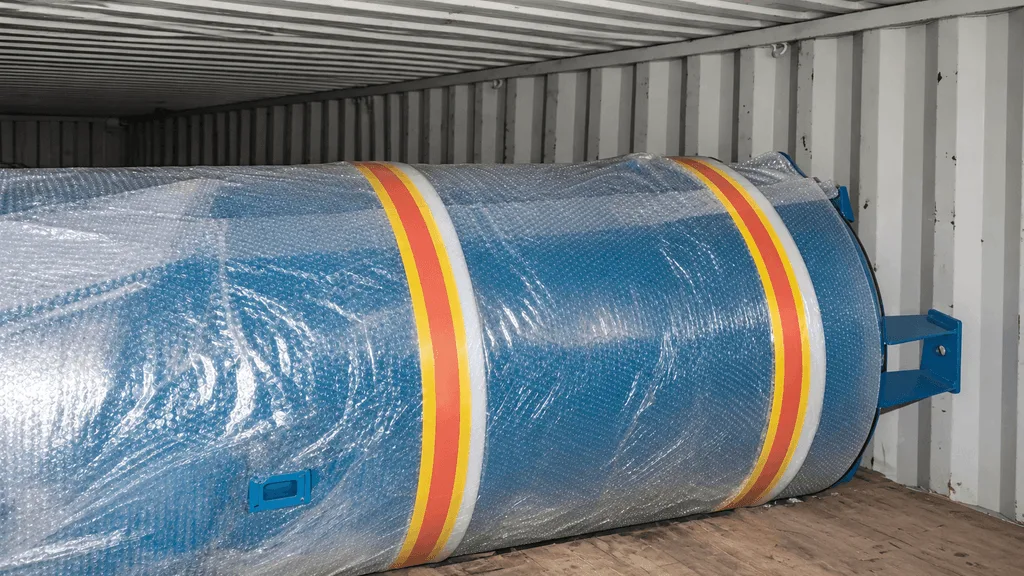
Portable diesel compressors may be shipped in containers, as suitable breakbulk cargo, or under other arrangements depending on dimensions, weight and configuration.
The supplier should confirm the shipping dimensions, lifting points, center of gravity and approved securing method before booking transportation.
Cargo preparation should address residual fuel, batteries, lubricants, pressure release and carrier-specific safety requirements. Requirements depend on the actual shipment and applicable transport rules.
If wooden packaging is used, check whether ISPM 15 treatment and marking are required by the destination.
Five Pre-Shipment Documentation Checks
- Confirm the exact Incoterm, named place, freight scope, insurance arrangement and destination charges.
- Verify the commercial invoice, packing list and relevant shipping-document instructions.
- Match model numbers, serial numbers, quantities, weights and dimensions across documents.
- Obtain packaging photographs, loading records, cargo-securing details and container information where applicable.
- Check destination-country requirements for emissions, origin evidence, inspections, duties and import permits before dispatch.
A Certificate of Origin or other supporting document should be requested when required; it should not be assumed that every shipment automatically includes the same certificates.
5. Spare Parts and Warranty: Evaluate the Cost of Ownership
A portable compressor used in mining or drilling may operate far from an authorized service center.
The ability to obtain genuine or correctly specified filters, lubricant, separators and engine parts can be as important as the initial purchase price.
A machine with a common engine family may offer sourcing advantages, but compatibility still depends on exact part numbers, engine variants and serial numbers.
Spare Parts Worth Identifying Before Shipment
Ask the supplier to identify the compressor oil filter, engine oil filter, fuel filters, air filters, oil separator element, approved lubricants, belts or drive components where applicable, and relevant sensors.
The quotation should distinguish parts included in the machine from optional maintenance kits and recommended local stock.
A maintenance kit described only as “one set of filters” is insufficient if the buyer cannot identify which components it contains or when they are needed.
The supplier should also confirm the availability of electronic-controller parts, software support and diagnostic access where applicable.
What Should a Written Warranty Specify?
Warranty terms should identify the coverage period, any operating-hour limit and the event that starts the warranty.
The contract should state how defective parts are assessed, who approves claims, and which party pays for replacement parts, international freight, local labor and technician travel.
Consumables, improper operation, unauthorized modifications and maintenance failures may be subject to exclusions. These should be disclosed before purchase.
A statement such as “12-month warranty” is incomplete unless the start date, coverage and claim process are clear.
6. Commissioning and Final Acceptance at the Jobsite
FAT and shipment inspection occur before delivery. Commissioning verifies whether the machine can be prepared and operated correctly under actual site conditions.
Transport can introduce loose connections, damaged fittings, shifted components or contamination. The receiving team should inspect the compressor before its first startup.
Diesel-powered equipment also requires suitable exhaust management, ventilation, fuel handling and safe positioning.

Five Commissioning and Handover Checks
- Receiving inspection: Record shipping damage, missing accessories, serial numbers and preservation condition before acceptance.
- Preparation: Check fluid levels, approved fuel and lubricants, cooling system, filters, hoses, tires or support structure, and safety devices.
- Initial operation: Follow the manufacturer’s startup procedure and observe pressure, temperature, engine behavior and alarms.
- Loaded verification: Test the compressor against the intended equipment demand using approved procedures and suitable instrumentation.
- Handover: Record operator training, maintenance instructions, installed options, commissioning results and outstanding corrective actions.
A successful factory test does not guarantee identical field performance at a hot, high-altitude drilling location. The supplier and buyer should agree on how environmental differences and site-related problems will be evaluated.
Formal site acceptance should be recorded separately when required by the purchase contract.
Compressor Procurement Verification Matrix
The following table summarizes the evidence a buyer should request at each stage.
| Procurement Stage | Minimum Verification | Common Risk |
|---|---|---|
| RFQ | FAD at pressure, engine model, environment and duty | Wrong compressor capacity |
| Supplier approval | Legal entity, component configuration, applicable compliance | Undisclosed substitutions |
| FAT | Test results, serial numbers, deviations and approvals | Pressure shown without actual flow |
| Before shipment | Packing list, invoice, shipping terms and loading evidence | Unexpected charges or missing items |
| Spare-parts planning | Exact part numbers, service schedule and availability | Long equipment downtime |
| Warranty agreement | Coverage, start date, exclusions and claims process | Unresolved repair responsibility |
| Commissioning | Receiving inspection, first startup and loaded test | Field failure after factory acceptance |
The most useful procurement record connects the approved specification, tested machine, shipped equipment and commissioned unit through consistent identification.
Technical Field References: Lessons from Published Equipment Projects
The following cases illustrate how industrial compressor suppliers have handled factory acceptance, export logistics and field commissioning.
They are external published examples, not Peakroc® customer projects. Supplier-reported results should not be interpreted as independently audited performance guarantees.
Field Reference 1: Remote Factory Acceptance for an Indonesian Offshore Project
A Chinese equipment manufacturer reported conducting a live remote acceptance test for engine-driven offshore compressor packages in 2020.
The Indonesian customer could not travel to China because of pandemic restrictions.
According to the published account, the team prepared more than 400 electrical and mechanical test items, with a remote demonstration and discussion lasting approximately ten hours.
The equipment passed the reported acceptance process before delivery and planned onsite installation.
Procurement lesson: Remote FAT can provide structured buyer participation when travel is impossible, but evidence must be tied to agreed test requirements.
These were specialized offshore compressor packages, not portable diesel air compressors. Their testing scope should not be treated as a standard requirement for every mobile unit.
Field Reference 2: Container Shipment of Compressor and Drilling Equipment to Indonesia
A Chinese drilling-equipment exporter published a 2025 account describing a shipment containing a 22 m³/min, 20 bar diesel compressor, 150 meters of high-pressure air hose, DTH hammers, drill bits, spare parts and associated equipment.
The shipment reportedly occupied a 40-foot high-cube container.
Heavy rain complicated loading, requiring additional protection for tools and equipment.
The supplier described preparing export documents, photographing packed cargo and sharing serial-number information and loading records with the customer.
Procurement lesson: Shipment acceptance should cover accessories, documentation, cargo protection and traceability—not only the compressor itself.
The account is supplier-published and does not independently establish final jobsite performance.
Field Reference 3: High-Pressure Compressor Commissioning in Brazil
A published water-well drilling project account described a portable diesel compressor rated at 33 m³/min and 25 bar for drilling applications in northeastern Brazil.
The supplier reported adapting the equipment for high ambient temperatures, performing factory checks, arranging delivery and completing onsite pressure calibration and operational adjustments.
The account also described integration with the drilling system and operator training.
Procurement lesson: The factory’s rated pressure and airflow are starting points. Actual site conditions, cooling, hose connections and equipment operation must also be addressed during commissioning.
The results were reported by the supplying company and should not be interpreted as guaranteed performance for another site or compressor model.
Common Buying Mistakes to Avoid
Some purchasing problems can be avoided before the initial deposit.
One common mistake is comparing different pressure-flow ratings as though they were equivalent. Another is accepting a quotation that names an engine brand but omits the exact model or emissions configuration.
Buyers also sometimes assume that a short running video constitutes formal FAT, that CIF includes all destination costs, or that a general warranty statement covers overseas labor and transport.
A lower machine price can become expensive if parts are difficult to obtain or the equipment cannot be commissioned at its destination.
The solution is to establish clear acceptance criteria and responsibility boundaries before production begins.
Final Recommendation
Buying a portable diesel air compressor from China should be managed as a documented equipment procurement process rather than a comparison of advertised prices.
Define the operating requirements first, verify the supplier and installed components, agree on FAT before shipment, clarify the international delivery terms and confirm how warranty and commissioning will work after arrival.
The most reliable purchase is one in which the specified compressor, tested compressor, shipped compressor and commissioned compressor can all be verified as the same agreed configuration.
FAQ
What should I check before buying a diesel air compressor from China?
Verify the required FAD and working pressure, exact engine and airend configuration, operating environment, emissions compliance, supplier identity, FAT requirements, shipping terms, spare parts and warranty obligations.
How do I verify the actual CFM or FAD before shipment?
Request an agreed performance test using suitable calibrated instruments. The report should identify the compressor, measured airflow, working pressure, operating conditions, reference corrections and applicable acceptance criteria.
Is a factory running video sufficient for compressor FAT?
Not necessarily. Video can confirm machine identity and demonstrate functions, but it cannot replace calibrated performance measurements when the contract requires verified FAD, pressure or other quantitative results.
Which shipping term is better for buying a compressor from China: FOB, CIF or DAP?
The appropriate term depends on transport arrangements, the destination and which party should manage freight and risk. FOB and CIF apply to maritime transport, while DAP can cover delivery to a named inland destination. Compare total costs and obligations.
What documents are normally needed to import a portable diesel compressor?
Common documents include a commercial invoice, packing list and transport document. Depending on the destination, import permits, emissions documents, inspection records, origin evidence or other certifications may also be required.
What spare parts should be purchased with a new diesel screw compressor?
Consider the approved oil and fuel filters, air filters, oil separator element, lubricants and selected service components. Exact quantities and part numbers should follow the compressor configuration and maintenance schedule.
When should the compressor warranty begin?
There is no universal starting point. It may begin at shipment, delivery or another contractually agreed event. The purchase contract should identify the exact start date, duration, operating-hour limits and claim responsibilities.
What is the difference between FAT and onsite commissioning?
FAT verifies agreed equipment requirements before shipment under defined test conditions. Onsite commissioning covers receiving inspection, preparation, initial operation, integration and testing under actual jobsite conditions.
Author

Mark Chen – Senior Mechanical Engineer, Peakroc®
Mark Chen is a senior mechanical engineer at Peakroc®, specializing in compressed air systems and drilling equipment for mining and construction applications. With over 15 years of field experience, he has led multiple projects on optimizing air delivery efficiency, equipment durability, and energy consumption.