
Key Takeaways
- Blast nozzle diameter and operating pressure determine most of the compressor airflow requirement. A small increase in nozzle size can produce a substantial increase in CFM demand.
- Compare verified Free Air Delivery at the required pressure, not only compressor horsepower, tank size, theoretical displacement, or a model number.
- The compressor must cover the combined demand of blast nozzles, spray equipment, pneumatic pumps, blast-pot controls, breathing-air equipment, and system losses.
- Moisture and oil contamination can interrupt abrasive flow, promote flash rust, contaminate a prepared surface, and reduce coating quality.
- Sandblasting and compressed-air spray painting can use one compressor package, but they normally require different pressure regulation and increasingly fine downstream air treatment.
- Airless paint spraying is not the same as compressed-air spray painting. Some airless systems may require little or no compressor airflow for atomization.
Abrasive blasting is one of the most demanding continuous-air applications found on construction sites, in shipyards, coating workshops, storage-tank projects, and mobile surface-preparation businesses. Unlike an impact wrench or breaker that may consume air intermittently, a blast nozzle can draw a large volume of compressed air throughout the working cycle.
Spray painting usually consumes much less air than industrial blasting, but the required air quality is more demanding. A blasting nozzle may continue operating with slightly wet air until the abrasive begins to clog. A spray gun can show finish defects much sooner when moisture, oil aerosol, dust, or unstable pressure reaches the air cap.
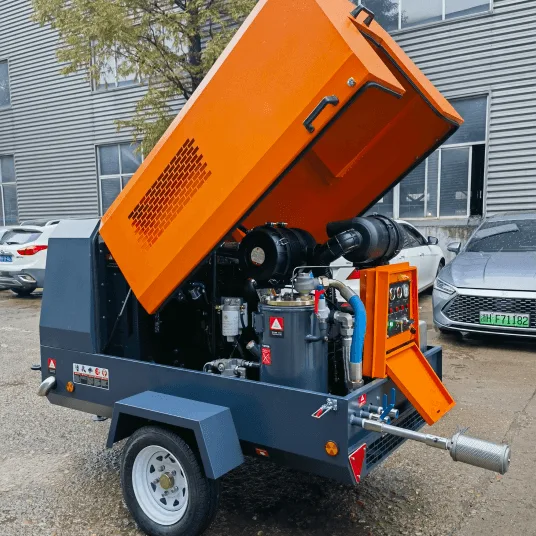
Peakroc® offers portable diesel screw air compressors for continuous-duty blasting, construction, mining, and industrial projects. For projects near the 600 CFM class, the 600 CFM portable compressor selection guide explains how pressure and FAD change application fit. A 17 m³/min, 8 bar portable diesel compressor may be a relevant direction for high-volume blasting, while the final selection should still begin with nozzle and system demand.
Sandblasting, Abrasive Blasting, and Spray Painting Are Different Air Loads
“Sandblasting” is commonly used as a general name for abrasive blasting, even when the abrasive is garnet, steel grit, aluminum oxide, glass bead, slag, or another non-sand material. The compressor supplies the energy that accelerates the abrasive through the nozzle and toward the workpiece.
The required airflow is affected by nozzle diameter, nozzle pressure, nozzle condition, abrasive-delivery system, hose arrangement, and whether more than one operator works simultaneously.
Compressed-air spray painting is a different process. Conventional air spray and HVLP guns use compressed air to atomize coating material at the gun. Air-assisted systems combine fluid pressure with atomizing air, while airless equipment primarily atomizes coating through high fluid pressure rather than a large compressed-air stream. Graco distinguishes air spray from airless and air-assisted technologies, so the spray-equipment manufacturer’s data must be checked before compressor sizing.
The same compressor may support both surface preparation and coating, but the two processes should not normally share the same untreated air connection.
Why CFM and FAD Matter More Than Compressor Tank Size
CFM means cubic feet per minute. In international specifications, airflow may be stated in cubic meters per minute.
1 m³/min ≈ 35.3 CFMAbrasive blasting needs sustained airflow. A large receiver tank can temporarily support a small compressor, but it cannot make up for a continuous production deficit. Once the stored air is used, nozzle pressure falls toward the level that the compressor can continuously maintain.
FAD, or Free Air Delivery, represents usable compressor output under stated reference conditions. For a meaningful comparison, the quotation should identify:
- FAD at the proposed working pressure
- The testing or rating basis
- Maximum ambient temperature and altitude
- Whether the flow is continuous or temporary boost output
- Any output reduction caused by an aftercooler, dryer, or other downstream equipment
A “185 CFM compressor” should therefore not be selected simply because a nozzle chart lists 140 CFM. The practical system also needs reserve for pressure loss, nozzle wear, auxiliary demand, and real jobsite conditions.
How Nozzle Size Changes Air Consumption
The reference article from BlastTrader emphasizes that nozzle diameter and nozzle pressure must be evaluated together. It gives approximately 196 CFM for a 3/8-inch No. 6 nozzle at 100 PSI and approximately 338 CFM for a 1/2-inch No. 8 nozzle at the same pressure.
Other compressor manufacturers publish similar reference values. Sullair gives approximately 140 CFM for a 5/16-inch No. 5 nozzle and approximately 200 CFM for a 3/8-inch No. 6 nozzle at 100 PSI.
| Nozzle designation | Nominal orifice | Approximate air demand at 100 PSI | Practical compressor direction |
|---|---|---|---|
| No. 5 | 5/16 in / about 8 mm | About 137–140 CFM | A 185 CFM class machine may support one new nozzle with limited reserve |
| No. 6 | 3/8 in / about 9.5 mm | About 196–200 CFM | A 250 CFM or larger package is generally more realistic |
| No. 8 | 1/2 in / about 12.7 mm | About 338 CFM | Commonly requires a 375–400 CFM class package or more |
These are sizing references, not guaranteed project requirements. The blast-pot manufacturer’s nozzle chart should remain the primary source because nozzle geometry, pressure, and equipment design can differ.
The important pattern is clear: air demand rises much faster than the nozzle diameter appears to increase. Moving from a No. 6 to a No. 8 nozzle is not a minor adjustment. It can require well over 100 CFM of additional airflow.
Nozzle Wear Is Hidden Compressor Demand
Abrasive media gradually enlarges the nozzle bore. The operator may still call it a No. 6 nozzle even though its actual opening has become closer to the next size.
As the orifice grows, the nozzle consumes more air. Pressure at the nozzle then falls if the compressor has no reserve. Operators sometimes respond by increasing the compressor setting, but higher outlet pressure does not correct an airflow shortage caused by a worn nozzle.
Kaeser specifically warns that a worn blasting nozzle requires significantly more CFM to maintain pressure and that low nozzle pressure commonly indicates insufficient flow rather than an inadequate maximum pressure setting.
Nozzle condition should therefore be measured rather than judged by appearance. A nozzle gauge is inexpensive compared with fuel wasted by a worn nozzle or production lost while an undersized compressor runs at full load.
How to Calculate the Required Compressor Capacity
A practical sizing calculation begins with the airflow demand of all equipment that will operate simultaneously.
Required compressor FAD =
Total nozzle demand
+ auxiliary air demand
+ distribution losses
+ operating reserve
Auxiliary demand may include blast-pot controls, pneumatic pumps, agitators, breathing-air equipment, spray-gun atomizing air, dust-collection functions, and other tools connected to the same compressor.
For one No. 6 nozzle requiring approximately 200 CFM, a compressor rated at exactly 200 CFM leaves no reserve. A more realistic package must account for hose loss, nozzle wear, leakage, filter restriction, altitude, temperature, and the possibility that another air consumer operates during blasting.
For two No. 6 nozzles, the nozzle demand alone is approximately 400 CFM. After adding reserve and auxiliary loads, a 450–500 CFM package may be more suitable than a nominal 400 CFM unit.
For three No. 6 nozzles, the theoretical nozzle demand is around 600 CFM. This does not automatically mean that a 600 CFM compressor is sufficient. The final package may need additional capacity, especially when long hoses, hot weather, high altitude, or heavily worn nozzles are expected.
Pressure at the Nozzle Matters More Than Pressure at the Compressor
The compressor control panel shows pressure near the machine. The nozzle may be tens or hundreds of feet away through hoses, couplings, valves, a moisture separator, and the blast pot.
Pressure is lost through:
- Undersized or excessively long hoses
- Restrictive couplings and fittings
- Dirty filters and separators
- Leaking connections
- Excessive bends and manifolds
- A partially closed valve
- Air-treatment equipment selected without pressure-drop allowance
BlastTrader presents a rule of thumb that each 1 PSI loss at the nozzle can reduce production by approximately 1.5%. That figure should be treated as an application estimate rather than a universal engineering law, but it illustrates why apparently small pressure losses matter in high-production blasting.
Increasing compressor discharge pressure is not always the best response. Higher pressure increases compressor load and fuel consumption. Correcting hose restrictions and leakage often improves nozzle performance at a lower operating cost.
Hose Diameter Is Part of Compressor Sizing
A correctly sized compressor can perform poorly when connected through a hose intended for a much smaller machine.
The main air hose should be selected according to total airflow, working pressure, hose length, permitted pressure drop, and the number of branches. The whip hose near the nozzle should balance flexibility with sufficient internal diameter.
For multi-operator blasting, the manifold must distribute air without creating one restrictive point. Each branch should have properly rated isolation and non-return components where required.
The calculation should be based on the pressure required at the nozzle, not merely the compressor outlet pressure.
Why Dry Air Matters in Abrasive Blasting
When air is compressed, its temperature rises and it carries water vapor. As the air cools in the receiver, hose, aftercooler, or downstream piping, some of that vapor condenses into liquid water.
Wet compressed air can cause abrasive media to bridge inside the pot, stick in the hose, pulse at the nozzle, or stop flowing completely. It also increases the risk of flash rust on freshly blasted steel, especially in humid conditions.
Atlas Copco identifies drying and filtration as essential elements of industrial sandblasting because dry, clean air helps prevent nozzle clogging and removes oil and solid contamination that can affect work quality.
A basic mobile blasting air-treatment package may include an aftercooler, moisture separator, automatic or manual drains, and suitable filtration. More demanding work may require a refrigerated or desiccant dryer, depending on ambient conditions and the required dew point.
An air receiver can also help cool compressed air and separate bulk moisture, but it is not a substitute for a properly sized dryer when a low dew point is required.
Aftercooler, Separator, Filter, or Dryer?
These components solve different problems.
An aftercooler lowers the compressed-air temperature. Cooling causes part of the water vapor to condense.
A water separator removes much of the condensed liquid generated after cooling.
A coalescing filter removes fine liquid aerosols and particles. Its effectiveness and pressure drop depend on grade, condition, and installation.
A refrigerated dryer commonly provides air suitable for many industrial applications by lowering the pressure dew point, often to around +3°C under rated conditions.
A desiccant dryer is used when a much lower pressure dew point is needed, although it may consume purge air and introduce additional pressure drop.
The package should be sized for actual inlet temperature, flow, pressure, and ambient conditions. A dryer nominally rated for 500 CFM under mild reference conditions may process substantially less air when the inlet air and ambient temperature are high.
Spray Painting Requires Cleaner Air Than Blasting
Abrasive blasting removes contamination and creates the surface profile. Spray painting applies the protective or decorative finish to that surface.
Water or oil in the atomizing air can contribute to inconsistent spray patterns, coating contamination, poor appearance, or rework. Graco instructs users of professional spray equipment to use filtered, dry air for the best finish quality.
For compressed-air spray painting, a practical treatment train may progress from bulk water removal to finer filtration near the spray area. The final filter and regulator should be installed close enough to the point of use to limit contamination and pressure variation.
Do not place a lubricator in the atomizing-air line for a paint gun. Oil introduced for pneumatic tools can contaminate the coating process.
The air supplied to pneumatic pump motors may have different treatment requirements from the air supplied to the spray gun. These branches should be designed according to the equipment manuals rather than treated as one identical air-quality requirement.
Can One Portable Compressor Support Both Blasting and Painting?
Yes, provided that the compressor has sufficient capacity and the air distribution system is designed correctly.
The blasting branch usually consumes much more air and may operate around 7 bar or approximately 100 PSI. The painting branch normally requires lower regulated pressure, more stable delivery, and finer air treatment.
A combined system should include independent pressure regulation and appropriate filtration for each function. The painting line should not receive untreated air directly from a heavily loaded blasting hose.
Simultaneous operation must also be checked. A compressor selected for one blast nozzle may have enough spare capacity for one small spray gun after blasting stops, but not while both processes run at full demand.
In many workflows, blasting and painting occur sequentially. This allows one compressor package to serve both operations without adding the peak demands together. The production plan should confirm whether the tasks truly overlap.
Portable Diesel or Electric Compressor?
A diesel-driven portable screw compressor is practical when the work moves between tanks, bridges, ships, pipelines, heavy equipment, or remote construction sites without dependable grid power.
An electric portable compressor may be better for indoor blasting or fixed workshops where electricity is available and exhaust emissions, ventilation, and noise are important.
In a manufacturer-reported case from Poland, a container-rental company selected an Atlas Copco E-Air H450 VSD for indoor sandblasting. The company needed steady compressed air in a dusty environment without diesel exhaust and with lower noise. The customer reported improved efficiency, easier installation, and reliable performance, although this remains a manufacturer case rather than an independent comparative test.
This example shows that mobility does not always require a diesel engine. The power source should follow the site rather than the traditional assumption that every portable compressor must be diesel-driven.
Practical Application Examples
One No. 5 Nozzle for Mobile Equipment Restoration
A new No. 5 nozzle may consume approximately 140 CFM at 100 PSI. A 185 CFM compressor can appear suitable, leaving around 45 CFM of nominal reserve.
That reserve may be reduced by nozzle wear, long hoses, hot weather, altitude, filter pressure drop, or auxiliary air consumption. The compressor supplier should confirm verified FAD at the intended pressure rather than relying only on the model label.
Two No. 6 Nozzles for Structural Steel
Two No. 6 nozzles can require about 400 CFM before auxiliary demand and losses are included. A compressor with only 400 CFM of verified output provides little practical margin.
A larger package, correctly sized manifold, and aftercooler may produce better productivity than operating a smaller compressor continuously at its limit.
Blasting Followed by Spray Painting
The blast nozzle may consume hundreds of CFM, while the spray gun uses a much smaller volume. If the processes occur sequentially, the same compressor may support both.
The key investment may not be additional compressor airflow. It may be a better aftercooler, separator, dryer, fine filter, and isolated painting branch.
What Real Compressed-Air Assessments Reveal
Compressor sizing charts are necessary, but field measurements often reveal a different demand profile.
In one published Compressed Air Best Practices assessment, a sandblasting system had a peak demand of 2,290 scfm but an average flow of only 66 scfm. The large blasting equipment operated for a small percentage of the monitored time, while compressors consumed substantial energy during non-production periods. The proposed on-demand control strategy was estimated to reduce annual energy use by about 85% without purchasing new compressors.
The lesson is not that every blasting system can achieve the same saving. It is that peak nozzle demand, average demand, leakage, idle periods, and control strategy are different measurements.
For a mobile compressor, this can influence whether the contractor chooses one large unit, two modular units, or a smaller base compressor with an additional machine used only during peak production.
Another assessment found that a blasting system theoretically expected to consume approximately 360 scfm was actually using around 910 scfm. Field flow measurement exposed leakage and system inefficiency that equipment nameplate calculations alone would not reveal.
Spray-Application Case Insight
Graco reports a farm-equipment finishing case in which an HVLP gravity-feed gun reduced material and labor costs by 50% while applying rust-prevention coating at the intended thickness. The result relates to the complete application method rather than the compressor alone, but it demonstrates why atomization technology, air regulation, coating delivery, and operator process should be evaluated as one system.
A larger compressor will not correct an unsuitable spray gun, incorrect fluid pressure, poor viscosity control, contaminated air, or inadequate operator setup.
Fuel Efficiency and Cost per Finished Area
A blasting contractor should not evaluate fuel use only in liters per hour.
The more useful metric is:
Compressed-air cost per finished area =
Fuel, maintenance, ownership, and downtime cost
÷ square meters blasted and coated
A smaller compressor may burn less fuel per hour but cost more per square meter if nozzle pressure fluctuates and production slows.
A larger compressor may improve blasting speed but waste fuel during painting or idle periods. Variable-pressure control, proper shutdown practices, modular compressor staging, and leakage management can reduce that waste.
The most economical machine is the one that matches the real duty profile rather than only the highest possible nozzle demand.
Maintenance Priorities for Blasting and Painting
Blasting dust can rapidly block intake filters and cooler fins. Restricted intake filters reduce compressor output, while dirty coolers increase operating temperature and shutdown risk.
Moisture separators and drains must be checked frequently. A blocked automatic drain can send accumulated water downstream even when the aftercooler is operating correctly.
Filters should be changed according to pressure drop and manufacturer limits. Installing a fine filter without monitoring it can create a hidden restriction that lowers nozzle or spray-gun pressure.
Hoses, couplings, nozzle seals, blast-pot valves, and manifolds should be inspected for leakage. A small continuous leak becomes expensive when the compressor runs for long shifts.
Safety and Respiratory Air Are Separate Design Issues
Abrasive blasting can expose workers to rebounding abrasive, noise, toxic coating residues, and respirable dust. NIOSH warns that dust from silica sand and other blasting materials can create serious lung hazards, while removing lead-based coatings may generate hazardous lead particles.
OSHA guidance requires suitable protective equipment and identifies Type CE NIOSH-certified supplied-air blasting respirators for applicable abrasive-blasting operations.
Do not connect a blasting helmet directly to ordinary compressor discharge and assume that an aftercooler or general-purpose filter makes the air safe to breathe. Breathing-air systems require dedicated engineering, monitoring, purification, and compliance with applicable regulations.
Silica sand should also not be treated as the default abrasive. NIOSH has recommended replacing silica-containing blasting abrasives with less hazardous alternatives where feasible.
Peakroc® Compressor Selection Direction
For high-volume outdoor blasting, a Peakroc® portable diesel screw compressor can provide continuous airflow without dependence on grid power. The appropriate model depends on nozzle demand, pressure, altitude, temperature, hose length, air treatment, and simultaneous equipment.
A contractor using one smaller nozzle may need a machine near the 185 CFM class. Multiple nozzles or a large industrial nozzle may require 375, 600 CFM, or more.
A 17 m³/min, 8 bar compressor provides approximately 600 CFM and may suit larger blasting demand, but the nozzle calculation should be completed first.
Peakroc’s compressor selection service can review nozzle size, number of operators, hose dimensions, working pressure, air-treatment needs, ambient conditions, and delivery location before recommending a model.
Practical RFQ Checklist
| Information required | Why it matters |
|---|---|
| Blast nozzle size and manufacturer | Determines reference airflow at pressure |
| Number of nozzles operating together | Defines combined peak demand |
| New and maximum worn-nozzle diameter | Protects the system from hidden demand growth |
| Required nozzle pressure | Determines compressor outlet pressure after losses |
| Main and whip hose diameter and length | Identifies pressure-drop risk |
| Blasting and painting overlap | Determines whether demands must be added together |
| Spray technology and gun data | Distinguishes air spray, HVLP, air-assisted, and airless demand |
| Aftercooler, dryer, and filtration target | Defines pressure drop and air-quality equipment |
| Altitude, temperature, and humidity | Allows output and dryer corrections |
| Daily operating hours and fuel cost | Supports productivity and TCO analysis |
The final quotation should state verified FAD at pressure, engine or motor type, air-treatment equipment, outlet arrangement, maximum ambient capability, operating weight, fuel consumption where applicable, service intervals, warranty, and recommended spare parts.
Common Selection Mistakes
Selecting by Tank Size
A receiver stores air temporarily but cannot replace insufficient continuous compressor output.
Matching Compressor CFM Exactly to New-Nozzle Demand
This leaves no reserve for nozzle wear, pressure loss, leakage, or auxiliary loads.
Raising Pressure Instead of Fixing Flow Restrictions
Higher pressure increases energy or fuel use and may not correct undersized hoses or worn equipment.
Using Untreated Blasting Air for Painting
Bulk water and oil aerosol that may be tolerated temporarily during blasting can contaminate coating application.
Treating Airless Painting as a High-CFM Application
Airless equipment primarily relies on fluid pressure. Its compressor requirements may be limited to auxiliary pneumatic functions.
Final Recommendation
Portable compressor selection for sandblasting and spray painting should begin at the point of use.
For abrasive blasting, confirm the nozzle’s CFM requirement at the intended pressure. Add all simultaneously operating nozzles, auxiliary equipment, distribution losses, nozzle-wear allowance, and a justified operating reserve.
For spray painting, confirm the actual spray technology. Conventional air spray and HVLP guns require clean, regulated atomizing air, while air-assisted and airless systems follow different pressure and airflow rules.
Do not assume that a large compressor automatically produces good surface preparation or coating quality. Hose sizing, nozzle condition, moisture removal, oil control, filtration, pressure regulation, and maintenance are equally important.
The best compressor package is not simply the one with the highest CFM. It is the system that maintains the required pressure at the nozzle, supplies dry and clean air to the coating equipment, and achieves the lowest cost per correctly prepared and finished square meter.
FAQ
How many CFM are needed for sandblasting?
The requirement depends mainly on nozzle diameter and pressure. A No. 5 nozzle may need about 140 CFM at 100 PSI, while a No. 6 nozzle may require approximately 196–200 CFM. Larger nozzles require substantially more air.
Is a 185 CFM compressor enough for sandblasting?
It may operate one new No. 5 nozzle under suitable conditions, but the available reserve may be limited after accounting for nozzle wear, hose loss, auxiliary demand, heat, and altitude.
What pressure is normally used for abrasive blasting?
Many industrial blasting operations work near 90–100 PSI at the nozzle, but the correct pressure depends on the abrasive, surface, coating specification, nozzle, and blast equipment.
Can a 600 CFM compressor operate three blast nozzles?
Possibly, but only after calculating each nozzle’s demand at pressure. Three No. 6 nozzles may consume around 600 CFM before auxiliary demand, leakage, nozzle wear, and pressure loss are included, so a nominal 600 CFM unit may not provide enough reserve.
Why does a worn blast nozzle need more air?
Abrasive enlarges the nozzle opening over time. The larger orifice passes more air, which can reduce nozzle pressure when the compressor has insufficient reserve.
Is an aftercooler enough for spray painting?
Not always. An aftercooler and separator remove much of the bulk water, but fine filtration and a dryer may also be required depending on humidity, coating quality, and the spray-equipment specification.
Can the same compressor be used for blasting and painting?
Yes, particularly when the processes occur at different times. The painting branch should have separate pressure regulation and finer air treatment to protect the coating finish.
Does an airless paint sprayer need a large compressor?
Usually not for atomization. Airless spray relies mainly on high fluid pressure, although some systems may still use compressed air for pumps, controls, or accessories.
Author

Mark Chen – Senior Mechanical Engineer, Peakroc®
Mark Chen is a senior mechanical engineer at Peakroc®, specializing in compressed air systems and drilling equipment for mining and construction applications. With over 15 years of field experience, he has led multiple projects on optimizing air delivery efficiency, equipment durability, and energy consumption.