
Key Takeaways
- Oil analysis evaluates lubricant condition, contamination and potential mechanical wear. Viscosity, Total Acid Number (TAN), water, particles and wear metals provide complementary information. The Peakroc® rotary screw compressor airend failure guide explains why oil results should be interpreted alongside vibration, temperature and operating performance.
- Trend analysis matters more than one isolated result. New-oil baselines, consistent sampling locations and operating history help distinguish gradual deterioration from sudden contamination or sampling errors.
- Compressor oil and discharged-air oil carryover are different problems. Oil analysis examines lubricant circulating inside the machine; oil carryover concerns lubricant escaping into the compressed-air stream. See the Peakroc® oil separator failure and oil carryover guide for that separate diagnosis.
- High temperature, dust and operating duty influence oil life. Mobile equipment may experience demanding environmental conditions, making lubricant condition monitoring useful alongside routine inspections. The portable compressor overheating guide covers related cooling-system problems.
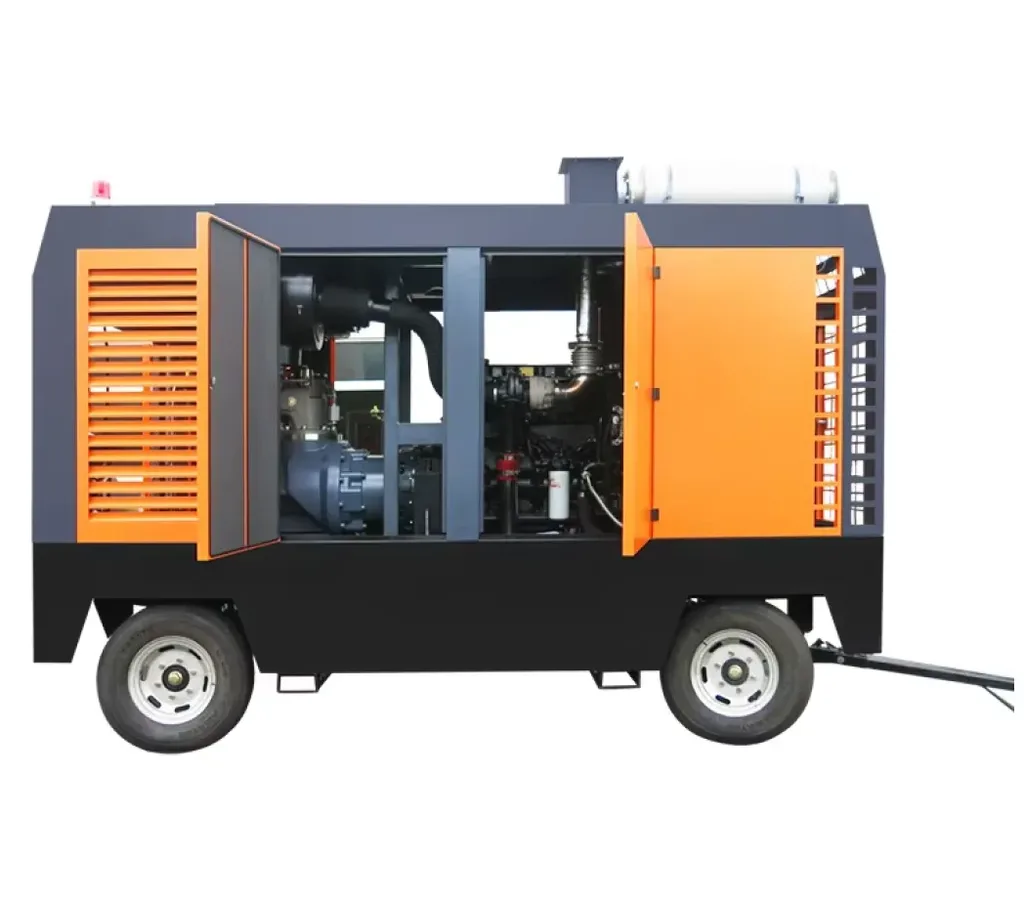
- Oil analysis supports maintenance decisions but cannot predict every airend failure. A compressor such as the Peakroc® 20 m³/min, 13 bar portable diesel screw compressor can be considered for a condition-monitoring program appropriate to its duty and service requirements. The actual sampling method and limits must follow the equipment and lubricant manufacturers.
Rotary screw compressor oil performs several important functions: it lubricates bearings, removes heat, helps seal compression clearances and protects internal surfaces from corrosion and wear.
Over time, the oil can deteriorate through oxidation, become contaminated with water or particles, or accumulate debris generated by lubricated components. These changes may occur before obvious symptoms such as abnormal temperature, mechanical noise or declining compressor performance.
Routine oil changes reduce the risk, but changing lubricant at fixed intervals provides limited information about what happened inside the machine between services.
Oil analysis adds a condition-based perspective by measuring lubricant properties, contamination and wear-related indicators.
For maintenance managers, the challenge is not simply obtaining a laboratory report. It is understanding which changes are significant, what they suggest and when further inspection is justified.
This guide explains the main oil-analysis tests used for oil-injected rotary screw compressors, how to obtain representative samples and how to interpret results without assuming that every abnormal value proves airend damage.
Why Oil Analysis Matters for Rotary Screw Compressors
In an oil-injected screw compressor, lubricant circulates through a system that may include a separator vessel, oil cooler, thermostat, filters and the compression element.
Oil exposed to compression temperatures and repeated circulation must maintain suitable viscosity, oxidation resistance and lubricating properties.
If the oil becomes contaminated or its properties deteriorate, the protective film between moving surfaces may be compromised. Water and abrasive particles can contribute to corrosion and wear, while oxidation products may create deposits and interfere with lubrication.
Oil analysis provides three broad categories of information: fluid condition, contamination and machine wear.
These categories should be assessed together. A lubricant can have acceptable viscosity while containing excessive particles. Conversely, a high TAN result may indicate chemical deterioration without providing evidence that a bearing has failed.
Portable diesel compressors require another important distinction: the diesel engine oil and compressor airend lubricant are separate fluids in their respective systems. They may require different oil grades, laboratory test packages and maintenance limits.
A sample of engine oil cannot be treated as an analysis of the compressor airend.
Five Laboratory Tests to Request
- Viscosity: Measure kinematic viscosity, commonly at 40°C, and compare it with new oil and the specified grade.
- Total Acid Number: Measure TAN, typically reported in mg KOH/g, to assess changes in oil acidity.
- Wear Metals: Analyze elements such as iron, copper, aluminum and chromium for changes associated with contamination or component wear.
- Water Content: Use an appropriate quantitative method, such as Karl Fischer testing, when moisture contamination must be assessed.
- Particle Count: Evaluate solid contamination using a suitable method and, where appropriate, report an ISO 4406 cleanliness code.
Additional tests for oxidation, additive condition, varnish potential or abnormal debris may be justified by the lubricant chemistry and operating history.
The laboratory test package should be agreed upon before sampling so that results remain comparable over time.
Viscosity and TAN: Detecting Lubricant Deterioration
Viscosity describes a lubricant’s resistance to flow under defined conditions. It influences the formation of a protective oil film, circulation through the lubrication system and heat removal.
If viscosity becomes too low for the operating conditions, the lubricant may not provide adequate film thickness. Excessively high viscosity may increase circulation resistance or interfere with lubrication, particularly during cold starting.
A viscosity change can result from oxidation, contamination, mixing incompatible fluids or other chemical and physical changes.
The result should therefore be compared with the actual new-oil baseline rather than interpreted from the ISO viscosity grade alone.
Understanding Total Acid Number
Total Acid Number measures the quantity of base required to neutralize acidic constituents in the lubricant under the specified test method.
It is commonly expressed as mg KOH/g.
Oxidation and lubricant degradation can increase TAN, but different additive packages and base-oil chemistries produce different initial values and aging patterns.
A TAN result of 1.0 mg KOH/g may be acceptable for one lubricant yet concerning for another, depending on its original condition and manufacturer’s specifications.
An increase in TAN may justify closer review of operating temperature, oxidation, oil life and contamination.
However, there is no universal TAN replacement limit applicable to every rotary screw compressor lubricant.
TAN is also not the same as the oil’s pH. Treating the two measurements as interchangeable can lead to incorrect maintenance decisions.
Five Checks When Viscosity or TAN Changes
- Compare results with an unused sample of the same approved lubricant.
- Confirm whether oil was added, mixed or replaced between tests.
- Review operating temperature, overheating events and duty cycle.
- Check oxidation indicators and other laboratory findings for supporting evidence.
- Consult lubricant-specific limits before deciding on retesting, investigation or an oil change.
For example, rising TAN combined with increasing viscosity and oxidation indicators provides a stronger reason to investigate lubricant aging than an isolated TAN reading without a reliable baseline.
Wear Metals: What Can Oil Analysis Reveal About Airend Health?
Metal concentrations provide indirect information about wear occurring within the lubricated system.
Laboratories commonly report elemental concentrations in parts per million (ppm). Iron may come from ferrous components; copper, aluminum, chromium and other elements may be associated with particular materials or contamination sources.
However, identifying a metal does not automatically identify the component producing it.
A rising iron concentration could be associated with bearings, rotating components, gears or another oil-contacting surface. The actual source depends on machine design and the components connected to the sampled oil circuit.
The most useful evidence is often a repeatable increase from the machine’s established baseline, particularly when supported by abnormal particle characteristics or mechanical symptoms.
Why Metal Particle Size Matters
Elemental spectroscopy can detect dissolved metals and many small wear particles, but common methods may underrepresent larger debris.
As a result, severe component wear can sometimes produce large metal fragments while a routine elemental result remains unexpectedly low.
For suspected abnormal wear, supplementary tests such as analytical ferrography, ferrous debris measurements or filter-debris examination may provide information not captured by standard elemental analysis.
These methods can help distinguish ordinary small wear particles from larger fatigue, cutting or sliding-wear debris.
They still require careful interpretation and do not independently establish the remaining life of a bearing.
Five Wear-Metal Interpretation Checks
- Compare current element concentrations with historical samples from the same machine.
- Review the construction materials and components connected to the sampled oil circuit.
- Distinguish gradual changes from sudden increases after maintenance or contamination.
- Request particle morphology or filter-debris examination when large wear particles are suspected.
- Correlate oil findings with vibration, bearing temperature, mechanical noise and operating history.
A high metal concentration may justify urgent investigation, but an apparently normal result does not guarantee that the airend is free from internal damage.
Water Contamination, Particle Count and ISO 4406
Water can enter compressor lubricant through condensation, contaminated storage containers, unsuitable handling practices or other system-specific leakage paths.
Repeated short operating cycles, humid conditions and changes in temperature may increase condensation risk in some installations.
Water can reduce lubrication reliability, promote corrosion and contribute to additive degradation or sludge formation.
Visible cloudiness may suggest substantial moisture, but visual inspection cannot reliably quantify low water concentrations.
When moisture is a concern, laboratory testing provides more useful information.
A quantitative result should be interpreted according to the lubricant’s chemistry and the manufacturer’s permitted limits. Water behavior differs between mineral oils and various synthetic lubricants.
Understanding Particle Count
Solid particles may originate from external dust, contaminated From Laboratory Results to Maintenance Decisionsnew oil, maintenance activities, deteriorating components or internally generated wear.
Particle counting helps describe the cleanliness of the circulating lubricant.
An ISO 4406 code typically contains three numbers corresponding to particle concentrations at sizes of 4 µm(c), 6 µm(c) and 14 µm(c).
For example, a reported code of 18/16/13 describes three particle concentration bands. It does not establish that the lubricant is suitable for every screw compressor.
Likewise, a rise to a much higher code can indicate a significant increase in contamination, but the reason must still be investigated.
The acceptable cleanliness target depends on equipment design, lubrication-system sensitivity and the approved maintenance requirements.
Particle counts can also be affected by certain fluid conditions, sample handling and test methods. An unexpected result should be checked for analytical or sampling interference before major maintenance decisions are made.
How to Take Representative Compressor Oil Samples
Even an accurate laboratory cannot compensate for a sample that does not represent the oil circulating through the components being evaluated.
Sampling location is particularly important.
A sample taken downstream of a filter may contain fewer wear particles than the oil arriving from a deteriorating bearing. Similarly, a sample collected from a dirty drain container can exaggerate contamination.
For a circulating system, the chosen point should represent the intended monitored circuit and follow the manufacturer’s sampling procedure.
Do not open pressurized oil lines, loosen fittings or remove components from a running compressor to obtain a sample. Use only approved sampling ports and procedures, with appropriate isolation, cooling and depressurization where required.
Five Practices for Reliable Oil Sampling
- Use a consistent approved sampling point: Keep the location the same between routine samples, unless a documented diagnostic investigation requires otherwise.
- Sample under comparable conditions: Record operating hours, lubricant temperature, loading state and the time since shutdown or service.
- Prevent external contamination: Use clean laboratory-approved containers and approved sampling equipment.
- Document maintenance history: Include lubricant type, top-ups, filter replacement, recent repairs and previous oil changes.
- Label and submit promptly: Record equipment identification, sample location, date and operating hours, then follow the laboratory’s handling instructions.
For new monitoring programs, retain or analyze a fresh-oil reference sample of the exact lubricant being used.
This provides a starting point for assessing viscosity, TAN, additives and contamination.
A single sample may identify an obvious problem, but several properly collected samples are generally more useful for establishing a reliable trend.
Interpreting Oil Analysis Results and Maintenance Actions
Oil-analysis reports should not be reduced to a simple green, yellow or red judgment without considering the machine and lubricant.
One result may show that the lubricant is chemically deteriorating. Another may indicate external contamination. A third may suggest abnormal mechanical wear.
Different findings require different actions.
| Oil Analysis Finding | Possible Explanation | Recommended Verification | Maintenance Direction |
|---|---|---|---|
| Viscosity increases | Oxidation, mixing or contamination | Compare with new oil and oxidation data | Investigate lubricant degradation |
| Viscosity decreases | Fluid mixing, chemical change or unsuitable lubricant | Verify lubricant identity and service history | Correct source; assess oil replacement |
| TAN rises significantly | Oil aging or chemical deterioration | Review baseline, temperature and oxidation | Evaluate lubricant condition and oil-change timing |
| Iron or copper increases | Component wear or external contamination | Trend metals, inspect debris and review vibration | Investigate lubricated components |
| Water content increases | Condensation, handling contamination or leakage | Repeat quantitative water test; inspect source | Correct moisture source and evaluate oil |
| Particle count rises | Dust, internal wear, contamination or sampling error | Confirm sampling and inspect filters | Improve cleanliness; investigate wear |
| Large metallic debris appears | Potential abnormal mechanical wear | Examine debris and mechanical condition | Prioritize qualified inspection |
No single row constitutes a definitive fault diagnosis.
An especially concerning pattern is the simultaneous appearance of abnormal metallic debris, rising vibration and unusual bearing noise. Such findings may justify immediate removal from service, depending on severity and manufacturer requirements.
By contrast, a modest change in one chemical indicator may justify a repeat sample and closer monitoring rather than immediate compressor disassembly.
Technical Field References
The following published cases illustrate what oil analysis can contribute to compressor maintenance and where its limitations become important.
They are external industrial references, not Peakroc® customer projects. The results reflect particular machines, fluids and monitoring arrangements.
Field Reference 1: Particle Contamination Before Bearing Failure
A 2019 engineering study documented condition monitoring on a 300 HP oil-flooded screw compressor in an industrial instrument-air application.
Oil particle counts rose sharply after approximately 70 days of operation, reaching an ISO 4406 cleanliness code of 27/26/22. The lubricant was replaced after 96 days.
A later increase in particle count was observed, while overall vibration measurements began rising more noticeably after approximately 148 days.
The compressor ultimately failed after 192 days, with damage confirmed in a non-drive-end bearing.
The investigation identified an operating-condition problem associated with process-valve positioning as the root cause.
Engineering lesson: Oil contamination trends can provide warnings before conventional overall-vibration measurements show a substantial change.
This study involved one industrial screw compressor. It does not establish that oil analysis will always detect bearing problems earlier than vibration monitoring.
Field Reference 2: Oil Analysis Supporting a Longer Drain Interval
A published industrial rotary screw compressor lubricant trial monitored oil condition over approximately two years.
The previous lubricant had been changed at 6,000-hour intervals. During the trial, periodic analysis showed relatively stable viscosity, low oxidation indicators, low TAN and limited wear-metal concentrations.
The supplier reported extending the oil drain interval to approximately 14,000 hours under the trial conditions.
Engineering lesson: Oil analysis can help validate lubricant condition and support changes to maintenance intervals when the oil, compressor and operating conditions permit.
The reported results belong to a specific customer trial and lubricant formulation. They do not justify extending the oil-change interval of another compressor without manufacturer approval and suitable monitoring.
Field Reference 3: Bearing Failure Missed Because of Sampling Location
A laboratory published a 2020 case involving a critical industrial compressor that suffered unexpected bearing failure despite regular oil sampling.
Several routine samples reported low wear-metal concentrations and apparently acceptable oil condition.
After the failure, examination of oil from the filter housing and the filter itself revealed substantial metallic debris, including large fatigue-related particles.
The investigation found that previous routine samples had been collected downstream of the oil filter, where significant wear debris had already been removed.
Engineering lesson: A normal laboratory report can be misleading when the sampling location prevents the relevant debris from reaching the sample.
This case demonstrates a sampling limitation, not proof that routine oil analysis is ineffective. The optimal sampling location must be selected according to the actual lubrication circuit.
From Laboratory Results to Maintenance Decisions
The practical value of oil analysis comes from deciding what to do next.
For a stable compressor with consistent viscosity, TAN, water and particle results, the maintenance team can continue the approved service program while monitoring trends.
When results begin to change, additional sampling or mechanical inspection may be justified.
A sudden increase in water content calls for investigating the moisture source. A rising particle count may require checking filtration, oil handling and potential internal wear.
Persistent abnormal wear-metal trends can justify vibration analysis, debris examination and component inspection.
The distinction between oil condition and machine condition remains essential. Changing contaminated oil may restore lubricant cleanliness, but it will not repair a damaged bearing or eliminate the source of contamination.
Five Maintenance Decisions Supported by Oil Analysis
- Continue monitoring: When results remain within approved limits and trends are stable.
- Repeat testing: When a result is inconsistent, unexpected or potentially affected by sampling conditions.
- Correct contamination: When water, particles or another contaminant is confirmed.
- Change lubricant: When the approved oil-life criteria or manufacturer requirements indicate replacement.
- Inspect mechanical components: When wear debris, vibration, temperature or operating symptoms suggest developing damage.
For portable diesel compressors used in dusty, hot or remote environments, oil-analysis results should be considered together with air-filter maintenance, cooler condition, operating hours and actual workload.
Where severe abnormal noise, overheating, substantial metallic debris or protective shutdowns occur, operators should follow immediate safety and shutdown requirements rather than waiting for another laboratory report.
Final Recommendation
Rotary screw compressor oil analysis is a useful condition-monitoring method when sampling and interpretation are performed correctly.
Viscosity and TAN help evaluate lubricant deterioration. Water and particle counts reveal contamination, while wear metals and debris examination can provide evidence of mechanical wear.
However, no single indicator can reliably determine airend health or predict the exact time to bearing failure.
The strongest maintenance decisions combine consistent oil sampling, laboratory trends, vibration measurements, operating temperature and equipment-specific service limits.
For equipment operators and fleet maintenance managers, the objective is to identify changes early, investigate their causes and avoid unnecessary repair or replacement.
A reliable oil-analysis program does not simply tell you when to change oil. It helps you understand whether the lubricant and the compressor are continuing to operate under healthy conditions.
FAQ
What does rotary screw compressor oil analysis test?
A typical test package evaluates viscosity, TAN, water, wear metals and particle contamination. Additional oxidation, additive or debris tests may be appropriate for specific lubricants or suspected faults.
Can oil analysis detect compressor airend bearing wear?
It can reveal abnormal metal particles or contamination associated with wear, but it cannot confirm every bearing fault. Vibration analysis, operating measurements and mechanical inspection may also be required.
What does high TAN mean in compressor oil?
A rising TAN may indicate lubricant oxidation or chemical deterioration. Its significance depends on the new-oil baseline, formulation and manufacturer limits; there is no universal replacement threshold.
What does high iron content in compressor oil indicate?
Increased iron may indicate wear involving ferrous components or contamination. The source cannot be confirmed from elemental concentration alone; trend analysis and debris examination may be needed.
How much water is acceptable in screw compressor oil?
The acceptable amount depends on lubricant chemistry, equipment design and manufacturer requirements. Use quantitative testing and approved limits rather than applying one universal water-content threshold.
What does ISO 4406 mean in an oil-analysis report?
ISO 4406 expresses particle contamination using coded concentration ranges, commonly at 4, 6 and 14 µm(c). It describes cleanliness, not the identity of the contaminant or a universal pass/fail limit.
How often should rotary screw compressor oil be sampled?
Sampling frequency depends on equipment criticality, duty, operating conditions and manufacturer guidance. Establish a consistent baseline schedule, with additional samples after abnormal results or significant operating changes.
Can oil analysis extend compressor oil-change intervals?
It can support longer intervals in suitable conditions, but only when the lubricant, equipment requirements and monitoring results justify the change. Do not exceed mandatory service limits without manufacturer approval.
Author

Mark Chen – Senior Mechanical Engineer, Peakroc®
Mark Chen is a senior mechanical engineer at Peakroc®, specializing in compressed air systems and drilling equipment for mining and construction applications. With over 15 years of field experience, he has led multiple projects on optimizing air delivery efficiency, equipment durability, and energy consumption.