
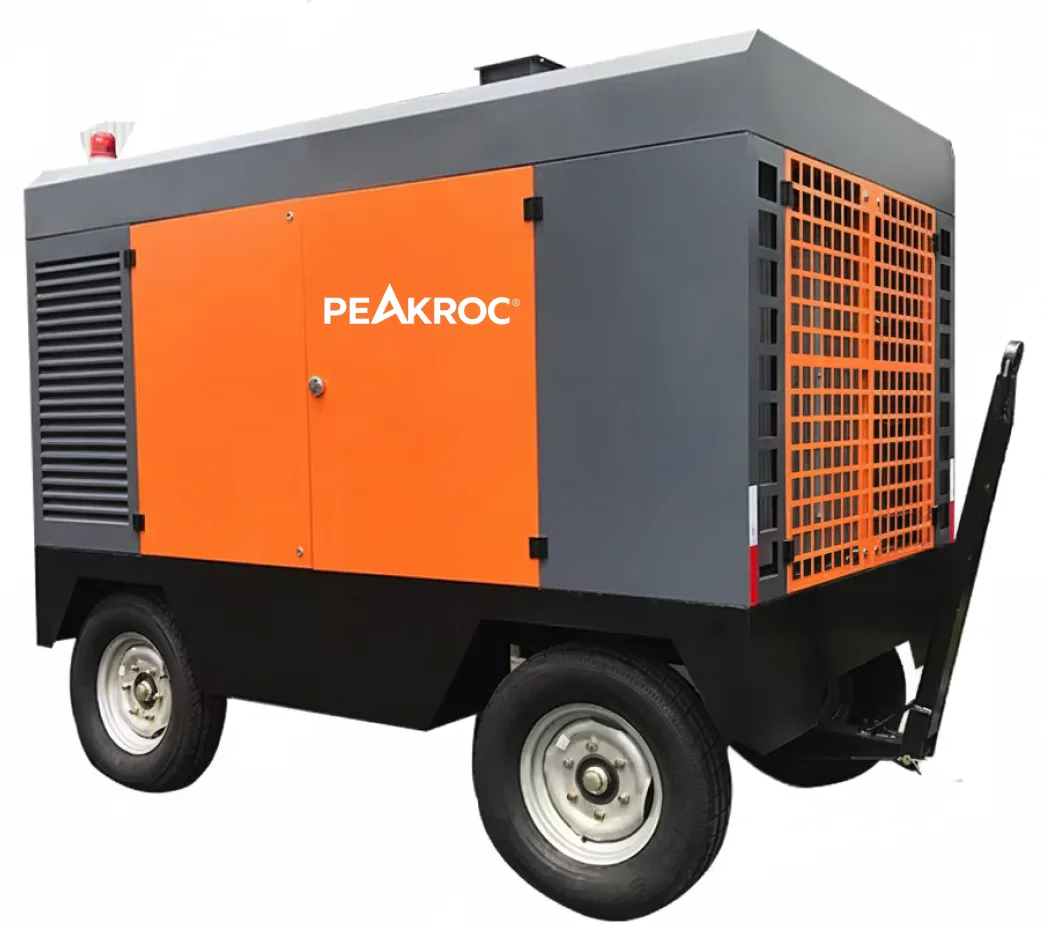
27 m³/min 12 bar Portable Diesel Air Compressor for Mining Industrial
12 bar · 27 m³/min · 264 kW · Cummins
VIEW MOREPeakroc®
Air Compressor
10 m³/min
8 bar
81 kW
Cummins
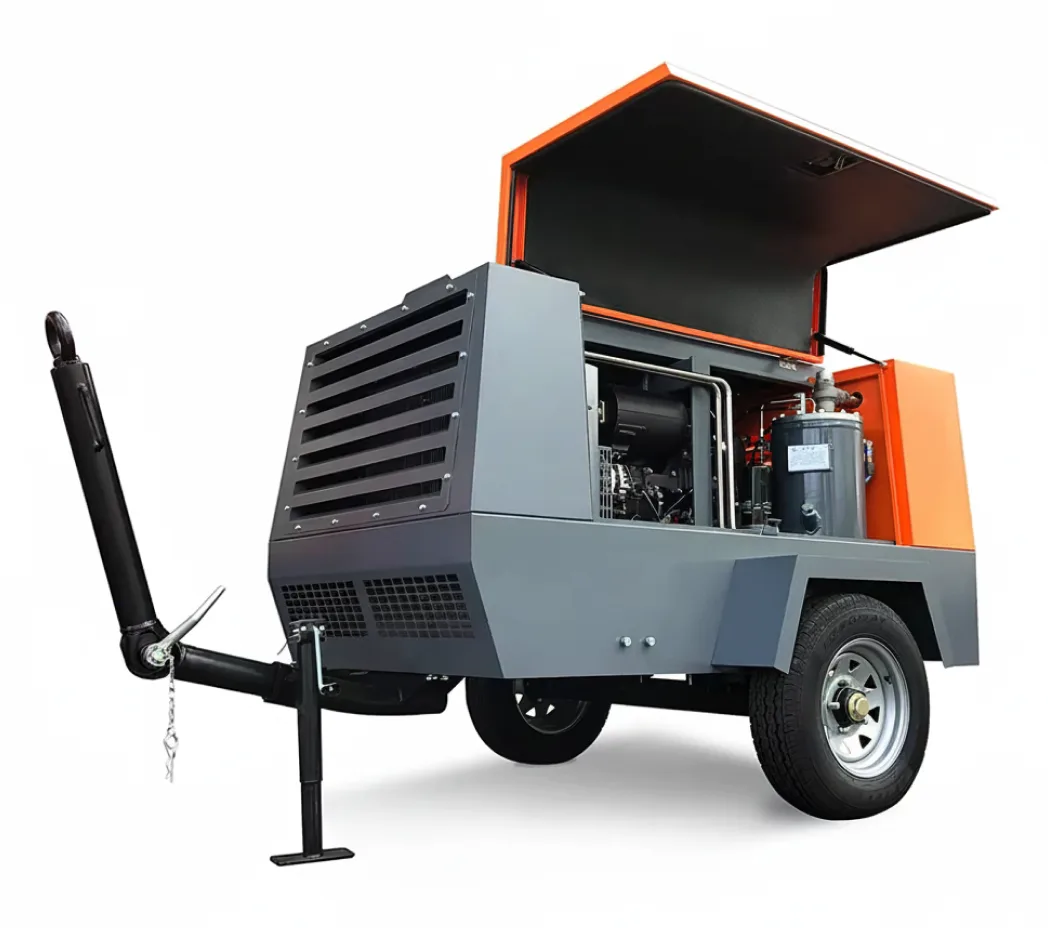
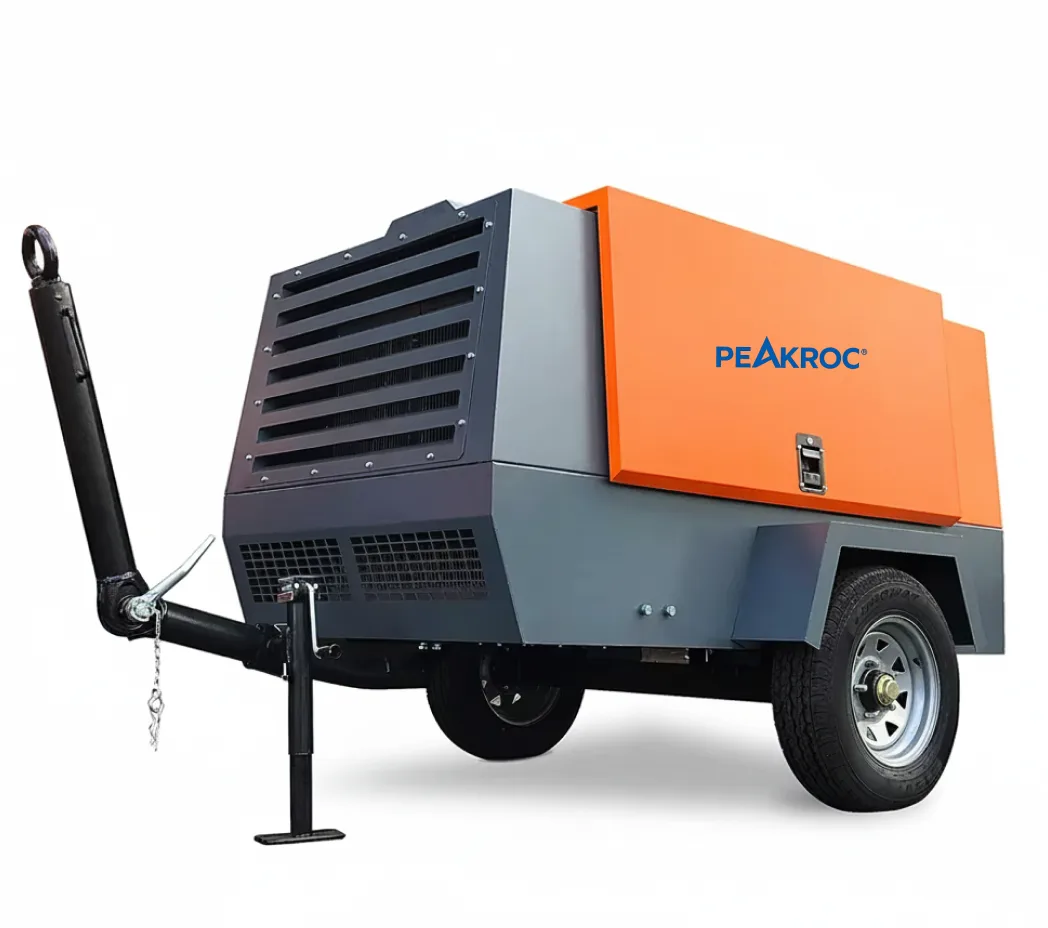
The Peakroc® PRMD-1008 is a versatile mid-capacity portable air compressor delivering 10 m³/min at 8 bar—engineered for construction sites, light industrial applications, and municipal maintenance where moderate airflow and standard pressure meet daily operational needs. This unit occupies the sweet spot between small 5 m³/min single-tool compressors and large 20+ m³/min multi-rig units, providing sufficient capacity for 2–4 pneumatic tools operating simultaneously without the fuel consumption and complexity of oversized equipment.
Why 10 m³/min at 8 bar Matters:
Core Applications:
Global Certifications:
✔ ISO9001 Quality Management System
✔ UKAS Quality Management Certification
✔ CE Marking (European Union Safety Compliance)
The Peakroc® PRMD-1008 (10 m³/min · 8 bar) is purpose-built for construction, maintenance, and light industrial applications where moderate airflow and standard pressure deliver optimal performance without wasting fuel on unnecessary high-pressure capacity:
The Peakroc® PRMD 10/8 model delivers a free air delivery of 10 m³/min at a working pressure of 8 bar (375cfm 116psi).. It is built for applications that require a stable air supply rather than high-pressure impact energy. Compared with smaller 5–7 m³/min units, this configuration offers higher flow for simultaneous tool operation, sandblasting, pipeline drying, or general site utility air.
Powered by an industrial diesel engine designed for continuous-duty operation.
The chassis uses a welded steel frame with vibration isolation mounts to minimise shock transfer during towing and operation.
The canopy is manufactured from 2 mm cold-rolled steel with internal flame-retardant acoustic lining for reduced sound emission and mechanical protection.
Fitted with a rotary screw air end with a precision-ground SAP rotor profile.
Rotors are made from alloy steel and supported by SKF bearings.
The system maintains a constant 8 bar discharge pressure with minimal flow drop under continuous load. Mechanical tolerances and low rotor clearance ensure efficiency and thermal stability.
Two-stage air filtration system removes fine dust to protect the air end in abrasive environments such as blasting yards and concrete worksites.
The lubricating oil circuit is filtered to maintain stable viscosity and extend internal component life.
Service points — oil filter, coolant system, separator tank — are positioned for direct access, reducing service time on-site.
Compare the 10 m³/min · 8 bar construction-focused model with other Peakroc compressors. This unit is optimized for fuel economy and standard-pressure applications—choose it when you need moderate airflow without paying for high-pressure capability you won’t use.
| Model | Air Delivery | Pressure | Engine Power | Fuel Consumption | Best For |
|---|---|---|---|---|---|
| PRMD-507 | 5 m³/min (185 cfm) |
7 bar (102 psi) |
45 kW (60 hp) |
5–8 L/h | Single tool (one breaker, one blaster). Most economical for light-duty work. |
| PRMD-1008 (Current Model) |
10 m³/min (375 cfm) |
8 bar (116 psi) |
81 kW (110 hp) |
10–15 L/h | 2–4 pneumatic tools, single sandblast nozzle. Sweet spot for construction contractors. |
| PRMD-2013 | 20 m³/min (710 cfm) |
13 bar (189 psi) |
194 kW (260 hp) |
18–22 L/h | Drilling rigs, mining operations. Pressure-priority, not construction-focused. |
| PRMD-2710 | 27 m³/min (954 cfm) |
10 bar (145 psi) |
239 kW (320 hp) |
24–30 L/h | Multiple blast nozzles, large crews. Volume-priority for heavy industrial. |
Choose smaller models (5 m³/min) if:
Choose PRMD-1008 (10 m³/min) if:
Choose larger models (20–27 m³/min) if:
Don’t choose PRMD-1008 if:
Fuel Economy Comparison: The PRMD-1008 consumes 10–15 L/hour—approximately 40% less than the PRMD-2013 (18–22 L/h) when both are doing the same construction work. If you’re not drilling wells or operating in mining environments, the 8 bar model delivers identical performance for pneumatic tools and sandblasting while saving $3,000–5,000 annually in fuel costs (based on 2,000 operating hours/year).
| Location: | Interstate 405 Widening Project, Los Angeles, California |
| Client: | Regional construction contractor (Caltrans subcontractor) |
| Application: | Concrete and asphalt pavement removal, shoulder widening |
| Equipment Deployed: | 3 units PRMD-1008 replacing 5 smaller compressors |
| Tools Supported: | Pneumatic breakers (90 lb class), pavement saws, tampers |
| Project Duration: | 6 months (March–August 2024, night shifts only) |
The contractor needed to demolish 4.2 km of existing concrete shoulder and median barriers during overnight road closures (11 PM–5 AM, 6-hour windows). Three demolition crews worked simultaneously across different sections to maximize productivity within tight closure windows. Their previous setup: five 5 m³/min compressors distributed among crews—one compressor per pneumatic breaker.
Problems with the old setup:
Peakroc supplied three PRMD-1008 units—one compressor per crew. Each crew operated 2–3 pneumatic tools simultaneously from a single centralized air source.
Key specifications:
“We used to think we needed one compressor per breaker. The PRMD-1008 changed that thinking—one unit per crew handles everything. Each crew runs two breakers continuously and we still have reserve capacity for a tamper or saw when needed.”
“The fuel savings were significant, but the real win was simplicity. Three compressors instead of five means less to transport, less to fuel, less to maintain. On a tight-schedule highway project where every minute of road closure counts, that operational simplicity translated directly into more pavement removed per shift.”
— Project Superintendent, Interstate 405 Widening
The PRMD-1008 proved ideal for multi-crew construction operations requiring moderate airflow without the fuel waste of oversized drilling compressors. The 10 m³/min capacity hits the sweet spot for 2–3 simultaneous pneumatic tools—enough to keep crews productive without paying for unused high-pressure capability. Contractor has standardized on PRMD-1008 for all future pavement removal and urban construction projects.
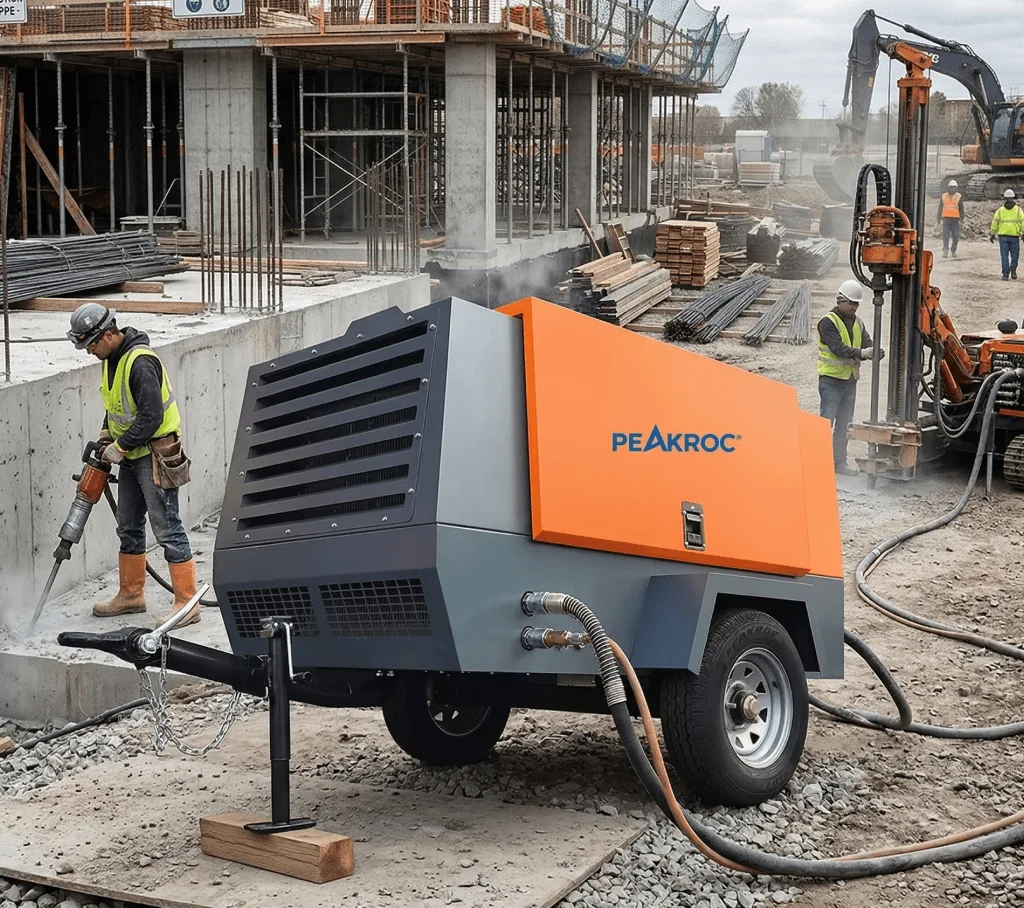
A practical decision table for 10 m³/min · 8 bar construction-focused compressors. This is the fuel-efficient choice for moderate airflow applications—select it when you need multi-tool capacity without paying for high-pressure drilling capability you won’t use.
| Job Type | Typical Requirement | PRMD-1008 Suitability |
|---|---|---|
| Construction site pneumatic tools (2–4 tools) | Breakers, impact wrenches, tampers, grinders operating simultaneously—each tool draws 2.5–3.0 m³/min at 6–8 bar | Excellent fit – 10 m³/min supports 3–4 tools with reserve capacity; 40% less fuel than 13 bar drilling units doing the same work |
| Single-nozzle sandblasting (6–10 mm nozzles) | Rust removal, paint stripping, surface preparation for bridges, tanks, structural steel | Excellent fit – 8 bar delivers consistent abrasive velocity; provides 40–60% longer runtime per fuel tank versus oversized 13 bar units |
| Pipeline purging & drying (DN100–DN400) | Water, gas, sewage line commissioning; construction debris removal; low-pressure leak testing | Excellent fit – 10 m³/min high volume rapidly purges medium-diameter pipelines; 8 bar sufficient for municipal test pressure requirements |
| Building renovation & interior demolition | Wall removal, floor chipping, concrete breaking in confined spaces; requires compact mobile unit | Excellent fit – 1,800 kg two-wheel design accesses tight urban sites; 160L tank = 10–12 hours indoor work without refueling |
| Municipal road maintenance | Asphalt cutting, patching, utility trench work; frequent moves between job sites | Good fit – Easily towed by pickup trucks; sufficient for 2–3 crew members with standard pneumatic tools |
| Light fabrication shops | Pneumatic grinders, impact tools, air-powered sanders in metal shops and welding facilities | Good fit – Continuous-duty rating and industrial filtration suitable for workshop environments; 8 bar matches most hand tool ratings |
| Single small tool only (one breaker, one blaster) | Minimal airflow demand, budget-conscious operations | Over-specified – Use 5 m³/min model for 50% fuel savings |
| Well drilling, mining, deep boreholes | DTH hammers, blast hole drilling requiring 12–25 bar sustained pressure | Wrong choice – 8 bar insufficient. Use 13 bar or 25 bar models |
Economic Rule: The PRMD-1008 saves approximately 40% in fuel costs versus 13 bar drilling compressors when used for construction work (10–15 L/hour vs 18–22 L/hour). Over 2,000 operating hours per year, this represents $3,000–5,000 in fuel savings. Only choose high-pressure models if your application genuinely requires drilling capability—for standard construction tools and sandblasting, 8 bar delivers identical performance at significantly lower operating cost.
| Model: PRMD-1008 | |
|---|---|
| Free air delivery | 10.00 m³/min (375 cfm) |
| Working pressure | 8 bar (116 psi) |
| Max. design pressure | 8 bar (116 psi) |
| Dimensions (L × W × H) | 3240 × 1880 × 2100 mm |
| Weight | 1800 kg |
| Wheel quantity | 2 |
| Outlet valve size | G 3/4″ × 1 + G 1-1/2″ × 1 |
| Diesel Engine | |
| Engine brand | Cummins |
| Engine model | QSB3.9-C110-31 |
| Rated power | 81 kW (110 hp) |
| Bore × stroke × cylinders | 102 × 120 mm × 4 |
| Engine type | Turbocharged |
| Engine speed (rated) | 2500 RPM |
| Engine speed (unloaded) | 1700 RPM |
| Engine oil capacity | 11 L |
| Coolant capacity | 28 L |
| Battery capacity | 720 CCA |
| Fuel tank capacity | 160 L |
| Compressor System | |
| Compressed air vessel capacity | 90 L |
| Lubricant capacity | 40 L |
The PRMD-1008 typically supports 2–4 pneumatic tools operating simultaneously, depending on tool type and air consumption rates:
Common construction combinations that work well:
The 10 m³/min capacity provides sufficient reserve to handle intermittent peak demand when all tools activate simultaneously, preventing pressure drop that would reduce tool performance.
For construction applications, 8 bar is not only sufficient—it’s optimal. Here’s why:
Most construction tools are rated for 6–8 bar optimal operating pressure:
Using 13 bar for these tools wastes fuel without performance benefit:
Only choose 13+ bar models if you’re drilling wells or operating in mining environments. For road construction, building renovation, municipal maintenance, and general contractor work, the PRMD-1008’s 8 bar pressure delivers full tool performance at minimum operating cost.
The PRMD-1008 consumes 10–15 liters per hour at typical construction workloads (70–100% capacity). This represents significant savings versus drilling-oriented high-pressure models:
Fuel consumption comparison:
Annual cost savings example:
Assuming 2,000 operating hours per year at $1.20/liter diesel:
The 160-liter fuel tank provides approximately 10–12 hours of continuous operation at moderate load, sufficient for full-day construction shifts without refueling. This is particularly valuable for urban job sites with limited fuel delivery access or overnight highway projects with tight closure windows.
Yes, the PRMD-1008 is well-suited for single-nozzle sandblasting operations with 6–10 mm nozzles—the most common size range for general surface preparation work including:
Performance characteristics:
Not recommended for:
For typical contractor sandblasting—one operator removing rust from bridge steel, cleaning tank exteriors, or preparing concrete surfaces—the PRMD-1008 delivers professional results at the lowest fuel cost in its class.
The PRMD-1008 is designed for easy mobility on construction sites with the following specifications:
Physical dimensions and weight:
Towing compatibility:
Site mobility advantages:
This portability makes the PRMD-1008 ideal for contractors operating across multiple small-to-medium job sites rather than large fixed installations requiring stationary high-capacity units.
The PRMD-1008 follows a straightforward maintenance schedule designed for field serviceability by construction crews:
Daily checks (before each shift):
Every 50–100 hours (weekly for full-time use):
Every 250 hours (monthly maintenance):
Every 500 hours (major service):
Service accessibility: All maintenance points (oil filter, coolant fill, air filter, separator) are positioned for tool-free or basic-tool access through wide service doors on both sides of the enclosure. Routine maintenance can be performed on-site by trained operators without requiring factory technicians for normal intervals.
Cummins QSB3.9 engine parts are globally available through the Cummins service network in 190+ countries, ensuring minimal downtime for international projects or remote locations.
Models similar in brand/specs
12 bar · 27 m³/min · 264 kW · Cummins
VIEW MORE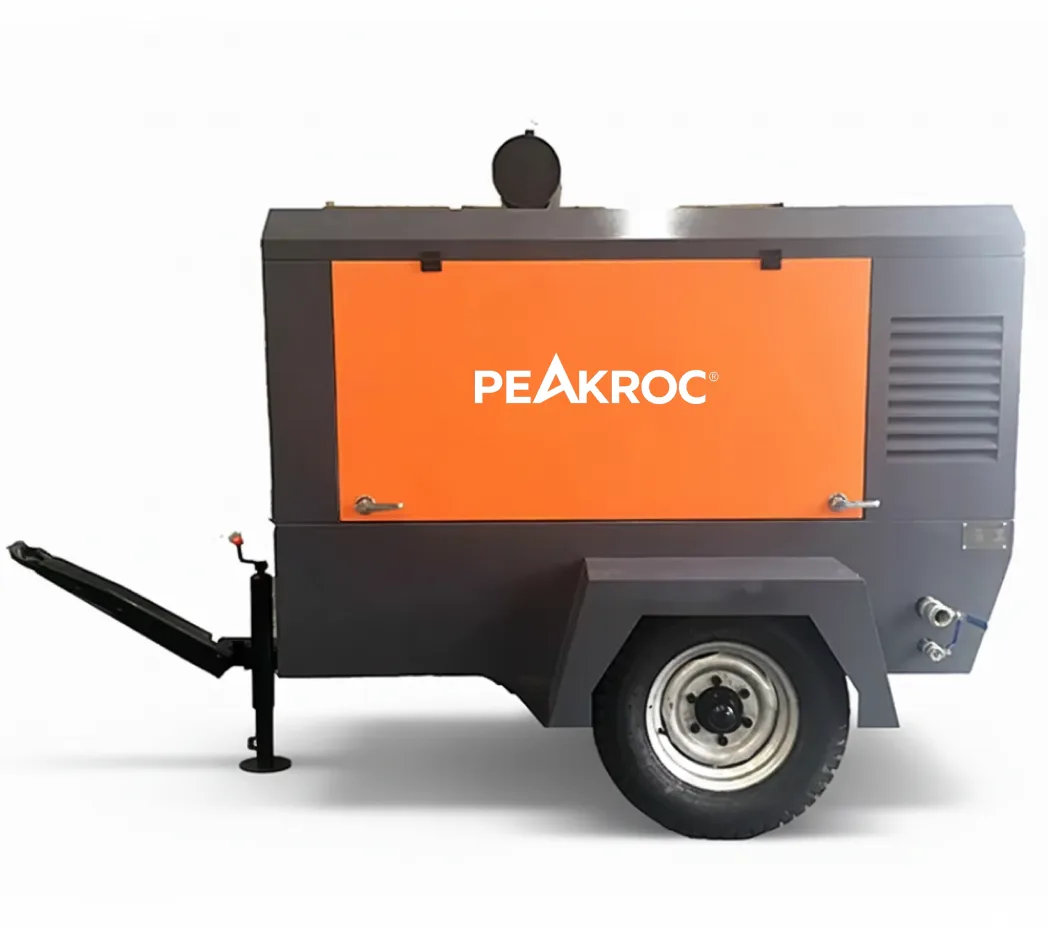
20 bar · 13 m³/min · 154 kW · Cummins
VIEW MORE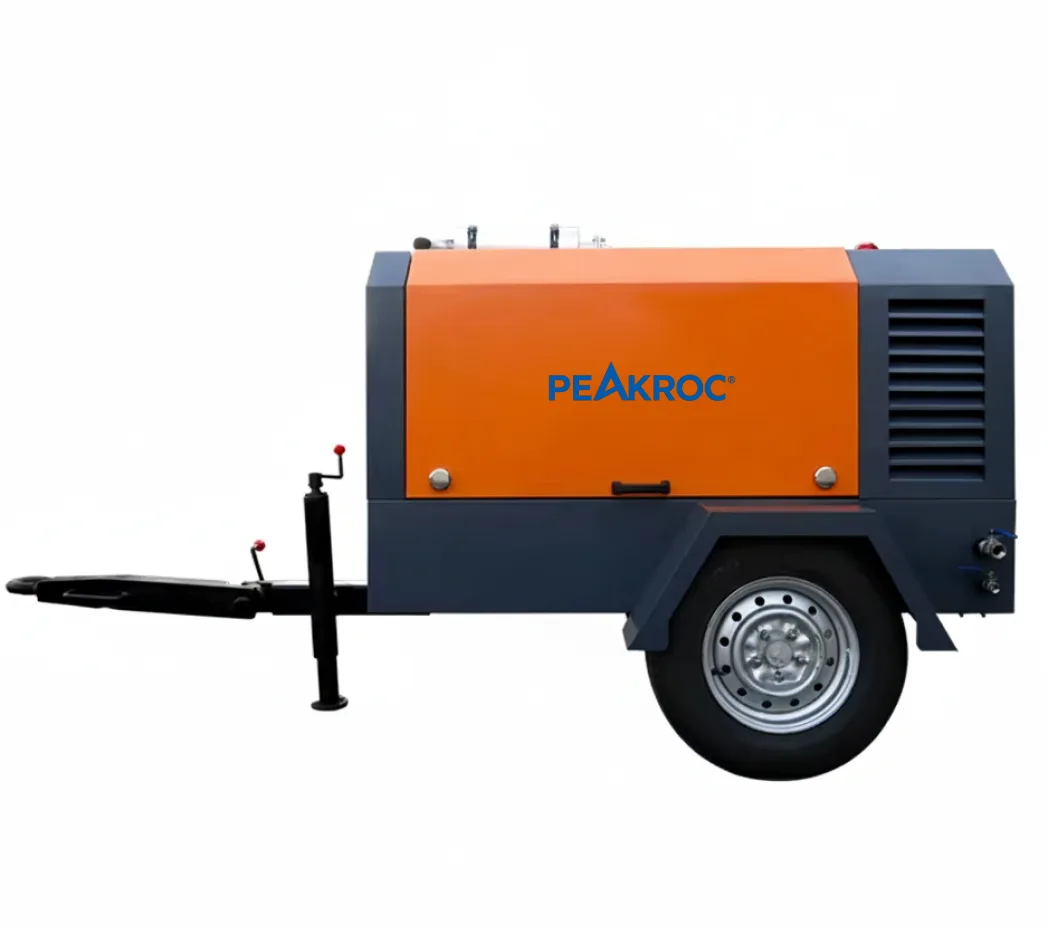
7 bar · 5 m³/min · 45 kW · Yanmar
VIEW MORE

