
Key Takeaways
A Variable Speed Drive (VSD) portable compressor uses an electronic drive to adjust motor speed according to real-time compressed-air demand. Instead of running continuously at one fixed speed and controlling output mainly through unloading or inlet modulation, the compressor slows down when demand falls and accelerates when more air is required.
For mobile projects with a reliable electrical supply, this design can reduce energy consumption, improve pressure stability, lower starting current, reduce noise, and simplify maintenance compared with a diesel-powered portable compressor.
However, VSD is not automatically the best choice for every site. The strongest business case usually exists when:
- Air demand changes significantly during the working cycle
- The compressor spends substantial time at partial load
- Grid power or a suitable generator is available
- Low noise and local emissions are important
- One machine must serve several pressure settings
Peakroc® supplies mobile air compressors for construction, mining, drilling, industrial, and infrastructure applications. Buyers can also review air compressor applications, learn about the benefits of smart compressor controls, or submit project requirements through the compressor selection service.
The correct model should be chosen according to airflow demand, working pressure, power availability, load profile, environmental conditions, mobility requirements, and total operating cost.
What Is a VSD Portable Compressor?
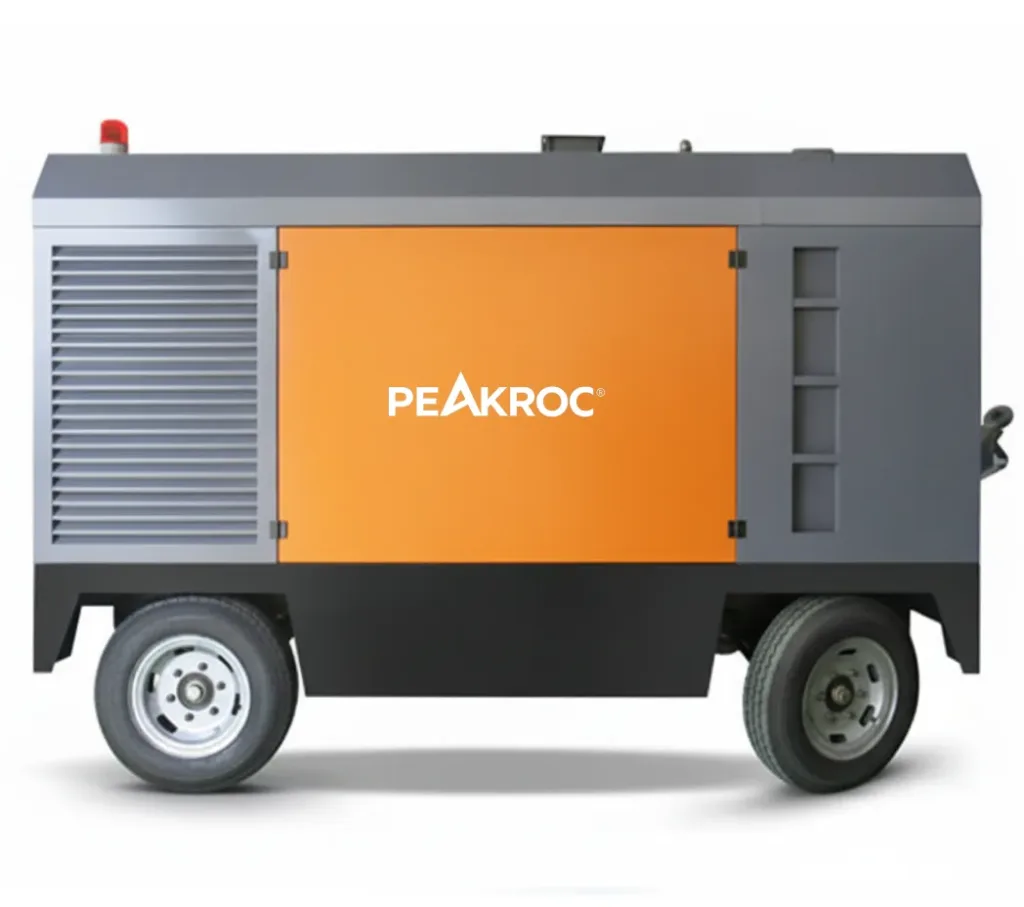
A VSD portable compressor is usually an electric-driven rotary screw compressor mounted on a wheeled chassis, skid, or transportable frame. Its motor is controlled by a variable frequency drive, also called a variable speed drive.
The drive changes the frequency and voltage supplied to the motor. This allows the compressor controller to increase or reduce motor speed in response to measured system pressure and air demand.
When demand drops, the motor slows down. When demand rises, the drive increases speed so the compressor can deliver more airflow. The controller continuously adjusts this balance to maintain the selected working pressure.
This is fundamentally different from a conventional fixed-speed electric compressor, which runs its motor at a constant speed and relies more heavily on loading, unloading, throttling, or stopping to control output.
It is also different from a diesel portable compressor. Many modern diesel compressors automatically adjust engine speed as air demand changes, but they do not normally use an electrical variable frequency drive to control the prime mover. The two systems may produce a similar practical result—reduced speed at lower load—but their power systems, controls, maintenance requirements, and efficiency characteristics are different.
How Does Variable Speed Drive Technology Improve Efficiency?
A compressor is normally selected to meet the highest expected air demand. In real applications, however, that maximum demand may occur only during a small part of the working day.
A fixed-speed machine must still run its motor at full rotational speed whenever it is loaded. When demand falls, it may partially close the inlet valve, unload the air end, or cycle between loaded and unloaded states. The motor continues consuming power even when useful air production is limited.
A VSD system responds differently. It reduces motor speed so that compressor output more closely follows actual demand.
Demand matching — The compressor produces only the airflow needed at that moment, reducing unnecessary unloaded operation.
Lower pressure band — Precise electronic control can maintain pressure within a narrower range, so the machine may not need to operate at an unnecessarily high pressure setpoint.
Soft starting — A VSD motor accelerates gradually rather than drawing a large direct-on-line starting current. This can reduce electrical stress and avoid the need to oversize transformers, generators, or cables solely for starting.
The energy-saving potential depends heavily on the duty cycle. A VSD compressor that regularly operates between moderate and low load may save significantly more energy than a machine that runs at full output for nearly every operating hour.
Is a VSD Portable Compressor Always More Efficient?
No. A VSD compressor is most efficient when air demand varies.
If a compressor operates continuously at or near full load, a well-sized fixed-speed machine may provide similar or even better lifecycle economics because it has a simpler drive system and a lower initial cost.
The drive, controller, permanent magnet motor, cooling components, and electrical protection add cost and technical complexity. These components deliver value only when the operating profile allows the compressor to reduce speed for a meaningful portion of the working time.
A professional selection process should therefore begin with the load profile, not with the assumption that VSD is always superior.
| Operating Pattern | Likely Best Direction | Reason |
|---|---|---|
| Highly variable demand | VSD compressor | Motor speed can follow changing airflow requirements |
| Long periods at partial load | VSD compressor | Reduces unloaded and inefficient operation |
| Nearly constant full-load demand | Fixed-speed may be suitable | Lower complexity with limited VSD saving opportunity |
| Frequent starting and stopping | VSD may be beneficial | Soft start reduces current peaks and mechanical stress |
| Remote site without electricity | Diesel portable compressor | Independent operation is more important than VSD |
| Urban or underground site with grid access | Electric VSD portable compressor | Low noise and no local diesel exhaust |
Where Are VSD Portable Compressors Commonly Used?
The strongest applications are those that combine mobility with access to stable electrical power.
Tunneling and Underground Construction
Underground projects must manage diesel exhaust, heat, and ventilation. An electric portable compressor eliminates engine exhaust at the point of use and produces less heat and noise than a comparable diesel unit.
VSD control adds another advantage because tool demand may change during drilling, scaling, shotcrete support, cleaning, and maintenance activities. The compressor can reduce output during lower-demand periods instead of continuing to consume energy at a fixed motor speed.
Lower starting current is also useful underground, where available electrical capacity may be limited and power infrastructure can be expensive to expand.
Urban Construction and Road Work
Noise restrictions are increasingly important near hospitals, residential areas, schools, and commercial districts.
Electric VSD compressors are well suited to sites where the compressor powers pneumatic tools intermittently. When a breaker, drill, or cleaning nozzle is not being used, the motor can slow down rather than remaining fully loaded.
The absence of a diesel engine also reduces local exhaust emissions and eliminates the need for fuel storage and refueling within the work zone.
Sandblasting and Surface Preparation
Sandblasting normally requires stable pressure and substantial airflow. The blasting demand may still vary when operators stop to inspect the surface, refill abrasive, reposition equipment, or change nozzle size.
A VSD compressor can reduce speed during these pauses and then respond as blasting resumes. Stable pressure helps maintain abrasive velocity and surface consistency.
For this application, buyers should consider not only compressor output but also the aftercooler, moisture separator, filters, receiver volume, and ambient humidity. A highly efficient compressor will not produce good blasting results if moisture causes abrasive flow problems.
Cable Blowing
Cable installation can require different combinations of pressure and airflow depending on duct diameter, route length, cable type, and friction.
A portable VSD compressor with electronic pressure control can serve several cable-blowing jobs without forcing the operator to use the same maximum pressure for every application.
Precise control is valuable because excessive pressure may not improve installation and can place unnecessary stress on the duct or cable. The ability to select pressure while allowing airflow to adjust accordingly improves machine utilization across different projects.
Industrial Maintenance and Temporary Plant Air
Factories sometimes require temporary compressed air during maintenance, expansion, shutdowns, or compressor-room repairs.
If the plant has sufficient electrical power, a VSD mobile compressor can provide temporary air without bringing diesel exhaust or fuel handling into the facility.
This application often has a variable demand profile because different maintenance teams connect and disconnect tools throughout the day. The VSD responds to these changes while maintaining network pressure.
For sensitive industrial processes, the temporary package may also require a dryer, filtration, oil-removal system, or oil-free compressor.
Mining and Quarry Support
Surface mines and quarries often favor diesel compressors because electrical infrastructure may not reach the work area. However, electric VSD mobile units can be attractive at semi-permanent crushing plants, workshops, underground mines, processing areas, or fixed drilling zones with grid access.
The choice depends on how frequently the machine moves. A compressor may be physically portable but still require a high-capacity electrical cable, transformer, and connection point. If it must move several times per shift, the electrical setup may reduce practical mobility.
What Pressure and Airflow Do You Need?
Pressure and airflow are separate selection variables.
Pressure is the force required to operate the application. Airflow is the volume of air needed to keep that pressure available while the tool or process is running.
A compressor can have sufficient pressure but insufficient airflow. In that case, pressure will fall as soon as the application begins consuming air.
The first step is to identify every tool or process that may operate simultaneously. Add their rated air consumption and then include a practical reserve for leakage, hose pressure loss, altitude, temperature, and future expansion.
For example, suppose a site uses:
- One pneumatic tool requiring 120 CFM
- One cleaning nozzle requiring 40 CFM
- A small control-air load requiring 20 CFM
The simultaneous base demand is 180 CFM. Depending on the project, a reserve of approximately 15–25% may be appropriate, giving a target capacity of roughly 207–225 CFM.
The required working pressure should be based on the pressure needed at the point of use, not only at the compressor outlet. Long hoses, small pipe diameters, filters, dryers, valves, and fittings all create pressure loss.
Why Turndown Range Matters
The turndown range describes how far a VSD compressor can reduce output while remaining stable and efficient.
A wide turndown range is useful when the difference between minimum and maximum demand is large. However, every compressor has a minimum stable speed.
When demand falls below that minimum, the compressor may unload, stop, or enter a low-demand operating mode. A large VSD machine serving a very small average load may therefore cycle frequently and lose much of its efficiency advantage.
This is why oversizing remains a problem even with VSD technology.
A good selection should place the expected operating demand inside the compressor’s efficient modulation range for most working hours. The maximum capacity should cover genuine peak demand, while the minimum capacity should be low enough to handle normal reduced-load operation without repeated cycling.
Permanent Magnet Motor or Induction Motor?
Modern VSD portable compressors may use either an induction motor or a permanent magnet motor.
| Motor Type | Main Characteristics | Selection Consideration |
|---|---|---|
| Induction motor | Mature technology, widely serviceable, robust | Practical where local motor-service capability is important |
| Permanent magnet motor | High efficiency, compact size, strong partial-load performance | Attractive where energy use and package size are priorities |
| Direct-drive PM motor | Fewer transmission losses and compact layout | Requires trained service support and compatible drive controls |
| Belt-driven induction motor | Familiar mechanical arrangement | Belt inspection and replacement may be required |
Permanent magnet motors avoid some rotor losses found in induction motors and can maintain strong efficiency over a broad speed range. They are often more compact, which is useful in portable equipment.
However, efficiency should be assessed at the package level. Motor efficiency alone does not guarantee low energy consumption if the air end, cooling system, control logic, pressure setting, or power electronics are poorly matched.
Check the Electrical Supply Before Choosing a Model
A VSD portable compressor depends on a suitable electrical source. This is one of the most important differences from a diesel unit.
Before selecting the compressor, confirm:
- Available voltage and frequency
- Three-phase power capacity
- Maximum continuous current
- Transformer or generator rating
- Cable length and conductor size
- Plug and socket standard
- Grounding and electrical protection
- Voltage stability at the site
Although VSD reduces starting current, the supply must still support full-load operation.
Long electrical cables create voltage drop. High ambient temperature can also reduce cable capacity. The compressor supplier should review the total electrical installation rather than checking only the motor’s nominal kilowatt rating.
When a generator will power the machine, the generator and VSD must be technically compatible. Harmonics, voltage regulation, grounding method, and transient response should be reviewed by the equipment suppliers.
Using a diesel generator to power an electric VSD compressor can still provide flexibility, but it may reduce the environmental and operating-cost advantages compared with direct grid power.
How Mobile Does the Compressor Need to Be?
“Portable” can mean different things.
A towable compressor is designed to move between job sites. A skid-mounted unit may be transported by truck or forklift. A wheeled electric unit may move easily within a factory or construction site but still depend on nearby power connections.
Consider how often the machine will move and how long setup can take.
Frequent relocation — Check chassis design, lifting points, towing approval, cable handling, plug type, ground clearance, and connection time.
Semi-permanent use — A skid-mounted VSD unit may be more economical when it remains in one project area for several months.
Indoor mobility — Compact dimensions, low noise, non-marking wheels, and ventilation become more important than highway towing capability.
Electrical cable management should be treated as part of the mobile package. A compressor may be compact, but an unsuitable cable arrangement can make relocation slow and unsafe.
Air Quality and Treatment Options
Portable compressor selection should include the required air quality.
A standard oil-injected screw compressor produces efficient general-purpose compressed air, but small amounts of oil aerosol, moisture, and particles may remain downstream.
Applications such as general pneumatic tools may tolerate untreated compressed air. Sandblasting often benefits from an aftercooler and water separator. Instrument air, painting, electronics, food processing, and sensitive industrial work may require dryers and finer filtration.
Typical options include an aftercooler, water separator, refrigerated dryer, desiccant dryer, coalescing filter, particulate filter, receiver, and condensate drain.
Air treatment creates pressure loss. The compressor must be sized so that the application still receives the required pressure after the air passes through all treatment components.
Environmental and Jobsite Conditions
Portable machines operate in conditions that can differ greatly from a controlled compressor room.
Temperature, dust, rain, altitude, humidity, salt exposure, and ventilation all affect performance and reliability.
For outdoor service, check the motor and electrical enclosure protection rating. A ruggedized motor may use sealed windings and enhanced protection against water and dust.
The VSD cabinet must also remain clean and cool. Power electronics are sensitive to overheating and contamination, so cooling design and filtration are critical.
At altitude, the thinner air affects compressor capacity and motor cooling. The supplier should confirm whether derating applies at the actual operating elevation.
For underground and indoor work, make sure heat from the compressor can be removed from the space even though there is no diesel exhaust.
VSD Portable Compressor vs. Diesel Portable Compressor
| Selection Factor | VSD Electric Portable Compressor | Diesel Portable Compressor |
|---|---|---|
| Energy source | Grid, transformer, or generator | Diesel fuel |
| Local exhaust emissions | None at the compressor | Engine exhaust present |
| Noise | Generally lower | Generally higher |
| Starting current | Controlled by VSD | Not applicable to electric supply |
| Mobility | Limited by electrical connection | Highly independent |
| Partial-load efficiency | Strong when correctly sized | Depends on engine and control system |
| Routine maintenance | No diesel engine service | Engine oil, fuel, filters, and emissions system |
| Remote-site suitability | Limited without power infrastructure | Excellent |
| Best application | Grid-connected, variable-demand work | Remote or frequently moving work |
The correct decision is not simply electric versus diesel. It is a comparison of the entire project cost, including energy, fuel logistics, maintenance, ventilation, noise control, electrical infrastructure, utilization, and relocation frequency.
How to Estimate Total Cost of Ownership
Purchase price alone can be misleading. A VSD compressor often costs more initially than a basic fixed-speed electric model, but energy savings may offset the difference.
A total-cost calculation should include:
- Purchase and installation
- Electricity or fuel consumption
- Demand charges
- Service parts and labor
- Electrical infrastructure
- Cable or transformer cost
- Downtime risk
- Resale value
- Expected annual operating hours
The analysis should use the actual load profile rather than assuming the compressor always operates at full load.
For a site with highly variable demand and thousands of operating hours per year, electricity savings may justify a VSD investment quickly. For occasional use at constant full load, the payback may be much longer.
A logged air-demand study provides the best foundation. It shows minimum, average, and peak airflow over time and reveals how often the compressor would operate at reduced speed.
Common Selection Mistakes
The first common mistake is selecting capacity according to the largest possible future demand rather than realistic simultaneous demand. This can place normal operation below the efficient control range.
The second is focusing on maximum pressure while ignoring airflow at that pressure. Portable compressors commonly deliver less airflow as the selected pressure increases.
The third is assuming that available electrical power is adequate without checking voltage drop, cable size, transformer capacity, or generator compatibility.
Another mistake is comparing only rated motor power. Two compressors with the same motor kilowatt rating may have different free air delivery, pressure range, control efficiency, cooling capacity, and service requirements.
Finally, some buyers assume that VSD eliminates the need for storage. A correctly sized air receiver can still stabilize rapid demand changes and reduce unnecessary speed fluctuations.
Practical Selection Checklist
Before requesting a quotation, prepare three groups of information:
- Air requirement: minimum, average, and peak airflow; required pressure; simultaneous tools; duty cycle
- Site conditions: voltage, frequency, temperature, altitude, dust, indoor or outdoor use, and relocation frequency
- Configuration: towable or skid-mounted design, motor type, air treatment, outlets, cable length, telemetry, and local certification
This information allows the supplier to evaluate whether VSD is economically justified and which model will remain within its efficient operating range.
Peakroc® Selection Support
Peakroc® provides portable compressor solutions for construction, mining, tunneling, drilling, sandblasting, cable installation, industrial maintenance, and infrastructure projects.
For VSD portable compressor selection, Peakroc® can help evaluate the required airflow and pressure, demand variation, electrical supply, motor configuration, mobility, air treatment, environmental conditions, and expected annual operating hours.
Where direct grid power is unavailable, the team can also compare electric VSD, generator-powered, and diesel portable alternatives rather than forcing one technology into every project.
Final Recommendation
A VSD portable compressor is a strong choice when a site has reliable electrical power and compressed-air demand changes throughout the working cycle. Its principal advantages are reduced partial-load energy consumption, stable pressure, low starting current, lower noise, and reduced diesel-engine maintenance.
The best model is not necessarily the unit with the highest pressure or largest motor. It is the compressor whose efficient operating range matches the project’s real minimum, average, and peak demand.
Peakroc® can help customers select a suitable VSD portable compressor based on airflow, pressure, power supply, load profile, mobility, air quality, and site conditions. Contact Peakroc® with your technical requirements for a practical model recommendation.
FAQ
1. What is a VSD portable compressor?
A VSD portable compressor is a transportable electric screw compressor whose motor speed is adjusted electronically according to real-time compressed-air demand.
2. When does a VSD compressor save the most energy?
It normally delivers the greatest savings when demand changes frequently and the compressor spends substantial time below full load.
3. Is a diesel compressor with automatic engine-speed control a VSD compressor?
Not in the usual technical sense. A true VSD compressor uses an electronic variable frequency drive to control an electric motor. Diesel compressors may vary engine speed through their own governing and compressor-control systems.
4. Can a VSD portable compressor run from a generator?
Yes, provided the generator, variable speed drive, grounding, voltage regulation, harmonics, cable, and protection system are compatible. The compressor and generator suppliers should confirm the combination.
5. Is a VSD compressor suitable for continuous full-load operation?
It can operate at full load, but if demand remains nearly constant, a fixed-speed compressor may offer similar performance with a lower initial cost. A load-profile study should guide the decision.
6. What information is needed to size a VSD portable compressor?
The supplier needs the required pressure, minimum and maximum airflow, simultaneous tools, daily operating hours, available electrical supply, ambient temperature, altitude, mobility requirements, and air-treatment needs.
7. Does a VSD portable compressor need an air receiver?
An air receiver is still useful in many systems. It helps manage sudden demand changes, stabilize pressure, and reduce rapid motor-speed fluctuations.
8. Does Peakroc® supply VSD portable compressor solutions?
Yes. Peakroc® can help customers evaluate and source portable compressor solutions according to their application, electrical supply, pressure, airflow, environmental conditions, and mobility requirements.
Author

Mark Chen – Senior Mechanical Engineer, Peakroc®
Mark Chen is a senior mechanical engineer at Peakroc®, specializing in compressed air systems and drilling equipment for mining and construction applications. With over 15 years of field experience, he has led multiple projects on optimizing air delivery efficiency, equipment durability, and energy consumption.