
Key Takeaways
- Smart controls in industrial air compressors — including variable speed drive (VSD), permanent magnet motors, IoT-based remote monitoring, and centralized sequencing systems — reduce energy consumption by 15–60% compared with traditional fixed-speed, load/unload operation.
- Energy typically accounts for over 70% of an air compressor’s total lifecycle cost. Smart controls attack the largest cost driver directly, making them the highest-ROI upgrade available in most compressed air systems.
- Permanent magnet VSD (PM VSD) screw compressors combine rare-earth permanent magnet motors (5–10% more efficient than standard induction motors) with variable frequency drives that match motor speed to real-time air demand — eliminating the massive energy waste of idle running and unloaded operation.
- Real-world case studies show measurable results: a glass ceramics manufacturer saved approximately $39,000 per year through centralized compressor sequencing; a South American bearing manufacturer reduced energy consumption by 18% and cut 263 tons of CO₂ equivalent annually through predictive maintenance and smart monitoring.
- The global PM VSD screw compressor market is valued at approximately $3.3 billion (2025) and growing at 4.3% CAGR through 2033 — driven by energy efficiency mandates, carbon reduction targets, and industrial automation expansion worldwide.
Why Traditional Compressor Controls Waste Energy
To understand why smart controls matter, you first need to understand what happens inside a traditional compressed air system — and how much energy it throws away.
A conventional fixed-speed rotary screw compressor runs at one speed. When the system reaches its target pressure, the compressor doesn’t stop — it “unloads.” The motor keeps spinning, the airend keeps turning, but the intake valve closes so no air is compressed. The machine is running, consuming electricity, producing nothing.
In load/unload operation, a fixed-speed compressor typically consumes 25–45% of its full-load power while unloaded. On a system with variable air demand — which describes virtually every factory, since demand fluctuates with production cycles, shift changes, and tool use patterns — the compressor spends a significant portion of its operating hours in this wasteful unloaded state.
Multiply that waste across an 8,000-hour operating year and a 75 kW motor, and the numbers become impossible to ignore. A compressor running unloaded 30% of the time at 35% power draw wastes roughly 63,000 kWh per year — enough electricity to power 15–20 average European homes.
This is the problem smart controls solve. Not by making the compressor itself more efficient at compressing air, but by eliminating the time the compressor spends doing nothing useful while consuming power.
Variable Speed Drive: The Foundation of Smart Compressor Control
Variable speed drive (VSD) technology is the single most impactful efficiency improvement in compressed air history. Introduced over two decades ago and refined continuously since, VSD allows the compressor motor to adjust its speed in real time based on actual air demand.
When demand is high, the motor runs fast. When demand drops, the motor slows down. The compressor produces exactly the air the system needs — no more, no less. There is no unloaded running, no wasted energy, and no pressure band cycling.
How much energy does VSD actually save?
The answer depends on the demand profile. The more variable the demand, the greater the savings:
| Demand Variability | Typical VSD Energy Savings vs. Fixed-Speed |
|---|---|
| Highly variable (40–100% load fluctuation) | 35–60% |
| Moderately variable (60–100% load fluctuation) | 20–35% |
| Relatively constant (80–100% load fluctuation) | 10–15% |
| Nearly constant (95–100% load) | Minimal — fixed-speed may be equivalent |
Most manufacturing facilities fall into the “moderately variable” to “highly variable” categories. Shift changes, lunch breaks, tool changeovers, weekend operation, and seasonal demand variations all create the fluctuations that VSD exploits.
The latest generation of VSD compressors — particularly those with permanent magnet motors — push savings even further by eliminating the rotor losses that exist in standard induction motors.
Permanent Magnet Motors: Why They Make VSD Even Better
A standard three-phase induction motor works by inducing current in the rotor through electromagnetic induction. This process inherently creates losses — the rotor gets hot because electrical energy is being converted to heat instead of mechanical work.
A permanent magnet (PM) motor replaces the induction rotor with a rotor containing rare-earth permanent magnets. The magnetic field is always present — no induction current is needed. This eliminates rotor losses entirely, making PM motors 5–10% more efficient than equivalent induction motors across the operating speed range.
When combined with VSD, the permanent magnet advantage compounds. At partial speeds — where VSD compressors spend most of their operating hours — the efficiency gap between PM and induction motors widens. A PM VSD compressor operating at 50% speed retains a higher percentage of its full-load efficiency than an induction VSD compressor at the same speed.
The PM VSD compressor architecture
A typical PM VSD screw air compressor integrates:
- Permanent magnet synchronous motor — rare-earth magnets in the rotor, no excitation current, no rotor losses
- Variable frequency drive (inverter) — converts fixed-frequency grid power to variable-frequency output, controlling motor speed
- Vector control algorithm — manages the motor’s torque and speed response with millisecond precision
- Pressure feedback loop — a discharge pressure sensor feeds real-time data to the controller, which adjusts motor speed to maintain constant system pressure within ±0.1 bar
- Soft start capability — the VFD ramps the motor up gradually, eliminating the 6–10× inrush current spike of direct-on-line starting, reducing electrical stress and mechanical shock
This architecture achieves what no fixed-speed compressor can: constant pressure air supply at minimum energy consumption, regardless of how demand fluctuates.
Centralized Sequencing: Managing Multiple Compressors as One System
Large facilities often run multiple compressors. Without intelligent coordination, these machines operate independently — each responding to its own pressure switch, loading and unloading on its own schedule, with no awareness of what the other machines are doing.
The result is predictable: two or three compressors running partially loaded when one machine at full load plus one on standby would deliver the same air at half the energy cost.
Centralized sequencing controllers solve this by treating the entire compressor room as a single system. The controller reads total system pressure, calculates demand, and activates or deactivates individual compressors in the optimal sequence to match demand with minimum energy consumption.
A well-documented example: a glass ceramics manufacturer implemented centralized compressor sequencing and achieved annual energy savings of approximately $39,000 by balancing compressor loads, reducing idle running, and fine-tuning pressure settings. The system paid for itself within the first year of operation.
IoT and Remote Monitoring: From Reactive to Predictive
The latest evolution in smart compressor controls is the integration of Industrial Internet of Things (IIoT) connectivity, which moves maintenance from reactive (“fix it when it breaks”) to predictive (“fix it before it breaks”).
What smart monitoring actually tracks
Modern connected compressors transmit real-time data on discharge pressure, discharge temperature, oil temperature, oil pressure, motor current, vibration, bearing temperature, filter differential pressure, and operating hours. This data streams to a cloud platform or local dashboard where trends are analyzed automatically.
How predictive maintenance reduces cost
When the system detects that oil temperature is trending 5°C higher than its historical baseline, or that filter differential pressure is climbing faster than normal, it generates an alert before a shutdown occurs. The maintenance team schedules a service intervention during planned downtime rather than scrambling to respond to an emergency at 2 AM on a Saturday.
A South American bearing manufacturer adopted this approach across its compressed air fleet and achieved an 18% reduction in energy consumption along with a carbon footprint reduction of 263 tons of CO₂ equivalent annually — demonstrating that smart monitoring delivers both economic and environmental returns.
Smart features in modern compressors
Beyond basic monitoring, the latest generation of intelligent compressors includes:
- Smart Temperature Control — automatically adjusts oil injection temperature based on actual running conditions, maximizing compression efficiency while eliminating condensation risk
- Boost Flow Mode — temporarily exceeds the compressor’s rated maximum capacity to meet short-term peak demand without oversizing the machine for steady-state operation
- Limp Mode — keeps the compressor running at reduced capacity when a non-critical fault is detected, maintaining air supply while the fault is addressed during scheduled maintenance
- Smart unload algorithms — on fixed-speed machines, optimize the timing and duration of unload cycles to minimize energy waste
- Consumable sensors — continuously monitor pressure drop across the inlet filter, oil filter, and oil separator, alerting operators when replacement is needed rather than relying on calendar-based schedules
Smart Controls for Portable Diesel Compressors: The Field Perspective
While PM VSD technology is primarily deployed in stationary electric compressor installations, the principles of smart control are increasingly relevant to portable diesel air compressors used in construction and mining operations.
Modern portable diesel screw compressors — including the Peakroc® range — incorporate intelligent features adapted for field conditions:
Step-less speed regulation. Rather than running at a fixed rpm, the engine speed adapts to actual air demand. When a drilling rig pauses for a rod change, the compressor drops rpm and fuel consumption. When drilling resumes, the engine ramps back up. This is the diesel-engine equivalent of VSD — and it delivers measurable fuel savings on every shift.
Automatic safety shutdowns. Smart sensors monitor discharge temperature, engine oil pressure, engine coolant temperature, and fuel level. When any parameter exceeds its threshold, the controller shuts the engine down to prevent damage — the same protective intelligence that stationary systems provide.
Pressure-based loading control. The intake valve modulates smoothly based on system pressure, rather than slamming between full load and complete unload. This reduces fuel consumption, extends airend life, and delivers steadier air pressure to the tools.
Service interval monitoring. Hour counters and condition-based alerts prompt filter changes, oil changes, and separator replacements at the right time — not too early (wasting consumables) and not too late (risking equipment damage).
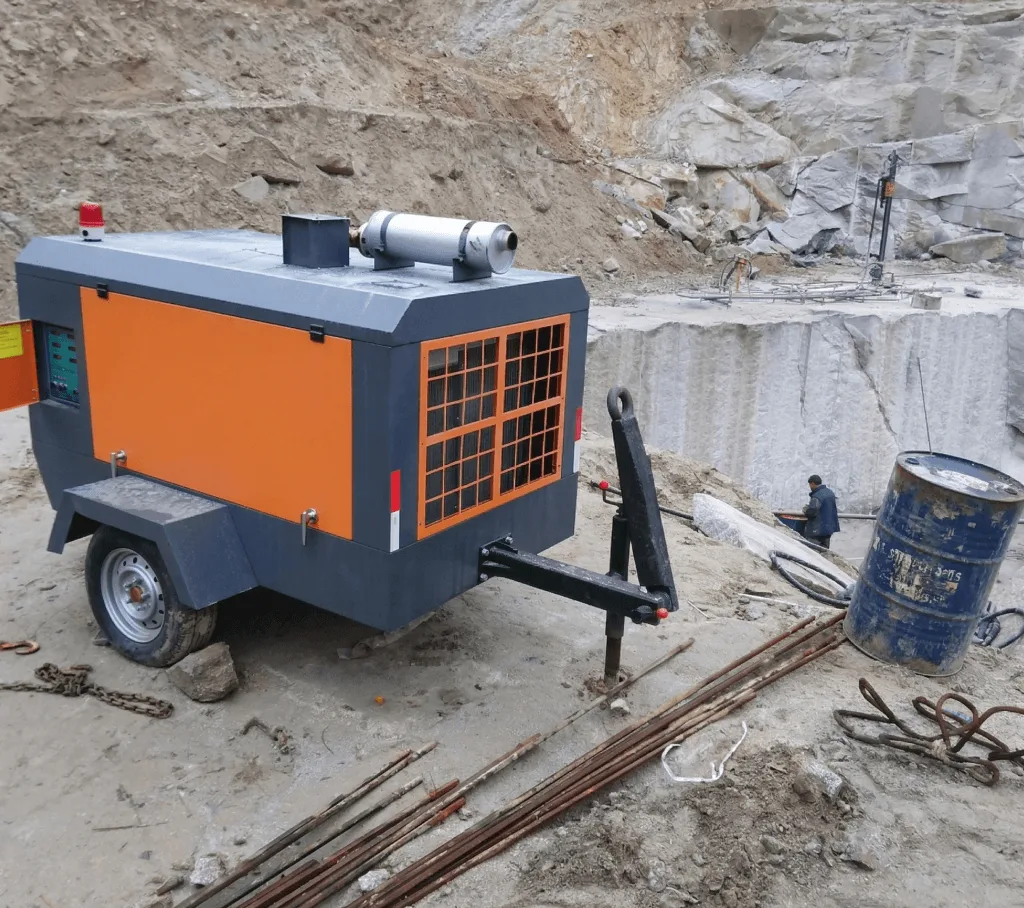
For operations that need this field-ready intelligence in a diesel-portable package, Peakroc® builds compressors from 5 m³/min for construction to 45 m³/min for mining and tunneling.
ROI: When Does a Smart Compressor Pay for Itself?
The financial case for smart controls is straightforward once you accept that energy costs dominate total cost of ownership.
A PM VSD screw compressor typically costs 20–35% more than an equivalent fixed-speed machine. But the energy savings — conservatively estimated at 35% for a moderately variable demand profile — typically recoup the premium in 10–18 months.
For the remaining 9+ years of the compressor’s operational life, the annual savings flow directly to the bottom line. On a 75 kW compressor running 6,000 hours per year at $0.10/kWh, a 35% energy reduction saves approximately $15,750 per year — every year, for a decade.
The additional soft benefits — reduced maintenance cost from soft starts (no inrush current, no mechanical shock), longer bearing life from reduced vibration, and fewer emergency shutdowns from predictive monitoring — further improve the total cost of ownership but are harder to quantify precisely.
Frequently Asked Questions
Are permanent magnet VSD compressors worth the higher price?
For the vast majority of applications with fluctuating air demand, yes. Energy accounts for over 70% of a compressor’s lifetime cost. The 20–35% price premium typically pays back in under 18 months through energy savings of 35–50%. If your air demand is truly constant 24/7 with almost no variation, a properly sized fixed-speed compressor may be comparable — but very few facilities have this demand profile.
Can I retrofit smart controls onto an existing compressor?
Centralized sequencing controllers can be added to existing multi-compressor installations without replacing the machines. IoT monitoring sensors can be retrofitted to most modern compressors. However, VSD and PM motor upgrades require replacing the motor and drive — which usually means replacing the compressor. The ROI calculation determines whether retrofitting controls or replacing the machine makes more financial sense.
Do smart controls work on portable diesel compressors?
Yes, in adapted form. Portable diesel screw compressors use engine speed regulation, pressure-based loading control, and automatic safety shutdowns to deliver similar intelligence benefits in field conditions. Full VSD electric drives are not applicable to diesel-powered units, but the fuel savings from step-less speed regulation and smart loading control are significant — typically 10–15% over fixed-speed diesel operation.
What industries benefit most from PM VSD compressors?
Any industry with variable compressed air demand: automotive manufacturing, food and beverage processing, pharmaceutical production, textile mills, electronics assembly, packaging, and general manufacturing. The greater the demand variation, the greater the energy savings.
Contact Peakroc®
Peakroc® Machinery engineers portable diesel air compressors with intelligent field controls for construction, mining, drilling, and industrial applications.
Contact Peakroc® Engineering Team for compressor selection, system design, or technical consultation.
📧 [email protected] | +86 17180424886
Author

Mark Chen – Senior Mechanical Engineer, Peakroc®
Mark Chen is a senior mechanical engineer at Peakroc®, specializing in compressed air systems and drilling equipment for mining and construction applications. With over 15 years of field experience, he has led multiple projects on optimizing air delivery efficiency, equipment durability, and energy consumption.