
Key Takeaways
A road repair mobile air compressor provides compressed air for pavement breaking, asphalt removal, trenching, pneumatic drilling, surface cleaning, sandblasting, and municipal maintenance work.
For many road repair crews, a portable diesel screw compressor operating in the 7–10 bar range offers a practical balance of pressure, airflow, fuel economy, and mobility. A machine around 5 m³/min or 185 CFM at 7 bar can commonly power one heavy pneumatic breaker with useful reserve capacity, while larger teams may require 7.5–12 m³/min or more.
The correct compressor should be selected according to three main groups of factors:
- Tool demand: tool type, rated air consumption, and number of simultaneous operators
- Site conditions: hose length, ambient temperature, altitude, dust, and access
- Machine configuration: airflow, pressure, mounting style, engine, and service support
Peakroc® supplies mobile air compressors for road construction, demolition, drilling, sandblasting, and municipal maintenance. Buyers can also review the 5 m³/min 7 bar portable diesel air compressor, the guide to portable air compressors for jackhammers, and Peakroc’s compressor selection service.
What Is a Road Repair Mobile Air Compressor?
A road repair mobile air compressor is a transportable compressed-air unit used to power pneumatic tools and support maintenance work on roads, highways, bridges, sidewalks, and utility trenches.
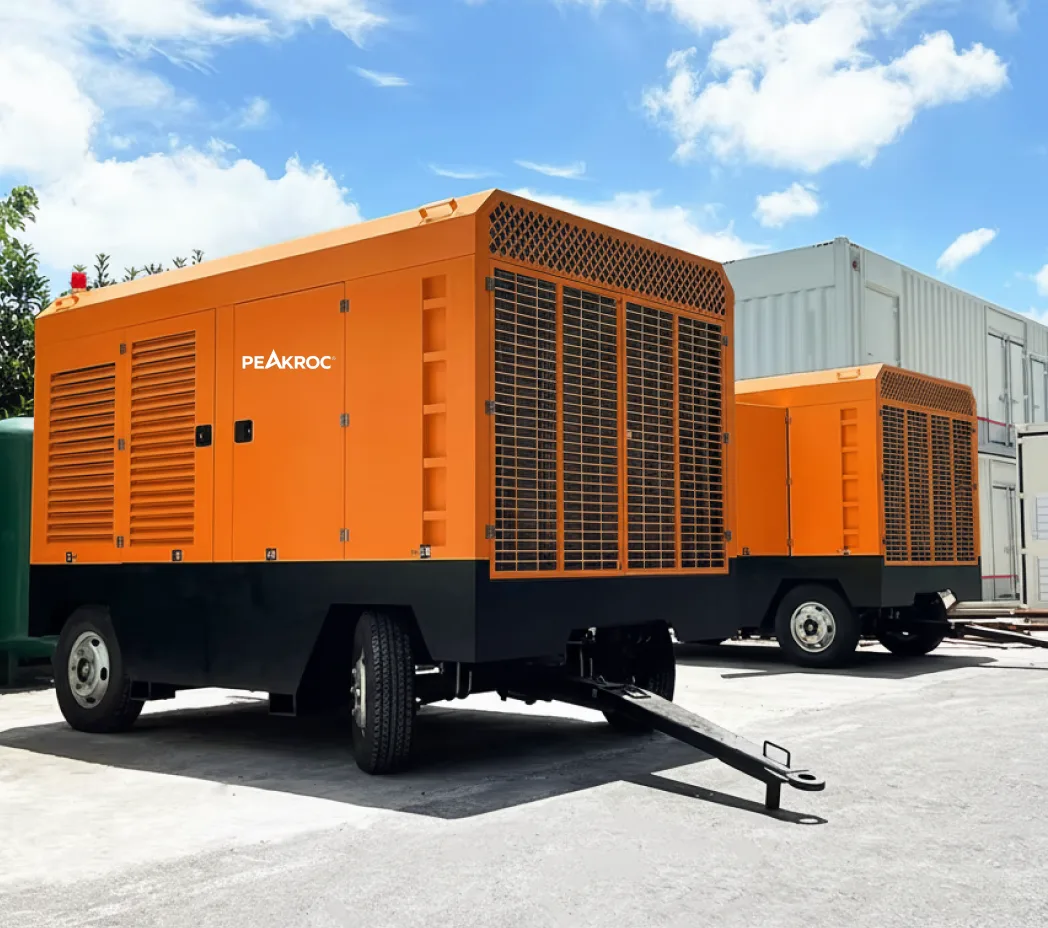
Most professional road repair compressors are diesel-driven rotary screw machines mounted on a trailer or skid frame. Unlike small workshop compressors, they are designed to deliver continuous airflow for several hours in outdoor environments where electricity may be unavailable.
The term “mobile compressor” may refer to tow-behind, skid-mounted, truck-mounted, or compact wheel-mounted equipment. For general road repair, tow-behind diesel screw compressors are the most common because they are easy to move between work zones and can serve several types of pneumatic equipment.
Why Compressed Air Is Still Important in Road Maintenance
Road maintenance increasingly uses electric and hydraulic tools, but pneumatic equipment remains important because it is durable, relatively simple, and suitable for demanding outdoor conditions.
A pneumatic breaker can run for long periods when supplied with stable airflow. This makes it effective for pavement removal, concrete edge breaking, trench repair, and utility access work. Pneumatic tools also avoid placing an electric motor at the point of use, which can be useful on dusty or wet sites.
Another advantage is flexibility. The same compressor may power a breaker during pavement removal, provide blow air for site cleaning, and support a pneumatic drill or abrasive blasting system later in the shift. This allows contractors and municipal crews to use one machine for several stages of the repair process.
Main Applications of Mobile Air Compressors in Road Repair
| Road Repair Application | Typical Air Requirement | Main Equipment |
|---|---|---|
| Asphalt breaking | Stable airflow around normal tool pressure | Medium or heavy pneumatic breaker |
| Concrete pavement removal | Continuous airflow under heavy load | Heavy breaker or demolition hammer |
| Utility trenching | Breaking, chipping, and cleaning air | Tow-behind diesel compressor |
| Pothole repair | Light breaking and debris removal | Compact mobile compressor |
| Pneumatic drilling | Stable pressure and low pulsation | Road drill or rock drill |
| Surface preparation | High-volume cleaning or blasting air | Blow lance or blasting nozzle |
| Bridge maintenance | Chipping, scaling, cleaning, and coating preparation | Mobile screw compressor |
Pavement Breaking and Asphalt Removal
Pavement breaking is one of the most common uses of a road repair compressor. A pneumatic breaker converts compressed air into repeated impact energy, allowing the operator to break asphalt, concrete, and compacted road layers.
The compressor must deliver enough air continuously. If airflow falls below the tool requirement, the breaker may continue to operate, but impact force and working speed will drop. This slows the project and may increase tool wear.
A medium pneumatic breaker may consume around 60–75 CFM, while a heavier breaker may require approximately 75–85 CFM or more. A 185 CFM compressor therefore provides a practical margin for one heavy breaker under normal field conditions.
That reserve matters because rated compressor output is measured under controlled test conditions. Real roadwork sites may have long hoses, worn couplings, high temperatures, dirty filters, or minor leakage. All of these reduce the amount of air reaching the tool.
Concrete Chipping and Edge Repair
Road crews often need more controlled removal rather than full demolition. Chipping hammers and smaller pneumatic tools are used around expansion joints, drainage channels, bridge decks, curbs, manholes, and damaged concrete edges.
These tools generally use less air than heavy breakers, so one compressor may support several work points. However, the total demand still needs to be calculated carefully. Three smaller tools can consume more air than one heavy breaker when they operate at the same time.
A correctly sized rotary screw compressor keeps pressure stable without forcing operators to wait for pressure recovery. This is especially helpful during detailed repair work where tool response and operator control are important.
Utility Trenching and Emergency Road Repairs
Water, gas, power, and telecommunications repairs often require roads to be opened quickly. In these situations, fast deployment is just as important as compressor capacity.
A tow-behind compressor can be positioned near the trench, connected to breakers, and started without waiting for electrical service. Diesel power also allows crews to work during emergency repairs, nighttime road closures, storms, or remote highway projects.
For this type of work, several practical machine features are especially valuable:
- Compact trailer dimensions and safe towing hardware
- Multiple air outlets and long fuel autonomy
- Easy access to filters, drains, and routine service points
The machine should also be positioned so exhaust cannot accumulate around workers or enter nearby buildings.
Road Surface Cleaning and Preparation
Compressed air is often used after cutting or breaking work to remove dust, loose chips, and debris. A clean repair area improves inspection and helps asphalt, sealant, grout, or coating bond more effectively.
Basic blow cleaning does not normally require very high pressure, but it can consume significant airflow when large nozzles are used. Surface preparation work may also require moisture control.
For applications such as sandblasting, road marking removal, or bridge coating preparation, an aftercooler and water separator may be useful. Dry air improves abrasive flow and reduces the risk of moisture affecting the prepared surface.
Why Rotary Screw Compressors Are Commonly Used
Continuous Duty — Portable rotary screw compressors are widely used in road maintenance because they are built for continuous operation. The screw elements provide a steady supply of air with less pulsation than many small reciprocating compressors.
Stable Airflow — This consistent delivery is important when pneumatic tools are used for extended periods. Road crews often work within limited traffic-control windows, so the compressor must keep operating without repeated interruptions or long pressure-recovery delays.
System Integration — A complete mobile compressor includes the diesel engine, screw air end, cooling system, air-oil separator, controller, fuel tank, chassis, and enclosure. These components must work together correctly. A powerful engine alone cannot guarantee good field performance if the cooling system, filtration, or air-end sizing is inadequate.
What Size Compressor Is Suitable for Road Repair?
There is no single compressor size for every road repair team, but several practical capacity ranges are commonly used.
| Compressor Class | Typical Capacity | Suitable Work |
|---|---|---|
| Compact service unit | 2–3 m³/min at about 7 bar | Inflation, cleaning, and light pneumatic tools |
| Standard road repair unit | Around 5 m³/min at 7 bar | One heavy breaker or several smaller tools |
| Medium contractor unit | 7.5–10 m³/min at 7–10 bar | Multiple breakers, trenching, and pneumatic drilling |
| High-flow unit | 10–12 m³/min or more | Larger crews, heavy demolition, and abrasive blasting |
| Higher-pressure unit | 10–13 bar or above | Specialized drilling or demanding pneumatic applications |
A 5 m³/min, 7 bar machine is often a practical starting point for municipal road crews and contractors using one heavy breaker. It offers useful airflow without making the machine unnecessarily large.
For teams using two or more breakers simultaneously, a 7.5–10 m³/min compressor may be more suitable. The final choice should be based on actual tool data rather than the number of workers alone.
How to Calculate Tool Air Demand
The basic calculation is straightforward: add the rated air consumption of all tools expected to operate at the same time.
For example, a heavy breaker may consume around 85 CFM and a blow lance may require another 30 CFM. If both operate simultaneously, the base demand is approximately 115 CFM. A reserve should then be added for hose pressure loss, leakage, high ambient temperature, altitude, and future tool additions.
A practical reserve of around 15–25% is often useful, but tool manufacturer data should always be the starting point. Two breakers with similar weight may still have different airflow requirements.
Pressure Loss in Hoses and Couplings
A compressor may show the correct pressure at the outlet while the tool receives much less. This usually happens because the hose is too long, too narrow, leaking, or connected through restrictive fittings.
Long hoses create friction loss, especially when high airflow passes through a small diameter. The problem becomes more noticeable when several tools share one supply line.
Tool performance can often be improved by checking three simple areas:
- Use the hose diameter recommended for the required airflow
- Keep hose runs as short and direct as practical
- Replace leaking couplings, damaged fittings, and undersized manifolds
Increasing the compressor pressure setting is not always the correct solution. In many cases, improving the hose arrangement restores tool efficiency while reducing unnecessary fuel use.
Tow-Behind, Skid-Mounted, or Truck-Mounted?
A tow-behind compressor is usually the most flexible choice for road contractors. It can move between projects, be disconnected from the service vehicle, and be shared by multiple crews.
A skid-mounted compressor is more suitable for companies that transport equipment on flatbeds or install machinery permanently on service trucks. It usually has fewer trailer components, but loading and unloading require lifting equipment.
Truck-mounted compressors are useful for municipal fleets and mobile service teams because they reduce setup time. The disadvantage is that the compressor remains tied to the vehicle even when the truck is needed for another task.
The most suitable arrangement depends on how often the machine moves, local towing rules, available trucks, site access, and whether the compressor serves one crew or several.
Diesel Engine Performance and Fuel Economy
Road repair compressors commonly use diesel engines because they provide independent power and strong torque. The engine must respond quickly when pneumatic tools begin consuming air while reducing fuel use when demand falls.
Modern compressor controls adjust engine speed according to load. When tools stop, the compressor unloads and engine speed decreases. When airflow demand returns, the system increases output again.
Fuel efficiency depends on compressor sizing, pressure setting, filter condition, leakage, and idle time. An oversized compressor may offer large reserve capacity but consume more fuel and cost more to transport. The most economical solution is normally the smallest unit that can meet peak demand with a reasonable reserve.
Dust, Heat, Noise, and Jobsite Durability
Roadwork exposes compressors to dust, heat, vibration, rain, and frequent transport. A road-duty machine should therefore include a robust cooling system, effective air filtration, and a durable enclosure.
Heavy-duty intake filters protect the engine and compressor air end. Large radiators and oil coolers help control temperature during long shifts. A sound-attenuated canopy reduces disturbance in urban areas and during nighttime road closures.
Service doors should provide easy access to filters, drains, and routine inspection points. A machine that is difficult to maintain is more likely to suffer neglected service and unexpected downtime.
Safety Practices for Road Repair Compressors
Compressed air contains significant stored energy. A damaged hose or loose coupling can move violently and cause serious injury.
Before each shift, workers should inspect hoses, fittings, safety clips, tool connections, tires, trailer lighting, and visible leaks. The compressor should be parked securely with the wheels chocked before operation.
Operators should depressurize the line before disconnecting tools and keep exhaust gases away from enclosed areas. Eye, ear, hand, foot, and respiratory protection should be used according to the task.
Compressed air from a standard oil-injected construction compressor must not be used for breathing unless it passes through a properly designed breathing-air treatment system.
Maintenance That Protects Roadwork Productivity
Road repair schedules are often linked to temporary traffic closures. Compressor downtime can therefore delay the entire crew and increase disruption for road users.
Daily inspection should cover oil levels, coolant, air filters, fuel-water separation, radiator cleanliness, hoses, tires, warning indicators, and leaks. Dusty work sites may require air filters and cooling surfaces to be checked more frequently than the standard maintenance interval suggests.
Service should be performed according to actual operating hours. Even when the machine is used seasonally, it may accumulate a high number of hours during intensive road maintenance campaigns.
A Practical Peakroc® Road Maintenance Example
For a road repair crew using one heavy pneumatic breaker, Peakroc® commonly considers a 5 m³/min, 7 bar portable diesel screw compressor a practical starting configuration.
This size provides enough airflow for a heavy breaker with useful reserve capacity while remaining compact enough for towing and municipal maintenance. It can also support chipping hammers, cleaning nozzles, small pneumatic drills, and light surface-preparation work.
For larger teams using several tools at the same time, Peakroc® may recommend a 7.5–10 m³/min model. The final selection should consider tool consumption, hose arrangement, daily operating time, ambient conditions, and transport requirements.
Peakroc® can also assist customers who need to compare portable compressor options from Atlas Copco, Sullair, Ingersoll Rand, and other established brands.
What Information Is Needed Before Buying?
Before requesting a quotation, buyers should prepare the tool models and air consumption, the number of simultaneous operators, required working pressure, maximum hose length, daily operating hours, ambient temperature, altitude, preferred mounting method, and destination market.
It is also helpful to confirm whether the project needs an aftercooler, water separator, dryer, or additional filtration. This allows the supplier to recommend a machine that supports the work without unnecessary oversizing.
Final Recommendation
A road repair mobile air compressor should provide stable airflow, dependable diesel power, easy transport, and continuous-duty performance for pavement breaking, trenching, drilling, cleaning, and maintenance work.
For many single-breaker crews, a 5 m³/min, 7 bar portable screw compressor is a practical choice. Larger teams should select capacity according to the total simultaneous tool demand and expected hose losses.
Peakroc® can help contractors, municipalities, and equipment distributors choose and purchase a suitable road maintenance compressor based on tool requirements, site conditions, transport method, and local service needs.
FAQ
1. What size air compressor is suitable for a jackhammer?
A heavy pneumatic jackhammer commonly requires around 75–85 CFM. A portable compressor rated at about 185 CFM and 7 bar can generally support one heavy breaker with useful reserve capacity.
2. Is 7 bar enough for road repair?
Yes. Many pneumatic breakers, chipping hammers, and road maintenance tools operate effectively at around 7 bar. The compressor must also deliver sufficient airflow for the tool.
3. Can one portable compressor power two jackhammers?
It depends on the combined air consumption of both tools and the compressor’s free air delivery. Two medium breakers may require approximately 125–150 CFM before reserve capacity and hose losses are added.
4. Why are diesel screw compressors used for road maintenance?
They provide continuous airflow, independent field power, stable pressure, and convenient mobility for outdoor repair sites.
5. Should a road repair compressor include an aftercooler?
An aftercooler is not essential for every breaker application, but it is useful when moisture control matters, particularly in sandblasting, coating preparation, and long hose systems.
6. Does Peakroc® supply road maintenance compressors?
Yes. Peakroc® supplies portable diesel screw compressors for jackhammers, pavement breaking, trenching, cleaning, sandblasting, and general road maintenance applications.
Author

Mark Chen – Senior Mechanical Engineer, Peakroc®
Mark Chen is a senior mechanical engineer at Peakroc®, specializing in compressed air systems and drilling equipment for mining and construction applications. With over 15 years of field experience, he has led multiple projects on optimizing air delivery efficiency, equipment durability, and energy consumption.