
I’ve spent the last fifteen years with a wrench in one hand and a pressure gauge in the other. Most of that time has been on jobsites — water well pads in West Africa, iron ore benches in Western Australia, geothermal drilling sites in Indonesia, quarry floors in Chile. The conversation always comes back to the same thing: how do you move enough air, at the right pressure, without burning a hole in your fuel budget or stranding a rig halfway through a hole?
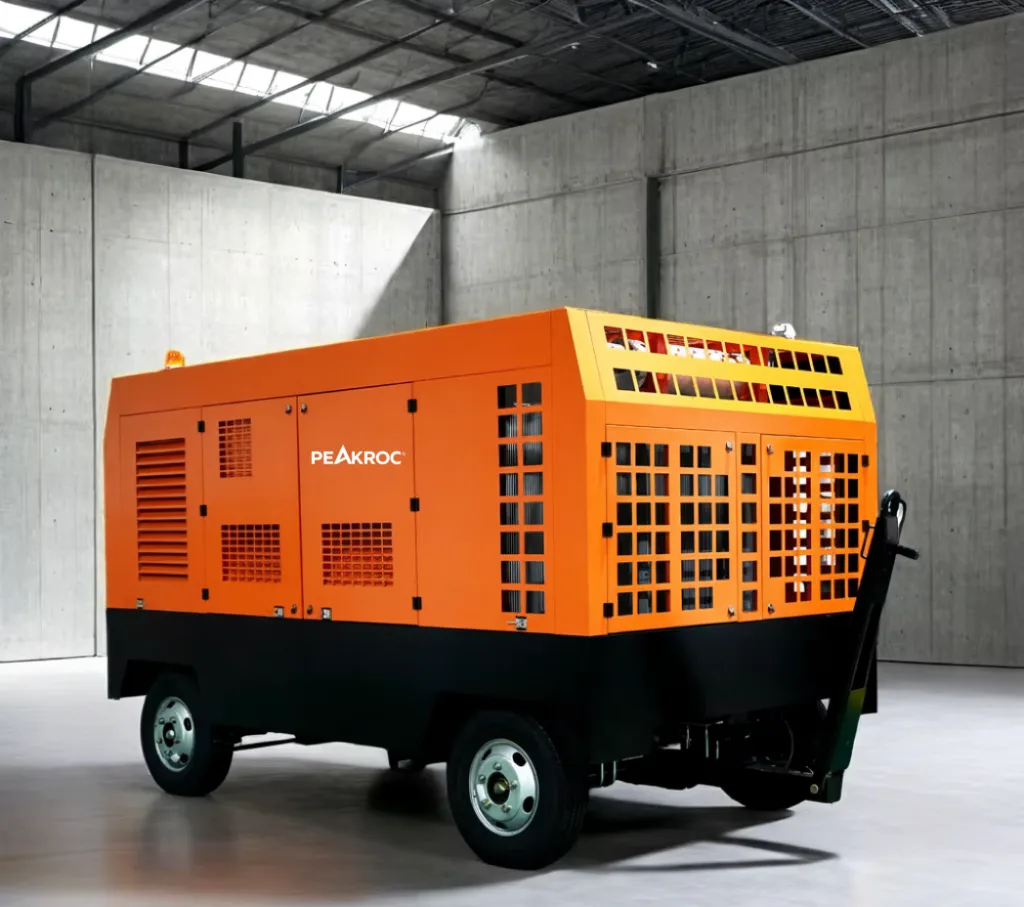
That question is exactly why the 850 CFM 25 bar portable diesel air compressor exists as a category, and it’s why Peakroc® engineers one around a Cummins engine rather than chasing cheaper substitutes. This guide is the one I wish I’d had early in my career. I’ll walk you through what 850 CFM at 25 bar actually means in the field, why the Cummins pairing matters, how the airend behaves under real load, and how to match this machine to drilling and blasting work without oversizing or starving the rig.
If you’re scoping a portable diesel air compressor for deep borehole, DTH hammer, or high-pressure service work, this is for you.
Why 850 CFM at 25 bar is a distinct drilling class — not just “a bigger compressor”
In the portable diesel compressor market, capacity is often reported in rounded brackets: 400 CFM, 750 CFM, 1,200 CFM. Those numbers are easy for sales teams to remember but they flatten real engineering decisions. 850 CFM at 25 bar sits in a very specific slot — it’s the pressure-flow combination that matches medium-diameter down-the-hole (DTH) hammers drilling in the 115–165 mm bit range, to depths of roughly 200–350 meters depending on formation hardness and hole cleaning requirements.
Converting the units for clarity: 850 CFM is approximately 24 m³/min of free air delivery (FAD), and 25 bar corresponds to roughly 363 psi. That combination is what we call the “high-pressure medium-volume” class in drilling operations. It’s too much pressure for general construction work, where 7–10 bar is standard, and it’s a different beast from the 35 bar units we build for the deepest hardrock geothermal holes.
The physics behind the spec
A DTH hammer needs two things from its air supply: enough pressure to drive the piston and enough volume to lift the cuttings out of the annulus. Skip either one and the hole fails — either the hammer stalls or the cuttings pack around the bit and you lose the string.
For a typical 4.5-inch (115 mm) DTH hammer, the manufacturer will specify something like 350 psi minimum working pressure and an air volume that rises with hole depth. At 200 meters, you might need 650 CFM just to maintain the minimum annular velocity. Push to 300 meters with rougher cuttings, and you’re looking at 800–900 CFM. Now add the friction loss in the drill string, the pressure drop through the swivel, and the safety margin you want when ambient temperature climbs to 45°C — and suddenly 850 CFM at 25 bar is not overkill, it’s exactly the reserve capacity that keeps a hammer alive through an eight-hour shift.
This is the principle Peakroc® engineers around. We don’t sell “big numbers” — we sell margin. And for a large segment of water well, mineral exploration, and quarry pre-splitting work, that margin lives at 850 CFM / 25 bar.
Why the Cummins engine pairing matters more than spec sheets suggest
I’ve heard the argument that “any diesel engine with enough horsepower will do.” It’s wrong, and I can show you why with a single real-world scenario.
When a DTH rig hits a hard seam after ten meters of soft overburden, the airend load spikes within seconds. The compressor’s intake valve opens wider, the governor demands more fuel, and the engine has to hold rpm while torque demand climbs. If the engine can’t respond cleanly, the airend falls off its efficiency curve, discharge temperature rises, and oil carryover into the air stream increases. That’s when separator elements start to fail early and tools downstream get contaminated.
What Cummins brings to the airend partnership
Peakroc® builds the 850 CFM 25 bar class around the Cummins QSB6.7 or QSL9 platform depending on market emissions tier. Two things make these engines correct for this duty cycle:
Torque curve geometry
The Cummins QSL9 delivers peak torque at around 1,400 rpm and holds it flat through 1,800 rpm. That matters because a two-stage airend working at 25 bar discharge runs hardest in that exact rpm band. The engine and the airend are coupled mechanically — no hydraulics, no clutches — so the torque has to be there when the airend demands it. Undersquare, under-torqued engines drop rpm under load, the airend drops flow, and the rig operator has to slow the penetration rate. On a metered contract, that’s lost money every meter.
Turbocharger transient response
The variable-geometry turbos on modern Cummins units respond in a fraction of a second to load change. In a DTH cycle — where a hammer blow dumps air, the pressure in the receiver tank drops, and the airend has to recover — that transient response is what keeps pressure stable at the tool.
Global service network
This is the part engineers downplay and operations managers never forget. Cummins has authorized service dealers in nearly every country where drilling happens. When you’re three days’ drive from the nearest city and a turbo goes down, you don’t want to be searching for a proprietary replacement part. Cummins parts ship globally and local mechanics are trained on them. That alone justifies the premium over lesser engines.
Peakroc® buys Cummins engines in full OEM supply agreements, not grey-market, and each unit ships with the Cummins engine serial number registered for international warranty coverage. That detail matters when you’re deploying capital equipment into remote territories.
The airend: where the real engineering happens
An air compressor’s reputation is made or broken in the airend — the rotor assembly that actually compresses the air. At 25 bar, you are well outside the single-stage comfort zone.
Why 25 bar demands a two-stage airend
A single-stage screw compressor can physically reach 13–14 bar with reasonable efficiency. Push it past that and three problems compound: discharge temperatures climb past the oil’s thermal limit, the pressure ratio causes back-leakage across the rotors, and specific power (kW per CFM delivered) goes through the roof. You end up with a machine that burns a lot of fuel to deliver disappointing air.
A two-stage airend splits the compression. First stage takes ambient air to roughly 5–6 bar, an intercooler drops the temperature, then the second stage takes it from there to 25 bar. The intercooling step is not a luxury — it’s thermodynamics. Cooling between stages reduces the work required in the second stage and brings the final discharge temperature back into a range where mineral oils can survive.
The fuel economy difference on a 25 bar duty is substantial. In our field tests on Peakroc® two-stage units versus comparable single-stage machines forced to run at high pressure, we routinely see 18–24% lower specific fuel consumption across a drilling shift. Over a year on a contract rig, that’s a number that changes project P&L.
For a deeper treatment of the engineering case, we’ve written about the advantages of two-stage diesel screw compressors separately.
Rotor profile and clearances
Peakroc® uses asymmetric rotor profiles with optimized blow hole geometry, and we control the rotor-to-housing clearance to tolerances measured in hundredths of a millimeter. The reason is simple: in a high-pressure machine, any leakage path back from the discharge side to the suction side is paid for twice — once in lost flow and once in recompression work. On the 850 CFM 25 bar class, tight clearances can mean the difference between 850 CFM actually delivered and 780 CFM delivered with 850 CFM stamped on the plate.
This is also where cheap aftermarket or copycat compressors fall apart within a year. The rotors wear, the clearances open up, and capacity quietly drops off. A field crew often doesn’t notice until the rig starts struggling on holes it used to drill easily.
Real-world applications: where the 850 CFM 25 bar class earns its keep
Over fifteen years, I’ve seen this specification deployed across a surprisingly broad range of work. Let me walk through the ones where it genuinely shines.
Water well drilling — 200 to 350 meter holes
Deep water well drilling is probably the single largest application for the 850 CFM 25 bar class globally. In arid and semi-arid regions — Sub-Saharan Africa, Central Asia, northern Mexico, parts of the Middle East — the water table has dropped year after year, and 300-meter holes are no longer unusual. A 4.5-inch to 6-inch DTH hammer working at those depths needs exactly the pressure-flow combination this compressor delivers.
I’ve had clients tell me that moving from a 750 CFM 24 bar unit to an 850 CFM 25 bar unit on the same rig improved their meters-per-day by 15–20%, simply because the bit never starved for air and cuttings lifted cleanly. For a detailed methodology on matching compressors to water well rigs, see our guide on water well drilling rigs with high-pressure air compressors.
Mineral exploration and reverse circulation (RC) drilling
Exploration geologists need clean, uncontaminated sample return. Reverse circulation drilling relies entirely on air pressure to bring chips back up through the inner tube of the dual-wall drill pipe. At depths of 250–400 meters in mineralized rock, the 25 bar pressure class is often the baseline, and 850 CFM provides the volume margin for effective sample lift.
Quarry pre-splitting and contour blasting
Quarry operators use the 850 CFM 25 bar class for mid-diameter blast hole drilling — typically 3.5 to 5 inch holes for controlled blasting along a bench. The pressure is high enough to work hard granite and basalt, the flow is sufficient for 15-meter production holes, and the machine is portable enough to move between benches several times a day. Our ultimate guide to quarry air compressor sizing goes into bench geometry considerations in detail.
Geothermal shallow loops and HDD pilot bores
More recent applications include horizontal directional drilling pilot bores in hard ground and shallow geothermal loop installation. These operations need high pressure to work mud-free in certain geologies, and 850 CFM gives the reserve capacity to push through unexpectedly dense formations without pulling string.
Practical sizing: how to know 850 CFM 25 bar is actually your machine
I get this question constantly: “How do I know this is the right compressor for my job?” Here’s the decision logic I walk clients through.
Step 1 — Start with the hammer and bit size
Pull the spec sheet for your DTH hammer. Look for two numbers: minimum working pressure and air consumption at working pressure. If the hammer spec says something like “350 psi minimum, 650 CFM at 350 psi,” you’ve just established your floor. Your compressor must exceed both numbers with margin.
Step 2 — Add depth-based volume margin
For every 100 meters of hole depth, add roughly 10–15% to the hammer’s baseline air consumption to account for friction loss in the drill string and the increased annular lift requirement as cuttings travel farther. At 300 meters with a 4.5-inch hammer baseline of 650 CFM, you’re realistically looking at 820–870 CFM required at the compressor discharge.
Step 3 — Factor in altitude and ambient temperature
A diesel compressor’s performance derates with elevation and heat. As a rule of thumb, lose about 3% of volume per 300 meters of elevation and another 1% per 5°C above 25°C ambient. Drilling at 2,500 meters elevation in 40°C heat? Your 850 CFM machine is delivering closer to 780 CFM. That’s why we always recommend not running a compressor at its absolute nameplate limit in harsh conditions.
Step 4 — Compare against adjacent classes
If after all this analysis you’re sitting right at 850 CFM with thin margin, consider the next pressure class up. For deeper holes or consistently hotter conditions, our 22 m³/min 20 bar unit or the 34 m³/min 25 bar machine gives you more headroom. For lower-pressure, lower-volume work, see the 7 m³/min 10 bar mining and drilling compressor or 8.5 m³/min 10 bar water well drilling unit.
Undersizing kills jobs. Oversizing wastes fuel. The discipline is matching the machine to the real duty cycle, not the spec sheet peak.
What separates a good 850 CFM 25 bar compressor from a poor one
After years of teardown analysis on competitor units — we do this regularly as part of our product development process — I can tell you the failure patterns.
Cooling system sizing
A 25 bar machine rejects a lot of heat. If the cooler package is marginal, the unit fine in 25°C ambient but derates badly at 40°C. Peakroc® oversizes coolers by a deliberate margin for the Middle East, African, and Australian markets where we know ambient will be extreme. Look for cooler face area in the spec — it tells you more about hot-weather performance than any other single dimension.
Air/oil separator quality
The separator element is what keeps compressor oil out of your drilling air. A poor separator carries 20+ ppm of oil into the air stream; a good one keeps it under 3 ppm. For DTH drilling, this directly affects hammer life — oil-fouled hammers fail lubricators and seize. We use multi-stage coalescing separators with glass fiber media and engineered drain-back geometry. It costs more per element. It saves a lot of downstream hardware.
Control system intelligence
Modern drilling operations run long shifts, and the operator is managing the rig, not babysitting the compressor. A quality 850 CFM 25 bar unit has automatic safety shutdowns for high discharge temperature, low oil pressure, high oil temperature, and low coolant level. It also has pressure-based loading control that modulates the inlet valve intelligently so the machine doesn’t slam between full load and idle. That smoother modulation reduces fuel burn and extends airend life meaningfully.
Chassis and transportability
An 850 CFM 25 bar unit typically weighs between 3,500 and 4,500 kg depending on the fuel tank size and trailer configuration. The chassis has to handle that weight over rough drilling access roads without stress-cracking. We use heavy-gauge channel steel with proper reinforcement at the axle and tongue, and torsion axles rated well above static weight. I’ve seen cheap imports with chassis cracks after six months of field duty. It’s not a part you want to learn about in the middle of a contract.
Maintenance: the honest version
Nobody loves hearing the maintenance lecture. Here’s the condensed truth from fifteen years of field failures I’ve investigated.
Compressor oil is the single biggest determinant of airend life. Use the specified synthetic or semi-synthetic oil, change it on interval (typically every 1,000 hours for synthetics, 500 for mineral), and never top off with the wrong viscosity grade. I’ve personally torn down airends that failed at 4,000 hours because someone topped off with engine oil. The rotors were scored beyond repair.
Air filters matter more on drilling sites than anywhere else because the ambient air is full of dust. Check the filter restriction gauge daily and change elements before they go fully loaded — not after. A restricted intake filter costs you flow before it trips any alarm.
Cooler cleaning is the maintenance task most often skipped and most often responsible for derates. In dusty environments, the cooler fins pack with fine particulate and the machine starts running hot. A weekly compressed-air blowdown of the coolers takes five minutes and preserves performance.
Fuel quality is the quiet killer. Cummins engines tolerate a lot, but water-contaminated or high-sulfur fuel will eventually find the injectors and the common rail. Use a primary fuel filter at the fill point when possible, and keep the onboard filter changed on schedule.
Do these four things and an 850 CFM 25 bar Peakroc® unit will deliver 15,000+ hours before major airend work. Skip them, and you’ll be chasing problems within two years.
Frequently asked questions from buyers and spec engineers
What is the difference between 850 CFM at 25 bar and 1,070 CFM at 25 bar?
About 25% more airflow at the same pressure. The 1,070 CFM class (roughly 30 m³/min) is appropriate for deeper holes — 350 to 500 meter water wells, larger-diameter DTH hammers in the 6-inch range, and larger quarry blast patterns. The 850 CFM class is the right size for medium-depth, medium-diameter work. Sizing up when you don’t need to means burning more fuel for no gain.
Can I run surface work (sandblasting, road maintenance) with an 850 CFM 25 bar unit?
Technically yes, practically no. Surface work rarely needs more than 10–14 bar, so you’d be running the machine at a fraction of its pressure capability. The specific fuel consumption would be poor, and you’re paying for pressure capability you don’t use. For surface work, see our 7.5 m³/min 7 bar road maintenance compressor — it’s built for that duty and runs far more efficiently at lower pressures.
What’s the fuel consumption at full load?
A well-engineered 850 CFM 25 bar Cummins-powered unit burns between 38 and 46 liters per hour at sustained full load, depending on ambient conditions and altitude. That’s the number to use for fuel budgeting on long drilling contracts. Units claiming dramatically lower numbers are either measured at partial load or are outright misleading.
How long does delivery and commissioning take?
Peakroc® typically ships globally within 25–35 working days from order, and commissioning on-site takes a half day for a trained operator. The Cummins engine comes with its own startup procedure, and the airend requires initial oil temperature stabilization before first loaded operation.
Is financing or long-term warranty available?
Yes, Peakroc® offers extended warranty programs on the airend (up to 5 years or 10,000 hours) and partners with regional financing providers for drilling contractors. The Cummins engine carries its own international warranty through the Cummins dealer network.
Closing thoughts from the field
If you’re specifying a compressor for medium-depth drilling — water wells in the 200–350 meter range, exploration RC work, quarry pre-splitting, or geothermal pilot bores — 850 CFM at 25 bar with a Cummins engine is the workhorse specification. It’s not the flashiest number on a catalog, and it’s not the biggest machine we build. It is, in my experience, the single most broadly useful portable diesel compressor in the high-pressure market.
Peakroc® builds this machine because we’ve been the people on the rig, the people on the service call, and the people doing the teardown analysis. The specification is not arbitrary; it comes from fifteen years of watching which machines finish contracts on time and which ones don’t.
If you want help sizing the right compressor for your specific rig, formation, and depth targets, our engineering team can run the analysis with you. You can find your compressor using our guided tool, browse our full Peakroc® compressor range, or contact our team directly with your project specs.
The right compressor is the one that matches your job. The 850 CFM 25 bar Cummins-powered Peakroc® unit is that match for a large and important slice of the drilling world.
Author

Mark Chen – Senior Mechanical Engineer, Peakroc®
Mark Chen is a senior mechanical engineer at Peakroc®, specializing in compressed air systems and drilling equipment for mining and construction applications. With over 15 years of field experience, he has led multiple projects on optimizing air delivery efficiency, equipment durability, and energy consumption.