
Key Takeaways
- Diesel piston air compressors and diesel screw air compressors are fundamentally different machines built for different duty cycles — choosing the wrong type costs fuel, uptime, and tool life.
- Piston compressors deliver air in pulses, handle intermittent demand well, and are cheaper upfront — but they cannot sustain continuous full-load operation for hours, which is exactly what drilling and mining require.
- Rotary screw compressors deliver continuous, pulse-free air at 100% duty cycle, making them the correct choice for DTH drilling, mining operations, sandblasting, and any application that runs for extended shifts.
- At flow rates above 100 CFM (≈3 m³/min) and pressures above 7 bar, diesel screw compressors are more fuel-efficient, more compact, and significantly more reliable than equivalently rated piston machines.
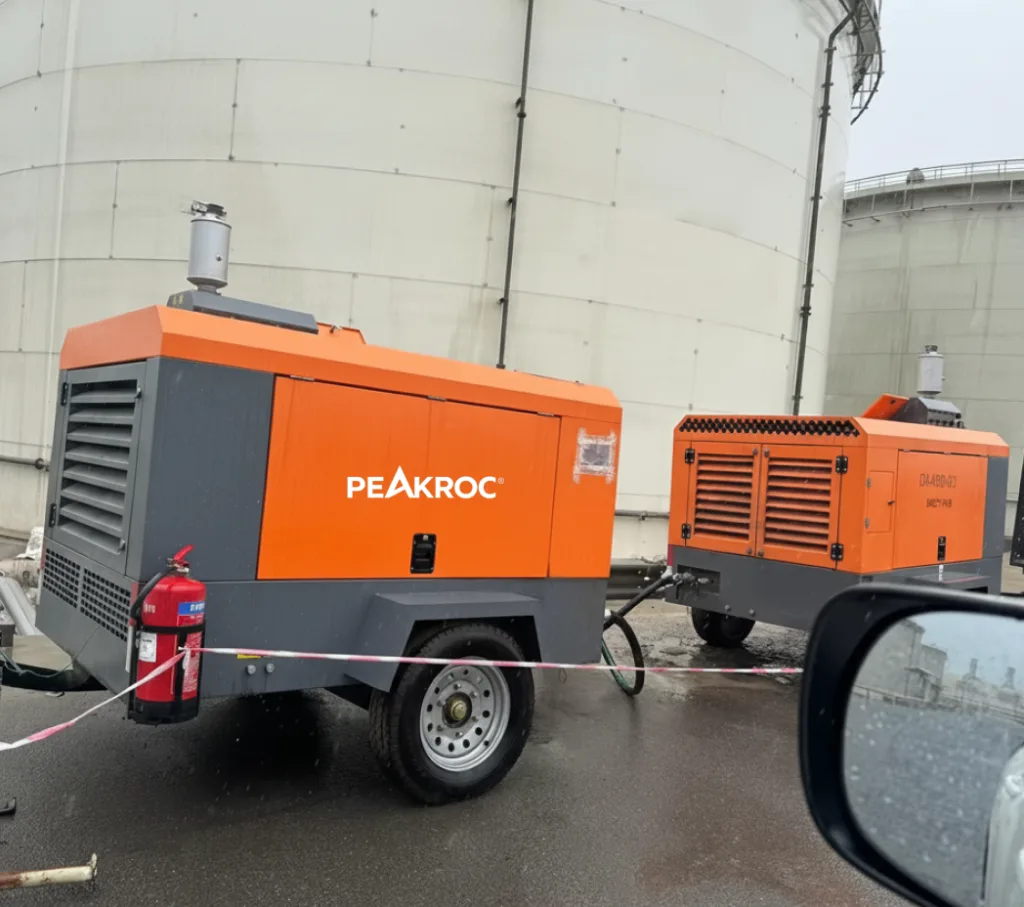
- Peakroc® engineers rotary screw portable diesel air compressors specifically for mining, drilling, and construction — from 5 m³/min units for jackhammers to 45 m³/min machines for tunneling.
How a Diesel Piston Compressor Actually Works
A piston compressor — also called a reciprocating compressor — uses one or more cylinders to compress air through mechanical stroke. A crankshaft drives the pistons up and down inside the cylinders. On the downstroke, air is drawn in through an intake valve. On the upstroke, the air is compressed and pushed out through a discharge valve into a receiver tank.
This is the oldest compression technology in industrial use. The design is simple, parts are cheap, and any diesel mechanic who understands an engine can understand a piston compressor — because the operating principle is essentially the same.
Where piston compressors work well
Piston compressors are a reasonable choice for:
- Intermittent tool use — running a jackhammer for 20 minutes, then stopping for 10
- Low-volume, low-duty applications — tire inflation, small paint spraying, occasional pneumatic tool use
- Very high pressure at very low volume — some specialty applications above 30 bar where flow demand is minimal
- Budget-constrained operations with light workloads — small farms, workshops, roadside repair
Where piston compressors fail
The piston compressor’s fundamental limitation is duty cycle. Most diesel piston compressors are rated for 60–70% duty cycle, meaning they should only run loaded for 60–70% of any given hour. The remaining time, the machine needs to unload and cool down.
In mining and drilling, compressors run loaded for 8, 10, sometimes 12 hours straight. A piston compressor forced into 100% duty cycle overheats. The cylinders, valves, and piston rings wear at accelerated rates. The discharge air temperature climbs, and with it, moisture content rises — which is damaging to downstream pneumatic tools and DTH hammers.
The second limitation is pulsation. Piston compressors deliver air in distinct pulses corresponding to each piston stroke. For tools that need smooth, continuous airflow — DTH hammers, pneumatic drills, sandblasting nozzles — pulsating air reduces efficiency and increases wear on the tool’s internal components.
How a Diesel Rotary Screw Compressor Works
A rotary screw compressor uses two interlocking helical rotors — a male rotor and a female rotor — spinning inside a close-tolerance housing. As the rotors turn, air is trapped between the rotor lobes and progressively compressed as the trapped volume decreases from the suction end to the discharge end.
In an oil-injected rotary screw (which is the standard for portable diesel units), lubricating oil is injected into the compression chamber. The oil serves three functions: it seals the clearances between the rotors, it cools the air during compression, and it lubricates the rotor surfaces. After compression, the air-oil mixture passes through a separator vessel where the oil is removed, cooled, and recirculated.
This is the technology used in virtually every modern portable diesel air compressor designed for mining, drilling, and construction — including every machine in the Peakroc® range and the portable compressor lines from Atlas Copco, Ingersoll Rand, Sullair, and other major manufacturers.
Why screw compressors dominate industrial mobile applications
Three engineering reasons:
100% continuous duty cycle. A properly designed rotary screw compressor runs loaded, all day, every day. The oil injection system manages heat continuously. There is no thermal cycling between loaded and unloaded states that would cause fatigue in valves or cylinder walls — because there are no cylinders or valves in the compression path.
Smooth, pulse-free air delivery. The rotary motion produces a continuous stream of compressed air with minimal pressure fluctuation. DTH hammers, pneumatic rock drills, and sandblasting systems all perform better and last longer on smooth air.
Compact power-to-size ratio. A diesel screw compressor delivering 10 m³/min at 10 bar fits on a single-axle trailer and weighs around 1,800 kg. An equivalently rated piston compressor would be physically larger, significantly heavier, and produce far more vibration and noise.
Head-to-Head Comparison: Piston vs. Screw for Mining and Drilling
This is the comparison that matters for purchasing decisions. Not abstract theory — real operational parameters on a jobsite.
| Parameter | Diesel Piston Compressor | Diesel Rotary Screw Compressor |
|---|---|---|
| Duty cycle | 60–70% (intermittent) | 100% (continuous) |
| Air delivery pattern | Pulsating | Smooth, continuous |
| Typical flow range | 50–400 CFM | 100–1,600+ CFM |
| Typical pressure range | 7–30+ bar | 7–35 bar |
| Fuel efficiency at full load | Lower (more heat loss per CFM) | Higher (less thermodynamic waste) |
| Noise level | Higher (mechanical impact noise) | Lower (enclosed, sound-attenuated) |
| Vibration | High (reciprocating mass) | Low (rotational balance) |
| Physical size per CFM | Larger | Compact |
| Weight per CFM | Heavier | Lighter |
| Maintenance complexity | Simple but frequent (valves, rings, gaskets) | Less frequent but specialized (separator, oil system) |
| Initial purchase price | Lower | Higher |
| Lifecycle cost (5-year) | Higher (repairs, fuel, downtime) | Lower (efficiency, uptime, tool preservation) |
| Suitable for DTH drilling | No | Yes |
| Suitable for continuous mining ops | No | Yes |
| Suitable for sandblasting | Marginal | Yes |
The table makes the engineering case clearly: for any application that runs more than 4 hours per day at consistent load — which describes virtually every mining, drilling, and construction use case — the diesel rotary screw compressor is the correct machine.
Why Piston Compressors Still Get Purchased for the Wrong Jobs
If the technical case for screw compressors is so clear, why do operators still buy piston machines for drilling and mining work?
Three reasons, and none of them are engineering-based.
Lower upfront price
A diesel piston compressor costs 30–50% less than an equivalently rated screw compressor at the point of purchase. For buyers focused narrowly on initial capital outlay — particularly in price-sensitive markets — the piston machine looks attractive on a purchase order. The fuel penalty, the maintenance frequency, the downtime, and the shortened tool life downstream only show up later.
Familiarity
In some markets, piston compressors have been the default for decades. Mechanics know them. Dealers stock them. The purchasing department has always bought them. Switching to screw technology requires training, new spare parts inventory, and a different maintenance schedule. Organizational inertia is real.
Misapplication of small-shop logic
A piston compressor is perfectly fine for a workshop running impact wrenches for 30 minutes at a time. The mistake is extrapolating that experience to a mining borehole drilling operation that runs a DTH hammer at full pressure for 10 hours. The physics are different, the duty cycle is different, and the cost structure is completely different.
Application-by-Application Decision Guide
Rather than making a general recommendation, here is how to decide by application.
DTH Drilling (Water Well, Mining, Blast Hole)
Use a diesel screw compressor. No exceptions.
DTH hammers need continuous, high-pressure air — typically 10–25 bar depending on hole depth and hammer size. The hammer runs for the entire drilling shift. A piston compressor cannot maintain this duty cycle, and the air pulsation will reduce hammer efficiency and accelerate piston wear inside the hammer itself.
Quarry Production Drilling
Diesel screw compressor.
Quarry drilling is continuous, repetitive, high-volume work. The compressor runs loaded all day, moves between benches, and runs again. The ultimate guide to quarry air compressor sizing covers this application in depth.
Sandblasting and Surface Preparation
Diesel screw compressor for professional operations; piston may work for very light, occasional use.
Professional sandblasting requires steady pressure and high volume — typically 7–12 bar at 200–600 CFM depending on nozzle size. Pulsating air from a piston compressor causes uneven blast patterns and wastes abrasive. A 12 m³/min 7 bar screw compressor is the minimum practical size for single-nozzle production blasting.
Jackhammer and Light Pneumatic Tools
Either type can work — screw is still better for full shifts.
A single jackhammer needs roughly 3–5 m³/min at 6–7 bar. A piston compressor can handle this if the duty cycle is truly intermittent — break for 20 minutes, rest for 10, break again. But if the crew runs breakers all day long, a small diesel screw compressor is more reliable, quieter, and ultimately cheaper to run. Our guide on portable air compressors for jackhammers compares the options in detail.
Road Construction and General Construction
Diesel screw compressor for continuous tool use; piston for truly occasional, light-duty support.
The deciding factor is how many hours per day the compressor runs loaded. If it’s more than 4 hours, a screw compressor is the economically and mechanically correct choice. For construction site applications, the Peakroc® range starts at 5 m³/min and scales to whatever the job requires.
Pipeline Pressure Testing
Diesel screw compressor — specifically a high-pressure model.
Pipeline testing requires filling a vessel to a target pressure and holding it. The compressor runs at full load during the fill phase, which can take hours on a large-diameter pipeline. A piston compressor would overheat before the fill is complete on any significant pipe volume. The Peakroc® 15 m³/min 18 bar pipeline pressure testing compressor is designed for this duty.
The Two-Stage Screw Advantage for High-Pressure Work
One area where the screw vs. piston discussion gets more nuanced is at pressures above 14 bar. A single-stage screw compressor starts losing efficiency above 13–14 bar — discharge temperatures climb, oil degrades faster, and specific fuel consumption rises.
This is where the two-stage rotary screw compressor takes over. Two-stage compression with intercooling between stages achieves pressures of 20, 25, even 35 bar with the same thermal control and fuel efficiency that a single-stage unit delivers at 7–10 bar.
Peakroc® builds two-stage diesel screw compressors for deep borehole drilling and high-pressure mining work — including models at 25 bar and 35 bar discharge pressure. These are the machines that have replaced both high-pressure piston compressors and forced single-stage screw units in serious drilling operations worldwide.
For the full engineering breakdown, see why high-pressure compressors are essential for deep boreholes.
Total Cost of Ownership: A 5-Year Comparison
The purchase price difference between a diesel piston and a diesel screw compressor in the 10 m³/min class is typically 30–40%. But purchase price is a misleading comparator. Here is what the total cost picture looks like over 5 years at 2,000 hours per year (10,000 total hours):
| Cost Category | Diesel Piston (10 m³/min, 10 bar) | Diesel Screw (10 m³/min, 10 bar) |
|---|---|---|
| Purchase price | Lower (index 100) | Higher (index 135–140) |
| Fuel consumption (per hour at full load) | Higher (+15–25%) | Baseline |
| Major overhaul frequency | Every 2,000–3,000 hours (rings, valves, gaskets) | Every 8,000–15,000 hours (airend, separator) |
| Unscheduled downtime | Higher (valve failure, ring blowby, overheating) | Lower (fewer wear components) |
| Downstream tool damage | Higher (pulsation, moisture, oil carryover) | Lower (smooth, dry, clean air) |
| Residual value at year 5 | Lower | Higher |
| 5-year total cost index | ~180–200 | ~150–160 |
The screw compressor costs more to buy and less to own. For any operation running more than 1,500 hours per year — which includes every professional mining, drilling, and construction fleet — the screw compressor is the cheaper machine over its lifetime.
Frequently Asked Questions
Is a diesel piston compressor ever the right choice for drilling?
For actual DTH or rotary drilling — no. The duty cycle and air quality requirements rule out piston compressors. For very shallow, intermittent top-hammer work with light rock drills in soft formation, a piston compressor can function, but a screw compressor still performs better.
Can I convert a piston compressor to run drilling tools?
Physically, yes — you can connect any air source to a drill. Practically, the piston compressor will overheat under continuous load, the air pulsation will reduce tool efficiency, and the moisture in the pulsating air stream will damage hammer seals. The conversion doesn’t change the fundamental engineering mismatch.
Why are diesel piston compressors still common in some developing markets?
Price sensitivity and legacy dealer networks. In markets where capital is scarce and the buyer focuses on purchase price rather than lifecycle cost, piston compressors sell on initial price advantage. As operations mature and buyers calculate total cost of ownership, the shift to screw technology accelerates.
What size diesel screw compressor replaces a typical large piston unit?
A piston compressor rated at 300 CFM (≈8.5 m³/min) at 10 bar can be replaced by a Peakroc® 8.5 m³/min 10 bar portable diesel screw compressor — which will be lighter, quieter, more fuel-efficient, and capable of running at 100% duty cycle all day.
How do I choose the right Peakroc® screw compressor for my application?
Use the Peakroc® compressor finder tool to match your pressure and flow requirements to the correct model, or contact the Peakroc® engineering team directly with your application details.
Author

Mark Chen – Senior Mechanical Engineer, Peakroc®
Mark Chen is a senior mechanical engineer at Peakroc®, specializing in compressed air systems and drilling equipment for mining and construction applications. With over 15 years of field experience, he has led multiple projects on optimizing air delivery efficiency, equipment durability, and energy consumption.