
Key Takeaways
- Identify what is actually cycling. A diesel engine running while the airend repeatedly loads and unloads is not the same as the engine stopping and restarting. Repeated trips are a third, separate problem. Peakroc’s compressor-will-not-load troubleshooting guide covers a machine that remains unloaded rather than repeatedly changing state.
- Record the pressure pattern before replacing a valve. Compare compressor outlet pressure, control pressure or separator pressure where safely available, load commands, engine RPM and tool demand. A tight pressure band is one possible cause, not a universal diagnosis.
- Usable storage depends on volume and pressure differential. A receiver can buffer intermittent demand, but its location, pressure rating, piping and control arrangement matter. The Peakroc compressed-air system design guide covers distribution and external storage.
- Unloaded diesel operation still burns fuel. The relevant cost is fuel used for useful air delivery, not engine hours alone. See the diesel compressor fuel consumption guide for the broader calculation method.
- A trend log is often more valuable than a single gauge reading. Compare loaded and unloaded hours, alarms, pressure and RPM across representative shifts, as discussed in Peakroc’s fleet-monitoring guide. Use the compressor selection checklist if duty changes reveal a capacity mismatch.
Portable diesel screw compressors normally change load with air demand. Excessive transitions become a concern when pressure fluctuates, tool output suffers or unloaded running wastes fuel.
First establish whether the engine, loading system or protective shutdown is cycling before adjusting controls or replacing valves.
What Short Cycling Means on a Portable Diesel Screw Compressor
In loaded operation, the compressor delivers air to meet demand. In unloaded operation, the engine may remain running while the compressor inlet closes, output falls, or internal pressure is managed according to the machine design. Some portable compressors also modulate engine speed and inlet opening rather than switching abruptly between two states.
Repeated engine starts differ from load/unload transitions. Alarm-related shutdowns require investigation, not a wider pressure band.
Acceptable transition rates and control delays are model-specific. Do not apply an electric compressor’s motor-start limit to a diesel unit.
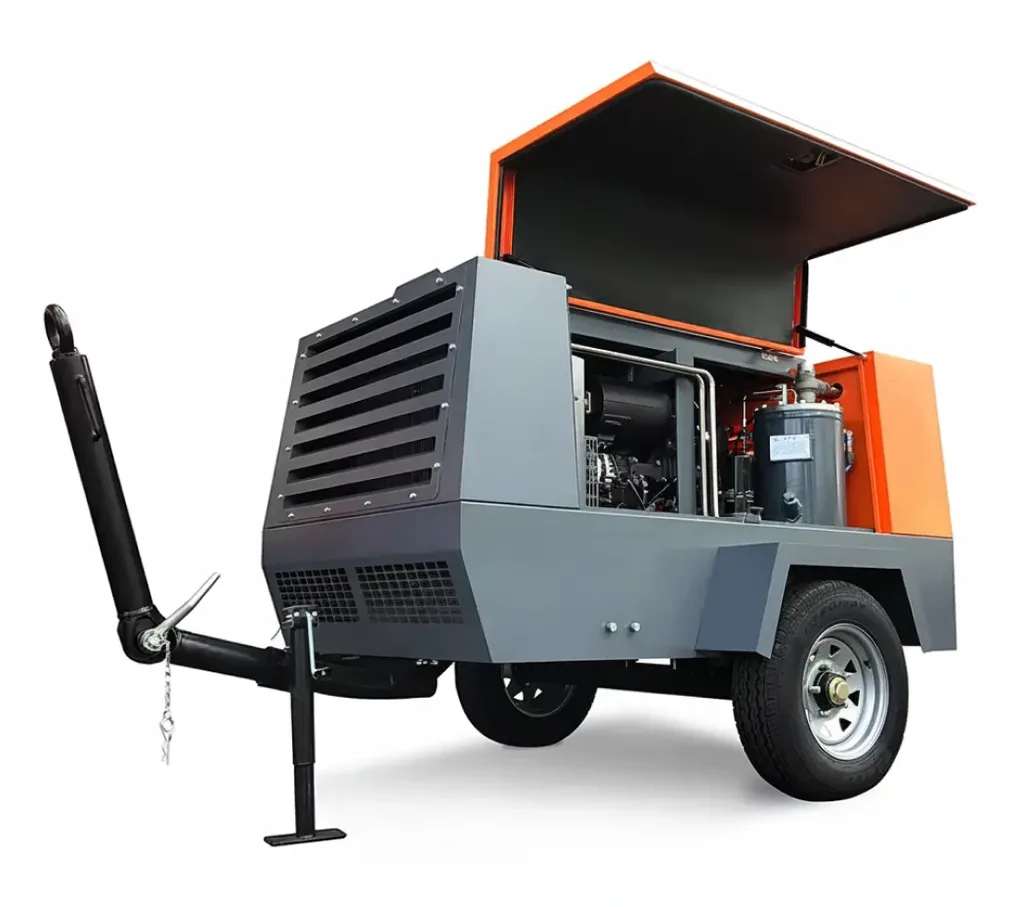
Five Observations to Record Before Troubleshooting
- Is the diesel engine continuously running, or actually stopping and restarting?
- At what pressure and time does each load, unload or stop event occur?
- Does engine RPM change with each event, and does the controller command that change?
- Are the symptoms linked to tool shutdowns, air-demand peaks or periods of no demand?
- Do any controller warnings, temperature alarms or safety-valve events appear?
How Pressure Band and Compressor Controls Affect Cycling
With basic pressure-dependent regulation, a controller or pneumatic governor responds to pressure. At an upper threshold, the machine reduces delivery or unloads; as pressure falls toward a lower threshold, it increases output or reloads.
The pressure band is the difference between these operating thresholds. A narrow band leaves less room to absorb varying demand. It may cause rapid transitions if the compressor is large relative to the job’s actual airflow or if the system contains very little usable storage.
For illustration only, imagine a controller that reloads at 7.0 bar and unloads at 7.2 bar. Its band is 0.2 bar. A different approved setting with a wider band could reduce transitions, but whether either setpoint is permissible depends on the exact compressor, attached tools, minimum system pressure and safety limits.
Do not widen the band by arbitrarily raising maximum pressure. That can increase fuel use, exceed downstream component limits, or trigger protection. Lowering the minimum pressure can leave tools without enough working pressure after hose and filter losses.
Six Reasons a Portable Diesel Compressor Loads and Unloads Too Often
1. Air Demand Is Far Below Compressor Capacity
An oversized unit may fill the available receiver quickly, unload, and reload when a relatively small tool or leakage drains the stored air. This is more likely during partial shifts, intermittent tool use or when several tools normally connected to the compressor are idle.
2. Pressure Band or Controller Timing Is Unsuitable
Incorrect settings, an unstable pressure signal, excessive sensor filtering delay or inappropriate control timing can make the machine respond repeatedly to small pressure fluctuations.
3. The Receiver Does Not Provide Useful Buffering
An integrated separator vessel or small onboard receiver is not the same as a suitably sized external air-storage system. A receiver placed behind a restricted valve or narrow connection may not supply the control point quickly enough. Closed isolation valves and malfunctioning drains can also reduce the usable volume.
Additional storage must be engineered for the actual compressor, pressure, site conditions and transient demand. The compressor’s internal air/oil separator vessel must never be treated as a general-purpose storage tank or modified for extra receiver capacity.
4. A Hose, Filter or Valve Creates Pressure Drop
The compressor may reach its upper setpoint while pressure at the tool remains low. A blocked filter, undersized hose, defective check valve or partly closed isolation valve can separate what the controller senses from what the job needs.
Compare pressure at the compressor and at the user while air is flowing. A restriction often looks harmless when tools stop and line pressure equalizes.
5. Inlet-Valve, Solenoid or Pilot-Air Control Hunts
A sticking inlet valve, inconsistent solenoid response, leaking control line or faulty transducer can cause output to oscillate. But a cycling symptom does not prove that the valve is defective.
6. Intermittent Demand, Leaks or Multiple Compressor Controls Interact
Short blasts of pneumatic demand can depress pressure faster than an average-CFM calculation suggests. In multi-compressor arrangements, overlapping control bands may cause two units to load and unload together.
Receiver Tank and Pressure Band: A Simple Calculation
Stored air depends on receiver volume, absolute pressure and the allowable pressure change. A useful first approximation for an isothermal receiver is:
Usable free-air volume ≈ receiver volume × (upper pressure − lower pressure) ÷ atmospheric reference pressure
Use consistent units and absolute pressure for the reference. With pressure difference expressed in bar and atmospheric reference approximately 1 bar, a 1.0 m³ external receiver operating across a 1 bar pressure difference stores about 1.0 m³ of reference-volume air between those limits.
If a tool consumes 2 m³/min of reference air while the compressor is unloaded, the ideal storage-only interval is roughly 30 seconds. If the permitted pressure swing were only 0.2 bar, the same receiver provides about 0.2 m³ of reference air—approximately 6 seconds at the same demand.
This is an illustration, not a receiver-sizing recommendation. Actual cycling also depends on compressor response, temperature, pressure losses and demand. Mobile storage requires proper pressure certification, space, weight and safe connections.
Five Checks Before Considering Additional Storage
- Confirm that insufficient usable storage, rather than control instability or a restricted line, is responsible.
- Measure peak and average airflow demand and the duration of each demand event.
- Verify the approved minimum tool pressure and maximum allowed system pressure.
- Have qualified personnel size, rate, protect, drain and secure any external receiver.
- Confirm that the revised arrangement maintains correct compressor minimum-pressure, lubrication and protection functions.
Idle Fuel Use: Why Frequent Unloading Matters
A diesel engine does not stop consuming fuel just because the compressor delivers little or no useful air. Many mobile units reduce engine speed during unloaded running; others offer a distinct no-load mode or an automatic shutdown sequence.
For a representative shift, calculate fuel using the actual fuel rate in each operating state:
Shift fuel = loaded hours × loaded L/h + unloaded hours × unloaded L/h + other running states
For example, if a particular machine consumes 10 L/h during unloaded running, two unloaded hours consume 20 liters without productive compressed-air delivery. That rate is only an illustrative machine-specific value, not a universal diesel-compressor idle rate.
Short Cycling Troubleshooting Table
| Observed pattern | Most useful first check | Likely investigation | Avoid |
|---|---|---|---|
| Engine runs; load/unload events are very frequent | Pressure and event trend | Pressure band, demand mismatch, available storage | Replacing the inlet valve without confirming commands |
| Pressure rises at compressor but tool pressure stays low | Simultaneous flowing-pressure readings | Hose, filter, dryer, valve or coupling restriction | Raising discharge pressure blindly |
| Cycling mainly during light tool use | Actual load versus compressor FAD | Oversizing, modulating range, job scheduling | Adding another large compressor |
| Pressure display differs from test gauge | Instrument comparison | Pressure sensor, sensing port, wiring or control | Adjusting settings against an unverified reading |
| Engine repeatedly stops with alarm | Fault/event history | Temperature, oil pressure, fuel or protective shutdown | Treating shutdowns as ordinary unload cycles |
| Two compressors unload together | Lead/lag and control-setpoint log | Overlapping bands or sequencing | Changing both controls independently |
Five-Step Field Diagnostic Sequence
- Observe safely: Capture at least several complete cycles during the complaint, including normal and low demand.
- Compare pressures: Note compressor outlet, receiver and tool pressure with airflow present, using existing safe instruments.
- Match the events: Plot load state, RPM, pressure, tool operation and any alarm on the same timeline.
- Separate control from demand: Check actual FAD requirements, pressure band, storage availability and control-command response.
- Verify the repair: After approved adjustments or component service, repeat the test at the same demand and document pressure stability and loaded/unloaded time.
Safety: Pressure systems store hazardous energy. Do not disconnect pressurized hoses or pilot lines, bypass relief or protective controls, or make live electrical adjustments. Any internal inspection, receiver installation, or control modification requires manufacturer-approved procedures and qualified personnel.
Real-World Operating Lessons
The following examples come from published third-party project accounts. They illustrate general compressed-air system behavior.
Case 1 — Intermittent Demand Caused Four Compressors to Overcycle
At a large industrial facility, four fixed-speed 300 hp screw compressors were installed, including one intended as a standby unit.
High-flow, intermittent demand events caused pressure to dip outside the planned control range. All four units responded by loading and unloading too frequently. The same events also made inadequately supported point-of-use piping move and stressed pipe hangers.
The published investigation describes corrective work involving additional piping support and appropriately sized local buffer tanks. The system subsequently achieved more stable pressure and returned the standby machine to its intended role.
Practical lesson: A compressor may be reacting correctly to poorly buffered demand. This case concerns a stationary industrial system; its equipment and receiver sizes are not recommendations for portable diesel units.
Case 2 — Storage, Restrictions and Control Settings Interacted
A precision manufacturing plant operated two 50 hp compressors.
One unit exceeded its recommended cycling frequency, and the facility also experienced oil contamination in its compressed-air lines.
An assessment identified limited effective storage, a 4–6 psi restriction through downstream treatment, and control settings that needed coordination.
The published service account describes a revised receiver arrangement, added filtration and adjustments to the two compressors’ controls. It reports reduced cycling on the first unit, along with improvements in air treatment and system performance.
Practical lesson: Replacing an inlet valve alone may not resolve cycling when pressure losses, controls and storage interact.
This is a supplier-reported stationary electric-system example, not a mobile diesel compressor test.
Case 3 — Unloaded Diesel Operation Still Uses Fuel
In a published portable-compressor operating account, a drilling contractor reported approximately 10 L/h at idle and 44 L/h at full load for one specific machine.
The contractor also described lower fuel use than its previous equipment under its particular operating pattern.
Practical lesson: Long unloaded periods can have a measurable fuel cost even when no productive air is delivered.
The figures belong to one reported machine and duty cycle. This is not a short-cycling repair case, and the rates must not be applied to Peakroc® models without their own data.
Final Recommendation
Do not judge a portable diesel screw compressor by the sound of repeated loading alone.
Identify the actual operating state, collect pressure and controller trends, compare demand with verified capacity, and only then investigate storage or control components.
For many field complaints the most useful question is not, “Which part should I replace?”
It is “What pressure does the compressor sense, what airflow is the job asking for, and how does the controller respond?”
Correcting the cause can improve pressure stability, avoid unnecessary parts replacement and reduce nonproductive fuel consumption.
Any change must remain within the manufacturer-approved operating envelope.
FAQ
Why does my portable diesel air compressor keep loading and unloading?
Common causes include a pressure band unsuited to actual demand, low usable storage, a large compressor serving a small load, restrictions, pressure-sensor faults, or unstable inlet/control valves. Record operating states and pressures before replacing parts.
Is a 30–60 second load/unload cycle always abnormal?
No. There is no universal cycle-time limit across all portable diesel compressors. Compare the observed pattern with the specific model’s control strategy, minimum-run requirements and manufacturer instructions.
Does short cycling mean the diesel engine keeps starting and stopping?
Not necessarily. On many portable screw compressors the engine keeps running while the airend changes between loaded and unloaded states. Repeated engine starts or protective shutdowns require separate diagnosis.
Can a narrow pressure band cause frequent unloading?
Yes. A narrow difference between loading and unloading thresholds allows less pressure variation before the next transition. Any adjustment must preserve tool pressure and stay within the compressor’s approved limits.
Will adding a receiver tank stop compressor short cycling?
Only when inadequate usable storage contributes to the problem. A receiver will not repair a faulty pressure sensor, unstable inlet valve, restricted hose or unsuitable control logic. Any added receiver must be properly engineered and protected.
Can a faulty inlet or unloader valve cause pressure hunting?
Yes, but so can sensors, pilot-air leaks, solenoid faults or control settings. Verify the pressure signal and the complete control-command chain before deciding which component needs repair.
Does a diesel compressor burn fuel while unloaded?
Usually yes, if the engine continues running. The fuel rate depends on engine speed, compressor design and control mode. Record loaded, unloaded and idle hours with actual fuel data to estimate cost.
What should I measure before changing compressor controls?
Record compressor and tool pressure during airflow, load/unload thresholds, event duration, engine RPM, actual tool demand, recent maintenance changes and any alarms. Use qualified service personnel for approved adjustments.
Author

Mark Chen – Senior Mechanical Engineer, Peakroc®
Mark Chen is a senior mechanical engineer at Peakroc®, specializing in compressed air systems and drilling equipment for mining and construction applications. With over 15 years of field experience, he has led multiple projects on optimizing air delivery efficiency, equipment durability, and energy consumption.