
Key Takeaways
- There is no universal rule saying every factory should install 10%, 20%, or 30% spare compressor capacity. The correct margin depends on what the reserve is expected to cover.
- A practical planning range can be around 10–20% when demand is well measured and relatively stable, while larger margins may be justified where production varies substantially or confirmed expansion is approaching. These percentages are starting points, not engineering standards.
- Use compressor FAD for sustained demand and receiver storage for short peaks. A larger receiver cannot permanently compensate for insufficient compressor output.
- Reserve for normal demand variation is different from N+1 redundancy. If losing one compressor would stop critical production, the factory may need dedicated standby capacity rather than simply adding 20% to one large machine.
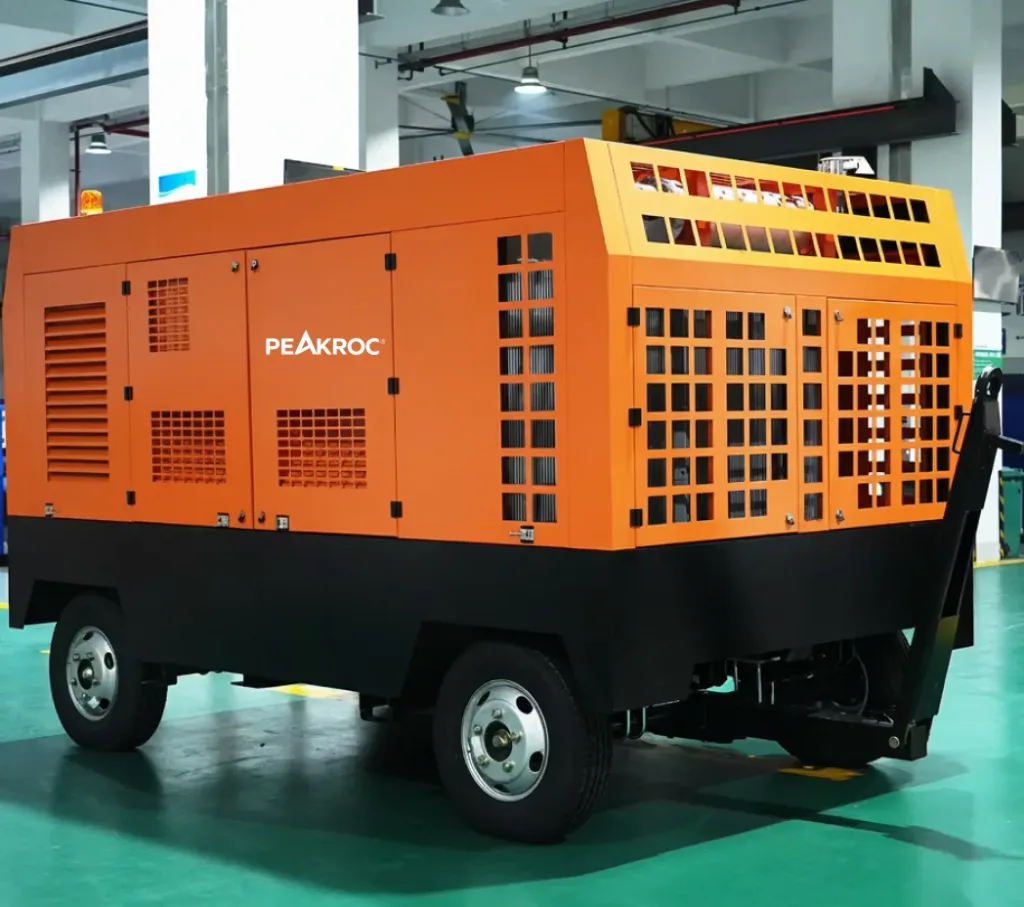
- For temporary maintenance or contingency capacity where the plant requirement matches the operating range, Peakroc® offers the 20 m³/min, 13 bar portable compressor and the higher-flow 45 m³/min, 10 bar portable compressor. Final selection must follow the actual missing FAD and pressure requirement.
Once a factory has calculated its compressed-air demand, another question usually appears:
How much extra compressor capacity should we install?
10%?
20%?
30%?
It is tempting to choose one percentage and apply it to every project.
That is rarely the best approach.
A useful compressor reserve is not simply “extra CFM.” It should protect the plant against a specific source of uncertainty or risk.
That might be:
normal demand variation, short production peaks, measurement uncertainty, near-term growth, planned maintenance, or compressor failure.
Those conditions should not all be solved in the same way.
First Define What the Reserve Is Supposed to Cover
Suppose a factory’s measured peak demand is:
1,000 CFM
Adding:
10% reserve = 1,100 CFM
20% reserve = 1,200 CFM
30% reserve = 1,300 CFM
The calculation itself is simple:
Reserve % = (Usable Installed Capacity − Design Demand) ÷ Design Demand × 100
The harder question is whether the additional 100, 200, or 300 CFM is actually needed.
The reference sizing guide suggests that relatively stable, well-measured systems can often begin with a moderate spare-capacity range, while more variable production and near-term expansion may justify a larger allowance.
That is useful as a planning framework, but it should not become a universal rule.
CAGI recommends establishing a real demand profile that captures minimum, average, and maximum flow over representative operating periods. A week of logged compressor power, pressure, or flow data can reveal how much the system actually changes between shifts and production conditions.
For an existing factory, this is usually more valuable than estimating demand from compressor nameplates.
Peakroc follows the same principle in our Factory Compressed Air System Sizing Guide: measure or calculate production demand first, then decide how much additional capacity the system needs.
When 10% May Be Enough
A reserve around 10% can be reasonable when:
- demand has been measured across representative production cycles;
- production is relatively stable;
- leakage and pressure losses are well controlled;
- no major equipment additions are expected soon.
In that situation, the extra capacity mainly protects against small day-to-day variation and normal operating uncertainty.
When 20% Is More Comfortable
Around 20% is often used as a planning margin when demand is generally predictable but the plant still expects:
- moderate shift-to-shift variation;
- small new air users;
- changes in production mix;
- normal filter loading and system variation.
But even here, 20% should not be treated as a compulsory number.
If the plant consumes only 55% of installed capacity most of the year, adding another 20% may simply create more unused capacity.
When 30% Needs a Clear Reason
A 30% reserve may be justified where the plant has significant demand variation, confirmed production additions, uncertain measurement data, or repeated sustained peaks.
But before buying that extra compressor capacity, ask why the margin is needed.
If the real cause is:
large leaks, poor sequencing, excessive pressure, or distribution restrictions
then installing another 30% of compressor capacity may only hide the underlying system problem.
Short Peaks Do Not Automatically Need More Compressor CFM
One of the most common reasons factories oversize compressors is short-duration peak demand.
Imagine a production line that normally consumes:
700 CFM
but briefly rises to:
950 CFM for 15 seconds
when several actuators operate together.
Should the factory install a compressor capable of continuously supplying 950 CFM?
Not necessarily.
Receiver storage exists partly to handle this type of event.
The compressor supplies relatively steady airflow while the receiver supplies the short additional burst. After the event, the compressor restores receiver pressure.
CAGI emphasizes that storage and compressor capacity solve different problems.
The simple rule is:
Compressor reserve handles sustained demand.
Receiver storage handles short-duration demand.
If production consumes 950 CFM continuously while the compressor only produces 800 CFM, even a very large receiver will eventually lose pressure.
But if the 950 CFM event lasts only seconds, proper storage may avoid permanently operating an oversized compressor.
This is why peak demand must always be recorded together with:
peak flow + peak duration + allowable pressure drop + recovery time
rather than peak CFM alone.
Capacity Margin Is Not the Same as N+1 Redundancy
Another common mistake is assuming that:
“We installed 20% reserve, so we have backup.”
Usually, that is not true.
Suppose a factory needs:
1,000 CFM
and installs one:
1,200 CFM compressor
The system has a 20% operating margin.
But if that compressor fails:
available capacity = 0 CFM
There is no compressor redundancy.
N+1 answers a different question:
Can the required production load continue when one required compressor is unavailable?
CAGI gives useful examples.
For a relatively stable plant, two compressors each capable of supplying 100% of system demand can provide full standby.
For more variable demand, three compressors each sized around 50% of maximum demand can allow two units to cover peak production while the third remains available as backup. At lower demand, one smaller machine can operate as trim instead of deeply part-loading one very large compressor.
So:
20% reserve ≠ N+1
and:
N+1 does not necessarily mean 20% or 30% extra capacity.
If compressor failure would immediately stop production, evaluate redundancy separately.
Peakroc’s N+1 Compressor Redundancy Guide explains this one-compressor-out calculation in more detail.
Peakroc Client Experience: Reserve Capacity Should Have a Job
A Peakroc customer project provides a useful real-world example of why installed capacity should be divided between working capacity and reserve capacity rather than simply maximizing the amount of compressor equipment running.
The customer was operating four drilling rigs using three 15 m³/min compressors in parallel.
The arrangement supplied enough air, but it also created:
multiple fuel systems, separate maintenance schedules, uneven loading, and additional service complexity.
After reviewing the actual simultaneous airflow requirement, Peakroc supplied one 45 m³/min, 10 bar PRMD-4510 to carry the main operating load.
The customer did not discard all previous capacity.
One 15 m³/min compressor was deliberately retained as emergency reserve.
After ten months, Peakroc’s published project data reported operational uptime of 96.8% compared with 91.2% previously, around 60% less maintenance downtime, and substantially lower combined fuel consumption.
This was a mining application rather than a stationary factory compressor room, so the exact configuration should not be copied into a factory.
The engineering lesson is transferable:
Reserve capacity creates value when it has a defined purpose. It does not necessarily need to operate every hour.
In this case:
main capacity handled production
while:
separate reserve protected against interruption.
That is often better than operating excess equipment simply because spare capacity exists.
Oversizing Can Create Its Own Operating Problem
A larger compressor may appear safer because it offers more reserve.
But excess capacity has consequences.
Consider a factory with:
800 CFM average demand
and:
1,000 CFM sustained peak demand
If the plant buys one 1,300 CFM fixed-output machine simply because “30% reserve sounds safer,” the compressor may spend much of its life well below full load.
Depending on compressor type and control method, this can lead to:
part-load operation → unloading → cycling → unnecessary energy consumption
CAGI notes that industrial compressed-air systems frequently spend substantial operating time below full load and that poor part-load control can be highly inefficient.
The better architecture may be:
base compressor + trim compressor + standby capacity
rather than:
one compressor large enough for every possible scenario.
For highly variable factories, modular capacity also makes future growth easier.
Instead of buying today’s compressor for a production line that may arrive three years from now, the plant can prepare:
- electrical capacity;
- compressor-room space;
- main header capacity;
- controls;
- dryer and filtration expansion;
- future connection points.
Then add the compressor module when the actual demand appears.
This avoids operating oversized equipment for years while still making expansion straightforward.
Peakroc Factory Experience: Fix Delivery Problems Before Adding Reserve
Reserve planning should also consider whether apparent capacity shortage is really a compressor problem.
One Peakroc industrial customer operates a cement plant where compressed-air equipment must work in high dust and elevated temperatures.
Supplying stable compressor capacity was only part of the project.
Peakroc engineers also worked with the customer on optimizing the compressed-air pipeline system because sufficient compressor output is useful only if air reaches production with acceptable pressure.
The customer later specifically highlighted both stable compressor operation and the pipeline improvement work.
This matters to reserve sizing.
If the factory experiences low point-of-use pressure because of:
undersized piping, restrictive filters, valves, leaks, or distribution losses
adding another 20% of compressor capacity may not solve the root problem efficiently.
The compressor room can have plenty of spare CFM while the production equipment still receives inadequate pressure.
So before increasing reserve, verify:
Actual Demand → Leakage → Treatment Pressure Drop → Distribution → Point-of-Use Pressure
This prevents “reserve capacity” from becoming a substitute for system troubleshooting.
A Practical Way to Decide Between 10%, 20%, and 30%
Instead of choosing a percentage first, work through the following sequence.
1. Establish measured design demand
Determine minimum, average, sustained peak, and short-duration peak FAD.
2. Separate short peaks from continuous demand
Use receiver storage and controls where the event is genuinely brief.
3. Remove avoidable demand
Repair leaks, eliminate unnecessary blow-off, and correct excessive operating pressure before sizing permanent reserve.
4. Define future growth separately
Add confirmed production demand when it is known. For uncertain future growth, prepare the infrastructure rather than automatically installing all future compressor capacity today.
5. Calculate reliability reserve separately
If one compressor failure is unacceptable, perform an N+1 study rather than relying on an arbitrary percentage.
This leads to a much stronger decision than:
“Industry practice says add 20%.”
For one factory, the correct answer may indeed be:
1,000 CFM demand + 15% operating margin
For another, it may be:
1,000 CFM production demand + receiver storage + two 500 CFM base units + one 500 CFM standby
And for another, the most efficient solution may be:
1,000 CFM today + infrastructure for another 400 CFM later
The percentage is the result of the engineering decision—not the starting point.
Final Recommendation
There is no universal answer to:
“Should we add 10%, 20%, or 30% compressor reserve?”
The correct reserve depends on what the extra capacity is expected to protect against.
Use a moderate operating margin for normal demand uncertainty.
Use receiver storage for short peaks.
Use trim capacity and sequencing for variable demand.
Use dedicated redundancy when losing one compressor would stop critical production.
And treat confirmed future expansion separately from hypothetical growth.
The most useful planning sequence is:
Measure Demand → Define Peak Duration → Remove Waste → Add Operating Margin → Evaluate Storage → Evaluate N+1 → Plan Confirmed Growth → Check Part-Load Efficiency
The goal is not to install the highest possible spare CFM.
It is to maintain:
stable pressure + sufficient airflow + reliable production + efficient compressor loading
through normal production, peak demand, maintenance, and future changes.
That is what useful compressor capacity reserve should accomplish.
FAQ
Is 20% spare compressor capacity enough for a factory?
It can be a reasonable planning margin for a stable system, but it is not a universal standard. Actual reserve should follow measured demand variation, future growth, storage, leakage, and reliability requirements.
When is 10% compressor reserve enough?
A smaller margin may be appropriate where demand has been measured accurately, production is stable, leakage and pressure losses are controlled, and no major near-term expansion is expected.
Is 30% compressor reserve too much?
Not necessarily, but it should have a clear reason. Significant production variation or confirmed expansion can justify a larger margin. Installing 30% extra capacity simply because of uncertainty can lead to oversizing and inefficient part-load operation.
Can a receiver tank replace spare compressor capacity?
Only for short-duration peaks. A receiver cannot continuously supply a sustained airflow deficit.
Does 20% reserve provide N+1 redundancy?
No. N+1 means the system can lose one required compressor and still maintain the defined critical load. A single compressor with 20% spare capacity still provides zero capacity if that machine fails.
Should future factory expansion be included in compressor sizing?
Yes, but distinguish confirmed expansion from possible future growth. Often it is better to reserve electrical, piping, controls, and compressor-room capacity and add another compressor module when the new demand actually arrives.
Author

Mark Chen – Senior Mechanical Engineer, Peakroc®
Mark Chen is a senior mechanical engineer at Peakroc®, specializing in compressed air systems and drilling equipment for mining and construction applications. With over 15 years of field experience, he has led multiple projects on optimizing air delivery efficiency, equipment durability, and energy consumption.