
Key Takeaways
- Compressed-air leakage should be quantified in lost CFM/FAD first and annual cost second. The cost depends on system pressure, compressor specific power, annual pressurized hours, and electricity rate.
- Hole-size tables are useful for screening, not exact measurement. Real leaks have irregular geometry, so field measurements or ultrasonic estimates are more reliable when money or capacity decisions are involved.
- Higher system pressure makes every existing leak more expensive because it increases leak flow and usually raises compressor power consumption.
- A good leak program follows one loop: detect → estimate CFM → calculate cost → repair → verify → re-survey.
- Before adding compressor capacity, confirm how much current output is useful production demand and how much is being lost through leakage or distribution problems.
A compressed-air leak is easy to ignore because the system normally keeps working. The compressor simply runs longer, loads more often, or operates at a higher duty cycle to replace the lost air.
That is why leakage should be treated as a measurable production cost rather than a maintenance nuisance.
The useful question is not:
“How loud is the leak?”
It is:
“How much free air is being lost, how much power is required to replace it, and what does that cost over the hours the system remains pressurized?”
From Leak Size to Lost CFM
Many leak-cost guides estimate airflow by treating the leak opening as an orifice.
The important relationship is that leak area increases with the square of diameter:
Area = π × (Diameter / 2)²
So a hole twice the diameter has approximately four times the flow area under similar conditions.
Using a sharp-edged-orifice assumption at about 100 psig, one engineering calculation gives approximately:
| Approx. Leak Diameter | Estimated Leakage |
|---|---|
| 1/32 in | 1.34 CFM |
| 1/16 in | 5.35 CFM |
| 1/8 in | 21.4 CFM |
| 1/4 in | 85.6 CFM |
These numbers are useful for ranking leaks, but they should not be treated as universal field measurements.
A worn quick coupling, cracked hose, damaged gasket, corroded thread, or irregular opening does not behave exactly like a clean drilled hole.
Different calculation assumptions can therefore produce different CFM estimates for the same nominal diameter.
The practical rule is:
Use leak-size tables to estimate order of magnitude; use field measurement when the financial or compressor-capacity decision is important.
For factories also reviewing total compressor capacity, Peakroc’s Factory Compressed Air System Sizing Guide explains how production demand, peak flow, pressure, storage, and distribution should be evaluated together.
Convert Lost CFM Into Annual Cost
Once leak airflow is known, the cost calculation becomes much more useful.
A practical relationship is:
Annual Leak Cost = Leak CFM × Compressor Specific Power × Pressurized Hours × Electricity Rate
If compressor specific power is expressed in kW per CFM, every variable is easy to understand.
For example, assume:
- leak flow: 21.4 CFM
- compressor specific power: 0.178 kW/CFM
- system pressurized: 8,760 hours/year
- electricity rate: $0.10/kWh
Power required only to replace the leaked air is:
21.4 × 0.178 ≈ 3.81 kW
Estimated annual electricity cost becomes:
3.81 × 8,760 × $0.10 ≈ $3,338/year
If electricity costs $0.15/kWh, the same physical leak costs approximately $5,000 per year.
Nothing about the hole has changed.
Only the cost of producing the replacement compressed air has changed.
This is why statements such as:
“A 1/8-inch leak costs $X per year.”
should always be treated cautiously.
The actual result depends on:
compressor efficiency + pressure + annual operating hours + electricity price
The strongest calculation uses the actual compressor’s measured or published specific power at the relevant working pressure rather than a generic industry average.
Operating hours also matter.
A one-shift workshop and a continuous 24/7 factory can have exactly the same leak but very different annual losses.
Use the number of hours the distribution system is actually pressurized, including nights and weekends if the compressor remains running after production stops.
Pressure Makes Every Leak More Expensive
System pressure affects leakage in two ways.
First, higher upstream pressure generally pushes more air through the same opening.
Second, producing compressed air at a higher pressure normally requires more compressor power.
This means that solving a low-pressure complaint by simply increasing compressor discharge pressure can make every existing leak more expensive.
Suppose production requires 6.5 bar, but operators keep the compressor substantially above that pressure because air is being lost through piping, filters, valves, or branch lines.
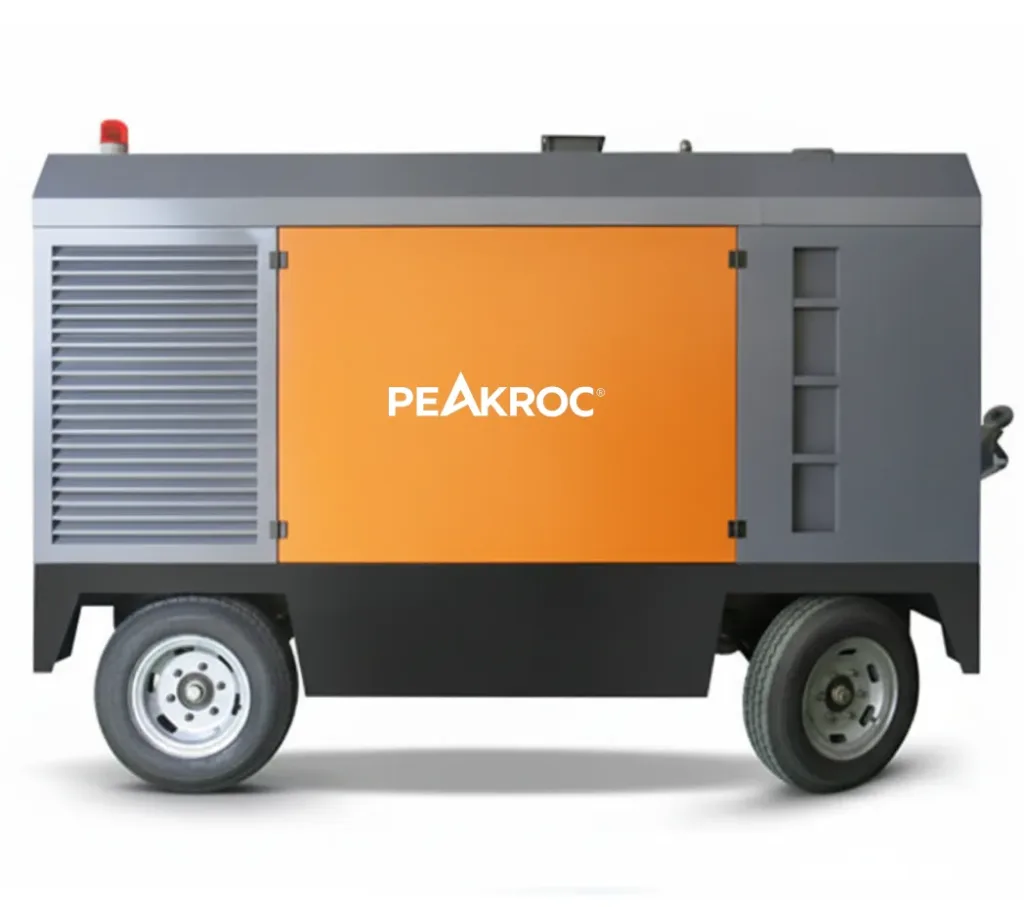
The factory may then be paying for:
distribution pressure loss + unnecessary compression pressure + increased leakage
at the same time.
A better approach is to diagnose the pressure path.
Check whether the problem comes from:
leaks → undersized piping → dirty filters → restrictive valves → long branch lines
before increasing compressor pressure or purchasing more capacity.
Peakroc’s compressed-air filter selection guide explains the same principle from the treatment side: an undersized or dirty filter can consume pressure that the compressor has already paid to produce.
Peakroc Client Experience: Optimize Air Delivery Before Adding Capacity
One Peakroc industrial customer operates a cement plant where the compressed-air equipment must work in a high-dust, high-temperature environment.
Reliable compressor operation was an important part of the project, but Peakroc’s engineering support did not stop at supplying the machines.
Our engineers also worked with the customer on optimizing the compressed-air pipeline system so that air could reach the operating equipment more efficiently.
The customer later highlighted both the stable operation of the Peakroc compressors and the pipeline optimization support.
This project was not presented as a formal compressed-air leak audit, so it should not be interpreted as one.
The engineering lesson is broader:
A correctly sized compressor can still deliver poor system performance if the distribution network wastes pressure or airflow.
When a factory reports low pressure or believes additional compressor capacity is needed, Peakroc therefore looks beyond the compressor nameplate.
A useful system review follows this path:
Compressor Output → Treatment Pressure Drop → Main Header → Branch Piping → Hoses and Couplings → Point-of-Use Pressure → Unproductive Air Demand
Leaks belong inside that same analysis.
The compressor cannot distinguish between productive air and air escaping from a damaged fitting.
To the compressor, both are simply demand.
So before installing another compressor, the more useful question is:
How much of the current compressor output is actually reaching useful production?
More Peakroc factory applications can be found in our industrial compressed-air case resources.
Estimate Total Plant Leakage, Not Just Individual Leaks
Individual leak tags are useful, but management also needs a plant-level baseline.
For load/unload compressors, total leakage can be estimated during non-production periods by monitoring how long the compressor remains loaded compared with unloaded.
Another approach is a controlled pressure-decay test using known system volume and measuring how quickly pressure falls between two defined values.
These methods do not tell technicians where each leak is located.
They answer a different question:
What percentage of compressor capacity is being consumed when useful production demand should be minimal?
That baseline is valuable before and after a leak-repair campaign.
If technicians repair dozens of tagged leaks but total plant leakage remains high, the survey may have missed:
inaccessible piping, automatic drains, leaking valves, open blow-offs, or idle machines that continue consuming air.
A stronger program therefore combines:
Plant-Level Baseline + Individual Leak Detection + Post-Repair Verification
Find Leaks Efficiently and Repair by Value
Some large leaks can be found by sound.
Many others cannot.
A production plant contains motors, fans, conveyors, pneumatic tools, exhaust systems, and other background noise that can mask the hiss of escaping air.
Ultrasonic leak detection helps locate the high-frequency acoustic energy produced by turbulent compressed-air leakage.
But finding the leak is only the first step.
A useful survey should record:
Location + Estimated CFM + Estimated Annual Cost + Repair Status
Then prioritize work economically.
The largest leak is often the logical first repair, but repair difficulty also matters.
A medium-size leak at a quick coupling that takes ten minutes to replace can offer a better immediate payback than a difficult leak that requires a full production shutdown.
A practical priority concept is:
Repair Priority ≈ Estimated Annual Leak Cost ÷ Repair Cost or Repair Effort
After the repair, verify that the leak is actually gone and check whether compressor loading or total plant flow has changed.
A maintenance ticket marked “completed” does not prove the energy saving occurred.
Treat Leak Detection as an Ongoing Program
Leaks return.
Vibration loosens connections.
Hoses age.
Quick couplings wear.
Seals harden.
Maintenance activities introduce new joints into the compressed-air network.
A one-time survey may create significant savings, but those savings gradually disappear if nobody owns the follow-up process.
A practical leak-management program only needs four connected stages:
- Baseline current flow, pressure, compressor loading, and identified leakage.
- Prioritize repairs by CFM loss, annual cost, and repair difficulty.
- Repair and verify that both the individual leak and system demand improve.
- Re-survey at an interval appropriate for the factory.
For plant management, the most useful KPI is usually not:
“Number of leaks found.”
Better measures include:
estimated total leak CFM
compressed-air kWh
or:
compressed-air consumption per unit of production
These indicators show whether the factory is actually sustaining the savings.
Final Recommendation
Compressed-air leakage should be treated as measurable energy waste.
Start with lost airflow.
Estimate or measure the leak CFM.
Convert that airflow into compressor power using the actual machine’s specific power whenever possible.
Then apply the real annual pressurized hours and electricity rate.
The practical sequence is:
Detect → Quantify CFM → Calculate Cost → Repair → Verify → Re-Survey
Do not use hole-size charts as exact field measurements.
Do not assume high compressor loading automatically means more compressor capacity is required.
And do not continuously raise system pressure to compensate for leaks or distribution restrictions.
Peakroc’s industrial system experience reinforces the same principle:
Reliable compressor output only creates value when the air reaches production efficiently.
Before investing in additional capacity, determine how much existing compressed air is being used productively and how much is being lost.
That is where compressed-air leak detection becomes more than a maintenance task.
It becomes a capacity, energy, and operating-cost decision.
FAQ
How do you calculate compressed-air leak cost?
Estimate or measure the leak flow in CFM, multiply it by compressor specific power in kW/CFM, then multiply by annual pressurized hours and electricity rate.
Does higher pressure increase compressed-air leakage?
Yes. Higher upstream pressure generally increases airflow through an existing leak and also increases the energy required to produce the compressed air.
Are leak-size tables accurate?
They are useful for estimating magnitude, but real leaks have irregular geometry. Use ultrasonic estimates, flow measurements, or plant-level leakage tests when greater accuracy is required.
What is the best way to find leaks in a noisy factory?
Ultrasonic leak detection is commonly used because it detects high-frequency energy produced by escaping compressed air even when normal production noise makes the leak difficult to hear.
Should leaks be repaired before buying another compressor?
In most cases, first confirm productive demand, leakage, pressure drop, and control performance. Repairing wasted demand may reduce or eliminate the need for additional compressor capacity.
Author

Mark Chen – Senior Mechanical Engineer, Peakroc®
Mark Chen is a senior mechanical engineer at Peakroc®, specializing in compressed air systems and drilling equipment for mining and construction applications. With over 15 years of field experience, he has led multiple projects on optimizing air delivery efficiency, equipment durability, and energy consumption.