
Key Takeaways
- N+1 should be defined by remaining usable capacity, not machine count. After one required compressor is unavailable, the remaining system should still deliver the factory’s defined critical FAD at the required pressure and air quality.
- For temporary or maintenance backup where the plant requirement matches its operating range, the Peakroc® 20 m³/min, 13 bar portable diesel compressor can provide an independent air source while permanent equipment is unavailable.
- Large low-to-medium-pressure plants requiring substantial emergency airflow can evaluate the Peakroc® 45 m³/min, 10 bar portable diesel compressor or multiple appropriately controlled units. Final selection must follow actual one-compressor-out demand.
- Receiver storage supports transient demand but does not replace standby compressor FAD. Stored air eventually runs out; sustained production requires sustained generating capacity.
- A truly redundant compressed-air system may also require redundancy in dryers, filtration, controls, power, and distribution, because a spare compressor cannot protect production from every single-point failure.
N+1 Starts With One Question: What Happens When One Compressor Stops?
Factories often describe compressor rooms this way:
“We have three compressors, so we have redundancy.”
That may be true.
It may also be completely wrong.
Consider a plant with:
| Compressor | Rated FAD |
|---|---|
| A | 2,000 CFM |
| B | 500 CFM |
| C | 500 CFM |
The plant requires 2,500 CFM during critical production.
All three machines together can provide 3,000 CFM, so installed capacity appears comfortable.
But if the 2,000 CFM compressor fails, only 1,000 CFM remains.
The plant owns three compressors, but it does not have meaningful N+1 redundancy for a 2,500 CFM critical load.
The engineering definition should therefore be closer to:
Remaining usable capacity after one credible compressor outage ≥ required critical production FAD
This is the central idea behind the entire redundancy study.
CAGI describes redundancy as duplication of critical capacity to improve system reliability and notes that it should be considered wherever loss of compressed air could shut down an operation.
The important word is critical.
A factory does not automatically need to reproduce every cubic foot of its absolute historical peak during an emergency.
It needs enough air to protect the level of production management has decided must continue.
Full Peak Demand and Critical Demand May Be Different
Suppose a factory normally reaches:
3,000 CFM
during maximum production.
But if one compressor fails, operators can temporarily stop non-critical cleaning air, selected packaging equipment, and several open blowing applications.
Essential production then requires only:
2,300 CFM
The N+1 design target may therefore be 2,300 CFM rather than the full 3,000 CFM.
That can significantly change the required standby investment.
However, the 2,300 CFM figure should not be guessed.
It needs to come from an agreed operating plan identifying which loads remain essential and which can be shed without creating quality, safety, or production problems.
For a factory where every production line must remain operational, critical demand may indeed equal the full sustained peak.
This is why Peakroc approaches redundancy as a production-risk problem first and a compressor-selection problem second.
How Much Standby Capacity Is Actually Enough?
CAGI provides a particularly useful example for a plant whose compressed-air consumption varies between approximately 500 and 1,500 CFM.
Three possible arrangements illustrate the trade-off:
| Configuration | Redundancy | Normal Load Behavior |
|---|---|---|
| 1 × 1,500 CFM | None | Large machine deeply part-loaded at 500 CFM |
| 2 × 1,500 CFM | 100% backup | Full redundancy, but low-load inefficiency remains |
| 3 × 750 CFM | 100% backup | Two cover peak; one covers lower demand more efficiently |
The third architecture allows two 750 CFM compressors to meet the 1,500 CFM maximum while the third remains available as backup.
At 500 CFM demand, one smaller machine can operate rather than deeply part-loading a 1,500 CFM unit.
This demonstrates why N+1 should be designed together with the load profile.
2 × 100% or 3 × 50%?
Both can be correct.
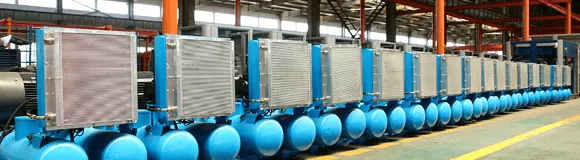
A factory with nearly constant demand may prefer two compressors, each capable of supplying the complete critical load. The arrangement is simple and provides straightforward full backup.
A plant whose demand varies substantially between shifts may benefit from three compressors at roughly 50% of maximum demand. Two units serve peak production, while one remains available as backup; during low-load periods only one smaller compressor may be required.
CAGI specifically identifies this three-machine arrangement as a practical way to combine redundancy with improved part-load efficiency.
The correct design therefore depends on two curves:
production demand over time
and
available compressor capacity after a failure.
A redundancy design that looks excellent at 100% production can still be inefficient for thousands of hours per year if minimum demand is ignored.
Base, Trim, and Standby Should Work as One System
Once a factory installs several compressors, each machine should have a clear operating role.
The base-load compressor carries the demand that exists most of the time.
The trim compressor follows changing factory demand.
The standby compressor provides capacity when another machine is unavailable because of failure or maintenance.
These roles may rotate, but the control philosophy should remain clear.
For variable-load factories, a properly sized VSD machine can often perform the trim role because it can adjust capacity more closely to demand. CAGI specifically notes that a variable-speed machine can improve the three-compressor, 50%-capacity arrangement when it serves as the trim compressor.
But simply adding a VSD compressor does not automatically produce an efficient compressor room.
The compressors still need to be sequenced correctly.
A factory with four compressors independently reacting to overlapping pressure bands can easily create a situation where several machines load and unload against one another.
The goal of a master sequencing strategy is different:
run the smallest efficient combination of compressors that can satisfy current demand while keeping required reserve capacity available.
An industrial compressed-air optimization project documented by the U.S. Department of Energy used measured demand bands to determine which compressor or combination of compressors should operate at each airflow range. That sequencing strategy formed part of a broader improvement program that reduced unnecessary compressor operation.
The lesson is important:
N+1 determines what capacity must remain available. Sequencing determines what capacity should be operating right now.
They solve different problems.
Where Does Receiver Storage Fit Into N+1?
Receiver storage is extremely useful, but it should not be counted as permanent standby compressor capacity.
Consider a plant that requires:
2,000 CFM continuously
after a compressor failure.
The remaining compressors can provide:
1,500 CFM
A large receiver may initially prevent pressure from collapsing.
But the system still has a continuous:
500 CFM generation deficit.
Once the stored air has been consumed, receiver pressure falls.
No practical receiver can permanently compensate for insufficient continuous compressor output.
Storage is better used for a different purpose: handling short-duration demand events and giving the compressor controls time to react.
For example, a brief pneumatic process may push demand from 2,000 to 2,700 CFM for only several seconds. Proper storage and pressure control may cover that transient without requiring another 700 CFM compressor to run continuously.
This distinction keeps the redundancy calculation cleaner:
Storage handles short-duration demand.
Standby compressors handle sustained loss of generating capacity.
That separation is especially important when evaluating whether the plant really needs another full-sized compressor.
Peakroc Client Case: Redundancy Without Running Every Compressor
A Peakroc project involving a major mining contractor provides a useful real-world example of the relationship between operating capacity and backup capacity.
The customer was running three 15 m³/min compressors in parallel to supply four drilling rigs.
The arrangement delivered the airflow, but it also created three separate fuel systems, three maintenance schedules, uneven loading when individual rigs stopped, and multiple potential service interruptions.
Peakroc reviewed the simultaneous airflow requirement and supplied one 45 m³/min, 10 bar PRMD-4510 as the main production source.
The important redundancy decision was what happened to the previous compressors.
The customer retained one of the original 15 m³/min machines as emergency backup rather than continuing to operate all three every day.
After ten months, Peakroc’s published project data reported 96.8% operational uptime compared with 91.2% previously, approximately 60% less maintenance downtime, fewer air-supply interruptions, and substantially lower combined fuel consumption.
The lesson for factories is not that one large compressor is always better.
For many factories, especially those requiring complete one-unit-out capacity, several smaller compressors may be the better design.
The transferable lesson is this:
Backup equipment creates reliability by being available when required. It does not necessarily need to run inefficiently every hour of normal production.
That distinction is central to good N+1 planning.
Peakroc Client Case: When Standby Capacity Protects Continuous Operation
A second Peakroc project shows the opposite side of the decision.
The application required high airflow and pressure for 18–20 operating hours per day in demanding field conditions.
In this case, losing the only compressor could immediately interrupt a time-critical operation.
Peakroc therefore deployed two PRMD-3925 units in a primary/standby arrangement rather than relying on a single machine.
Over the 14-week project, published operating data recorded 94.7% uptime and no pressure-related project failures while scheduled maintenance could be managed without sacrificing the required air-supply strategy.
Again, this is a field application rather than a factory compressor room.
But the reliability principle transfers directly.
If one compressor failure can stop a critical process, the question should not be:
“How reliable is our main compressor?”
It should be:
“What supplies the required air when the main compressor is unavailable?”
That is what redundancy is designed to answer.
Compressor Redundancy Alone Is Not Enough
A factory can install perfect N+1 compressor capacity and still have a single point of failure downstream.
Consider a plant with three compressors where any two can support production.
Now imagine all three discharge through one dryer.
If that dryer fails and production cannot tolerate wet air, compressor redundancy has not protected the plant.
CAGI specifically recommends applying a similar redundancy philosophy to air-treatment equipment when the process requires it.
For critical factories, the redundancy study should therefore look beyond the compressor and verify four areas:
- Air treatment: Can required dew point and filtration still be maintained with one treatment train unavailable?
- Controls: Can compressors still operate if the master controller or communication network fails?
- Utilities: Is there a common electrical, cooling, or ventilation failure that can stop every compressor?
- Distribution: Is there one valve, header, or connection whose failure isolates the entire factory?
This does not mean every component needs full 2N redundancy.
It means the engineer should know where the remaining single points of failure are and decide whether their risk is acceptable.
Maintenance Is When N+1 Is Most Easily Lost
A compressor room may be N+1 during normal production but become N during planned maintenance.
Imagine three compressors where:
two are required + one is standby.
One machine is taken offline for a major service.
The remaining two are now both required.
If either one fails, production capacity is lost.
This is why maintenance planning should include redundancy status rather than treating standby capacity as a permanent feature.
Before removing one compressor from service, compare the forecast production demand with the remaining compressor and dryer capacity.
If the remaining margin is unacceptable, temporary compressed air can restore additional reserve for the maintenance window.
CAGI goes even further and recommends installing a properly sized rental-compressor connection on the supply side so temporary equipment can be connected quickly when required.
Peakroc’s temporary compressed-air planning guide explains how temporary FAD, pressure, air quality, treatment, piping, and plant connections should be evaluated together.
This gives a factory several possible redundancy strategies:
permanently installed standby capacity, temporary portable capacity, or a combination of both.
The correct choice depends largely on how quickly compressed air must be restored.
How Much Redundancy Is Economically Justified?
The final decision is ultimately a risk-versus-cost calculation.
A spare compressor costs money.
So does the electrical infrastructure, dryer capacity, controls, maintenance, floor space, and spare parts that support it.
But having no usable backup also has a cost.
A better comparison is:
Annual cost of redundancy
versus
Expected cost of compressed-air downtime.
If compressed-air failure would stop a small workshop for an hour with little production loss, a permanently installed full N+1 system may not be economical.
If the same failure stops a continuous manufacturing line, destroys a batch, or requires a lengthy restart, the economics can reverse very quickly.
An independent U.S. manufacturing project documented by DOE illustrates the point. The plant improved compressor sequencing, storage, pressure control, trim capacity, and overall system architecture while retaining older machines as backup. The final system normally required fewer compressors to run, but still gained greater operational resilience; the project documentation also noted that temporary rental compressors had previously represented a substantial cost when permanent equipment was unavailable.
The important lesson is:
redundancy does not have to mean operating more compressors.
A well-designed system can simultaneously provide:
fewer running machines + better efficiency + greater usable standby capacity.
A Practical Five-Step N+1 Sizing Method
For most factory projects, Peakroc recommends reducing the redundancy study to five decisions:
- Measure the load profile. Establish minimum, average, sustained peak, and short transient demand.
- Define the critical one-out demand. Decide how much production must continue when the largest required compressor becomes unavailable.
- Test the remaining capacity. Confirm that the remaining compressors can deliver that FAD at the required pressure and air quality.
- Assign base, trim, and standby roles. Use sequencing and storage so redundant capacity does not create unnecessary part-load operation.
- Check the rest of the system. Review dryers, filters, controls, utilities, maintenance conditions, and temporary-air connections for remaining single points of failure.
Only after these five questions are answered should the number and size of compressors be finalized.
Final Recommendation
N+1 compressor redundancy should not be designed by simply adding one more compressor to the purchase order.
Start with production.
Determine the maximum sustained critical airflow that must continue after one required compressor becomes unavailable.
Then test the system:
Remaining usable FAD after the largest credible compressor outage ≥ critical one-out demand
If that condition is not satisfied, the factory does not have the redundancy it believes it has.
Next, consider the load profile.
A plant with stable demand may justify two 100%-capacity compressors.
A plant whose demand changes significantly may gain better flexibility from three 50%-capacity machines, with one machine acting as trim and another available as standby.
Use receiver storage for short demand peaks, not as a substitute for continuous backup capacity.
Sequence the compressors so standby equipment is available without forcing every machine to run inefficiently.
Then extend the same reliability thinking to dryers, filters, controls, power, and distribution.
Finally, check what happens during maintenance.
A system that is N+1 during normal operation can temporarily lose that protection the moment one machine is opened for service.
The most useful definition of N+1 is therefore not:
“N compressors plus one spare.”
It is:
“The compressed-air system can lose one required component and still deliver enough airflow, pressure, and air quality to maintain the level of production the factory has defined as critical.”
That is the redundancy level worth designing and paying for.
FAQ
What does N+1 mean for factory air compressors?
N+1 means enough additional compressor capacity is available so the defined critical production load can continue when one required compressor is unavailable because of failure or maintenance.
Does the standby compressor need to equal the largest compressor?
Not necessarily. Standby capacity should be calculated from the critical one-compressor-out demand and the capacity of the machines that remain available. Modular systems can sometimes provide the required redundancy using several smaller compressors.
Should N+1 be based on average or peak CFM?
It should be based on the maximum sustained production demand that must continue during the defined failure condition. Short transient peaks may be partly supported by receiver storage.
Can an air receiver replace a standby compressor?
No. A receiver can bridge short demand peaks or the time required for a standby compressor to start, but it cannot provide continuous FAD after stored air is depleted.
Do dryers need N+1 redundancy too?
If losing one dryer would make the compressed air unsuitable for critical production, the treatment system should also be evaluated for redundancy rather than protecting only the compressors.
Author

Mark Chen – Senior Mechanical Engineer, Peakroc®
Mark Chen is a senior mechanical engineer at Peakroc®, specializing in compressed air systems and drilling equipment for mining and construction applications. With over 15 years of field experience, he has led multiple projects on optimizing air delivery efficiency, equipment durability, and energy consumption.