
Key Takeaways
- Size emergency backup air from the critical production demand that must remain online after a compressor failure, not automatically from the motor kW or full FAD of the failed machine.
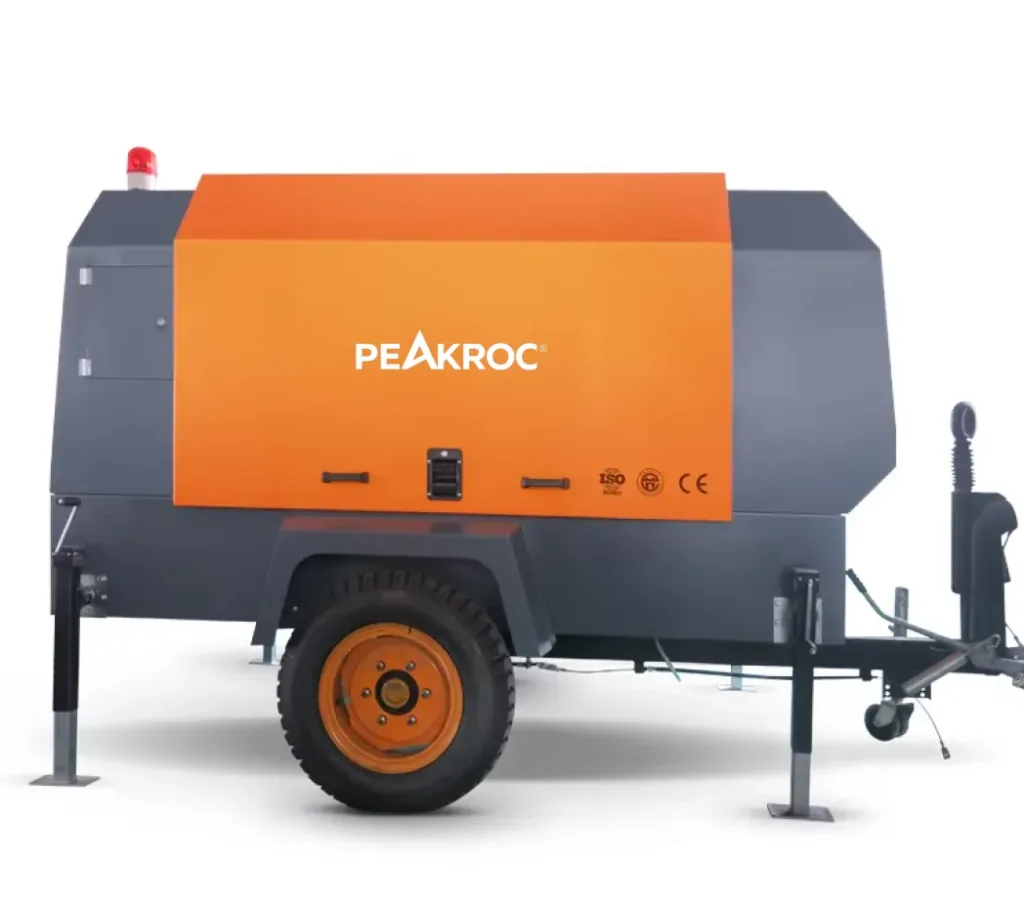
- For moderate standard-pressure backup demand, the Peakroc® 10 m³/min, 8 bar portable diesel compressor provides one possible mobile platform when its airflow and pressure match the factory requirement.
- For larger emergency requirements, the Peakroc® 20 m³/min, 13 bar portable diesel compressor delivers approximately 710 CFM and is documented for emergency industrial backup and maintenance-shutdown applications. High-flow contingency systems can evaluate the 45 m³/min, 10 bar portable compressor or multiple properly controlled units.
- Backup capacity and recovery time must be planned together. Receiver storage, permanently installed standby compressors, prepared portable units and externally mobilized temporary equipment provide very different recovery times.
- A successful emergency system must restore usable FAD + required point-of-use pressure + acceptable air quality. Sufficient compressor CFM alone cannot protect production if temporary piping, treatment or connections restrict the air before it reaches the plant.
A factory compressor rarely fails when the maintenance team is ready for it.
If compressed air operates process valves, instrumentation, packaging lines, conveying equipment or production machinery, the failure quickly becomes more than a compressor problem. It becomes a production-continuity problem.
The first question is therefore not:
“Which compressor can we rent?”
It is:
“How much usable compressed air must we restore to critical production, and how quickly must we restore it?”
Those two questions—capacity and recovery time—should define the entire emergency backup strategy.
Start With the Production Load You Cannot Afford to Lose
The easiest emergency-sizing mistake is replacing the failed compressor on a one-for-one basis.
If a 1,500 CFM compressor stops, the immediate reaction may be to find another 1,500 CFM unit.
Sometimes that is correct.
But it should not be assumed.
The failed compressor may normally supply several loads that do not all need to remain online during an emergency. Cleaning stations, secondary packaging, maintenance tools or non-critical blow-off applications may be temporarily isolated so that the remaining air is concentrated on process equipment that cannot stop.
The more useful calculation is:
Required Emergency FAD = Critical Production Demand − Dependable Remaining Compressor Capacity + Necessary Operating Allowance
Consider a factory whose normal peak demand is approximately 2,000 CFM.
After a failure, operations determines that 450 CFM of non-critical demand can temporarily be removed.
Critical demand becomes:
2,000 − 450 = 1,550 CFM
Another permanent compressor remains available and can reliably supply 500 CFM.
The missing emergency requirement is therefore:
1,550 − 500 = 1,050 CFM
That 1,050 CFM is a much better starting point for backup selection than the horsepower or rated capacity of the failed machine.
A reserve may still be required, but it should have a reason. Possible reasons include uncertain demand data, temporary maintenance-tool use, dryer purge demand or an agreed reliability margin.
It should not simply be an arbitrary percentage added to every project.
This is why emergency planning begins with the production process rather than with a compressor catalogue.
For plants that first need to understand their normal minimum, average and peak demand, Peakroc’s Factory Compressed Air System Sizing Guide provides the broader system-sizing framework.
Recovery Time Determines What “Backup” Really Means
Knowing that the factory is missing 1,050 CFM is only half of the problem.
The next question is:
How long can production tolerate that shortage?
Imagine two factories with exactly the same 1,000 CFM capacity loss.
One can operate at reduced production for four hours.
The other starts losing product after five minutes.
The compressor capacity requirement may be identical, but the backup architecture should be very different.
Receiver storage provides the first bridge.
Stored compressed air slows pressure decay while a standby compressor starts or operators respond. But storage cannot solve a sustained generation deficit.
If the factory consumes 1,000 CFM more than its surviving compressors can produce, the receiver is continuously being depleted. Eventually, header pressure falls regardless of how large the receiver is.
A permanently installed standby compressor provides much faster sustained recovery because the capacity is already connected to the system.
A prepared portable compressor offers another option. It may take longer to connect than an automatic standby unit, but the response can still be fast if the factory has already established the machine location, hose route, connection size and startup procedure.
External temporary capacity provides greater flexibility and avoids owning all standby equipment permanently, but transportation and commissioning time must now be included.
The useful sequence is:
Stored Air → Installed Standby → Prepared Portable Backup → External Temporary Capacity
This is why a contingency plan needs both a CFM target and a recovery-time target.
A 1,500 CFM compressor available tomorrow is not equivalent to a 700 CFM machine that can restore the factory’s most critical production within twenty minutes.
Sometimes restoring partial critical production quickly is economically more valuable than waiting much longer for enough capacity to restore the entire plant.
Emergency Air Must Be Usable at the Production Header
Finding enough FAD still does not complete the emergency design.
The compressed air has to reach production.
Suppose critical equipment requires 6.5 bar at the plant header.
The temporary compressor is installed outside the compressor room and the air travels through a long hose, dryer, filters, valves and an emergency connection before entering the permanent distribution network.
The compressor therefore needs to overcome these losses.
A practical pressure relationship is:
Required Backup Compressor Pressure = Critical Header Pressure + Treatment Loss + Temporary Distribution Loss + Connection Loss
If the complete temporary route loses 0.7 bar, a compressor supplying exactly 6.5 bar at its outlet cannot maintain 6.5 bar at the factory header under full flow.
But choosing the highest-pressure compressor available is not the correct answer either.
The restriction should be identified first.
A large compressor connected through an undersized hose can still produce poor pressure at production.
The same can happen with a small emergency connection, restrictive manifold, overloaded dryer or dirty filter.
Peakroc has seen the importance of this system-level approach in industrial work.
One Peakroc cement-plant customer operates in a high-dust, elevated-temperature environment. In addition to supplying compressed-air equipment, Peakroc engineers worked with the customer to improve the plant’s compressed-air pipeline system. The customer later specifically highlighted both stable equipment operation and the pipeline optimization support.
The engineering lesson is directly relevant to emergency backup:
what leaves the compressor matters less than what actually reaches the production equipment.
Temporary systems can make this problem worse because they often introduce longer hoses, additional couplings, temporary manifolds and smaller connection points than the normal compressor-room installation.
That is why Peakroc recommends evaluating the compressor and temporary distribution route together.
For planned temporary connections and hose layout, see the Temporary Compressed Air for Factory Maintenance Shutdowns guide.
Air Quality Is Part of “Usable Air”
Pressure and flow are not the only requirements.
Emergency compressed air must still be suitable for the process.
ISO 8573-1:2010 defines compressed-air purity classes for particles, water and oil. In other words, air quality remains a measurable engineering requirement even when the plant is operating under contingency conditions.
If the compressor fails but the existing dryer and filters remain available, the temporary source may be connected through the normal treatment train if its capacity and configuration allow.
If the dryer or filters are also unavailable, temporary treatment may need to become part of the backup system.
A general pneumatic assembly process may tolerate relatively basic treatment.
Instrumentation, coating, electronics or another moisture-sensitive process may require controlled pressure dew point and tighter oil or particulate limits.
The emergency design target should therefore be thought of as:
Required FAD + Minimum Header Pressure + Required Air Quality
Restoring the pressure gauge while delivering unsuitable air is not a complete recovery.
Peakroc Experience: Backup Capacity Should Match the Failure Scenario
Peakroc’s PRMD-2013 platform illustrates how an independent portable air source can fit into an industrial emergency strategy.
The unit delivers 20 m³/min, approximately 710 CFM, at 13 bar, and Peakroc’s published application information specifically includes emergency compressed-air support for industrial facilities during compressor failures, as well as maintenance-shutdown and valve-actuator applications.
The important point is not that every factory needs 20 m³/min at 13 bar.
Many factories operate at much lower pressure.
Its relevance is that a self-contained portable diesel compressor can provide compressed air independently of the failed compressor-room drive system.
That can be valuable when the failure involves the permanent compressor’s electrical supply, when maintenance prevents the fixed machines from operating, or when sufficient temporary electrical capacity is not available.
But equipment independence is useful only when the machine still matches the plant.
Before recommending a backup system, Peakroc needs to know the critical FAD, minimum required pressure, connection size, temporary hose distance, required air quality and expected emergency operating duration.
A 13-bar compressor is not automatically a better backup for a factory that only needs 7 bar.
Right-sizing remains important even during an emergency.
Peakroc Client Case: Keeping Emergency Capacity Without Running It Every Day
Another Peakroc project demonstrates the relationship between primary capacity and emergency reserve.
The customer’s previous high-flow system used three 15 m³/min compressors operating in parallel.
Peakroc reviewed the actual simultaneous demand and supplied one 45 m³/min, 10 bar PRMD-4510 as the main high-flow source.
Importantly, the customer did not eliminate every previous compressor.
One 15 m³/min unit was retained specifically as emergency backup.
After ten months, Peakroc’s published project data reported operational uptime of 96.8%, compared with 91.2% previously, around 60% less maintenance downtime, and fewer air-supply interruptions.
This was a mining application rather than a stationary factory compressor room, so the exact machine configuration should not be copied directly into a factory design.
The transferable reliability principle is more useful:
Backup capacity creates value by being available when the primary supply is unavailable. It does not necessarily need to consume energy during every hour of normal operation.
For a factory, that principle can lead to several valid architectures:
permanent standby capacity, prepared portable capacity, or a combination of permanent and temporary backup.
Which option is appropriate depends primarily on the cost of downtime and the required recovery time.
Turn the Backup Plan Into a Predictable First Hour
A useful compressor failure contingency plan should not be a large document that nobody can interpret while production is already stopped.
Its purpose is to make the first hour predictable.
The factory should know five things before a failure occurs:
- Critical demand. Record the FAD and minimum header pressure required to keep essential production operating.
- Remaining capacity. Know which permanent compressors, dryers, filters and receivers remain usable after the most important credible failure.
- Backup source. Decide whether recovery depends on installed standby capacity, an on-site portable compressor, external temporary equipment or a combination.
- Connection and treatment. Predefine the temporary connection, hose route, compressor location and required drying or filtration.
- Recovery responsibility. Define who isolates the failed system, connects the backup supply, verifies pressure and air quality, and authorizes the return to normal operation.
This information should be reviewed whenever production changes significantly.
A backup strategy developed when a plant consumes 800 CFM may be inadequate after a new line increases critical demand to 1,400 CFM.
The same applies to physical infrastructure.
If a temporary-air connection was designed only for a small maintenance compressor, it may become the largest restriction when a much larger emergency machine needs to be connected.
Planning the connection before failure therefore has considerable value.
The factory already knows where the machine will stand, which hose is required and whether the connection can actually pass the planned emergency airflow.
Emergency Recovery Still Requires Energy Control
Pressure to restart production should not bypass maintenance safety procedures.
Compressed air represents stored pneumatic energy.
OSHA’s hazardous-energy standard covers servicing and maintenance where unexpected startup or release of stored energy can injure employees. It specifically includes pneumatic energy and requires potentially hazardous stored or residual energy to be relieved, disconnected, restrained or otherwise made safe, followed by verification of isolation before work begins.
This becomes especially important when temporary compressed air is connected while technicians are repairing the failed compressor or associated piping.
The backup source must not unintentionally repressurize equipment that maintenance personnel believe is isolated.
Temporary connection, isolation, depressurization, verification and return to service should therefore remain under the factory’s approved engineering and energy-control procedures.
Final Recommendation
An emergency backup compressor should not be selected only after the main compressor has failed.
By that point, the factory is already spending its most valuable emergency resource:
time.
Start by determining the critical production demand that cannot be lost.
Then determine what dependable compressor capacity remains after the most important credible failure.
The difference defines the missing emergency FAD.
Next determine how quickly that capacity must return.
If the process can tolerate several hours of reduced production, external temporary equipment may be economical.
If production begins failing within minutes, installed or immediately available standby capacity becomes much more important.
Then look beyond the compressor.
Verify the pressure required at the critical production header, the temporary hose route, emergency connection capacity and required air treatment.
A correctly sized compressor connected through a restrictive temporary system is still an incorrectly designed backup solution.
Peakroc’s industrial and high-flow project experience repeatedly points to the same system-level principle:
air generation, air delivery and available reserve must work together.
A useful emergency planning sequence is therefore:
Critical Demand → Recovery Time → Backup Capacity → Pressure & Air Quality → Connection → Controlled Recovery
When these decisions are made before a compressor fails, the incident becomes a managed contingency.
When they are made after the alarm, every missing piece adds more time to the production outage.
That is the real purpose of an emergency compressed-air contingency plan.
FAQ
How large should an emergency backup compressor be for a factory?
Size it from the critical production FAD that must continue after the failure, minus dependable permanent compressor capacity that remains available. Do not automatically replace the full rated capacity of the failed compressor.
Does an emergency compressor need to replace 100% of factory peak demand?
Not always. If agreed non-critical loads can temporarily stop, backup capacity may be based on the lower critical-production demand. Plants that must maintain full production may require backup equal to the sustained peak.
Can an air receiver keep a factory operating until the backup compressor starts?
Only temporarily. Receiver storage can slow pressure decay and bridge short startup delays, but sustained demand eventually requires sufficient operating compressor FAD.
Does emergency compressed air need a dryer and filters?
Yes when the critical process requires controlled moisture, oil or particulate levels and the normal treatment equipment is unavailable. Emergency air still needs to be suitable for the process it serves.
Should a factory install a permanent emergency compressed-air connection?
For facilities where compressed-air downtime has a significant production consequence, a properly engineered emergency connection can reduce recovery time substantially. It should be sized for the planned critical airflow and pressure rather than for a convenient maintenance hose.
Author

Mark Chen – Senior Mechanical Engineer, Peakroc®
Mark Chen is a senior mechanical engineer at Peakroc®, specializing in compressed air systems and drilling equipment for mining and construction applications. With over 15 years of field experience, he has led multiple projects on optimizing air delivery efficiency, equipment durability, and energy consumption.