
Key Takeaways
- Shank adapter wear should be diagnosed by location, not simply by service hours. Striking face damage, spline wear, flushing problems, and thread failure can indicate different faults.
- Peakroc® top hammer shank adapters are designed to transmit percussion and rotation while providing a connection between the rock drill and the drill string.
- Impact marks or chipping on the striking face may indicate piston damage, worn bushings, or abnormal alignment inside the rock drill.
- Spline pitting, galling, and shoulder wear should trigger inspection of lubrication, chuck coupling condition, rotational loading, and related internal components.
- The Top Hammer Coupling Sleeve Troubleshooting Guide explains related joint wear and thread problems. These should be considered when a shank adapter repeatedly damages new couplings.
- Peakroc®’s Drill Rod Failure Guide covers fatigue, bending, hole deviation, and rod-side failure mechanisms.
- A worn bit or unstable drill string can increase abnormal loading. Proper top hammer drilling bit selection and maintenance therefore remain relevant.
- Replacing a failed shank adapter without checking the rock drill can allow the same failure to develop on the replacement.
How a Shank Adapter Works and Why It Fails
A shank adapter connects the rock drill to the drill string in a top hammer drilling system.
Its position makes it different from a normal extension rod or coupling sleeve.
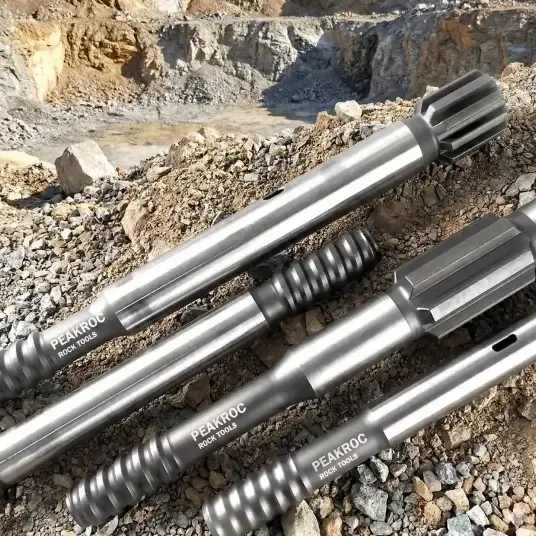
At one end, the adapter receives repeated impacts from the rock drill piston. Its splines engage the rotation drive, allowing torque to pass into the drill string. A flushing passage carries air or water toward the drilling tools, while the threaded end connects to the first rod or coupling.
These functions are concentrated in one relatively compact steel component.
During drilling, the shank adapter is repeatedly exposed to impact loading, rotation torque, contact pressure, vibration, and friction. Depending on its configuration, it also operates close to bushings, seals, damping components, and other parts of the rock drill.
As wear develops, the mechanical fit between these components may change.
A damaged striking face can affect the piston-contact interface. Worn splines can change how rotational forces are transferred. A deteriorated bearing surface may indicate problems with alignment or guidance, while thread damage can accelerate wear in the adjoining coupling.
For this reason, a shank adapter is both a wear component and a useful indicator of rock drill condition.
The correct troubleshooting approach begins with the location and appearance of the damage.
Striking Face Damage: Impact Marks, Chipping, and Deformation
The striking face is the part of the shank adapter that receives repeated contact from the rock drill piston.
Some contact polishing may occur during normal service. However, severe edge damage, chipped material, irregular indentation, or pronounced deformation should not be dismissed as ordinary wear.
A relatively centered contact pattern is different from damage concentrated heavily on one side.
Uneven damage can indicate that the piston and adapter are no longer making contact as intended.
Possible contributors include worn bushings, damaged piston surfaces, internal misalignment, or deterioration of associated guiding components.
Why a New Adapter Can Become Damaged Quickly
Consider a rock drill in which the old shank adapter develops severe chipping on one side of the striking face.
The adapter is replaced, but the same damage begins appearing again after relatively little drilling.
The repeated pattern suggests that the adapter itself may not be the only issue.
If a worn internal bushing allows the adapter to move or align incorrectly, the new component may experience similar contact conditions.
A damaged piston face may also create repeated abnormal impact.
In such situations, replacing only the adapter can result in unnecessary consumable costs and continued rock drill wear.
Repeated striking face damage should trigger inspection of the piston, bushings, and internal alignment before another adapter is installed.
Spline Wear and Failure: What the Rotation Connection Reveals
The splines on a shank adapter transfer rotation from the rock drill’s drive mechanism to the drill string.
Under normal operating conditions, these contact surfaces experience repeated rotational loads.
Over time, some wear is expected.
However, the severity, distribution, and location of spline damage provide important diagnostic information.
A spline that becomes gradually polished across its working surfaces is different from one showing deep scoring, severe galling, chipped edges, localized pitting, or cracking at the spline root.
Uneven wear may indicate that the adapter is not sharing loads uniformly through the connection.
Spline Pitting and Galling
Pitting appears as small surface cavities or localized material loss.
Galling involves more severe surface damage associated with adhesive contact and friction.
These conditions may be influenced by inadequate lubrication, contaminated or incorrect lubricant, abnormal rotational loading, or problems with mating drive components.
A rock drill that repeatedly operates with a sticking drill string may also expose the spline connection to unusually high torque and recovery loads.
If the spline profile is severely worn, adding lubricant will not restore the original geometry.
Lubrication helps protect the connection, but it cannot rebuild damaged spline surfaces.
Spline Shoulder Wear
The upper and lower shoulders of the spline area should also be inspected.
Damage concentrated at one shoulder can indicate different loading conditions from damage concentrated at the opposite side.
For example, excessive rotational loading during drill-string retraction can contribute to abnormal shoulder wear in some systems.
Other patterns may be associated with inadequate feed, worn rotation bushings, or damping-system problems.
Because these mechanisms differ, the exact wear location should be recorded rather than describing every damaged spline simply as “worn out.”
Flushing Passage Problems: Leakage, Blockage, and Corrosion
The shank adapter contains a passage for flushing air or water.
Flushing helps transport cuttings away from the bit and through the borehole.
Depending on the rock drill design, flushing medium passes through seals and interfaces before entering the shank adapter.
If these components deteriorate, operators may notice leakage around the flushing head, reduced flushing performance, or abnormal contamination.
However, a flushing leak does not automatically mean the shank adapter body is defective.
The surrounding seals, flushing head, supply lines, and connecting components should also be examined.
Internal Corrosion and Flushing Damage
Dirty or aggressive flushing water may contribute to corrosion inside the adapter.
Corrosion can gradually damage internal surfaces and create areas of increased stress concentration.
In severe cases, corrosion and repeated mechanical loading may contribute to fatigue failure.
A blocked or restricted flushing passage may also interfere with effective cuttings removal, although the restriction may originate elsewhere in the system.
The correct investigation should consider the condition of the flushing medium, seals, internal passage, and related rock drill components.
Flushing problems require inspection of the complete fluid path—not just replacement of the visible leaking part.
Thread Failure and Connection Wear
The threaded end of the shank adapter connects it to the first coupling or drill rod.
This area experiences repeated impact transmission and rotational loading.
Thread damage can include pitting, chipping, galling, deformation, and cracking.
A common mistake is to treat every thread failure as a material defect.
In practice, a worn mating coupling, incorrect thread match, loose connection, poor lubrication, feed misalignment, or drilling with a worn bit can contribute to abnormal loading.
A new shank adapter installed into a severely worn coupling may begin developing an unfavorable contact pattern much sooner than expected.
The connection should therefore be inspected as a matched assembly.
When Thread Damage Indicates a Wider Problem
If the adapter thread repeatedly develops pitting or cracks, inspect the coupling and adjoining drill string as well as the rock drill.
Unstable drilling, hole deviation, excessive bending, or operation with a stuck bit may introduce loads that affect several connected components.
The relevant feed, rotation, and percussion settings should also be checked against the rock drill manufacturer’s operating recommendations.
The correct repair may involve replacing both the adapter and damaged mating components, rather than replacing only the visibly failed thread.
Shank Adapter Failure Diagnosis Table
The following table provides a practical starting point for troubleshooting.
| Observed Failure | Possible Contributors | What to Inspect |
|---|---|---|
| Chipped or deformed striking face | Piston damage, worn bushings, misalignment | Piston face, guide bushings, internal alignment |
| Broken or cracked splines | Inadequate lubrication, high torque, worn chuck, jamming | Lubrication, chuck coupling, rotation system |
| Pitting or galling on splines | Lubricant problems, friction, abnormal loading | Lubrication delivery, oil quality, spline fit |
| Wear on spline shoulder | Retraction loads, feed imbalance, drive or damping problems | Feed, rotation, bushings, damping components |
| Damage near front bushing | Misalignment, bushing wear, poor lubrication | Front bushing, feed beam, alignment |
| Flushing leakage | Worn seals, flushing-head problems, damaged interfaces | Flushing seals, passages, water supply |
| Corrosion around flushing passage | Aggressive or dirty flushing medium | Water quality, internal surfaces, seals |
| Thread pitting or galling | Loose joint, poor grease, worn coupling | Threads, coupling, feed and rotation |
| Chipped thread end | Misalignment, damaged mating parts, handling problems | Coupling, drill rod, feed alignment |
A failure pattern does not prove a single root cause.
The table should be used to guide inspection, while measurements, maintenance records, and relevant component condition determine the final diagnosis.
Technical Field References: Documented Shank Adapter Failures
Published top hammer tool failure-analysis guidance provides detailed examples of shank adapter damage.
These are documented failure patterns from technical field guidance, not Peakroc® customer repair cases. The guide does not establish a named jobsite, failure frequency, or quantified service-life improvement for each example.
Reference 1: Chipped Striking Face Associated with Internal Rock Drill Wear
A documented failure category describes striking-face impact marks, chipping, and deformation.
The associated causes include misalignment caused by worn bushings and damage to the rock drill piston.
The recommended corrective actions involve servicing the affected internal components rather than replacing the adapter in isolation.
This is valuable because the visible failure appears on a consumable component, while the underlying problem may originate inside the rock drill.
Field lesson: Abnormal striking-face damage can be an early indication of piston or guide-bushing problems.
Reference 2: Spline Failure Associated with Lubrication and Torque
Another documented failure category identifies fractures across the spline area.
Potential contributors include insufficient lubrication, unsuitable or contaminated lubricant, worn chuck couplings, excessive torque, drill-string jamming, and abnormal operating conditions.
The guidance also documents spline pitting and galling associated with lubrication and rotational loading.
These patterns demonstrate that spline durability depends on both surface condition and the mechanical system transmitting torque.
Field lesson: Repeated spline damage should trigger lubrication, rotation-drive, and drill-string investigations—not just another adapter replacement.
Reference 3: Front Bushing and Spline Shoulder Failures
Published failure examples also distinguish failures near the front bushing from excessive wear on the upper and lower spline shoulders.
For front-bushing-region failures, the guidance identifies misalignment and lubrication among the possible factors.
Upper spline-shoulder wear can be associated with inadequate feed, worn rotation bushings, or damping-system problems.
Lower shoulder wear may occur under different retraction and drill-string loading conditions.
The key point is that these are not interchangeable symptoms.
Field lesson: Recording exactly where the adapter wears helps narrow down which internal mechanism needs inspection.
Reference 4: Thread-End Chipping and Mating-Component Damage
A documented thread-end chipping pattern includes possible causes such as adapter misalignment, a loose machine cradle, damaged drill rods, poor connection engagement, or worn couplings.
The recommended investigation includes feed alignment and mating-component condition.
This helps explain why an apparently minor defect at the threaded end may point to broader drill-string or machine positioning problems.
Field lesson: Thread-end failure is not always a lubrication issue; mechanical alignment and connection condition also matter.
A Practical Shank Adapter Inspection Checklist
Shank adapters should be inspected during scheduled maintenance and whenever abnormal drilling behavior develops.
Before removing or servicing the component, stop the machine and isolate applicable mechanical, hydraulic, pneumatic, and electrical energy sources according to the equipment instructions.
A practical inspection includes:
- Identify the component. Confirm the rock drill model, adapter part number, thread type, and configuration.
- Inspect the striking face. Look for chipping, severe pitting, cracks, deformation, and irregular contact patterns.
- Check the splines. Examine wear distribution, cracks, galling, pitting, and shoulder damage.
- Inspect bearing surfaces. Look for scoring, one-sided wear, and signs of abnormal bushing contact.
- Check flushing passages. Examine accessible areas for blockage, corrosion, erosion, and leakage-related damage.
- Inspect the threaded end. Check for cracks, chipped crests, thread deformation, and mating-component wear.
- Measure wear. Use the correct manufacturer’s gauges and specified measurement locations where applicable.
- Review associated components. Check the piston, chuck, bushings, seals, coupling, and drill-string condition.
Do not assume that one universal wear limit applies to every shank adapter.
Different rock drills use different geometries, materials, and service limits.
When Should a Shank Adapter Be Replaced?
A shank adapter should be removed from service when its condition exceeds the applicable manufacturer’s discard criteria or creates an unacceptable risk of failure.
Typical replacement conditions include:
- Visible structural cracks in the adapter body, splines, thread roots, or other critical areas.
- Severe striking-face deformation, material loss, or chipping beyond acceptable limits.
- Broken, severely rounded, or otherwise damaged splines that cannot maintain the specified drive fit.
- Significant pitting, galling, or scoring beyond the allowable condition.
- Severe thread deformation or damage preventing proper connection.
- Flushing-passage damage that compromises the required function or structural integrity.
- Wear exceeding the correct dimensional or profile limits for the installed rock drill.
A structurally cracked shank adapter should not be returned to normal percussion drilling.
If the same failure occurs repeatedly, inspect the mating components and machine systems before installing another replacement.
A new adapter cannot correct a worn piston, damaged chuck, failing bushing, or unsuitable lubrication system.
How to Prevent Premature Shank Adapter Failure
Preventive maintenance should focus on the complete rock drill and drill-string system.
Maintain the specified shank lubrication supply and verify that the correct lubricant reaches the intended contact areas.
Keep the rock drill’s internal guidance, chuck, and damping components within their service limits.
Use the approved feed, rotation, and percussion settings, and review them when ground conditions change.
Avoid continuing normal percussion against a stuck or improperly engaged drill string.
Maintain bit condition, thread lubrication, and proper coupling fit.
Inspect unusual wear patterns before they develop into major component failures.
For operations experiencing repeated shank adapter damage, record the exact failure location, condition of adjoining parts, drilling parameters, and adapter operating history.
Trend information may reveal recurring faults that are not obvious from one failed component alone.
Choosing a Replacement Shank Adapter
Shank adapters are not interchangeable simply because their threaded ends look similar.
Two adapters with the same rod-side thread may have different lengths, spline geometry, bearing surfaces, flushing arrangements, or striking-face configurations.
The correct component must match the installed rock drill.
For Peakroc® replacement enquiries, the identification process should begin with the drifter model and original part number wherever available.
Thread designation, overall dimensions, and photographs are useful supporting information, but they should not replace confirmation of the complete mating geometry.
A replacement should be assessed together with the coupling and related components when unusual wear has occurred.
Shank Adapter Replacement RFQ Checklist
When requesting a replacement, provide:
- Rock drill / drifter model: Exact manufacturer and model designation.
- OEM or existing part number: Include markings where available.
- Thread type: R32, T38, T45, T51, or another specified system.
- Adapter dimensions: Overall length and relevant connection dimensions.
- Spline configuration: Photographs and measurements, using the applicable specifications.
- Flushing arrangement: Relevant passage and seal configuration.
- Failure details: Location of cracking, wear, leakage, or deformation.
- Application and quantity: Quarrying, mining, tunneling, or construction, together with the number of replacements required.
If premature failure is involved, provide photographs of the damaged adapter and its mating components.
This helps distinguish a straightforward replacement request from a problem that may require further technical evaluation.
Common Shank Adapter Maintenance Mistakes
One common mistake is replacing an adapter after striking-face damage without inspecting the piston and bushings.
Another is treating spline galling as normal accumulated wear while ignoring lubrication delivery or drive-component condition.
Installing new adapters into badly worn couplings can also accelerate damage at the threaded connection.
Some operators rely only on drilling penetration rate to judge adapter condition. However, penetration may also be affected by bit wear, rock conditions, feed, rotation, and other components.
Finally, comparing wear measurements with limits intended for a different rock drill can lead to incorrect replacement decisions.
Shank adapter maintenance should be based on the correct component specifications and the condition of its mating parts.
Final Recommendation
A top hammer shank adapter should be evaluated as part of the rock drill and the drill string—not as an isolated consumable.
Striking-face damage may reveal problems with the piston or internal guidance.
Spline wear may indicate abnormal rotational loading, lubrication problems, or deteriorating drive components.
Flushing leakage and corrosion require inspection of the flushing system and related seals.
Thread damage can involve coupling wear, connection alignment, or unfavorable drilling conditions.
The most useful troubleshooting sequence is:
Identify Wear Location → Inspect Mating Components → Review Lubrication & Drilling Conditions → Measure Wear → Correct Root Cause → Replace if Required
A worn shank adapter can be the first visible warning of a developing problem inside the rock drill. Replacing it without investigating that problem may only repeat the failure.
Frequently Asked Questions
What causes top hammer shank adapter failure?
Common contributors include striking-face misalignment, spline wear, inadequate lubrication, excessive rotational loading, worn internal bushings, damaged couplings, flushing corrosion, and abnormal drilling conditions.
Why is my shank adapter striking face chipped?
Possible causes include abnormal piston contact, damaged piston surfaces, worn guide bushings, or misalignment inside the rock drill. The adapter and related internal components should be inspected together.
What causes shank adapter spline wear?
Spline wear may result from repeated torque loading, insufficient lubrication, contaminated lubricant, worn chuck couplings, abnormal alignment, or drill-string jamming.
Can a worn shank adapter damage the rock drill?
A damaged adapter can operate with abnormal contact conditions and may contribute to further wear in mating components. The extent of damage depends on the specific failure and rock drill configuration.
Why does flushing water leak around the shank adapter?
Possible causes include damaged flushing seals, problems with the flushing head, worn mating components, or damaged adapter interfaces. The complete flushing path should be inspected.
Should I replace the coupling when replacing a shank adapter?
Inspect the mating coupling whenever the adapter is replaced. A coupling that exceeds the applicable wear limits or has damaged threads should be replaced. Replacement of both parts is not automatically mandatory for every system.
How do I know when a shank adapter needs replacement?
Look for cracks, severe deformation, abnormal spline damage, damaged threads, serious flushing-passage defects, or wear beyond the correct manufacturer’s discard limits.
Can I use a T45 shank adapter on any T45 drilling system?
No. T45 identifies the rod-side thread family, but the adapter must also match the exact rock drill’s splines, dimensions, striking face, flushing arrangement, and other connection requirements.
Author

Mark Chen – Senior Mechanical Engineer, Peakroc®
Mark Chen is a senior mechanical engineer at Peakroc®, specializing in compressed air systems and drilling equipment for mining and construction applications. With over 15 years of field experience, he has led multiple projects on optimizing air delivery efficiency, equipment durability, and energy consumption.