
Key Takeaways
- A used portable diesel air compressor can be a practical investment, but its condition matters more than its asking price. Engine hours, service history, actual air delivery, previous operating conditions and upcoming repairs should all influence the buying decision.
- Low engine hours do not guarantee good condition. A lightly used machine may have suffered poor storage, neglected maintenance or corrosion, while a higher-hour compressor with documented servicing may remain suitable for productive work.
- Airend wear and FAD loss are important purchasing risks. A pressure gauge alone cannot confirm compressor capacity. Buyers should request loaded performance testing and investigate abnormal noise, vibration and temperature. The Peakroc® airend failure and diagnosis guide explains the mechanical issues that require specialist inspection.
- New and used machines must be compared at the same operating requirements. For example, the Peakroc® 10 m³/min at 10 bar, 20 m³/min at 13 bar and 34 m³/min at 25 bar diesel compressors represent different pressure-flow classes. Buyers should compare equivalent duties rather than machines with similar engine horsepower.
- Total ownership cost provides a better comparison than purchase price alone. Fuel consumption, immediate repairs, spare parts, downtime, warranty and resale value can change the economics considerably. The diesel compressor fuel-cost guide provides additional operating-cost context, while the factory acceptance testing guide explains formal performance verification for new equipment.
A used portable diesel air compressor may cost substantially less than a comparable new machine, making second-hand equipment attractive to construction contractors, rental businesses, quarry operators and industrial equipment buyers.
However, a lower purchase price does not always mean a lower operating cost. A compressor with worn engine components, deteriorating airend bearings or inadequate Free Air Delivery (FAD) may require expensive repairs shortly after delivery. Conversely, a properly maintained used compressor can remain productive for years, particularly when it is purchased for moderate-duty or backup applications.
This creates an important question for buyers: Is it better to purchase a new portable diesel compressor with manufacturer support or a used machine that offers immediate savings but carries greater uncertainty?
The answer depends on verified mechanical condition, required airflow and pressure, expected annual operating hours, maintenance history and the cost of unexpected downtime.
This guide explains how to assess those factors before purchasing a portable diesel rotary screw compressor, without assuming that new equipment is always the better choice.
Used vs New Portable Diesel Air Compressors: What Are You Actually Buying?
A new portable compressor is supplied as an unused machine under a defined equipment specification. The buyer can normally request the required engine, operating pressure, airflow capacity, chassis configuration and available options before production or delivery.
A used compressor has already entered service. Its actual condition depends on how it was operated, maintained, repaired and stored. Two machines of the same model and production year may therefore have very different remaining economic value.
New compressors generally offer clearer configuration traceability, warranty arrangements and access to current technical documentation. They may also support different engine or emissions configurations, depending on the model and destination market.
Used compressors may provide lower initial investment and faster availability. They can be especially attractive where equipment is needed for a limited project, where capital is constrained or where a reliable maintenance team is available.
Used, Serviced, Refurbished and Surplus Equipment
The second-hand equipment market includes several different conditions that should not be confused.
A machine sold as-is may have received little more than a visual inspection. A serviced compressor may have undergone routine maintenance, such as replacement of oil, filters and other scheduled consumables. A refurbished compressor may have received more extensive mechanical or electrical work, potentially including airend repair, engine work or replacement of damaged components.
Surplus equipment is another category. It may have been purchased for a project that was subsequently cancelled or kept in storage with very limited use.
However, surplus does not automatically mean new. Long storage periods may affect batteries, seals, lubricants, cooling components and fuel systems. Buyers should verify the machine’s actual commissioning and storage history rather than relying on the label.
The most important question is not what the seller calls the compressor, but what work has been completed and what evidence supports its current condition.
Engine Hours: How Much Do They Really Tell You?
Engine hours are among the first figures buyers examine when evaluating a used diesel compressor. They provide useful information about accumulated operating time, but they do not directly measure engine health or remaining compressor life.
A machine with 3,000 recorded hours could have operated mostly at moderate load with regular servicing. Another machine with fewer recorded hours may have experienced repeated overheating, severe dust exposure, contaminated fuel or long periods of poor storage.
These are different mechanical histories, even when the hour-meter readings appear attractive.
Why the Hour Meter Is Not Enough
A portable diesel compressor can record operating time through an hour meter, engine electronic control system or controller, depending on its configuration.
Where multiple records exist, compare them for consistency. A discrepancy may have a legitimate explanation, such as an instrument replacement, but it should be documented.
Buyers should also review the relationship between operating hours and service intervals. If a machine is advertised as having 5,000 hours but the seller cannot provide any oil, filter, coolant or engine maintenance records, the reported hours offer only limited assurance.
Five Records to Check Before Trusting Engine Hours
- Machine identification: Confirm the compressor serial number, engine serial number, manufacture year and nameplate details against the seller’s documents.
- Hour-meter history: Compare current operating hours with earlier inspection reports, rental records, service invoices or engine controller data where available.
- Maintenance documentation: Look for oil changes, filter replacement, coolant service, valve repairs and scheduled component inspections.
- Previous application: Establish whether the machine worked in dusty mining environments, abrasive blasting, construction, rental service or intermittent standby duty.
- Storage and repair history: Ask about extended storage, major engine or airend repairs, controller replacement, accidents and prior overheating events.
These records help explain how the machine accumulated its hours. A high-hour unit should not automatically be rejected, but undocumented history should increase the level of inspection required.
There is no universal engine-hour threshold at which every portable diesel compressor becomes uneconomical.
How to Evaluate Airend Wear in a Used Screw Compressor
The airend is one of the most important components to assess because internal wear can affect both mechanical reliability and delivered airflow.
In an oil-injected rotary screw compressor, precision rotors operate within a closely machined housing. Bearings maintain their positions, while lubricant supports cooling, sealing and mechanical protection.
Deteriorating bearings, poor lubrication or internal surface damage may cause increased vibration, abnormal noise, higher operating temperatures or reduced compression efficiency.
However, these symptoms are not conclusive evidence of airend failure. Intake restrictions, incorrect operating speed, control problems and cooling-system faults can produce similar results.
The purchasing objective is therefore to identify abnormal mechanical behavior and determine whether additional specialist inspection is justified.
Five Physical Inspections Before Buying Used
- Diesel engine and fuel system: Check for abnormal starting behavior, exhaust smoke, fuel leakage, coolant contamination, overheating history and unstable loaded operation.
- Airend and lubrication system: Listen for unusual mechanical noise, assess vibration and temperature, inspect oil condition and review any available oil-analysis or overhaul records.
- Cooling and filtration: Examine radiator and oil-cooler cleanliness, intake filters, hoses, fan operation and signs of previous overheating.
- Control and safety systems: Verify normal loading, unloading, pressure regulation, shutdown protection and accurate controller indications using approved procedures.
- Chassis and pressure-system integrity: Inspect the frame, wheels, tires, towing components, pressure-containing equipment, hoses, guards and visible corrosion.
Inspection findings should be documented rather than relying on a general statement that the compressor is in good condition.
A fresh paint finish, recently changed oil or clean engine compartment is not proof of mechanical health. These observations are useful, but measured performance and maintenance records provide stronger evidence.
For high-value machines, an independent pre-purchase inspection can reduce uncertainty, particularly when the buyer cannot visit the seller.
Why FAD Testing Matters More Than an Unloaded Pressure Reading
A used compressor may reach its rated discharge pressure while delivering less airflow than the original specification.
This is particularly important for portable machines because their useful performance depends on airflow and pressure at the same operating point.
FAD describes delivered airflow expressed relative to defined free-air conditions. It is different from theoretical compressor displacement and cannot be established by reading a pressure gauge alone.
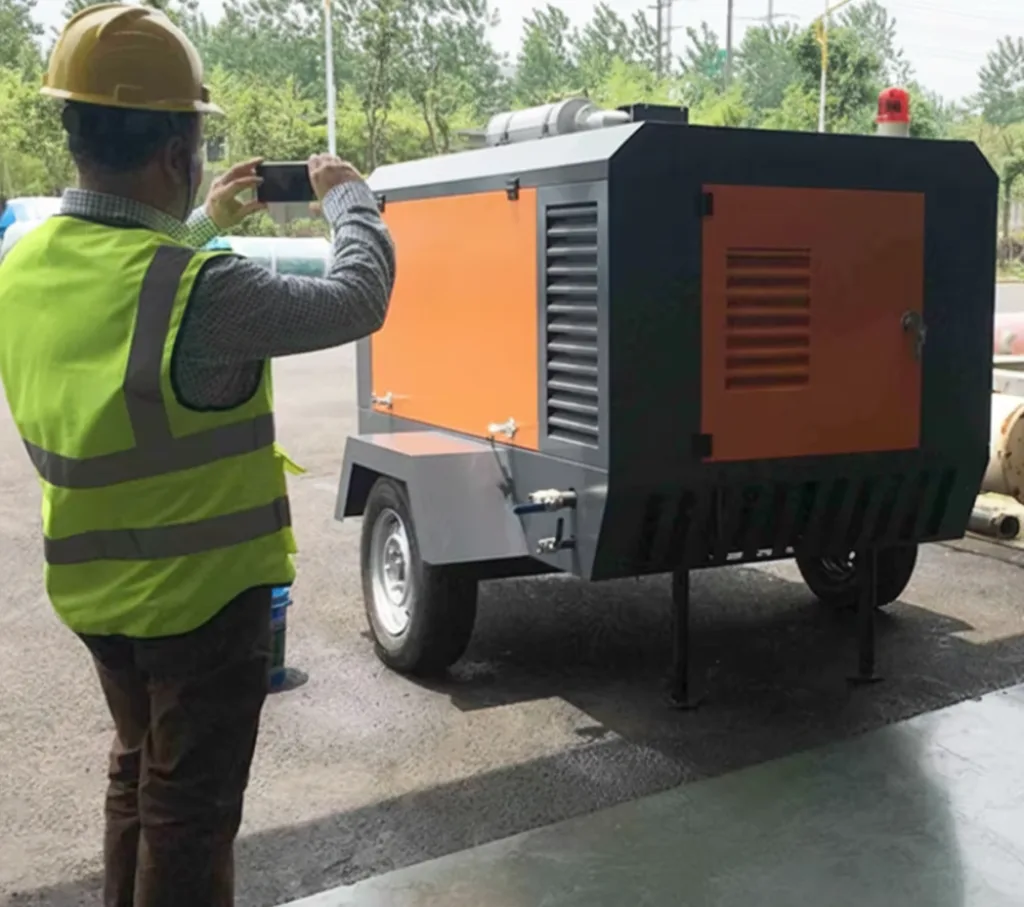
Comparing Current FAD With the Original Rating
Consider a hypothetical used compressor originally rated at 20 m³/min at 13 bar.
During a controlled performance test, it delivers 17 m³/min at the specified pressure and comparable operating conditions.
The measured capacity reduction is:
FAD Reduction = (20 − 17) / 20 × 100% = 15%
This is an illustrative calculation, not a documented field measurement.
A 15% reduction deserves investigation, but it does not automatically prove that the airend is worn. The technician must first verify the test method, inlet conditions, engine speed, intake restriction, loading controls and external losses.
The buyer should request an appropriately conducted airflow test, preferably with calibrated equipment and clearly documented operating conditions. ISO 1217 provides a recognized framework for displacement-compressor acceptance testing, although the exact procedure must suit the equipment and agreed inspection scope.
If full FAD testing is unavailable, the seller should disclose the limitation. A loaded operating demonstration and temperature measurements can still provide useful information, but they should not be represented as verified rated-capacity results.
Why This Changes the Buying Decision
A compressor sold as a 700 CFM unit may be unsuitable for an application requiring that full capacity if its actual delivery has declined substantially.
The economic consequence is not limited to repair cost. A machine that cannot provide the required airflow may reduce productivity, increase operating time or force the contractor to obtain additional equipment.
This is why verified useful output should carry greater weight than engine horsepower or an attractive asking price.
Used vs New Compressor Buying Comparison
The following table summarizes the main procurement considerations for equivalent portable diesel compressor classes.
| Assessment Factor | Used Compressor | New Compressor | What the Buyer Should Verify |
|---|---|---|---|
| Initial purchase price | Often lower | Usually higher | Final delivered price and included equipment |
| Engine condition | Depends on hours and maintenance | Newly supplied engine | Identity, configuration and operating records |
| Airend condition | May have accumulated wear | New assembly | Mechanical behavior and relevant inspection evidence |
| FAD performance | Must be verified against rated output | Should meet agreed new-machine specification | Measured airflow at the specified pressure |
| Fuel consumption | Depends on current condition and design | Depends on specified model and operating point | Fuel use at equivalent pressure and FAD |
| Immediate maintenance | May require overdue servicing or repairs | Initial servicing follows supplied schedule | Next service, major overhaul and parts cost |
| Warranty | Depends on seller and refurbishment scope | Defined new-equipment warranty | Written coverage, exclusions and claim procedure |
| Availability | May be ready for immediate delivery | Depends on inventory and production | Actual dispatch and shipping schedule |
| Compliance | Older engine configuration may limit some markets | Configuration may be selected for destination | Engine certification and applicable import requirements |
| Remaining economic life | Requires condition-based assessment | Longer unused-life potential | Duty cycle, reliability and total ownership cost |
The table describes general purchasing considerations, not guaranteed outcomes. A professionally refurbished compressor may outperform a poorly configured new machine in a particular application.
Likewise, a new compressor with insufficient FAD or the wrong working pressure is not a suitable purchase merely because it is new.
Fuel Costs and Total Ownership Cost: When Does Used Become Expensive?
The purchase-price difference between new and used compressors is often visible immediately. The difference in operating cost becomes apparent only after the machine has accumulated substantial working hours.
Diesel fuel consumption depends on compressor design, operating pressure, delivered airflow, engine efficiency, load factor and machine condition.
An older compressor is not automatically less fuel-efficient simply because of its age. However, internal deterioration, restrictive components or engine problems may increase fuel consumption relative to a properly functioning machine delivering equivalent useful air.
Buyers should compare measured fuel consumption under the same operating requirements.
A Practical Three-Year Cost Comparison
Consider two hypothetical portable diesel compressors that can meet the same application requirements:
A used compressor is offered for $18,000, while a new unit costs $29,000. The used machine requires $4,500 of immediate mechanical work.
Suppose comparable testing also establishes that the used machine consumes an additional 2 liters of diesel per operating hour at the required duty point.
If the customer operates for 1,000 hours annually, diesel costs $1.20 per liter and the comparison period is three years, the additional fuel expense is:
2 L/h × 1,000 h/year × 3 years × $1.20/L = $7,200
The used machine’s purchase cost, immediate repair and additional fuel expense total $29,700, compared with the new machine’s $29,000 purchase price.
This example is entirely hypothetical. It is not a claim about Peakroc products or the typical performance difference between new and used equipment. Common operating costs, future maintenance, financing, downtime, taxes, warranty value and resale value are excluded.
Nevertheless, it demonstrates how an initial $11,000 purchase-price saving can disappear when measurable condition-related costs are considered.
Five Cost Factors to Compare Over the Ownership Period
- Purchase and delivery: Equipment price, inspection, transportation, import charges, commissioning and required modifications.
- Initial repairs: Overdue maintenance, worn components, tire or chassis work, engine repairs and necessary airend servicing.
- Fuel consumption: Actual diesel use at comparable pressure, airflow, load factor and expected annual operating hours.
- Downtime and maintenance: Service intervals, spare-parts availability, repair labor, lost productivity and backup equipment requirements.
- Warranty and residual value: Written seller support, expected remaining service life, resale potential and financial exposure if a major component fails.
The appropriate decision horizon should match the planned use. A short-term project requiring only several hundred operating hours may favor a well-tested used compressor, while a high-utilization fleet may place greater value on service support and predictable performance.
When Is a Used Portable Diesel Compressor the Better Choice?
Used equipment can be economically attractive when the machine’s technical condition is documented and the required duty is clearly defined.
For example, a contractor needing temporary additional capacity may be able to purchase a serviced used machine with adequate performance records rather than investing in a completely new compressor.
A well-maintained machine from a rental fleet can also be considered if it has traceable service history, current inspection records and a clear warranty or support arrangement.
The critical requirement is that the machine should be evaluated against the intended application, not simply against the seller’s asking price.
A compressor with limited airflow capability may be acceptable for intermittent general construction use but unsuitable for a continuous high-demand process.
Conversely, an unnecessarily large compressor can impose higher fuel and ownership costs even when purchased at an attractive discount.
When Is a New Compressor the Better Investment?
New equipment becomes particularly attractive when the machine will operate for many hours, serve a critical process or be used in a remote location where unexpected failures are expensive.
A new compressor may also offer clearer procurement advantages when the project requires an exact pressure-flow configuration, documented factory testing, specific engine certification or a defined after-sales package.
International buyers should consider support availability carefully. A used compressor with no locally available replacement parts may become difficult to maintain, regardless of its purchase price.
However, new equipment should still undergo appropriate specification checks and acceptance testing. New condition does not eliminate the need to verify pressure, FAD, controls and contractual requirements.
The stronger comparison is therefore between a tested used compressor with known risks and a properly specified new compressor with documented support, rather than between used and new as labels alone.
Technical Field References
The following publicly documented industry examples illustrate how existing portable compressors can be refurbished, how second-hand equipment is evaluated and why inspection evidence matters.
They are external references, not Peakroc® customer projects. Public sources do not provide enough information to calculate independently verified post-refurbishment FAD recovery or fuel savings for the individual machines discussed.
Field Reference 1: Portable Water-Well Compressor Refurbishment in Ranchi, India
A manufacturer-published refurbishment program documents work on an existing portable compressor used by a water-well drilling customer in Ranchi, India.
The program offered different repair scopes, including screw-element overhauling, replacement of the airend and more extensive refurbishment options.
The project illustrates why an older portable compressor does not automatically become unusable when it requires major mechanical work. Depending on component condition and the economics of repair, refurbishment may extend its useful operation.
Engineering lesson: Remaining equipment value depends on the condition of the complete machine and the available repair scope, not age alone.
The public record confirms a refurbishment project but does not provide the machine’s original operating hours, independently measured FAD change or complete repair economics.
Field Reference 2: Portable Compressor Refurbishment in Maharashtra, India
The same publicly documented service program includes a separate portable compressor refurbishment project for a customer in Maharashtra.
The published account demonstrates that refurbishment can be applied to different portable compressor models and operating histories.
For used-equipment buyers, this highlights an important distinction between a machine that has received routine servicing and one that has undergone a more substantial mechanical restoration.
Engineering lesson: A refurbished compressor should be evaluated using its actual work records, replaced components, inspection findings and post-repair testing—not merely its appearance or seller’s description.
The source does not disclose all repaired components or detailed performance test results for this particular customer machine. Those details should not be assumed.
Field Reference 3: Inspection and Servicing of Pre-Owned Compressor Fleets
An established compressed-air equipment supplier publicly describes a process for preparing previously owned compressor equipment for resale or rental.
The stated process includes cleaning, servicing and recording important equipment information before making machines available. Warranty provisions depend on the particular equipment.
This is an example of documented resale practice rather than a quantified engineering experiment.
Engineering lesson: For second-hand equipment, buyers should expect a clear distinction between inspected, serviced and fully refurbished condition, supported by records and defined warranty terms.
A general assurance that a used machine has been checked is less useful than machine-specific maintenance, test and repair documentation.
What Should International Buyers Check Before Paying?
Purchasing a used compressor from another country creates additional risks because the buyer may be unable to inspect the machine directly or return it economically after delivery.
For these transactions, documentation and independent verification become especially important.
A video of the machine starting can help establish that it operates, but it cannot prove full FAD, internal mechanical condition or compliance with destination-market requirements.
The buyer should also confirm whether the compressor’s chassis, dimensions and towing configuration are suitable for local use. Diesel engine emissions documentation deserves particular attention because an older engine may not be suitable for import or operation in every market.
Any claimed certification should apply to the actual engine and equipment configuration being sold.
Five-Part Used Compressor Buying Checklist
- Identity and ownership: Obtain nameplate photographs, serial numbers, manufacture year, seller identification, ownership evidence and confirmation of the equipment included in the sale.
- Condition and maintenance: Request operating hours, service history, oil and filter records, major overhaul details, defect disclosures and recent inspection reports.
- Performance verification: Request loaded operating results, measured FAD where available, working pressure, temperature, noise observations and fuel data if relevant.
- Commercial and compliance review: Confirm total delivered cost, warranty terms, engine emissions documentation, import requirements, payment conditions and responsibility for damage during transport.
- Independent inspection and final acceptance: Arrange a qualified inspection when justified by equipment value, document outstanding defects and agree how discrepancies will be resolved before shipment or final payment.
If the seller refuses reasonable identification checks, will not disclose known faults or makes performance claims without supporting evidence, the buyer should reconsider the purchase.
For a high-value used compressor, the cost of a competent pre-purchase inspection may be small compared with an unexpected engine or airend repair.
Final Recommendation
Buying a used portable diesel air compressor can be an effective way to reduce initial equipment investment, but the purchase should be based on verified technical condition rather than price or operating hours alone.
Engine records help establish the machine’s history. Mechanical inspection and oil-analysis evidence can identify potential reliability risks. A suitable loaded performance test helps determine whether the compressor still delivers the required FAD at its intended working pressure.
Fuel consumption, immediate repairs, future maintenance and downtime should then be included in the economic comparison.
A properly inspected used machine may provide excellent value for moderate-duty or temporary applications. A new compressor may be the better investment when continuous operation, exact specifications, compliance or long-term support are critical.
The best buying decision is not simply used versus new. It is choosing the compressor that can reliably deliver the required air at the lowest justifiable total ownership cost over the planned operating period.
FAQ
Is it worth buying a used portable diesel air compressor?
Yes, when the machine’s condition is verified, its actual airflow and pressure meet the application requirements, and its purchase price plus expected maintenance and operating costs are economically attractive. A used compressor should be evaluated using service records, inspection findings and performance testing rather than price alone.
How many engine hours are too many for a used diesel compressor?
There is no universal engine-hour limit. Remaining service life depends on maintenance history, operating load, environmental exposure, mechanical condition and previous repairs. A higher-hour machine with documented servicing may be a better purchase than a neglected low-hour unit.
How can I tell whether a used compressor airend is worn?
Warning signs may include abnormal bearing noise, rising vibration, excessive temperature, contaminated lubricant and reduced measured FAD. These symptoms are not conclusive by themselves. External faults should be excluded, and specialist inspection may be necessary before diagnosing internal airend wear.
Should a used portable air compressor undergo FAD testing?
Yes, where practical, particularly for high-value purchases or applications requiring a defined airflow. FAD should be measured at the required working pressure using a suitable test method. An unloaded pressure reading or startup demonstration is not equivalent to verified airflow capacity.
Does a new diesel compressor always use less fuel than a used one?
No. Fuel consumption depends on compressor design, operating pressure, delivered airflow, engine characteristics, load factor and mechanical condition. New and used machines should be compared at equivalent operating requirements using reliable fuel-consumption data.
Is a refurbished compressor as reliable as a new compressor?
It depends on the refurbishment scope, original machine condition, repair quality, replaced components and post-repair testing. A properly refurbished machine may provide dependable service, but the term refurbished alone does not guarantee new-machine performance, remaining life or warranty coverage.
What is the biggest risk when importing a used diesel air compressor?
The main risks include undisclosed mechanical damage, inaccurate operating records, inadequate FAD, unavailable spare parts, unsuitable engine emissions configuration and unclear warranty responsibility. Independent inspection and documented performance verification can reduce these risks.
When should I buy a new portable diesel air compressor instead of a used one?
A new compressor may be preferable when the equipment will operate continuously, downtime is expensive, an exact configuration or emissions certification is required, or the cost of inspecting and repairing a used unit approaches the total cost of new equipment. Compare the planned ownership period and available support before deciding.
Author

Mark Chen – Senior Mechanical Engineer, Peakroc®
Mark Chen is a senior mechanical engineer at Peakroc®, specializing in compressed air systems and drilling equipment for mining and construction applications. With over 15 years of field experience, he has led multiple projects on optimizing air delivery efficiency, equipment durability, and energy consumption.