
Key Takeaways
- A 185 CFM (≈5.2 m³/min) portable diesel air compressor at 7 bar can reliably run one heavy-duty pneumatic jackhammer at full performance, or two medium-duty breakers simultaneously with some performance compromise.
- The real answer depends on the specific tool’s air consumption, hose length and diameter, elevation, ambient temperature, and whether the tools run continuously or intermittently.
- Standard pneumatic jackhammers (20–30 kg class) consume between 70 and 90 CFM (2.0–2.5 m³/min) at 6–7 bar working pressure. Heavier rock drills like the YT28 can consume up to 170 CFM (4.8 m³/min).
- Always size the compressor to the peak simultaneous demand of all connected tools, not the average — then add 20–30% margin for hose losses, altitude, and heat.
- For construction crews running more than two pneumatic tools simultaneously, step up to a 10 m³/min class compressor.
Why This Question Matters on Every Construction Site
“Can my compressor handle another breaker?” is probably the most common question asked on construction sites, road projects, and demolition jobs worldwide. The answer determines whether the crew works at full speed or fights sluggish tools all day — and whether the compressor overheats by noon.
Getting it wrong is expensive in both directions. Undersizing means slow impact energy, overheated compressors, and frustrated operators. Oversizing means paying for fuel and hauling capacity you don’t need.
This guide gives you the math, the real-world factors the math doesn’t capture, and a practical sizing table you can reference on site.
The Basic Math: 185 CFM vs. Tool Demand
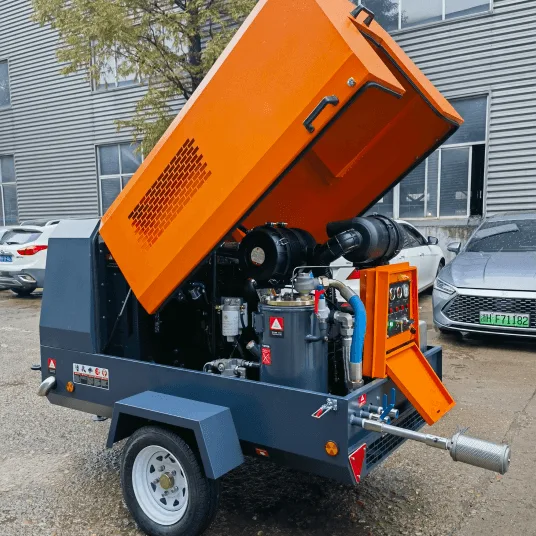
A 185 CFM portable diesel air compressor delivers approximately 5.2 cubic meters per minute of free air at 7 bar working pressure. That’s the machine’s rated output under standard conditions — sea level, 20°C ambient, clean filters.
Now look at the tools:
| Pneumatic Tool | Typical Air Consumption | Working Pressure |
|---|---|---|
| Light breaker / chipping hammer (10–15 kg) | 40–60 CFM (1.1–1.7 m³/min) | 6–7 bar |
| Medium jackhammer / breaker (20–25 kg) | 70–90 CFM (2.0–2.5 m³/min) | 6–7 bar |
| Heavy jackhammer / paving breaker (25–32 kg) | 80–100 CFM (2.3–2.8 m³/min) | 6–7 bar |
| Rock drill YT23 / YT24 class | 67–70 CFM (1.9–2.0 m³/min) | 4–6.3 bar |
| Rock drill YT28 class | Up to 172 CFM (4.8 m³/min) | 4–6.3 bar |
| Impact wrench (1″) | 25–40 CFM (0.7–1.1 m³/min) | 6 bar |
| Pneumatic tamper / rammer | 30–50 CFM (0.85–1.4 m³/min) | 6 bar |
The arithmetic is straightforward: divide 185 CFM by the per-tool consumption to get the theoretical tool count. For a medium jackhammer consuming 80 CFM, that’s 185 ÷ 80 = 2.3 tools — theoretically.
But theory and a construction site are two different things.
Why the Theoretical Number Is Always Too Optimistic
Hose friction loss
Air pressure drops as it travels through the hose from the compressor to the tool. A 20-meter run of ¾-inch (19 mm) hose at 80 CFM flow loses roughly 0.5–0.8 bar of pressure. If the compressor delivers 7 bar at the outlet and the tool receives 6.2 bar at the chuck, the hammer’s impact energy drops proportionally.
Use larger-diameter hose (1 inch / 25 mm) or shorter runs to minimize this loss. On a typical construction site with 30+ meter hose runs, friction loss alone can reduce effective tool performance by 10–15%.
Altitude deration
A diesel compressor’s output drops with elevation. At 1,000 meters above sea level, expect roughly 10% less flow. At 2,500 meters — common on mountain road projects — deration can reach 25%. Your 185 CFM machine is now delivering closer to 140 CFM, which changes the tool count from “two breakers with margin” to “one breaker comfortably.”
Ambient temperature
High ambient temperature reduces the density of intake air, which reduces mass flow. At 40°C ambient, expect 3–5% less output than the nameplate rating measured at 20°C.
Filter condition
A clean air intake filter passes full flow. A filter that’s been running on a dusty construction site for 200 hours without cleaning restricts intake air and quietly steals 5–10% of the machine’s capacity. Daily filter inspection is the cheapest performance improvement available.
Simultaneous vs. intermittent use
Two jackhammers don’t usually run at 100% duty simultaneously. Operators take breaks, reposition, and change bits. In practice, simultaneous peak demand might only occur 40–60% of the time. This is why two medium breakers on a 185 CFM machine can work on most sites — but the compressor will run at or near full load during simultaneous peaks, and the operators may feel momentary pressure drops.
Practical Answer: How Many Tools Can 185 CFM Actually Support?
Based on field experience across hundreds of construction sites, here is the realistic guidance:
| Tool Configuration | 185 CFM at 7 bar | Performance Level |
|---|---|---|
| 1 × heavy jackhammer (90–100 CFM) | Comfortable — good margin | Full impact energy, stable pressure |
| 1 × medium jackhammer (80 CFM) + 1 × impact wrench (30 CFM) | Comfortable | Both tools run well simultaneously |
| 2 × medium jackhammers (80 CFM each) | Workable — tight margin | Slight pressure dip during simultaneous peaks |
| 1 × heavy jackhammer + 1 × light chipping hammer | Workable | Adequate if hose runs are short |
| 2 × heavy jackhammers (100 CFM each) | Not recommended | Compressor at 100%+ load, tools starved |
| 1 × YT28 rock drill (170 CFM) | Maximum — no margin | Works, but no room for any other tool |
| 3 × any jackhammers | Not feasible | Need at least 300 CFM compressor |
The rule of thumb I give every construction foreman: one heavy-duty breaker with confidence, two medium breakers with discipline (stagger the work, keep hoses short, clean the intake filter daily).
When to Step Up to a Larger Compressor
If any of these conditions apply, 185 CFM is not enough:
- Running three or more pneumatic tools simultaneously
- Operating at elevation above 1,500 meters
- Using heavy rock drills (YT28 class or larger) plus any other tool
- Running tools through hose runs longer than 30 meters
- Ambient temperature consistently above 40°C
For crews running 2–3 jackhammers plus ancillary tools, a 10 m³/min (350 CFM) compressor at 8 bar is the correct step up. For larger demolition or road rehabilitation crews running 4+ breakers, the 17 m³/min (600 CFM) class handles the load with margin.
Our previous guide on portable air compressors for jackhammers covers the 185 CFM class in more detail, including engine and airend specifications.
The Sizing Formula: How to Calculate for Your Specific Site
Here is the step-by-step sizing process Peakroc® engineers use when clients ask us to spec a compressor for construction site tool loads.
Step 1 — List every pneumatic tool and its CFM rating
Pull the manufacturer’s spec sheet for each tool. Record the air consumption at rated working pressure. If the spec sheet gives consumption in liters per second, multiply by 2.12 to get CFM.
Step 2 — Identify the peak simultaneous demand
Determine the maximum number of tools that will run at the same time. Multiply each tool’s CFM consumption by the simultaneous usage factor (typically 0.7–0.9 for construction crews, 1.0 for automated or continuous operations). Sum the results.
Step 3 — Add a 20–30% safety margin
This margin accounts for hose friction loss, altitude deration, filter loading, and ambient temperature. Without this margin, the compressor runs at 100% load continuously — which shortens engine life and airend life, and leaves no headroom for pressure recovery between tool cycles.
Step 4 — Match to the nearest compressor size
Select a compressor whose rated FAD at your working pressure exceeds the Step 3 total. Use the Peakroc® compressor finder to identify the right model.
Example calculation:
A road construction crew plans to run 2 medium jackhammers (80 CFM each) and 1 impact wrench (30 CFM) at a site 800 meters above sea level with 35°C summer ambient.
- Peak simultaneous demand: (2 × 80 × 0.85) + (1 × 30 × 0.85) = 136 + 25.5 = 161.5 CFM
- Altitude + temperature deration: approximately 8%
- Adjusted demand: 161.5 ÷ 0.92 = 175.5 CFM
- Safety margin (25%): 175.5 × 1.25 = 219 CFM required
Result: 185 CFM is not quite enough. A 250–300 CFM machine is the correct choice for this site.
Frequently Asked Questions
What happens if I overload my 185 CFM compressor with too many tools?
The compressor runs at maximum engine rpm continuously, discharge pressure drops below the tools’ rated working pressure, and impact energy decreases. The compressor oil runs hotter, the engine burns more fuel, and both the airend and the engine wear at accelerated rates. In extreme overload, the machine may shut down on high-temperature alarm.
Can I run a jackhammer and a sandblasting nozzle on the same 185 CFM compressor?
Not effectively. Even a small sandblasting nozzle (No. 4 / 6.4 mm) consumes 80–100 CFM at 7 bar. Combined with a jackhammer at 80 CFM, you exceed the machine’s capacity. Sandblasting and jackhammer work should run on separate compressors.
Is 185 CFM the same as 5.2 m³/min?
Yes, approximately. 1 CFM = 0.0283 m³/min. So 185 × 0.0283 = 5.24 m³/min. When comparing compressor specs across markets, note that some manufacturers rate at different inlet conditions (temperature, pressure, humidity), so actual delivered flow may vary slightly.
Do I need a pressure regulator between the compressor and the jackhammer?
Most pneumatic jackhammers are designed for 6–7 bar. If your compressor’s discharge pressure matches (which it does on a standard 7 bar portable unit), no regulator is needed. If using a higher-pressure compressor for jackhammer work — which is not recommended — a regulator is essential to protect the tool from overpressure damage.
Author

Mark Chen – Senior Mechanical Engineer, Peakroc®
Mark Chen is a senior mechanical engineer at Peakroc®, specializing in compressed air systems and drilling equipment for mining and construction applications. With over 15 years of field experience, he has led multiple projects on optimizing air delivery efficiency, equipment durability, and energy consumption.