
Key Takeaways
Neither electric nor diesel is automatically the best portable air compressor for every mining operation.
An electric portable air compressor is usually the stronger choice for underground mines, tunnels, workshops, processing areas, and semi-permanent drilling stations with reliable electrical infrastructure. It produces no exhaust emissions at the point of use, operates more quietly, requires less engine maintenance, and can reduce ventilation demand.
A diesel portable air compressor is generally better for remote open-pit mines, exploration drilling, temporary work fronts, quarry operations, and sites where the compressor must move frequently or operate without grid power.
The decision should be based on:
- Power availability and voltage stability
- Underground or surface operation
- Required mobility and relocation frequency
- Pressure, airflow, and duty cycle
- Ventilation and emissions constraints
- Energy and fuel logistics
- Maintenance capability and lifecycle cost
Peakroc® supplies portable diesel and electric air compressors for underground and surface mining. Customers can review the 6.2–22.5 m³/min electric portable compressor range, explore mining air compressor solutions, or compare high-pressure diesel compressors for drilling and mining.
Why Do Mines Need Portable Air Compressors?
Compressed air remains essential across many surface and underground mining operations. It can power pneumatic tools, rock drills, ventilation equipment, dewatering controls, tire-service systems, exploration rigs, maintenance tools, and temporary production systems.
A portable compressor is particularly useful when the air demand is located far from a central compressor station or when the working face moves as mining progresses.
Unlike a permanent compressor room, a mobile unit can be positioned closer to the application. This helps reduce long pipe runs, pressure losses, installation time, and dependence on fixed infrastructure.
However, the word “portable” means different things in mining. A towable diesel compressor may move between remote drill pads several times a week. An electric compressor may be mounted on wheels or a skid but remain connected to the same underground power distribution point for months.
The correct power source depends on how the compressor will actually move and operate.
What Is an Electric Portable Air Compressor?
An electric portable compressor uses an electric motor to drive a rotary screw air end. The machine may be mounted on a towable chassis, skid, wheeled frame, or compact support base.
It requires a suitable external power supply, typically three-phase electricity from the mine grid, transformer, switchboard, or generator.
Modern electric portable compressors may use fixed-speed motors or variable-speed drives. A VSD model adjusts motor speed according to actual compressed-air demand, which can improve partial-load efficiency and pressure stability.
Electric compressors are especially attractive underground because they do not produce diesel exhaust at the point of use. They also generate less noise and require fewer engine-related service operations.
Their main limitation is dependence on electrical infrastructure. Even a highly mobile chassis cannot provide complete operational freedom if the machine requires a large cable, transformer, and approved connection point.
What Is a Diesel Portable Air Compressor?
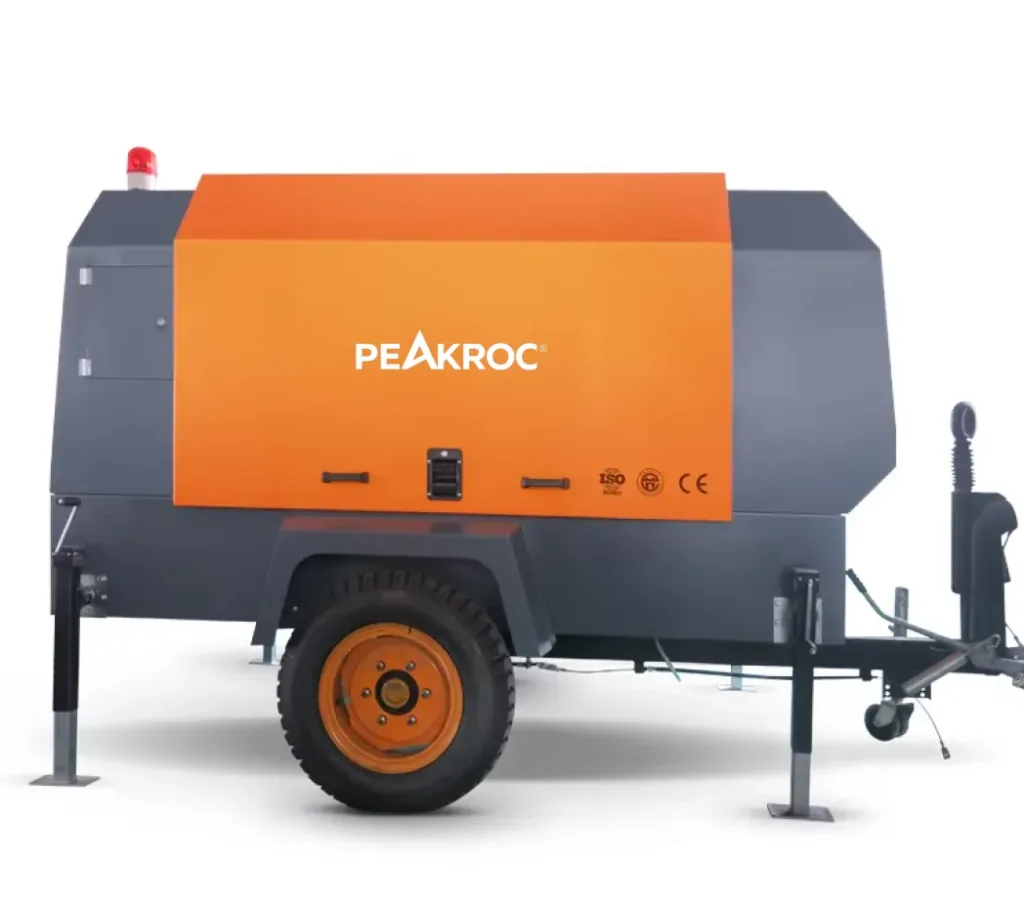
A diesel portable compressor combines a compression air end with a self-contained diesel engine, fuel tank, cooling system, control system, and trailer or skid.
It can operate independently of the mine’s electrical network, making it suitable for exploration sites, remote drilling areas, new mine developments, temporary work fronts, and surface operations.
Diesel compressors are available across a broad range of pressures and airflow capacities. Low-pressure units can power pneumatic tools and maintenance equipment, while two-stage high-pressure machines can support DTH drilling and deep-hole applications.
The main disadvantages are fuel consumption, exhaust emissions, higher noise, additional heat, and more complex routine maintenance.
Underground use may also increase ventilation requirements because diesel exhaust and heat must be removed from the working area.
Electric vs. Diesel Portable Compressors at a Glance
| Selection Factor | Electric Portable Compressor | Diesel Portable Compressor |
|---|---|---|
| Power source | Mine grid, transformer, or generator | Onboard diesel engine |
| Local exhaust emissions | None at the compressor | Diesel exhaust present |
| Noise level | Generally lower | Generally higher |
| Mobility | Limited by cables and electrical connections | Highly independent |
| Underground suitability | Strong where power is available | Requires careful ventilation planning |
| Remote surface suitability | Limited without electrical infrastructure | Excellent |
| Routine maintenance | Motor and compressor service | Engine and compressor service |
| Energy logistics | Electricity supply and cable management | Fuel delivery and storage |
| Starting characteristics | Electrical starting current must be considered | Self-contained starting system |
| Best operating pattern | Semi-fixed or regularly powered locations | Frequently moving or off-grid work fronts |
Which Is Better for Underground Mining?
For many underground applications, electric portable compressors offer the strongest overall advantage.
Ventilation is one of the largest operational concerns below ground. Diesel engines produce exhaust gases and heat that must be diluted and removed. Additional ventilation can increase power consumption and place further demand on fans, ducts, and mine infrastructure.
An electric compressor eliminates local combustion exhaust. This can improve working conditions and reduce the ventilation burden associated with another diesel engine operating underground.
Noise is another consideration. Underground tunnels and chambers reflect sound, making machinery feel louder than it would outdoors. Electric motors generally operate more quietly than diesel engines, especially when installed inside a sound-attenuated enclosure.
Electric compressors are therefore suitable for:
- Underground development headings
- Tunnel construction
- Maintenance workshops
- Rock-bolting and scaling support
- Fixed or semi-fixed pneumatic-tool stations
- Processing areas with reliable power
- Emergency or temporary plant air
The main question is whether the electrical system can support the compressor safely. Cable capacity, voltage drop, grounding, protection, plug type, transformer rating, and connection procedures must all be checked.
Which Is Better for Open-Pit and Remote Mining?
Diesel portable compressors usually have the advantage in remote surface mines and exploration work.
Open-pit operations can cover large areas, and work fronts may move frequently. A compressor may need to follow a drilling rig, service truck, blasting crew, or maintenance team across uneven terrain.
Running high-capacity electrical cables over these distances can be difficult, expensive, and unsafe. Even where mine power exists, connection points may not be available near every active area.
A diesel compressor can be transported, positioned, started, and operated without waiting for electrical installation.
This independence makes diesel compressors well suited to:
- Exploration drilling
- Remote open-pit mines
- Quarry and blast-hole work
- Temporary drilling pads
- New mine development
- Emergency maintenance
- Tire service and equipment repair
- Pipeline cleaning and testing
The trade-off is fuel logistics. Diesel must be delivered, stored, filtered, and monitored. Poor fuel quality can damage injectors and increase downtime, so additional filtration may be required in remote regions.
Mobility Is More Than Having Wheels
A common selection mistake is assuming that every wheeled compressor offers the same level of mobility.
A diesel tow-behind machine is operationally independent once it reaches the work area. An electric towable unit may still need a heavy power cable, approved electrical connection, transformer, and lockout procedure.
For a compressor that moves several times per shift, diesel often provides greater practical mobility.
For a machine that stays in one tunnel section or workshop for several weeks, an electric model may provide better long-term economics even if the initial setup takes longer.
The buyer should therefore define mobility in terms of:
- How often the compressor moves
- Distance between working locations
- Availability of power at each point
- Cable handling time
- Terrain and access conditions
- Towing or lifting equipment
- Setup and shutdown procedures
A portable machine that takes several hours to reconnect may function more like a semi-stationary unit in real operation.
Pressure and Airflow Requirements
Power source does not change the basic compressor-sizing process.
The machine must provide enough working pressure and free air delivery for all tools and processes expected to operate simultaneously.
Low-pressure mining applications may require approximately 7–10 bar for pneumatic tools, cleaning, and maintenance. Drilling applications can require 14, 20, 25, 35 bar, or more, depending on the hammer, hole depth, and geology.
Airflow demand depends on tool size, number of operators, duty cycle, hose length, leakage, altitude, and temperature.
| Mining Application | Typical Compressor Direction |
|---|---|
| Pneumatic hand tools | Low- to medium-flow, 7–10 bar |
| Workshop and maintenance air | Electric screw compressor where grid power is available |
| Underground development support | Low-noise electric portable compressor |
| Exploration drilling | Diesel portable compressor with suitable pressure and mobility |
| DTH production drilling | Medium- or high-pressure diesel or electric unit matched to the hammer |
| Remote tire service | Diesel mobile compressor |
| Processing-area backup air | Electric portable or skid-mounted compressor |
The rated free air delivery should always be checked at the required working pressure. A compressor may deliver less airflow as pressure increases.
Energy Cost: Electricity vs. Diesel
Electric compressors often have a lower direct energy cost where reliable mine power is available at a competitive tariff.
Electric motors convert energy efficiently and do not experience the same idle fuel consumption as diesel engines. VSD technology can improve performance further when air demand varies throughout the shift.
Diesel operating cost depends on fuel price, transport distance, storage losses, engine loading, and idle time. In remote mines, the delivered cost of fuel can be considerably higher than the purchase price at a central depot.
However, electricity is not automatically cheaper in every location. Some mines generate power with diesel or operate isolated grids with high production costs. Electrical infrastructure may also require expensive transformers, cables, switchgear, and installation work.
A realistic calculation should include:
- Energy or fuel cost per operating hour
- Expected load percentage
- Annual operating hours
- Electrical infrastructure
- Fuel delivery and storage
- Ventilation demand
- Service parts and labor
- Downtime and relocation cost
The correct comparison is total cost per productive hour, not simply electricity price versus diesel price.
Ventilation, Heat, and Emissions
Both electric and diesel compressors produce heat because compression itself generates heat.
An electric unit eliminates engine exhaust but still releases heat from the motor, air end, oil system, and cooling circuit. Underground installations require enough airflow to prevent hot-air recirculation and overheating.
A diesel machine adds engine heat and combustion exhaust. This increases the load on the mine ventilation system.
For underground use, the supplier and mine engineer should evaluate:
- Compressor heat rejection
- Diesel exhaust volume where applicable
- Available ventilation airflow
- Ambient temperature
- Air recirculation risk
- Gas-monitoring requirements
- Emergency shutdown procedures
An electric compressor may reduce the overall ventilation burden, but it does not remove the need for thermal management.
Maintenance Differences
Electric compressors generally have fewer service systems.
Routine work focuses on compressor oil, filters, separator elements, cooling surfaces, electrical connections, motor condition, and condensate management.
A diesel compressor requires all of those compressor-related tasks plus engine oil, coolant, fuel filters, air filters, belts, batteries, injectors, and possibly emissions-treatment components.
This does not mean diesel machines are unreliable. Industrial diesel compressors are specifically built for harsh outdoor conditions. They simply contain more serviceable systems.
Electric units can reduce routine maintenance in underground or semi-fixed applications. Diesel units may still be easier to support in remote areas where local mechanics are familiar with industrial engines but high-voltage electrical technicians are not always available.
The better choice depends on local technical capability, spare-parts access, and diagnostic support.
Noise and Worker Exposure
Electric compressors are generally quieter because there is no combustion engine.
This is particularly valuable underground, where rock surfaces reflect sound and workers may operate close to the machine.
Lower compressor noise can improve communication and reduce cumulative workplace exposure. However, the complete sound environment must still be assessed. Cooling fans, compressed-air discharge, pneumatic tools, drills, and other mining equipment may remain significant noise sources.
Diesel machines can also use sound-attenuated enclosures, low-speed fans, and advanced mufflers. Even so, they normally remain louder than equivalent electric models.
Noise ratings should be compared using the same measurement standard, operating condition, and distance.
Air Quality and Moisture Control
Both electric and diesel oil-injected compressors can produce similar compressed-air quality when they use comparable air ends and treatment systems.
The power source does not by itself determine air purity.
Moisture is often the more important issue in mining. Compressed air cools as it travels through hoses and pipelines, causing water to condense.
Wet air can damage tools, interfere with blasting operations, freeze in cold environments, and accelerate corrosion.
Depending on the application, the system may require:
- Aftercooler
- Water separator
- Refrigerated dryer
- Desiccant dryer
- Particulate and coalescing filters
- Automatic drains
The air-treatment package creates pressure loss, which must be included in compressor sizing.
Real-World Mining Examples
Electric portable compressors have already moved beyond light industrial use. In an underground copper mine in Yunnan, an electric portable compressor was deployed to supply compressed air without adding diesel exhaust at the working location.
This type of application demonstrates where electric machines are strongest: underground operations with available power, ventilation constraints, and a need for lower noise.
Diesel units continue to prove their value in surface and extreme-location mining. Portable compressors used in high-altitude Chilean operations have supported drilling and slope-stabilization work above 4,000 meters, where terrain, temperature, dust, and mobility create severe demands.
At an Indonesian coal mine, a fleet of portable diesel compressors has supported heavy-equipment tire service in humid, high-temperature conditions. The application requires machines that can be relocated and operate independently across a large site.
These cases do not prove that one technology is universally superior. They show that the operating environment determines the correct power source.
Can a Mine Use Both Electric and Diesel Compressors?
Yes. A mixed fleet is often the most practical strategy.
Electric compressors can serve workshops, underground production zones, processing plants, and semi-permanent stations with reliable power.
Diesel compressors can cover exploration, remote pits, temporary maintenance, new work fronts, and emergency backup.
A hybrid fleet allows the mine to use lower-emission, lower-maintenance equipment where electrical infrastructure exists without sacrificing mobility in off-grid areas.
It can also provide resilience. A diesel unit may act as backup during electrical outages, while an electric unit reduces routine fuel consumption in permanent work areas.
How to Choose Between Electric and Diesel
Before requesting a quotation, prepare the following information:
- Required pressure and airflow
- Underground or surface location
- Distance from the nearest reliable power point
- Voltage, frequency, and transformer capacity
- Expected moves per shift or week
- Daily operating hours and duty cycle
- Ambient temperature, altitude, and dust
- Ventilation limitations
- Fuel and electricity cost
- Required air treatment
- Local service capability
- Emissions and noise requirements
The supplier should provide free air delivery at working pressure, motor or engine details, energy or fuel consumption, cooling requirements, dimensions, weight, noise rating, service intervals, and environmental limits.
Peakroc® Mining Compressor Solutions
Peakroc® supplies both electric and diesel portable screw compressors for mining operations.
Electric models are available for underground mines, tunnels, workshops, and semi-permanent work areas where reliable electrical power is present. Available configurations cover multiple pressure and airflow classes, including VSD options for variable demand.
Diesel portable compressors are available for exploration, open-pit mining, quarrying, DTH drilling, equipment maintenance, and remote operations. Peakroc® offers low-, medium-, and high-pressure configurations, including two-stage machines for demanding drilling work.
Peakroc® can help customers evaluate the complete operating system, including power source, pressure, airflow, mobility, cooling, air treatment, engine or motor, electrical infrastructure, emissions level, and service planning.
Final Recommendation
Choose an electric portable compressor when the mine has stable electrical power, the compressor will remain in one area for extended periods, and reducing underground exhaust, noise, maintenance, and ventilation demand is a priority.
Choose a diesel portable compressor when the work front is remote, electrical infrastructure is unavailable, the machine moves frequently, or independent operation is essential.
For many mining companies, the best solution is not electric or diesel alone. It is a mixed fleet that uses electric compressors in powered underground and processing areas while retaining diesel machines for mobile, off-grid, and high-pressure drilling work.
Peakroc® can help mining contractors and equipment distributors compare both options according to pressure, airflow, site layout, power access, mobility, operating hours, and total lifecycle cost.
FAQ
1. Is an electric or diesel compressor better for underground mining?
An electric compressor is usually better where reliable power is available because it produces no local diesel exhaust, operates more quietly, and can reduce ventilation and engine-maintenance requirements.
2. Why are diesel compressors widely used in open-pit mines?
Diesel compressors are self-contained and can operate in remote areas without electrical infrastructure. They are easier to move between drilling, maintenance, and exploration locations.
3. Are electric portable compressors truly mobile?
They can be mounted on wheels, trailers, or skids, but their practical mobility is limited by cables, transformers, connection points, and electrical setup time.
4. Are electric compressors cheaper to operate?
They are often cheaper where grid electricity is reliable and competitively priced. The calculation must also include electrical infrastructure, utilization, ventilation, and local energy costs.
5. Can diesel compressors be used underground?
Yes, but exhaust, heat, noise, fuel handling, emissions compliance, and ventilation capacity must be carefully managed.
6. Do electric compressors require ventilation?
Yes. They produce no combustion exhaust, but the motor and compression process still generate heat that must be removed.
7. Which type is better for DTH drilling?
Either type can support DTH drilling if it provides the required pressure and airflow. Diesel is usually more practical for remote or frequently moving drilling, while electric units can suit fixed or semi-fixed powered locations.
8. Can a mine operate both electric and diesel compressors?
Yes. A mixed fleet often provides the best balance between low-emission operation and off-grid mobility.
9. What information is required before selecting a mining compressor?
The supplier needs the required pressure, airflow, application, operating location, power availability, relocation frequency, altitude, temperature, duty cycle, and air-treatment requirements.
10. Does Peakroc® supply both electric and diesel mining compressors?
Yes. Peakroc® supplies electric and diesel portable screw compressors across multiple airflow and pressure ranges for underground mining, open-pit operations, drilling, maintenance, and exploration.
Author

Mark Chen – Senior Mechanical Engineer, Peakroc®
Mark Chen is a senior mechanical engineer at Peakroc®, specializing in compressed air systems and drilling equipment for mining and construction applications. With over 15 years of field experience, he has led multiple projects on optimizing air delivery efficiency, equipment durability, and energy consumption.