
Key Takeaways
For many professional abrasive-blasting applications, the pressure measured at the nozzle is approximately 90–125 PSI, or 6.2–8.6 bar. Delicate surfaces may require less pressure, while heavy coating removal and large industrial projects may operate toward the upper end of that range.
Pressure alone, however, does not determine blasting performance. The compressor must deliver enough continuous airflow to keep the selected nozzle supplied while blasting. A machine that reaches 100 PSI but cannot maintain the required CFM will lose pressure as soon as the nozzle opens.
The most important selection factors are:
- Nozzle diameter, condition, and rated air consumption
- Required pressure at the nozzle rather than only at the compressor
- Total CFM for all simultaneously operating nozzles
- Air-hose diameter, length, and fitting restrictions
- Daily duty cycle, altitude, temperature, and moisture control
For professional outdoor work, a portable rotary screw compressor is generally more suitable than a small reciprocating unit because it can supply continuous airflow during long blasting cycles.
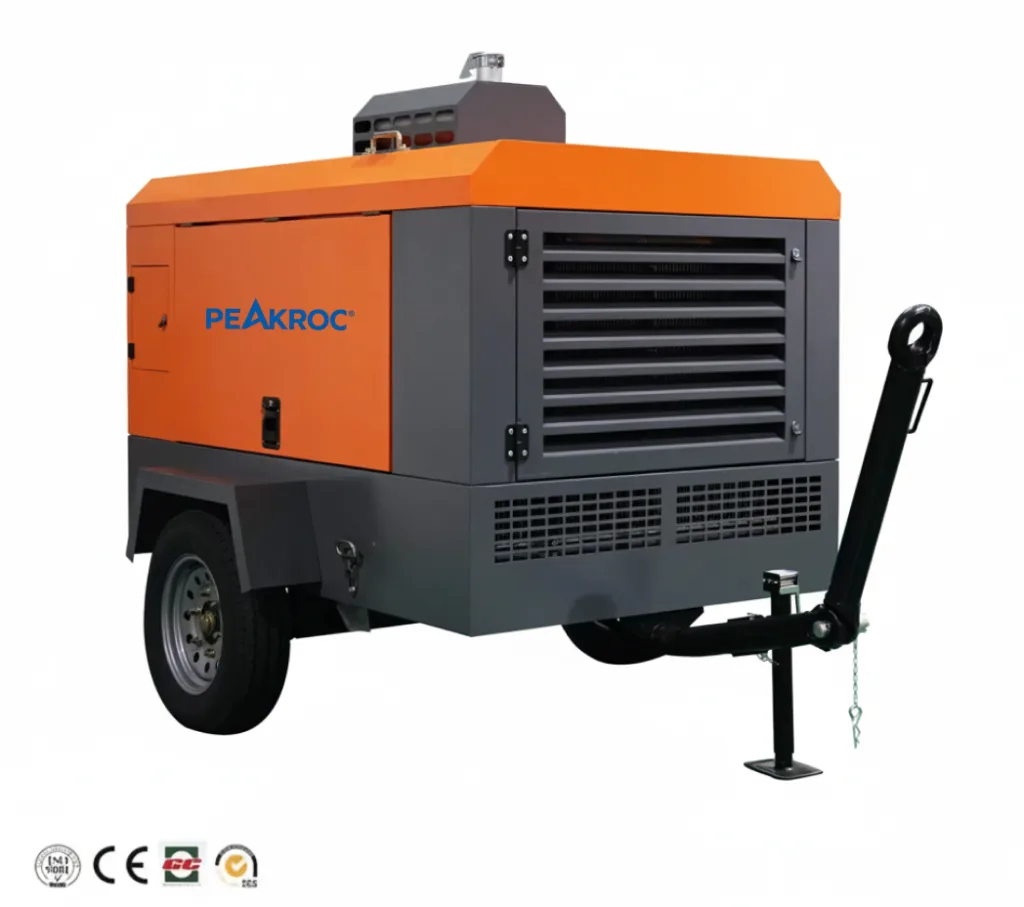
Peakroc® supplies portable mobile air compressors for abrasive blasting, construction, mining, coating preparation, and industrial maintenance. Available options include the 5 m³/min, 7 bar portable diesel air compressor, the 12 m³/min, 7 bar compressor for drilling and sandblasting, and Peakroc’s compressor selection service.
What Air Pressure Is Normally Used for Sandblasting?
Most pressure-blasting systems operate between approximately 90 and 125 PSI. This range provides enough abrasive velocity for many tasks involving structural steel, tanks, pipelines, heavy equipment, bridges, and industrial coating removal.
Lower pressure is often preferable for aluminum, automotive panels, wood, stone, fiberglass, or other surfaces that may distort, erode, or develop an excessive profile. In these cases, operators may work between approximately 40 and 80 PSI and combine the reduced pressure with a smaller nozzle or finer abrasive.
Higher pressure increases particle velocity and can improve the removal rate on hard surfaces. It also increases air demand, abrasive consumption, nozzle wear, hose loss, and the possibility of damaging the substrate.
The correct pressure therefore depends on the surface material, coating thickness, required cleanliness grade, desired profile, abrasive type, and nozzle design. The highest available compressor pressure is not automatically the best operating pressure.
Why CFM Matters as Much as PSI
PSI describes pressure, while CFM describes the volume of air delivered over time. Sandblasting requires both.
When the blast nozzle is open, compressed air escapes continuously. The compressor must replace that air fast enough to maintain the required nozzle pressure.
A compressor may be rated for 125 PSI, but that rating is not useful unless the machine can also deliver enough airflow at the selected pressure. If the nozzle consumes 200 CFM and the compressor supplies only 150 CFM, system pressure will fall after blasting begins.
Typical symptoms of insufficient airflow include weak abrasive velocity, inconsistent cleaning, pressure fluctuation, pulsing media, longer blasting time, and continuous operation at maximum compressor load.
The primary specification should therefore be free air delivery at the required working pressure. Rated motor power or engine horsepower alone does not show whether the compressor can support the nozzle.
How Nozzle Size Changes Air Consumption
The blast nozzle has a direct influence on compressor capacity.
A larger nozzle creates a wider blast pattern and can increase production, but it also allows substantially more air to escape. Because the opening area grows quickly with diameter, a small increase in nozzle size can create a large increase in CFM demand.
| Nozzle Diameter | Approximate Airflow Range | Typical Pressure | Typical Application |
|---|---|---|---|
| 3 mm | 0.3–0.8 m³/min | 5.5–7 bar | Spot cleaning and small components |
| 5 mm | 0.7–1.8 m³/min | 6–7 bar | Maintenance and light surface work |
| 6 mm | 1.3–3.1 m³/min | 6–8 bar | General fabrication and steel cleaning |
| 8 mm | 2.2–5.3 m³/min | 7–8.5 bar | Industrial rust and coating removal |
| 10 mm | 3.0–7.5 m³/min | 7–9 bar | Tanks, pipelines, and large structures |
| 11–13 mm | 4.0–13.0 m³/min or more | 7–10 bar | Shipyards and high-output blasting |
These values are preliminary planning ranges. Actual demand varies with nozzle design, pressure, abrasive equipment, wear, blasting method, and manufacturer specifications.
For accurate selection, use the air-consumption chart provided by the nozzle or blasting-equipment manufacturer.
Why Nozzle Wear Changes Compressor Requirements
Abrasive gradually enlarges the nozzle bore. The nozzle may still look usable, but its air consumption can increase substantially.
An 8 mm nozzle that has worn closer to 9 mm will allow more air and abrasive to pass. If the compressor was selected with no reserve, pressure at the nozzle will begin to fall.
Operators may notice a wider blast pattern, reduced cleaning intensity, increased abrasive use, or longer production time. The compressor may also stay at maximum load throughout the shift.
Nozzle diameter should therefore be measured periodically with an appropriate gauge. Worn nozzles should be replaced before they reduce productivity or overload the air system.
A reasonable compressor reserve also helps compensate for normal nozzle wear, small leakage, dirty filters, temperature, and hose losses. For preliminary calculations, a margin of approximately 15–25% is often useful, although the project conditions should determine the final figure.
Compressor Pressure Is Not Nozzle Pressure
The compressor outlet gauge shows pressure at the machine, not necessarily at the point where abrasive leaves the nozzle.
Air loses pressure while passing through the main hose, blast pot, moisture separator, valves, couplings, bends, filters, and blast hose. The longer and more restrictive the system, the greater the pressure loss.
For example, a compressor outlet may indicate 110 PSI while the nozzle receives only 90 PSI. Increasing the compressor setpoint may compensate temporarily, but it can also increase fuel consumption and thermal load.
Before purchasing a higher-pressure machine, inspect the distribution system. Common restrictions include undersized hoses, long hose runs, damaged internal hose walls, small quick couplings, unnecessary bends, leaking connections, and undersized separators.
Pressure should ideally be checked near the blast pot or nozzle while the equipment is operating under full load.
How Hose Size Affects Blasting Performance
Hose diameter can be just as important as compressor capacity.
A small hose restricts airflow and creates friction loss, especially over long distances. This may make an adequately sized compressor appear too small.
For industrial blasting, the main air-supply hose should be sized for the total system airflow rather than simply matched to the compressor outlet connection. Long runs around pipelines, bridges, tanks, or ship hulls may require a larger internal diameter.
The most effective arrangement normally uses the shortest practical route, wide-radius bends, full-flow couplings, and a manifold sized for all active operators.
In many cases, increasing hose diameter improves nozzle pressure more efficiently than raising the compressor setpoint.
How to Calculate Required Compressor Capacity
Begin with the rated airflow of every nozzle and auxiliary device that may operate at the same time.
The basic formula is:
Required compressor airflow = total nozzle demand + auxiliary air demand + operating reserve
Assume one 8 mm nozzle requires 4.5 m³/min at the target pressure, while the control system uses another 0.3 m³/min.
The base demand is:
4.5 + 0.3 = 4.8 m³/min
Adding a 20% reserve gives:
4.8 × 1.20 = 5.76 m³/min
A compressor rated around 6 m³/min at the required pressure would therefore be more suitable than a 5 m³/min unit.
For two identical operators, multiply the nozzle demand by two before adding auxiliary demand and reserve. Do not assume that two operators will never open their nozzles simultaneously unless the workflow actively prevents it.
Practical Compressor Sizing Examples
| Blasting Setup | Preliminary Compressor Range | Typical Use |
|---|---|---|
| 3–4 mm cabinet nozzle | Small piston or screw compressor | Short, intermittent parts cleaning |
| 5–6 mm pressure nozzle | Approximately 2–4 m³/min | Workshops and maintenance |
| One 8 mm nozzle | Approximately 5–7 m³/min | Structural steel and heavy rust removal |
| One 10 mm nozzle | Approximately 7–10 m³/min | Tanks, pipelines, and large equipment |
| Two 8 mm nozzles | Approximately 10–14 m³/min | Two-operator contractor work |
| Large industrial nozzle | Approximately 10–16 m³/min or more | Shipyards and heavy production blasting |
These are starting ranges rather than guaranteed equipment matches. The compressor must be checked against the actual nozzle chart, required pressure, hose arrangement, auxiliary demand, and environmental conditions.
Should You Choose 7 Bar, 8.5 Bar, or 10 Bar?
A 7 bar compressor is suitable for many standard blasting operations when the desired nozzle pressure is around 85–90 PSI and the hose run is short and properly sized.
An 8–8.5 bar compressor provides more margin for hose and equipment losses. It may be preferable where the operator needs to maintain approximately 100 PSI at the nozzle.
A 10 bar compressor can be appropriate for longer hose systems, elevated work areas, multiple separators or filters, demanding industrial cleaning, or equipment specifically designed for higher pressure.
However, a 10 bar unit will not automatically improve production if the nozzle already receives adequate pressure at 7 or 8 bar. Higher discharge pressure generally requires more power and can increase fuel consumption.
The correct process is to determine the required nozzle pressure, estimate total system pressure loss, and then select the compressor outlet pressure.
Rotary Screw Compressor or Piston Compressor?
Small reciprocating compressors can support cabinet blasting, hobby restoration, and brief intermittent work. Their lower purchase cost makes them practical where the nozzle is small and blasting time is limited.
They are less suitable for continuous industrial work. Once the receiver pressure drops, the operator may need to pause while the compressor recovers. Frequent cycling can also increase heat and component wear.
Portable rotary screw compressors provide a steadier air supply and are designed for long duty cycles. They are generally preferred for outdoor blasting, structural steel, pipelines, tanks, shipyards, mining equipment, bridges, and construction machinery.
The choice can be summarized as follows:
- Piston compressor: small nozzle, short cycle, occasional work
- Rotary screw compressor: continuous blasting, larger nozzle, professional production
- Large portable screw compressor: multiple operators or high-output industrial blasting
Why Moisture Control Matters
Air entering a compressor contains water vapor. Compression raises the temperature, and as the air cools downstream, part of the vapor condenses into liquid water.
Moisture can cause abrasive to clump or bridge inside the blast pot. It may also block metering valves, create unstable media flow, contribute to flash rust, and affect coating adhesion.
A professional system should normally include an effective water separator near the blast pot. In humid climates or coating-critical applications, additional equipment may be needed, including an aftercooler, coalescing filter, refrigerated dryer, or desiccant dryer.
An aftercooler lowers discharge-air temperature so moisture can condense before reaching the blasting equipment. The separator then removes the liquid from the airflow.
Air-treatment equipment also causes some pressure loss, so this must be included in the compressor calculation.
How Site Conditions Affect Compressor Output
Rated compressor capacity is normally measured under defined reference conditions. Real output can change with altitude, heat, dust, and maintenance condition.
At high altitude, lower air density reduces the mass of air entering the compressor. A larger machine or manufacturer-approved derating calculation may be necessary.
High ambient temperature increases the load on the cooling system. Dust can block the intake filter, radiator, oil cooler, and aftercooler, reducing airflow and increasing operating temperature.
Before selecting a model, provide the supplier with the maximum ambient temperature, elevation, humidity, dust level, hose distance, and expected hours per shift.
A useful field example is pipeline sandblasting in a hot desert environment. A mobile compressor may need to maintain pressure through a 10–20 m hose while operating for a full working shift at very high ambient temperature. Under those conditions, cooling capacity and continuous-duty design are as important as the nominal CFM rating.
Dry and Wet Abrasive Blasting
Dry abrasive blasting uses compressed air to accelerate dry media. It offers high productivity but can create considerable airborne dust.
Wet or vapor blasting introduces water to suppress dust and may reduce abrasive consumption. It is useful in urban, industrial, and maintenance settings where dust containment is difficult.
Wet blasting still requires sufficient compressor capacity. Nozzle air consumption remains determined by the nozzle opening, pressure, equipment design, and working method.
A wet system should not be assumed to need a small compressor simply because it produces less visible dust.
Abrasive and Surface Requirements
The chosen abrasive affects cleaning speed and surface profile.
Garnet, steel grit, aluminum oxide, glass bead, slag, and other approved media vary in hardness, density, shape, and cutting ability. Aggressive abrasives remove thick coatings quickly but may produce a deeper profile. Softer or finer media are more appropriate for delicate materials.
Pressure, abrasive, nozzle, and stand-off distance should be selected together. Thin steel, aluminum, fiberglass, masonry, and sensitive machinery surfaces may require lower pressure to avoid warping or erosion.
The required cleanliness and anchor profile should be specified before work begins. A compressor that supports maximum production but creates the wrong surface profile does not improve the final result.
Sandblasting Safety Requirements
Abrasive blasting creates dust, noise, high-velocity particles, static electricity, and potentially hazardous contaminants from both the abrasive and the surface coating.
Silica-containing sand should not be treated as the default abrasive. Inhaling respirable crystalline silica can cause serious and irreversible disease. Old coatings may also contain lead, chromium, or other toxic materials.
Professional projects require appropriate engineering controls, containment, ventilation, exposure monitoring, hearing protection, protective clothing, and approved respiratory equipment.
Air from a standard oil-injected compressor must never be supplied directly to a blasting helmet. Breathing air requires a dedicated treatment and monitoring system designed to comply with the applicable respiratory-air standard.
Common Selection Mistakes
The first mistake is choosing a compressor only by its maximum PSI. The machine may reach the pressure but lack the CFM needed to hold it once the nozzle opens.
The second is calculating demand using a new nozzle while ignoring wear. As the bore enlarges, airflow demand rises.
The third is using undersized hoses and restrictive couplings. In that situation, purchasing a larger compressor may not solve the underlying pressure-loss problem.
Another common mistake is overlooking moisture treatment. Even when pressure and airflow are adequate, wet air can disrupt abrasive flow and compromise the prepared surface.
Oversizing can also be costly. A compressor that is much larger than the real demand may consume more fuel, cost more to transport, and spend long periods operating inefficiently.
Information Needed Before Requesting a Quotation
Provide the following information so the compressor can be matched accurately:
- Nozzle diameter, model, and number of operators
- Required nozzle pressure and abrasive type
- Blast-pot model and dry or wet process
- Main hose diameter and maximum length
- Daily operating hours and expected duty cycle
- Temperature, altitude, humidity, and dust conditions
- Required aftercooler, separator, filters, or dryer
- Towable or skid-mounted configuration
- Destination country and emissions requirements
The supplier can then calculate total airflow, expected pressure loss, operating reserve, and appropriate compressor capacity.
Peakroc® Sandblasting Compressor Solutions
Peakroc® supplies portable diesel screw air compressors across multiple airflow and pressure ranges for structural steel, pipelines, shipyards, tanks, construction equipment, mining machinery, bridges, and industrial surface preparation.
A 5 m³/min, 7 bar compressor may support one medium nozzle where the hose is short and pressure demand is moderate. Larger nozzles, long hoses, high altitude, or multiple operators may require 7.5, 10, 12 m³/min, or substantially more.
Peakroc® can help customers compare pressure, airflow, engine options, trailer or skid configurations, cooling systems, moisture-treatment equipment, spare parts, and total operating cost.
Final Recommendation
For sandblasting compressor selection, start with the nozzle rather than the compressor.
Identify the nozzle diameter, rated air consumption, required nozzle pressure, number of simultaneous operators, hose losses, and auxiliary demand. Then add a reasonable reserve for wear, leakage, temperature, altitude, and future requirements.
For many professional applications, a compressor delivering 7–8.5 bar with sufficient continuous airflow provides a practical solution. A higher-pressure model should be selected only when the equipment or distribution losses genuinely require it.
Peakroc® can recommend a suitable portable screw compressor based on nozzle size, PSI, CFM, hose layout, abrasive, working environment, and project scale.
FAQ
1. What PSI is normally required for sandblasting?
Most professional pressure-blasting systems operate at approximately 90–125 PSI. Delicate surfaces and lighter cleaning may require lower pressure.
2. Is 100 PSI enough for sandblasting?
Yes. About 100 PSI is suitable for many general industrial applications, provided the compressor delivers enough continuous CFM at that pressure.
3. How many CFM does a sandblaster need?
The requirement depends mainly on nozzle size and pressure. Small cabinet nozzles may need less than 30 CFM, while an 8 mm industrial nozzle may require roughly 78–187 CFM. Larger nozzles may require several hundred CFM.
4. Can a 185 CFM compressor run a sandblaster?
Yes, it can support many medium industrial blasting setups. The exact nozzle diameter, working pressure, hose loss, nozzle wear, and reserve must still be verified.
5. Is a 7 bar compressor suitable for sandblasting?
Yes. Seven bar is suitable for many standard blasting applications when the system delivers adequate pressure and airflow at the nozzle.
6. Why does blasting pressure drop during operation?
Typical causes include insufficient compressor airflow, a worn or oversized nozzle, undersized hoses, long air lines, restrictive fittings, leakage, dirty filters, or several operators sharing the supply.
7. Does a larger nozzle need more CFM?
Yes. Air consumption increases rapidly with nozzle diameter. Normal nozzle wear can also raise the required airflow.
8. Does a sandblasting compressor need an aftercooler?
Not every project requires one, but an aftercooler and separator are strongly recommended where moisture causes abrasive clogging, flash rust, or coating-quality problems.
9. Is a screw compressor better for sandblasting?
A rotary screw compressor is generally better for continuous professional blasting because it supplies stable airflow for long periods. Piston compressors are more appropriate for light or intermittent work.
10. Does Peakroc® supply sandblasting compressors?
Yes. Peakroc® supplies portable diesel screw compressors across multiple pressure and airflow ranges and can recommend a configuration based on nozzle size, operator count, hose system, environment, and air-treatment requirements.
Author

Mark Chen – Senior Mechanical Engineer, Peakroc®
Mark Chen is a senior mechanical engineer at Peakroc®, specializing in compressed air systems and drilling equipment for mining and construction applications. With over 15 years of field experience, he has led multiple projects on optimizing air delivery efficiency, equipment durability, and energy consumption.