
Key Takeaways
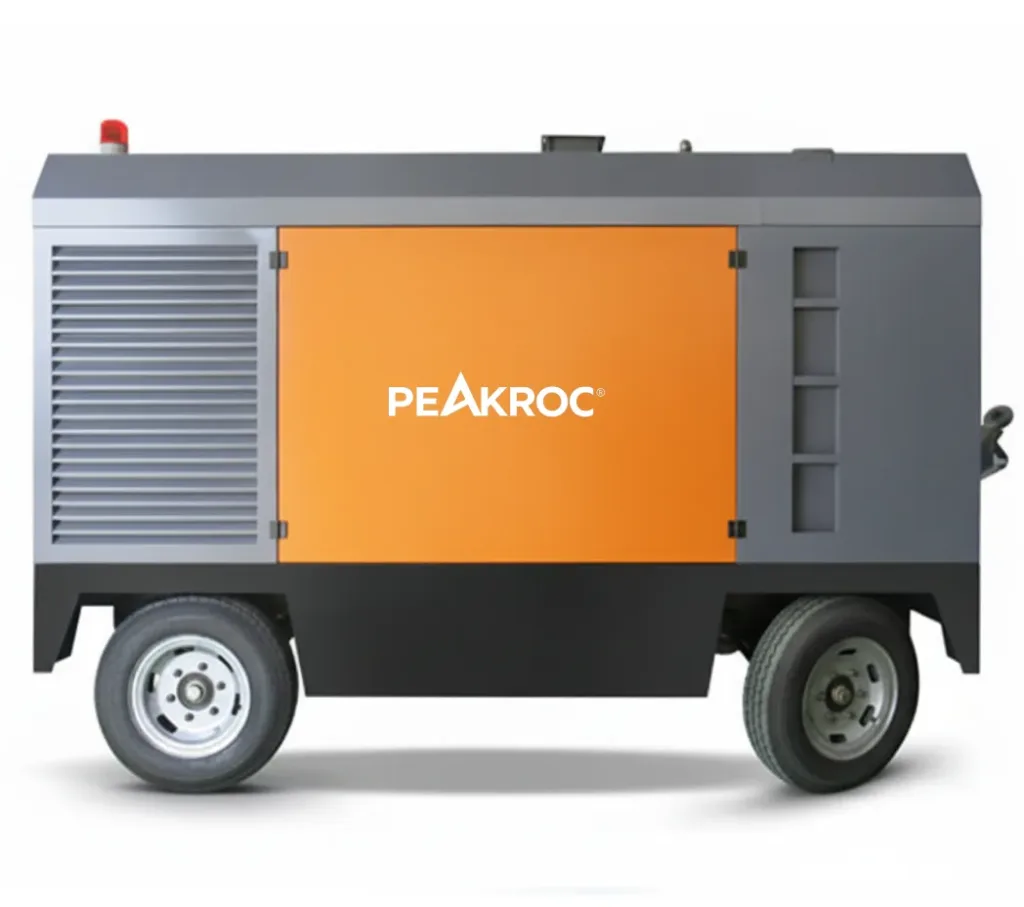
A 9 bar portable air compressor for construction is a mobile compressed-air unit designed to supply stable air for pneumatic tools and jobsite support work. Nine bar is approximately 130 PSI, which gives contractors a practical pressure margin for hoses, couplings, manifolds, and tool-side pressure loss.
This pressure class is commonly suitable for road repair, concrete breaking, trenching, chipping, compact drilling, surface cleaning, utility work, and general site maintenance. It is stronger than many basic 7 bar compressors but still more economical than high-pressure drilling compressors used for deep DTH applications.
However, a 9 bar rating alone does not confirm whether a compressor is suitable. The machine must also deliver enough free air delivery at working pressure. A compressor that reaches 9 bar but lacks airflow will lose pressure once the tool is operating.
The most important selection factors are:
- Tool air demand: breaker, chipping hammer, drill, nozzle, or cleaning tool consumption
- Simultaneous use: one operator or several tools working at the same time
- Air distribution: hose length, hose diameter, couplings, manifolds, and leakage
- Drive type: diesel for remote mobility or electric for powered and lower-emission sites
- Site conditions: heat, dust, altitude, rain, access, noise, and local regulations
Peakroc® supplies portable mobile air compressors for construction, road repair, drilling, mining, and industrial maintenance. Contractors can review construction and road repair compressor solutions, explore air compressor applications, or use Peakroc’s compressor selection service to match pressure and airflow to real jobsite needs.
What Is a 9 Bar Portable Air Compressor?
A 9 bar portable compressor is usually a rotary screw air compressor mounted on a towable chassis, skid frame, or compact mobile base. It may be powered by a diesel engine or electric motor, depending on the working environment.
Compared with small piston compressors, a portable screw compressor is built for continuous-duty air delivery. That matters on construction sites because pneumatic breakers, drills, and cleaning tools may run for long periods rather than in short bursts.
The 9 bar pressure class is particularly useful because many pneumatic tools are designed to operate around 6–8 bar at the tool. In real conditions, air must pass through hoses, quick couplings, water separators, manifolds, and sometimes long jobsite lines. Each connection creates pressure loss. A compressor capable of 9 bar provides a useful operating reserve, helping the tool receive the correct pressure under load.
This does not mean every tool should be operated at 9 bar. The tool manufacturer’s recommended working pressure should always be followed. The compressor’s higher pressure capability mainly helps offset system losses.
Why 9 Bar Is Practical for Construction Sites
Construction sites rarely have perfect air distribution. The compressor may be parked away from the work area because of traffic, access limits, exhaust direction, noise control, or safety barriers. Air hoses may run across uneven ground, around structures, or into trenches.
In these conditions, a standard 7 bar compressor may be enough for short hoses and one light tool, but it can struggle when hoses are long or multiple tools operate together. A 9 bar compressor gives a contractor more flexibility without jumping to a much larger high-pressure model.
This makes the 9 bar class practical for:
- Road repair crews using breakers and cleaning air
- Utility contractors opening trenches and removing debris
- Concrete repair teams using chipping hammers
- Small drilling and anchoring jobs
- General site maintenance and pneumatic tool support
The key advantage is balance. A 9 bar compressor can support a wide range of common construction tasks while keeping fuel consumption, machine size, towing weight, and purchase cost more manageable than oversized high-pressure machines.
Main Applications of a 9 Bar Construction Compressor
| Application | Typical Equipment | Why 9 Bar Helps |
|---|---|---|
| Road repair | Breakers, chipping hammers, blow lances | Maintains pressure through hoses and fittings |
| Concrete demolition | Pneumatic breakers and demolition tools | Supports continuous impact work |
| Utility trenching | Breakers, compact drills, cleaning air | Useful where grid power is unavailable |
| Surface preparation | Cleaning nozzles and light blasting tools | Provides strong air for debris and dust removal |
| Foundation support | Pneumatic tools and drilling support | Helps operate mobile tools near the work area |
| General maintenance | Tire service, cleaning, small tools | Supports mobile service crews on site |
The same compressor can often serve different work stages during the day. It may power a breaker in the morning, clean the work area before inspection, and support maintenance tools later.
Road Repair and Pavement Breaking
Road repair is one of the strongest use cases for a 9 bar portable compressor. Pneumatic breakers are still widely used because they are robust, simple, and effective for asphalt and concrete removal.
A breaker needs enough airflow to maintain impact energy. If the compressor cannot supply the required flow, the tool will still move but with weaker impact, slower breaking speed, and higher operator fatigue.
A 9 bar compressor provides useful pressure reserve when the machine is positioned away from the repair point. This is common in traffic-controlled zones where the compressor must be parked safely outside the working lane.
For a single heavy breaker, a medium-flow compressor may be enough. For two operators or a combination of breaker and cleaning nozzle, airflow must be recalculated. Pressure alone is not enough.
Concrete Chipping and Repair Work
Many construction tasks require controlled removal rather than heavy demolition. Chipping hammers and smaller pneumatic tools are used around bridge decks, curbs, expansion joints, drainage channels, manholes, anchor points, and repair edges.
These tools generally consume less air than heavy breakers, but several may operate at the same time. A 9 bar screw compressor can maintain stable pressure and reduce waiting time compared with a small tank-based unit.
Stable air supply also improves tool control. When pressure fluctuates, the operator may remove too much concrete or create uneven repair edges. For precision repair work, consistent compressed air supports both productivity and quality.
Trenching and Utility Construction
Utility projects often require fast deployment. Water, gas, power, drainage, and telecommunications crews may need to open pavement, break concrete, clean trenches, and operate compact pneumatic tools in one shift.
A towable diesel compressor is useful because it can be positioned close to the trench without relying on temporary electrical power. This is especially important for emergency repairs, night work, and rural construction.
A 9 bar compressor can power breakers for pavement opening, cleaning air for debris removal, and smaller drilling tools for anchoring or access preparation. For this type of work, practical features matter: easy starting, long fuel autonomy, durable canopy, simple controls, multiple outlets, and accessible daily service points.
Surface Cleaning and Preparation
Compressed air is often used after breaking, cutting, or drilling work to remove dust, chips, loose aggregate, standing water, and debris.
For general blow-off cleaning, operators must use pressure safely and follow local safety rules. High-pressure air should never be directed at people or clothing. Where compressed air is used for cleaning, proper pressure reduction, chip guarding, and personal protective equipment are required.
For more demanding surface preparation, such as light abrasive blasting or coating removal, airflow demand increases quickly. The compressor may also need an aftercooler and moisture separator to prevent water from affecting abrasive flow or causing flash rust.
A 9 bar compressor can be suitable for light surface preparation, but larger blasting nozzles or multiple operators may require substantially more airflow.
Diesel vs. Electric 9 Bar Compressors
Most outdoor construction sites use diesel portable compressors because they are independent. They can be towed to the work area, started immediately, and used where no site power is available.
Electric portable compressors are better for powered sites where lower noise, zero local exhaust, and reduced engine maintenance are important. They are useful in tunnels, basements, workshops, factories, enclosed construction areas, and urban locations with strict emission limits.
| Factor | Diesel 9 Bar Compressor | Electric 9 Bar Compressor |
|---|---|---|
| Power source | Self-contained diesel engine | Grid, generator, or site power |
| Mobility | Strong for remote and changing sites | Limited by cables and connection points |
| Local exhaust | Diesel exhaust present | No combustion exhaust at the compressor |
| Noise | Usually higher | Usually lower |
| Maintenance | Engine and compressor service | Motor and compressor service |
| Best fit | Roadwork, trenching, remote construction | Indoor, tunnel, powered urban sites |
The best choice depends on where the compressor works. A road contractor may need diesel mobility. A tunnel or indoor construction contractor may prefer electric power for cleaner operation.
How Much Airflow Is Needed?
Airflow determines whether the compressor can maintain pressure while tools are operating. It is usually expressed in CFM or m³/min.
The selection process should begin with the tools. Add the rated air consumption of all tools that may run simultaneously, then add reserve for leakage, hose loss, altitude, temperature, and future tool additions.
For example, if one breaker requires 80 CFM and a cleaning nozzle requires 30 CFM, the base demand is 110 CFM. Adding a 20% reserve gives a target of about 132 CFM.
If two breakers may work together, both must be included. A compressor that performs well with one tool may become undersized when another operator connects.
Always confirm free air delivery at 9 bar. Some compressors provide less airflow as pressure increases, so the rating at a lower pressure may not reflect real performance.
Hose Length, Couplings, and Pressure Loss
Many jobsite air problems come from the hose system, not the compressor.
Long hoses, narrow internal diameters, leaking couplings, undersized manifolds, and restrictive quick connectors reduce the pressure that reaches the tool. The compressor outlet gauge may show enough pressure while the breaker or drill receives much less.
Good practice includes using hoses sized for the required flow, keeping runs as short as practical, avoiding unnecessary bends, replacing damaged couplings, and checking pressure near the tool under load.
For multiple tools, the main supply hose and manifold must be sized for total flow. Otherwise, opening one additional tool can reduce pressure for everyone.
A 9 bar compressor gives extra margin, but it cannot fully compensate for a poorly designed air-distribution system.
Air Quality and Moisture Control
Construction compressors often operate in humid, dusty, and changing weather conditions. Compressed air naturally carries moisture, and as hot compressed air cools in hoses and tools, water can condense.
For breakers and chipping hammers, basic moisture separation may be enough. For surface preparation, blasting, painting support, or long hose runs, better moisture control may be required.
Common options include an aftercooler, water separator, coalescing filter, refrigerated dryer, or desiccant dryer. Each component improves air quality but also adds pressure drop. That pressure loss should be included when selecting compressor capacity.
Lubrication also matters. Pneumatic tools may require properly adjusted airline lubrication, while some applications need cleaner, dryer air. The user should follow both compressor and tool manufacturer recommendations.
Fuel Efficiency and Operating Cost
A properly sized 9 bar compressor can reduce operating cost compared with an oversized higher-pressure machine.
The most economical compressor is not always the smallest one. If it is undersized, tools run slowly and crews lose time. If it is oversized, fuel use, transport weight, and purchase cost may increase without improving productivity.
Modern diesel screw compressors may use load-unload control, engine speed regulation, temperature protection, and automatic shutdown systems. These features help protect the machine and reduce wasted fuel during variable site demand.
Electric models can be more economical where reliable site power is available. Variable-speed-drive electric compressors can be especially useful when air demand changes during the day.
Noise, Emissions, and Urban Construction
Construction sites in cities often face noise restrictions, emission rules, and limited working hours.
A diesel compressor should have a sound-attenuated canopy and an exhaust layout that directs fumes away from workers, buildings, trenches, tunnels, and public areas. It should also meet the emission requirements of the destination market.
Electric compressors reduce local exhaust and usually operate more quietly, making them suitable for enclosed or noise-sensitive sites.
Noise figures should be compared carefully. Distance, reflecting walls, open service doors, nearby machinery, pneumatic exhaust, and operator position all affect the sound level experienced on site.
Maintenance and Safety
A construction compressor must be inspected regularly because it operates in dust, vibration, rain, heat, and rough transport conditions.
Daily checks should include engine oil, compressor oil, coolant, fuel-water separator, air filters, radiator cleanliness, hoses, couplings, tires, trailer lights, warning indicators, and visible leaks.
Safety should also be part of selection and operation. Pneumatic tools must be secured to hoses by a positive means to prevent accidental disconnection. Impact tools should use proper retainers or safety clips to prevent attachments from being expelled.
Operators should depressurize lines before disconnecting tools, avoid using compressed air on the body or clothing, and use appropriate eye, hearing, hand, foot, and respiratory protection according to the task.
Common Selection Mistakes
The first mistake is choosing only by pressure. A compressor may reach 9 bar but lack enough airflow for the tool.
The second mistake is ignoring hose losses. Long or undersized hoses can reduce tool performance even when the compressor is correctly rated.
The third mistake is buying a larger compressor than needed. Oversizing increases cost and fuel use, especially when actual demand is light.
The fourth mistake is overlooking air treatment. Moisture can damage tools, affect surface preparation, and reduce system reliability.
The best compressor is the one that matches real jobsite demand—not simply the highest pressure or largest engine.
What Information Should Buyers Provide?
Before requesting a quotation, prepare the following information:
- Tool type and rated air consumption
- Number of tools working simultaneously
- Required pressure at the tool
- Maximum hose length and diameter
- Diesel or electric preference
- Daily operating hours
- Ambient temperature, altitude, and dust level
- Need for aftercooler, separator, or dryer
- Towable, skid-mounted, or compact frame requirement
- Destination country and emission rules
With this information, the supplier can recommend a compressor that provides stable air without unnecessary oversizing.
Peakroc® 9 Bar Construction Compressor Solutions
Peakroc® supplies portable screw compressors for construction, road repair, utility work, tunneling, mining, quarrying, drilling support, sandblasting, and site maintenance.
For construction users, Peakroc® can help match 9 bar compressors to breakers, chipping hammers, compact drills, cleaning nozzles, light blasting tools, and general pneumatic equipment.
Depending on the project, customers may choose diesel-powered units for mobility or electric units for powered sites with lower noise and no local exhaust emissions.
Peakroc® can support pressure and airflow calculation, engine or motor selection, chassis configuration, air-treatment options, spare-parts planning, and shipping.
The goal is not to recommend the largest compressor. The goal is to select a machine that delivers stable air at the required pressure while controlling fuel cost, maintenance workload, and transport difficulty.
Final Recommendation
A 9 bar portable air compressor is a practical and flexible pressure class for construction work. It provides useful pressure margin for common pneumatic tools while avoiding the cost and fuel consumption of high-pressure drilling compressors.
For road repair, trenching, concrete chipping, cleaning, light drilling, and general site support, a 9 bar rotary screw compressor can provide stable continuous airflow and strong mobility.
The right model should be selected according to airflow demand, tool count, hose loss, duty cycle, diesel or electric power availability, air-treatment needs, noise limits, and site conditions.
Peakroc® can help contractors, rental companies, and equipment distributors choose a suitable 9 bar portable compressor based on real construction tasks and operating requirements.
FAQ
1. Is a 9 bar portable compressor suitable for construction work?
Yes. A 9 bar compressor is suitable for many construction tasks, including breakers, chipping hammers, road repair, trenching, cleaning, light drilling, and general pneumatic tool support.
2. How much PSI is 9 bar?
Nine bar is approximately 130 PSI.
3. Is 9 bar better than 7 bar for construction tools?
It can be better when hose losses, longer air lines, or multiple tools reduce pressure at the point of use. However, tools should still be operated within their recommended pressure range.
4. What airflow is needed for a 9 bar construction compressor?
The required airflow depends on tool consumption and the number of tools operating simultaneously. Buyers should add all active tool demands and include reserve for pressure loss and leakage.
5. Can a 9 bar compressor run a jackhammer?
Yes, if the compressor provides enough CFM or m³/min for the jackhammer. Pressure alone is not enough.
6. Should I choose diesel or electric for construction?
Choose diesel for remote, outdoor, and frequently moving sites. Choose electric where reliable power is available and lower noise or zero local exhaust is important.
7. Does a 9 bar compressor need an aftercooler?
Not always. An aftercooler is useful when moisture control matters, such as surface preparation, blasting, long hose systems, or humid environments.
8. Can one compressor power multiple tools?
Yes, but the compressor must be sized for the total airflow of all tools operating at the same time, plus reserve for pressure loss and leakage.
9. Is a screw compressor better than a piston compressor for construction?
For continuous professional construction work, a rotary screw compressor is usually better because it provides stable airflow for long duty cycles. Piston compressors are more suitable for light or intermittent use.
10. Does Peakroc® supply 9 bar portable construction compressors?
Yes. Peakroc® supplies portable diesel and electric screw compressors for construction, road repair, utility work, drilling support, and general pneumatic-tool applications.
Author

Mark Chen – Senior Mechanical Engineer, Peakroc®
Mark Chen is a senior mechanical engineer at Peakroc®, specializing in compressed air systems and drilling equipment for mining and construction applications. With over 15 years of field experience, he has led multiple projects on optimizing air delivery efficiency, equipment durability, and energy consumption.