
Key Takeaways
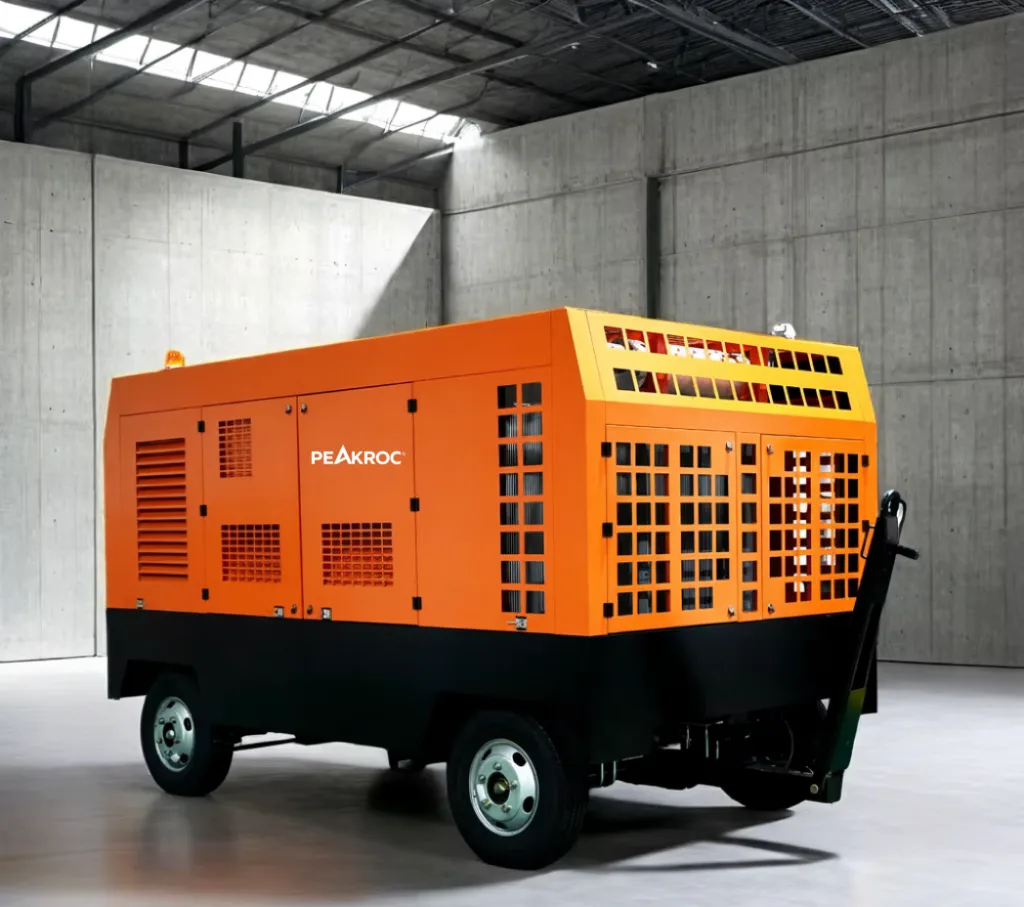
The Peakroc® 25 bar high-pressure air compressor is designed for contractors who require dependable compressed air for water well drilling, mineral exploration, geothermal boreholes, quarrying, foundation work, and other demanding DTH applications.
Peakroc® offers several airflow classes within the 25 bar range:
- Approximately 24 m³/min at 25 bar, equivalent to about 850 CFM at 363 PSI
- 34 m³/min at 25 bar for larger hammers and deeper boreholes
- 39 m³/min at 25 bar for high-volume drilling and difficult hole-cleaning conditions
Rather than competing only on the lowest purchase price, Peakroc® focuses on the equipment features that directly influence drilling productivity: two-stage compression, stable pressure, sufficient flushing airflow, industrial diesel power, effective cooling, accessible maintenance, and practical component support.
This makes the Peakroc® range a potential alternative to premium compressors from Atlas Copco, Sullair, Ingersoll Rand, and other established manufacturers when the specification is correctly matched to the project.
Customers can explore the Peakroc® portable air compressor range, review the Peakroc® 850 CFM 25 bar Cummins-powered compressor, or submit project details through the compressor selection service.
What Is a 25 Bar High-Pressure Air Compressor?
A 25 bar portable air compressor is a diesel-driven rotary screw compressor that produces compressed air at approximately 363 PSI.
This pressure is considerably higher than the 7–14 bar commonly used for road repair, general construction, pneumatic tools, and conventional sandblasting. A 25 bar compressor is mainly selected when compressed air must travel through a long drill string, overcome borehole backpressure, operate a DTH hammer, and lift rock cuttings from a deep hole.
Pressure is only one part of the specification. The compressor must also provide enough airflow to power the hammer and clean the borehole.
In practical drilling terms:
- Pressure influences hammer impact energy and the ability to overcome downhole resistance.
- Airflow controls hammer cycling, cuttings transport, and hole cleaning.
- Engine power allows the air end to maintain output under continuous load.
- Cooling capacity protects the compressor during long shifts and high ambient temperatures.
A machine with sufficient pressure but inadequate airflow may operate the hammer while failing to remove cuttings efficiently. A high-flow machine with insufficient pressure may struggle to maintain impact performance in deep or difficult formations.
The correct compressor must balance both variables.
Why Is 25 Bar Used for DTH Drilling?
A DTH hammer is located directly behind the drill bit. Compressed air drives an internal piston that repeatedly strikes the bit, while the exhaust air carries crushed rock toward the surface.
As the borehole becomes deeper, resistance increases. Pressure is lost through hoses, drill pipes, valves, and internal hammer passages. Cuttings must also travel farther through the annular space between the drill string and the borehole wall.
Water inflow, unstable formations, large hole diameters, and heavy cuttings can create additional backpressure.
For shallow holes in favorable formations, a lower-pressure compressor may be adequate. However, hard rock, deeper wells, larger DTH hammers, and demanding flushing conditions often require approximately 20–25 bar.
Typical 25 bar applications include:
- Medium- and deep-water well drilling
- Hard-rock DTH drilling
- Geothermal boreholes
- Mineral exploration
- Quarry and production drilling
- Foundation and ground-engineering projects
The hammer manufacturer’s pressure and airflow requirements should always be checked before selecting the compressor. Operating outside the recommended range can reduce penetration, increase component wear, or waste fuel.
Peakroc® 25 Bar Compressor Range
Peakroc® offers multiple airflow classes because no single 25 bar compressor can efficiently cover every drilling project.
| Peakroc® Capacity Class | Typical Application Direction | Main Selection Consideration |
|---|---|---|
| Approx. 24 m³/min at 25 bar | Medium-depth wells, exploration, and medium DTH hammers | Balanced output, mobility, and operating cost |
| 34 m³/min at 25 bar | Deeper boreholes and larger hammer systems | More flushing air and operating reserve |
| 39 m³/min at 25 bar | Large-scale water well, mining, and difficult formations | High airflow for larger holes and demanding cuttings removal |
The 24 m³/min or 850 CFM class is suitable where high pressure is required but the hammer and hole diameter do not justify a much larger compressor.
The 34 m³/min class provides more air for deeper drilling, larger hammers, high-altitude work, and projects where strong hole cleaning is essential.
The 39 m³/min configuration is intended for demanding drilling systems that require both sustained pressure and high-volume flushing.
Choosing the largest compressor is not always the most economical decision. Oversizing can increase fuel consumption, transport cost, machine weight, and initial investment. The preferred approach is to select the smallest model that safely covers the maximum expected demand with a reasonable operating reserve.
What Makes Peakroc® a Cost-Effective Alternative?
A cost-effective compressor is not simply the machine with the lowest quotation. It is the machine that delivers the required output with acceptable fuel use, maintenance access, parts availability, and operational reliability.
Peakroc® aims to provide competitive lifecycle value through practical engineering and a flexible supply model.
Practical Equipment Configuration
Premium compressors may include sophisticated telematics, proprietary electronic systems, fleet-management functions, advanced emissions packages, and multiple automated operating modes.
These features can be valuable for rental companies and large international fleets. However, an independent drilling contractor may prioritize simpler controls, familiar diesel components, straightforward maintenance, and lower capital cost.
Peakroc® compressors can be configured according to actual project needs. Depending on the model and market, available choices may include different diesel engines, emissions levels, trailer or skid frames, fuel-tank capacities, cold-weather packages, high-temperature cooling, aftercoolers, and moisture separators.
This enables buyers to invest in the features that directly support the project rather than paying for functions that may remain unused.
Established Diesel Engine Options
Selected Peakroc® 25 bar compressors use Cummins diesel engines.
For contractors operating in different countries, a widely used engine platform can simplify access to filters, lubricants, service knowledge, diagnostics, and replacement parts.
The engine model and emissions standard must still be confirmed for the destination market. A Cummins-powered compressor supplied for one country may not use the same configuration as a machine intended for another region.
Buyers should verify local engine support, emissions compliance, warranty conditions, fuel quality, and diagnostic access before placing an order.
Accessible Maintenance
Routine maintenance should not require excessive disassembly.
Peakroc® compressor packages emphasize practical service access to filters, coolers, separator components, fuel systems, drains, and inspection points. This can reduce maintenance time and allow local technicians to complete routine service without relying on highly specialized equipment.
Accessible design is particularly important for drilling companies operating in remote regions where the nearest authorized service center may be several hours or days away.
Can Peakroc® Replace Atlas Copco, Sullair, or Ingersoll Rand?
Peakroc® can be considered an alternative when it satisfies the same operational requirement, but it should not automatically be described as an identical replacement for every premium-brand model.
International manufacturers have proprietary air ends, control systems, dealer networks, telematics platforms, warranties, certifications, and resale characteristics. These advantages can justify their higher price in certain markets.
The correct comparison should therefore focus on the full specification and project outcome.
| Comparison Area | What Buyers Should Evaluate |
|---|---|
| Pressure and airflow | Actual free air delivery at 25 bar |
| Compression system | Number of stages, intercooling, and air-end design |
| Diesel engine | Brand, model, power, emissions, and local support |
| Cooling package | Maximum ambient temperature and cleaning access |
| Control system | Pressure regulation, diagnostics, alarms, and shutdown protection |
| Maintenance | Filter access, service intervals, and parts lead time |
| Mobility | Weight, dimensions, axle design, towing requirements, and ground clearance |
| Air treatment | Aftercooler, separator, filters, and moisture management |
| Lifecycle cost | Purchase price, fuel, service, downtime, logistics, and resale value |
Peakroc® is most competitive for customers who require strong pressure-flow performance and maintainable construction but do not need every element of a premium-brand dealer and digital-service ecosystem.
For large rental fleets, nationwide service support and resale value may remain decisive. For independent contractors and distributors, acquisition cost, configuration flexibility, direct factory support, and parts simplicity may carry greater weight.
Why Two-Stage Compression Is Preferred at 25 Bar
High-pressure portable screw compressors commonly use two-stage compression because compressing ambient air directly to 25 bar in one stage creates a high pressure ratio and substantial heat.
In a two-stage system, the first air end raises the air to an intermediate pressure. The air is then cooled before entering the second air end, where it is compressed to the final discharge pressure.
This arrangement offers several practical advantages.
Lower compression temperature — Intercooling removes part of the heat generated during the first stage, reducing the inlet temperature of the second stage.
Improved efficiency — Dividing the total pressure ratio allows each air end to operate within a more appropriate range.
Stable high-pressure output — The system can maintain 25 bar more effectively during long periods of continuous drilling.
Reduced component stress — Better temperature control can support lubricant life, sealing performance, and air-end durability.
The presence of two stages alone does not guarantee superior performance. Rotor profile, internal clearances, oil injection, intercooler efficiency, separation, regulation, and engine matching all influence the final result.
Engine and Air-End Matching
The diesel engine and compressor air end must operate as one system.
When the hammer encounters harder rock or the operator opens the air supply fully, compressor load can change quickly. The engine must provide enough torque to maintain speed while the control system adjusts airflow and pressure.
An undersized or poorly matched engine may experience speed drop, unstable discharge pressure, higher fuel consumption, and excessive operating temperature.
An oversized engine adds weight and cost without necessarily improving compressor efficiency.
Peakroc® selects industrial diesel platforms according to the required airflow and pressure class. Before ordering, buyers should request the engine model, rated power, operating speed, emissions level, cooling arrangement, and estimated fuel consumption.
Fuel consumption should be evaluated in relation to useful air output. A machine that burns less fuel per hour but delivers insufficient airflow may produce a higher cost per drilled meter.
Cooling for Hot and Dusty Environments
Producing compressed air at 25 bar generates considerable heat. The compressor must manage engine coolant, compressor oil, intake air, and the temperature between the two compression stages.
This becomes more challenging in deserts, quarries, mines, and tropical regions.
A high-pressure compressor intended for harsh sites should have adequate radiator and oil-cooler capacity, effective airflow through the canopy, heavy-duty intake filtration, and accessible cooling surfaces.
Hot discharge air must not circulate back into the intake. Recirculation raises internal temperature and can trigger protective shutdowns.
Dust is another major concern. Blocked radiators and oil coolers reduce heat rejection even when the cooling system was correctly sized at the factory. Operators should inspect and clean cooling surfaces according to site conditions rather than relying only on standard calendar intervals.
The supplier should know the expected maximum ambient temperature, elevation, humidity, dust level, and daily operating hours before confirming the model.
Matching the Compressor to the DTH Hammer
The hammer is the most important reference point in compressor selection.
Every DTH hammer has a recommended pressure range and air-consumption curve. The required airflow generally increases with hammer diameter and operating pressure.
The supplier should review:
- DTH hammer model and diameter
- Bit diameter
- Drill-pipe diameter
- Target hole depth
- Expected geology
- Water inflow
- Site elevation and temperature
- Desired penetration rate
The compressor must supply the hammer while maintaining enough additional air velocity to transport cuttings.
If the annular space around the drill string is too large, flushing velocity may be inadequate even when total airflow appears substantial. If the drill pipe is too small, friction losses can reduce the pressure reaching the hammer.
This is why compressor selection should be coordinated with the drilling rig, hammer, bit, rods, hole diameter, and geology rather than completed as an isolated purchase.
Application: Water Well Drilling
Water well drilling is one of the main uses for a 25 bar portable compressor.
In hard-rock formations, DTH drilling combines rotation with direct impact at the bottom of the hole. This approach can maintain effective penetration at depths where top-hammer energy transfer becomes inefficient.
A contractor drilling medium-diameter wells may find the 24 m³/min class sufficient for the selected hammer. It provides high pressure without the fuel use and transport burden of a larger 34 or 39 m³/min machine.
Larger compressors become more appropriate when the project involves wider holes, deeper targets, larger hammers, substantial water inflow, high altitude, or difficult cuttings.
The compressor should also be evaluated for fuel autonomy. Remote drilling sites may not have convenient refueling access, so tank capacity and expected consumption affect working time per shift.
Application: Geothermal and Foundation Drilling
Geothermal and ground-engineering projects often require deep, accurately constructed boreholes through mixed or hard formations.
A 25 bar compressor can provide the pressure required for DTH drilling while maintaining airflow for hole cleaning.
These projects may take place in urban or restricted environments, making machine dimensions, noise, trailer layout, and exhaust direction important.
Ground conditions can also change rapidly. The compressor should have enough reserve to handle harder rock or deeper sections without being unnecessarily oversized for the entire project.
Where moisture in the compressed air affects operation, an aftercooler or water-separation system may be considered.
Application: Quarrying and Mining
Quarry and mining operations usually place a high value on production per shift.
Although blast holes may be shallower than water wells, the rock can be extremely hard and the compressor may operate near full load for long periods.
In these conditions, cooling capacity, dust filtration, structural durability, fuel efficiency, and rapid maintenance access become critical.
A 25 bar compressor may support DTH drilling in granite, basalt, iron ore, and other competent formations where lower-pressure equipment cannot maintain acceptable penetration.
The compressor, rig, hammer, and bit should be matched as a production system. Increasing pressure will not correct problems caused by a worn bit, inadequate feed force, poor lubrication, damaged drill pipes, or unsuitable operating technique.
Total Cost of Ownership
The purchase price is only one part of compressor cost.
A proper lifecycle evaluation should include diesel consumption, lubricants, filters, separator elements, engine service, air-end maintenance, freight, customs, technician travel, downtime, and residual value.
Premium brands may offer stronger resale value, a larger dealer network, and standardized fleet support. Peakroc® may provide lower initial investment, more flexible configuration, and direct technical assistance.
The better option depends on the buyer’s operating model.
A national rental fleet may prioritize telematics, dealer coverage, and equipment standardization. A drilling contractor operating a small number of machines may prioritize purchase cost, local engine support, service accessibility, and spare-parts simplicity.
The objective should be the lowest reliable cost per productive operating hour—not merely the lowest invoice or the most famous name.
What Should Be Confirmed Before Ordering?
A quotation described only as “25 bar compressor” is not detailed enough for a purchasing decision.
Before ordering, confirm:
- Actual free air delivery at 25 bar
- Number of compression stages
- Air-end and intercooling configuration
- Engine brand, model, rated power, and emissions standard
- Full-load and partial-load fuel consumption
- Maximum ambient temperature
- Altitude derating requirements
- Fuel-tank capacity
- Trailer or skid dimensions and operating weight
- Air outlet sizes
- Controller functions and safety shutdowns
- Included filters, oils, and spare-parts kits
- Warranty coverage and claim procedure
- Manuals, certificates, commissioning, and technical support
The quotation should also clarify whether freight, customs documentation, air hoses, aftercoolers, separators, and commissioning are included.
Comparisons between suppliers should use equivalent specifications. A lower price may reflect a smaller engine, lighter frame, reduced cooling capacity, different emissions standard, or excluded accessories.
Peakroc® Selection and Procurement Support
Peakroc® supplies compressors for water well drilling, mining, quarrying, geothermal work, sandblasting, construction, and other industrial applications.
The selection team can review pressure and airflow demand, hammer compatibility, engine options, site conditions, mounting configuration, air treatment, spare-parts planning, and transportation requirements.
Peakroc® also has experience with international compressor brands. This allows customers to compare a Peakroc® solution with Atlas Copco, Sullair, Ingersoll Rand, or other alternatives according to the project rather than relying only on brand familiarity.
The recommendation should be based on whether the machine can complete the work reliably, economically, and with manageable service support.
Final Recommendation
The Peakroc® 25 bar high-pressure air compressor is a practical choice for drilling contractors seeking high-pressure performance, sufficient flushing airflow, industrial diesel power, and serviceable construction at a competitive investment level.
The 24 m³/min or 850 CFM class provides a balanced option for many medium-volume drilling projects. The 34 and 39 m³/min models offer additional airflow for larger hammers, deeper boreholes, high altitude, and difficult hole-cleaning conditions.
Peakroc® can serve as a cost-effective alternative to leading global brands when the pressure, airflow, engine, cooling system, configuration, and support match the project.
The final decision should be based on the hammer model, hole diameter, target depth, geology, climate, daily operating hours, local service conditions, and total lifecycle cost.
FAQ
1. What is a 25 bar air compressor mainly used for?
A 25 bar portable compressor is mainly used for medium- and deep-hole DTH drilling, water wells, mineral exploration, geothermal drilling, quarrying, and ground engineering.
2. How much is 25 bar in PSI?
Twenty-five bar is approximately 363 PSI.
3. Is the Peakroc® 25 bar compressor an alternative to Atlas Copco or Sullair?
It can be a cost-effective alternative when its airflow, pressure, engine, cooling package, configuration, maintenance support, and certification match the project requirement.
4. Which Peakroc® 25 bar compressor should I choose?
The correct model depends on hammer air consumption, hole diameter, depth, geology, temperature, altitude, and operating reserve. Peakroc® offers approximately 24, 34, and 39 m³/min configurations at 25 bar.
5. Why is two-stage compression preferred at 25 bar?
Two-stage compression divides the pressure ratio and cools the air between stages. This helps control discharge temperature and supports efficient, stable high-pressure operation.
6. Can a 25 bar compressor be used for sandblasting or road work?
It can technically supply those applications, but it is usually oversized for work requiring only 7–10 bar. A lower-pressure compressor is normally more economical.
7. Does Peakroc® use Cummins engines?
Selected Peakroc® 25 bar compressors use Cummins diesel engines. The exact model and emissions configuration depend on capacity and destination market.
8. What information is needed to select a 25 bar compressor?
The supplier needs the DTH hammer model, hole diameter, expected depth, geology, altitude, temperature, required airflow, daily operating hours, mounting preference, and delivery country.
9. Is the cheapest 25 bar compressor always the most cost-effective?
No. Lifecycle cost also depends on fuel consumption, uptime, cooling, maintenance access, spare-parts availability, technical support, and service life.
10. How can I request a Peakroc® compressor recommendation?
Provide Peakroc® with your drilling rig, hammer, hole depth, diameter, geological conditions, operating environment, and delivery location. The team can then recommend a suitable pressure-flow configuration.
Author

Mark Chen – Senior Mechanical Engineer, Peakroc®
Mark Chen is a senior mechanical engineer at Peakroc®, specializing in compressed air systems and drilling equipment for mining and construction applications. With over 15 years of field experience, he has led multiple projects on optimizing air delivery efficiency, equipment durability, and energy consumption.