
Key Takeaways
- A portable diesel air compressor is defined by three specifications that determine whether it fits your job: air flow (CFM or m³/min), working pressure (bar or PSI), and engine power (kW or HP). Get any one of these wrong and you’ll either starve the tools or burn fuel you don’t need.
- For construction and general pneumatic tool use, 7–10 bar (100–145 PSI) covers the full range. For DTH drilling and deep borehole work, you need 20–35 bar (290–508 PSI). The pressure class determines whether the compressor uses a single-stage or two-stage airend — which directly affects fuel economy, machine weight, and service life.
- Rotary screw compressors have entirely replaced piston compressors in professional portable diesel applications above 100 CFM. If anyone quotes you a diesel piston machine for continuous construction or drilling work, walk away.
- The diesel engine brand matters more than most buyers realize. Cummins, Kubota, Yanmar, and Deutz offer global service networks. Proprietary or no-name engines save money at purchase and cost it back in parts availability within two years.
- Peakroc® Machinery builds portable diesel screw air compressors from 5 m³/min to 45 m³/min, covering every application from jackhammer work to deep mining — and every machine ships with a Cummins, Kubota, or Yanmar engine backed by international warranty.
What Is a Portable Diesel Air Compressor?
A portable diesel air compressor is a self-contained unit that uses a diesel engine to drive a rotary screw (or in some legacy cases, piston) compression element. The compressed air is delivered through outlet valves to pneumatic tools, drilling equipment, or process systems. The entire package — engine, airend, cooler, separator, fuel tank, and controls — is mounted on a trailer chassis or skid frame for transport between job sites.
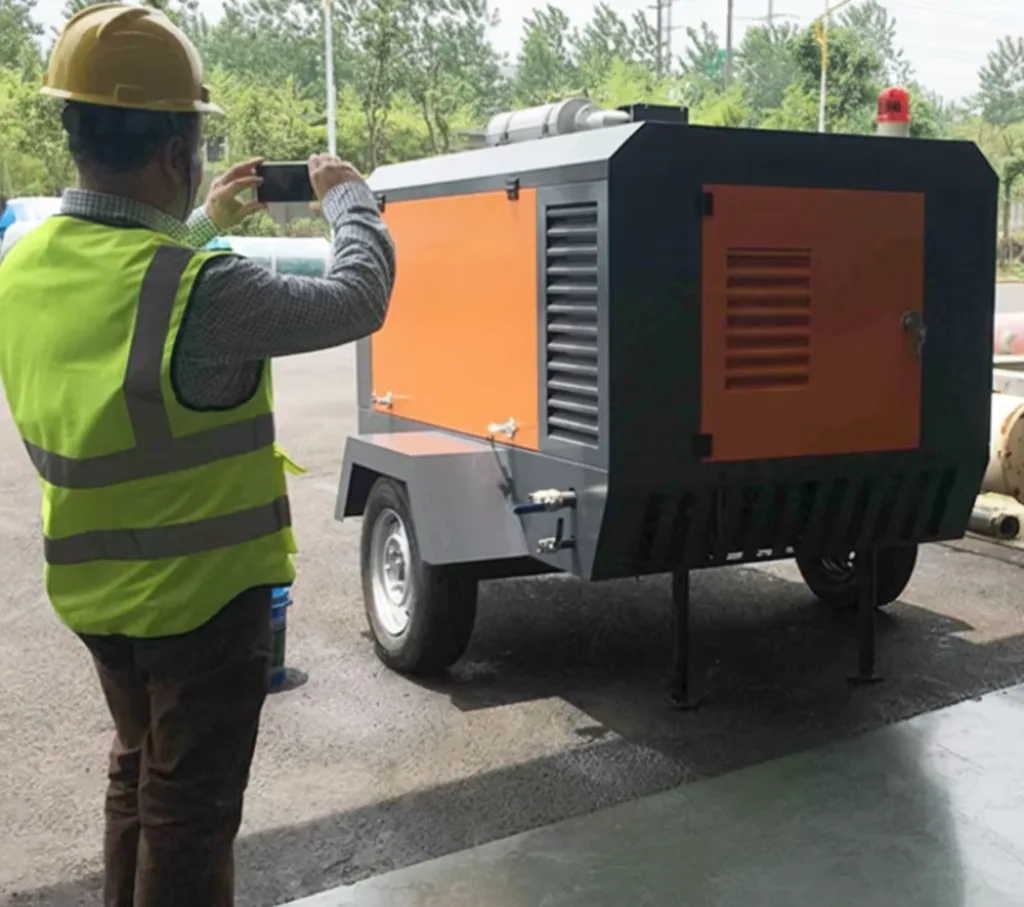
These machines work where grid power doesn’t exist: remote drilling pads, highway construction, quarry benches, pipeline corridors, mining operations, and emergency response sites. The diesel engine provides energy independence, and the portable chassis provides mobility.
The global market for portable diesel compressors is dominated by oil-injected rotary screw technology. Oil-free portable compressors exist but serve niche applications (pharmaceutical, food processing) where air purity requirements justify the cost and complexity premium.
The Three Specifications That Define Every Portable Diesel Compressor
Every purchasing decision starts with three numbers. Everything else — engine brand, chassis type, control system, canopy design — is secondary to getting these three right.
Air Flow: CFM or m³/min
Air flow is the volume of free air the compressor delivers per unit of time, measured at the machine’s discharge port under rated conditions. This number tells you how many tools you can run, how fast you can drill, and how quickly you can fill a vessel.
The industry uses two units interchangeably: cubic feet per minute (CFM) in North American and some Asian markets, and cubic meters per minute (m³/min) in European, African, and most international markets. The conversion: 1 m³/min ≈ 35.3 CFM.
Common portable diesel compressor classes by flow:
| Flow Class | CFM | m³/min | Typical Applications |
|---|---|---|---|
| Small | 185–250 | 5–7 | 1–2 jackhammers, small sandblasting, road maintenance |
| Medium | 350–600 | 10–17 | Multi-tool construction crews, shallow drilling, quarry work |
| Large | 600–950 | 17–27 | Mining production drilling, deep water wells, large sandblasting |
| Heavy | 950–1,600 | 27–45 | Deep DTH drilling, RC exploration, tunneling, large mining fleet |
Working Pressure: Bar or PSI
Pressure is what determines which applications the compressor can serve. A jackhammer needs 6–7 bar. A DTH hammer drilling at 300 meters needs 25 bar. The physics are non-negotiable — if the tool needs 25 bar and the compressor delivers 10 bar, no amount of extra flow will compensate.
Standard pressure classes for portable diesel compressors:
| Pressure Class | Bar | PSI | Typical Applications |
|---|---|---|---|
| Standard | 7–8 | 100–116 | Construction tools, sandblasting, road maintenance |
| Medium | 10–14 | 145–203 | Quarry drilling, shallow borehole, mining production |
| High | 18–25 | 261–363 | Deep water wells, RC exploration, blast holes |
| Ultra-high | 30–35 | 435–508 | Ultra-deep geothermal, hardrock mining, large-diameter wells |
For an in-depth treatment of how pressure class determines airend architecture, see our article on the advantages of two-stage diesel screw compressors.
Engine Power: kW or HP
Engine power must be sufficient to drive the airend at the rated flow and pressure while also running the cooling fan, oil pump, and control system. In general, higher flow and higher pressure demand more power — a 5 m³/min 7 bar machine runs on a 47 HP Yanmar, while a 39 m³/min 25 bar machine requires a 700 HP Cummins KTA19.
The engine power number itself matters less to the buyer than the engine brand and model. What you care about is whether the engine can hold torque under sustained load, and whether you can get parts and service in the country where the compressor operates.
How to Match a Compressor to Your Application
This is the section that prevents expensive mistakes. Don’t start with catalogs — start with the job.
Step 1 — List every tool and its air demand
Pull the spec sheet for each pneumatic tool you plan to run. Record the air consumption (in CFM or m³/min) at the tool’s rated working pressure. If you’re running a DTH hammer, the hammer manufacturer’s spec will give you both the minimum working pressure and the air consumption at that pressure.
Step 2 — Calculate peak simultaneous demand
Determine the maximum number of tools that will run at the same time. Multiply each tool’s consumption by a simultaneous-use factor (0.7–0.9 for construction crews with intermittent tool use; 1.0 for continuous drilling operations). Sum the results.
Step 3 — Add a 25–30% safety margin
This accounts for hose friction losses, altitude deration (3% per 300 meters of elevation), ambient temperature effects (1% per 5°C above 25°C), and intake filter loading on dusty sites. Without this margin, the compressor runs at 100% load continuously — which shortens engine and airend life.
Step 4 — Select the pressure class
Match the compressor’s rated working pressure to the highest-pressure tool in your inventory. For construction tools, that’s 7–10 bar. For DTH drilling, check the hammer spec — typically 10–25 bar depending on the hammer and hole depth.
Step 5 — Choose the right compressor
Use these four inputs — total flow, pressure class, engine preference, and deployment environment — to select a specific machine. Peakroc® provides a guided compressor finder tool that walks through this process and recommends a model.
Application-Specific Recommendations
Rather than making you figure out the sizing math from scratch, here are the compressor classes Peakroc® engineers recommend for the most common applications.
Jackhammers and Pneumatic Breakers
A single medium jackhammer consumes 70–90 CFM at 6–7 bar. For one or two breakers, a 5 m³/min 7 bar compressor handles the job. For three or more, step up to a 10 m³/min 8 bar unit. Our detailed guide on portable air compressors for jackhammers breaks down the sizing in full.
Sandblasting
Professional sandblasting requires steady flow at 7–12 bar. A No. 6 nozzle (3/8 inch) consumes approximately 200 CFM. A No. 8 nozzle (1/2 inch) jumps to 350 CFM. Match the compressor to the nozzle — not the other way around. A 12 m³/min 7 bar unit covers most single-nozzle production blasting.
Quarry Blast Hole Drilling
Mid-diameter blast holes (3.5–5 inch) in granite and basalt require 10–14 bar at 15–25 m³/min. The quarry air compressor sizing guide covers bench geometry and hole pattern considerations in detail.
Deep Water Well Drilling (200–350 Meters)
4.5–6 inch DTH hammers at depth require 25 bar. Flow requirements range from 20–35 m³/min depending on hammer size and hole diameter. See our guide on water well drilling rigs with high-pressure air compressors.
Mining and Tunneling
Large-scale mining production drilling and tunneling operations consume 27–45 m³/min at 10–25 bar. These machines run 10–12 hour shifts under full load, making fuel efficiency and cooling system sizing critical. The why high-pressure compressors are essential for deep boreholes article covers the engineering case.
What to Look for Beyond the Spec Sheet
The three primary specifications get you into the right class of compressor. The following factors determine whether the machine lasts five years or fifteen.
Engine Brand and Service Network
A Cummins, Kubota, Yanmar, or Deutz engine has authorized service dealers in nearly every country where portable compressors operate. A proprietary or regional engine may save $2,000–5,000 on the purchase price and then cost $10,000 in downtime when a turbo fails three days from the nearest dealer with parts. Peakroc® machines ship exclusively with globally supported engines — Cummins for medium and large units, Kubota or Yanmar for compact models.
Cooling System Capacity
The cooler must reject enough heat to keep discharge temperature and oil temperature within limits at the maximum ambient temperature the machine will face. In tropical and desert markets — where most portable compressors work — that means designing for 45–50°C ambient. A compressor that runs fine at 25°C in the factory may overheat at 42°C on a drilling pad in Chad. Always check the maximum ambient temperature rating, not just the nameplate flow and pressure.
Air/Oil Separator Quality
The separator element keeps compressor oil out of the air stream. A good separator holds residual oil below 3 ppm. A poor aftermarket separator passes 20+ ppm — which contaminates pneumatic tools, fouls DTH hammer seals, and degrades sandblasting surfaces. OEM separator elements from the compressor manufacturer cost more per unit and save more per year.
Chassis and Transportability
A portable compressor moves. The chassis has to survive unpaved access roads, rough terrain, and the vibration of towing at speed. Look for heavy-gauge steel channel frames, torsion axles rated above static weight, and proper reinforcement at axle and tongue mounting points. Chassis cracks from fatigue are a failure mode specific to portable compressors — they don’t affect stationary machines.
Control System
Modern portable compressors should include automatic safety shutdowns for high discharge temperature, low engine oil pressure, high oil temperature, and low fuel level. Pressure-based loading control that modulates the intake valve smoothly — rather than slamming between full load and idle — reduces fuel consumption and extends airend life.
Peakroc® Portable Diesel Air Compressor Range at a Glance
| Model Class | Flow | Pressure | Engine | Primary Applications |
|---|---|---|---|---|
| 5 m³/min 7 bar | 185 CFM | 100 PSI | Yanmar/Kubota | Jackhammers, light sandblasting |
| 10 m³/min 8–10 bar | 350–375 CFM | 116–145 PSI | Cummins | Construction, quarry, shallow drilling |
| 17 m³/min 8 bar | 600 CFM | 116 PSI | Cummins | Large sandblasting, multi-tool crews |
| 22 m³/min 20 bar | 780 CFM | 290 PSI | Cummins | Deep drilling, high-pressure applications |
| 34 m³/min 25 bar | 1,200 CFM | 363 PSI | Cummins | Deep water wells, RC exploration |
| 39 m³/min 25 bar | 1,375 CFM | 363 PSI | Cummins | Deep drilling, large mining operations |
| 45 m³/min 10 bar | 1,600 CFM | 145 PSI | Cummins | Mining production, tunneling |
Browse the full Peakroc® compressor range or use the compressor finder tool to match your application.
Frequently Asked Questions
What is the best portable diesel air compressor for construction?
For general construction with 2–4 pneumatic tools, a 10 m³/min (350 CFM) diesel screw compressor at 8–10 bar is the most commonly specified size. It provides enough flow for multiple jackhammers, impact wrenches, and pneumatic drills simultaneously while remaining compact enough for standard towing.
How much does a portable diesel air compressor cost?
Pricing varies by size and specification. Small units (185 CFM / 5 m³/min) from Chinese manufacturers like Peakroc® start in the $8,000–15,000 range. Medium units (350–600 CFM) run $15,000–40,000. Large high-pressure units (25–35 bar) range from $40,000–120,000 depending on flow rate and engine platform. Premium Western brands (Atlas Copco, Ingersoll Rand, Sullair) typically carry a 30–60% price premium over equivalent Chinese-manufactured machines.
Should I buy a Peakroc®, Atlas Copco, or Ingersoll Rand?
All three manufacturers produce quality portable diesel screw compressors. Atlas Copco and Ingersoll Rand carry established brand recognition and extensive dealer networks in Western markets. Peakroc® offers equivalent engineering quality — including Cummins engines, two-stage airends, and internationally certified pressure vessels — at a significantly lower price point, making it the value-for-money choice for drilling contractors and fleet operators in Africa, Asia, Latin America, the Middle East, and Eastern Europe.
How often does a portable diesel air compressor need maintenance?
Standard maintenance intervals for a well-engineered diesel screw compressor: engine oil and filter every 500 hours, compressor oil filter every 500–1,000 hours, air filter cleaning every 200–300 hours (dusty sites), compressor oil change every 1,000 hours (synthetic), and air/oil separator replacement every 3,000–4,000 hours.
Can I use one compressor for both construction and drilling?
Only if the pressure ratings match. A 10 bar construction compressor cannot run a DTH hammer that needs 25 bar — no matter how much flow it delivers. If you need one machine for both applications, choose the higher pressure class and accept that it will be slightly oversized for construction work. Most operations are better served by two purpose-matched compressors than one compromise machine.
Author

Mark Chen – Senior Mechanical Engineer, Peakroc®
Mark Chen is a senior mechanical engineer at Peakroc®, specializing in compressed air systems and drilling equipment for mining and construction applications. With over 15 years of field experience, he has led multiple projects on optimizing air delivery efficiency, equipment durability, and energy consumption.