
Key Takeaways
- Chinese-manufactured portable air compressors — from brands like Peakroc®, Denair, Kaishan, and Liutech — now represent a significant share of the global drilling and construction fleet, particularly in Russia, CIS countries, Africa, Southeast Asia, and Latin America.
- Spare parts procurement for Chinese compressors (запчасти для китайских воздушных компрессоров) is the single largest pain point reported by international operators, ahead of warranty, delivery time, or initial purchase price.
- Six categories of parts account for over 90% of all maintenance demand: air filter elements, oil filters, air/oil separator elements, compressor oil, thermostatic valves, and intake/unloader valve kits.
- Cross-referencing between Chinese OEM part numbers and Western equivalents (Atlas Copco, Ingersoll Rand, Sullair) is possible for many filtration components — but not for airend-specific parts, control boards, or proprietary valve assemblies.
- A structured procurement relationship with the original Chinese manufacturer — not a random trading company — is the only reliable path to long-term parts availability and technical support.
Why Spare Parts for Chinese Air Compressors Became a Global Issue
Ten years ago, most portable air compressors operating in Russian mining operations, African water well programs, and Latin American construction fleets were Atlas Copco, Ingersoll Rand, or Sullair. Parts sourcing was straightforward — established dealer networks, standardized part numbers, and global warehouse inventories.
That picture has changed. Chinese manufacturers have captured a growing share of the global portable air compressor market, driven by competitive pricing, faster delivery, and increasingly capable engineering. Operators in Russia, Kazakhstan, Uzbekistan, Mongolia, Ghana, Tanzania, Peru, and Indonesia now run significant numbers of Chinese-built compressors — and many of them run into the same problem within the first 12–18 months: where do I get parts?
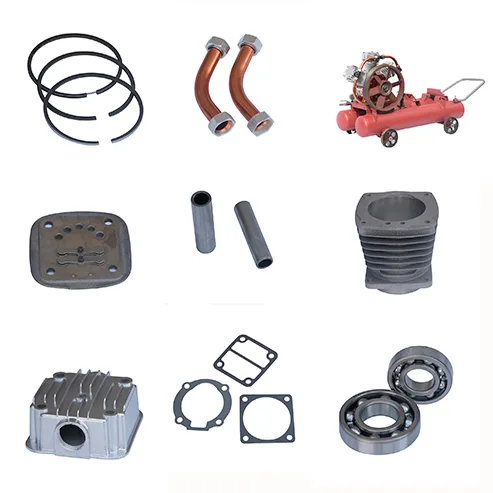
The search terms tell the story. Russian-speaking operators search for запчасти для китайских воздушных компрессоров (spare parts for Chinese air compressors), запчасти на китайский компрессор (parts for a Chinese compressor), and запчасти к китайским компрессорам (parts to Chinese compressors) in volumes that have grown steadily since 2019. The demand is real. The supply chain is fragmented.
This guide breaks down what parts you actually need, how to identify them correctly, where the cross-reference works (and where it doesn’t), and how to build a procurement system that keeps your fleet running — whether you bought from Peakroc®, Denair, Kaishan, Liutech, or another Chinese OEM.
The Six Parts Categories That Cover 90% of Maintenance Demand
Before getting into sourcing strategy, it helps to understand what you’re actually buying. In fifteen years of field service across Chinese-manufactured compressor fleets, these six categories cover the vast majority of routine and semi-routine maintenance demand.
Air Filter Elements
The air filter is the first line of defense for both the engine and the compressor airend. On a portable diesel air compressor used in mining and drilling, the air filter catches dust before it reaches the rotors. In environments like open-pit mines, quarry floors, and unpaved drilling access roads, filters load fast — sometimes within 200–300 operating hours.
Chinese compressors typically use a two-stage air filtration system: an outer element that can be cleaned and reused several times, and an inner safety element that should be replaced every fourth outer-element change. The part numbers vary by manufacturer — Peakroc® uses different specifications from Denair or Kaishan — but the physical dimensions (outer diameter, inner diameter, height) are often cross-referenceable.
Field rule: If you can measure the outer diameter, inner diameter, and total height of the element to the nearest millimeter, you can usually find a replacement. But always verify the gasket interface. A filter that physically fits but doesn’t seal properly will allow bypass air straight into the airend.
Oil Filters
Engine oil filters on Chinese compressors are usually standard — Cummins-powered units use Cummins-spec filters (Fleetguard LF series or equivalent), Yanmar-powered units use Yanmar-spec elements, and so on. These are globally available through the engine manufacturer’s dealer network regardless of who built the compressor.
Compressor oil filters are a different matter. These are typically spin-on canister filters specific to the compressor manufacturer’s oil circuit design. The thread size, bypass valve pressure rating, and filtration grade all matter. On Peakroc® machines, for example, the compressor oil filter specification is matched to the airend oil flow rate and operating temperature — substituting a generic filter with a different bypass valve setting can allow unfiltered oil to reach the rotors under cold-start conditions.
Air/Oil Separator Elements
This is the single most expensive consumable on any oil-injected screw compressor, and the one most commonly botched with aftermarket substitutes. The separator element sits inside the air/oil separator vessel and removes lubricating oil from the compressed air stream before it exits the machine.
A good separator keeps residual oil content below 3 ppm. A poor aftermarket separator can pass 20+ ppm — which doesn’t sound like much until you realize that oil-contaminated air destroys DTH hammer seals, fouls pneumatic tool lubricators, and degrades blasting hose linings over time.
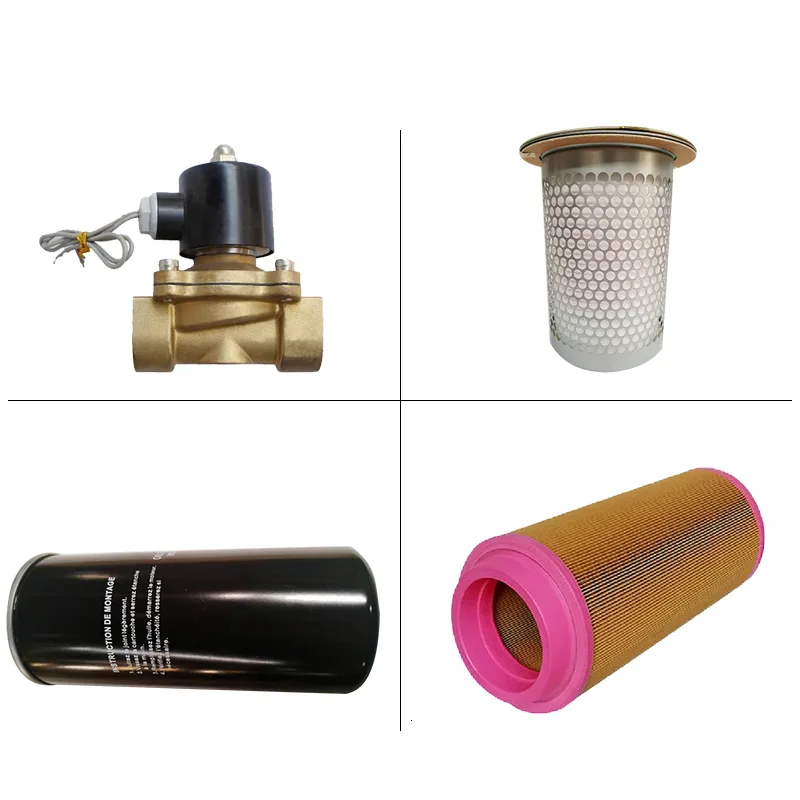
For deep borehole drilling applications especially, separator element quality directly determines hammer life. Using a no-name replacement separator to save $50 and then losing a $2,000 hammer at 150 meters is the kind of trade-off that only happens once.
Compressor Lubricating Oil
Compressor oil is not engine oil. This is the single most common mistake made by field crews servicing Chinese compressors for the first time.
Standard-pressure compressors (up to 16 bar) typically run on mineral-based compressor oil, grade 68. High-pressure compressors (above 16 bar) — the type used in deep drilling and high-pressure mining applications — require synthetic compressor oil, typically grade 46 or 68 depending on the airend specification.
Mixing oil brands or viscosity grades degrades the lubricant’s performance and can accelerate rotor wear. Using engine oil in the compressor side — which I’ve seen more than once on remote job sites — is a path to airend failure inside 4,000 hours. The thermal stability and foam resistance profiles are completely different.
Thermostatic Valves
The thermostatic valve (also called the thermal bypass valve) controls oil temperature by routing oil through the cooler or bypassing it based on temperature. When this valve fails in the open (bypass) position, oil runs permanently hot and degrades quickly. When it fails closed, oil stays cold and moisture condensation in the separator vessel becomes a problem — particularly in cold climates like Russia, Kazakhstan, and Mongolia.
This is a part that many operators don’t think about until something goes wrong. On Chinese compressors, the valve is typically a wax-element type with an opening temperature between 55°C and 72°C depending on the model. The exact opening temperature specification matters. A valve rated for 72°C installed in a machine designed for 60°C will run the oil hot for months before the consequences show up in elevated bearing temperatures and shortened separator life.
Intake Valve and Unloader Valve Kits
The intake valve (also called the inlet valve or suction regulator) controls how much air enters the compressor airend. On a portable diesel compressor used for quarry work or sandblasting operations, this valve cycles thousands of times per shift. The diaphragm, piston seals, and spring inside the valve are wear items that need periodic replacement.
When the intake valve kit wears out, symptoms include slow load-up, pressure hunting (where the machine oscillates between loaded and unloaded), and inability to reach full rated pressure. These are often misdiagnosed as airend problems when the real issue is a $30 seal kit in the intake valve assembly.
Cross-Reference: Where It Works and Where It Doesn’t
One of the most common questions from operators running Chinese compressors — especially those in Russia and CIS markets — is whether they can source parts from Western brands as direct replacements.
The short answer: it depends on the part category.
| Part Category | Cross-Reference Feasible? | Notes |
|---|---|---|
| Engine oil filters | Yes | Use the engine manufacturer’s part number (Cummins, Yanmar, Kubota, Weichai) |
| Engine fuel filters | Yes | Same — use the engine OEM part number |
| Air filter elements | Sometimes | Measure OD, ID, height carefully; verify gasket fit |
| Compressor oil filters | Rarely | Thread and bypass valve specs are often proprietary |
| Air/oil separator elements | Rarely | Vessel geometry, gasket type, and drain-back design vary between manufacturers |
| Thermostatic valves | Sometimes | Opening temperature must match exactly |
| Intake valve kits | No | Manufacturer-specific; no reliable cross-reference |
| Control boards / PLC | No | Completely proprietary |
| Airend bearings | Sometimes | SKF/NSK standard bearing numbers may apply, but clearance class matters |
| Coupling elements | Sometimes | Measure and match; not standardized across Chinese OEMs |
The parts that cross-reference easily — engine filters, fuel filters, some air filters — are the ones where the Chinese manufacturer has used a globally standardized subcomponent. The parts that don’t cross-reference — separators, intake valve kits, control electronics — are the ones where the compressor manufacturer has designed the system around their own specifications.
This is not unique to Chinese manufacturers. You can’t put an Atlas Copco separator element into an Ingersoll Rand vessel either. Proprietary fit is the norm across the industry.
How to Identify the Correct Part Number for Your Chinese Compressor
This is where most procurement failures happen. A purchasing agent searches for “Chinese compressor oil filter” online, finds something that looks right in a photo, orders twenty, and discovers on arrival that the thread pitch is wrong or the bypass valve cracks at a different pressure.
Here is the process that actually works:
Step 1 — Find the machine nameplate
Every Chinese compressor has a metal nameplate riveted to the frame or canopy. It contains the model number, serial number, manufacturing date, and rated specifications. Photograph this plate. It is the single most important document for parts ordering.
Step 2 — Locate the maintenance manual parts list
Reputable Chinese manufacturers — including Peakroc® — ship every unit with a parts list that includes OEM part numbers for all consumables. If you’ve lost the manual, contact the manufacturer with your serial number. They can retrieve the bill of materials from their production records.
Step 3 — Cross-reference the engine parts separately
If your compressor runs a Cummins engine, go to the Cummins parts catalog (QuickServe Online) with the engine serial number. Every Cummins filter, belt, gasket, and sensor has a Fleetguard or Cummins part number that is globally standardized. Do not order engine parts by the compressor manufacturer’s part number — use the Cummins number for faster, cheaper sourcing worldwide.
The same applies to Yanmar, Kubota, Deutz, and Weichai engines. Always source engine parts through the engine OEM channel.
Step 4 — For compressor-side parts, go direct to the manufacturer
For the separator element, compressor oil filter, intake valve kit, thermostatic valve, and any electronic controls, order from the compressor manufacturer or their authorized channel. This is not a suggestion — it’s the only path that guarantees correct fit and specification.
Peakroc® maintains an international parts desk that responds within 24 hours with part identification, pricing, and shipping timeline. Most orders ship within 5–7 working days. Contact the Peakroc® team with your machine serial number and they will provide the exact parts list.
Building a Spare Parts Inventory: What to Stock on Site
For operators running a fleet of Chinese compressors on a contract — whether that’s a mining operation, a construction project, or a water well drilling program — having the right parts on site prevents downtime that costs far more than the parts themselves.
Here is the minimum inventory we recommend per machine for a 12-month deployment:
| Part | Quantity per Machine | Change Interval |
|---|---|---|
| Air filter outer element | 4 | Every 500 hours (dusty: 200–300 hours) |
| Air filter inner element | 1 | Every 2,000 hours |
| Engine oil filter | 4 | Every 500 hours |
| Compressor oil filter | 4 | Every 500–1,000 hours |
| Fuel filter | 4 | Every 500 hours |
| Air/oil separator element | 1 | Every 3,000–4,000 hours |
| Compressor oil (full charge) | 2 drums | Every 1,000 hours (synthetic) or 500 hours (mineral) |
| Intake valve seal kit | 1 | As needed (typically 3,000–5,000 hours) |
| Thermostatic valve | 1 | As needed (spare for cold-climate operations) |
| V-belts or coupling elements | 1 set | As needed |
For a fleet of five heavy-duty mining compressors, this inventory costs a fraction of one day’s lost production from a compressor sitting idle while waiting for a filter to arrive.
The Russian and CIS Market: Specific Procurement Challenges
Operators in Russia and CIS countries face a unique set of logistics constraints that make spare parts planning even more critical.
Import and customs considerations
Parts shipped from China to Russia typically move by rail (China–Kazakhstan–Russia corridor) or by sea (Shanghai–Vladivostok or Shanghai–St. Petersburg). Rail transit takes roughly 14–20 days. Sea freight to Vladivostok runs 12–18 days; to St. Petersburg via the northern route, 35–45 days.
Customs classification matters. Air compressor spare parts are classified under different HS codes depending on whether they’re filtration elements (HS 8421), rubber seals (HS 4016), or electrical components (HS 8537). Getting the classification right on the commercial invoice prevents clearance delays.
Language and part identification
A recurring problem in the Russian market is that compressor manuals shipped with Chinese machines are often in English or Chinese — rarely in Russian. When a local mechanic in Yakutsk or Krasnoyarsk needs to order a separator element, he searches for “запчасти на китайский компрессор” (parts for a Chinese compressor) and ends up on trading platforms where part identification is unreliable.
The solution is to request a Russian-language parts list from the manufacturer at the time of purchase. Peakroc® provides multilingual documentation and technical support in both English and Russian for CIS market clients.
Cold-climate considerations
Russian operating conditions — particularly in Siberia, the Urals, and Far East — demand parts rated for extreme cold. Standard thermostatic valves, compressor oils, and battery systems may not perform at –30°C to –40°C ambient. When procuring parts for cold-climate deployment, verify the temperature rating explicitly. A synthetic compressor oil rated for –30°C pour point is not optional in a Yakutia winter — it’s mandatory.
OEM vs. Aftermarket: The Real Cost Comparison
The temptation to buy aftermarket parts is strong. An OEM separator element for a Chinese compressor might cost $120–180. An aftermarket copy from a random supplier on a B2B platform costs $35–50. That’s a compelling price difference — until you calculate the real cost.
A poor-quality separator element that passes excessive oil into the air stream does three things:
- Compressor oil consumption rises — you’re losing oil out the discharge port
- Downstream tools (DTH hammers, pneumatic drills, blasting equipment) degrade faster
- The separator vessel and minimum pressure valve accumulate oil residue, causing maintenance issues
Over a 4,000-hour separator life cycle, the “savings” from a $50 aftermarket separator versus a $150 OEM element can easily cost $500–1,000 in excess oil consumption and downstream tool repairs. The economics are clear.
This doesn’t mean every aftermarket part is bad. For commodity items like standard air filter elements and engine oil filters, quality aftermarket options exist. But for anything in the oil circuit — separator elements, compressor oil filters, thermostatic valves — use OEM parts from the compressor manufacturer.
How Peakroc® Handles International Spare Parts Support
Peakroc® built its aftermarket support infrastructure specifically for international fleet operators, because we recognized early that selling a compressor without a reliable parts supply chain is selling a problem, not a solution.
Every Peakroc® compressor ships with a detailed spare parts list keyed to the machine serial number. The list includes OEM part numbers for all consumables, the recommended change intervals, and the compressor oil specification.
For ongoing support:
- Parts orders placed with the machine serial number are identified and shipped within 5–7 working days
- Cummins engine parts are sourced through Cummins OEM channels and can be drop-shipped to the operating site directly
- Bulk consumable kits (12-month supply for a single machine or fleet) are available at contracted pricing
- Technical support is available in English, Russian, and Chinese for part identification and troubleshooting
Whether you operate a single 5 m³/min 7 bar compressor for sandblasting or a fleet of 45 m³/min 10 bar units for mining and tunneling, the parts process is the same: serial number in, correct parts out.
Use our compressor finder tool to identify your machine model, or contact our parts desk directly with your serial number and required parts list.
Frequently Asked Questions
Can I use Atlas Copco or Ingersoll Rand filters in a Chinese compressor?
Engine filters — sometimes, if both machines use the same engine model. Compressor-side filters — almost never. The vessel geometry, thread specification, and bypass valve settings are manufacturer-specific. Forcing a Western OEM filter into a Chinese compressor housing can create a bypass gap that allows unfiltered oil into the airend.
How do I find spare parts if I don’t know the compressor brand?
Start with the nameplate on the machine. If the nameplate is missing or unreadable, photograph the airend casting — most Chinese airend manufacturers cast a model code into the housing. Photograph the engine nameplate separately. With the engine serial number and airend model, a knowledgeable supplier can usually identify the compressor and its parts list.
What is the typical lead time for Chinese compressor spare parts shipped to Russia?
From order placement to CIS delivery, expect 20–30 days via rail freight or 15–20 days via express air freight for urgent items. Peakroc® maintains a fast-response parts desk for CIS clients — contact us for current lead times.
Are Chinese compressor spare parts cheaper than Western OEM parts?
For equivalent specification and quality, yes — typically 30–50% lower for compressor-side consumables (separators, oil filters, intake valve kits). Engine parts priced through the engine OEM channel (Cummins, Yanmar) are globally standardized and price differences are smaller.
Should I buy parts in bulk or on-demand?
For machines deployed on remote sites — deep borehole drilling projects, mining contracts, or rural water well programs — always stock a 12-month consumable kit on site. The cost of idle equipment waiting for a filter shipment far exceeds the holding cost of a parts inventory.
Author

Mark Chen – Senior Mechanical Engineer, Peakroc®
Mark Chen is a senior mechanical engineer at Peakroc®, specializing in compressed air systems and drilling equipment for mining and construction applications. With over 15 years of field experience, he has led multiple projects on optimizing air delivery efficiency, equipment durability, and energy consumption.