
Key Takeaways
- A portable compressor’s dB(A) rating is meaningful only when the measurement conditions are known. Sound quantity, microphone distance, engine speed, compressor load, test environment and background noise all affect how the result should be interpreted.
- Sound pressure and sound power are different acoustic quantities. Sound pressure describes noise at a measurement location, while sound power represents the noise emitted by the equipment. Buyers should not compare these figures directly, even when both are A-weighted.
- Noise measured at 1 meter cannot automatically be compared with noise measured at 7 meters. Measurement distance, microphone orientation, sound reflections and the physical size of the compressor influence the result. For example, the Peakroc® 20 m³/min, 13 bar portable diesel compressor has a published 7-meter noise specification that should be interpreted using its actual test conditions.
- Full-load testing provides a more useful basis for evaluating operating noise than idle-only readings. Noise generated by the engine, cooling fan, compressor airend and enclosure may change with load. Different compressor configurations, such as the Peakroc® 12 m³/min, 7 bar portable diesel compressor and 34 m³/min, 25 bar high-pressure compressor, should be evaluated against their own operating requirements.
- A credible noise test report is more useful than an isolated marketing figure. Buyers should request the applicable standard, sound quantity, operating conditions, microphone positions, calibration information and measurement uncertainty. The Peakroc® compressor selection service can be used to identify the required machine specification before comparing available noise data.
A portable diesel air compressor may be advertised as producing 70, 75 or 80 dB(A), but these numbers do not necessarily describe equivalent operating conditions.
One manufacturer may report sound pressure at 7 meters, another may measure at 1 meter, and a third may publish an A-weighted sound power level. Some figures are obtained with the compressor fully loaded, while others may describe unloaded operation or a specially configured sound-attenuated package.
These differences matter when selecting equipment for construction sites, mining operations, equipment rental fleets or projects near noise-sensitive areas.
A compressor that appears quieter on paper may simply have been measured from a greater distance or under a different operating condition. Likewise, a properly designed acoustic enclosure may reduce equipment noise, but the result should be verified without compromising cooling or maintenance access.
The correct way to compare portable diesel compressor noise is to identify what was measured, where it was measured and how the machine was operating.
This guide explains the differences between sound pressure and sound power, the significance of 1-meter and 7-meter measurements, the role of ISO 2151 and the information buyers should expect in a reliable compressor noise test report.
What Does dB(A) Mean for a Portable Air Compressor?
Decibels are logarithmic units used to express acoustic levels. The notation dB(A) indicates that an A-weighting filter has been applied to account for the varying sensitivity of human hearing at different frequencies.
For portable diesel compressors, A-weighting is commonly used when reporting equipment noise emissions and assessing general workplace noise.
However, dB(A) alone does not identify which acoustic quantity has been measured.
The distinction is important because a sound pressure level at a specified location and a sound power level describing the equipment’s overall emission may both be expressed using A-weighted decibel values.
Sound Pressure Level (LpA)
Sound pressure level describes the acoustic pressure at a particular measurement position.
It is influenced by the sound emitted by the compressor, the distance from the source, the measurement direction and the surrounding environment.
A portable compressor may produce different sound pressure readings at the front, rear and sides because its engine exhaust, cooling-air outlets and mechanical components do not radiate sound uniformly.
The A-weighted sound pressure level is commonly written as LpA and uses a reference sound pressure of 20 µPa in air.
A statement such as 75 dB(A) at 7 meters generally refers to sound pressure under a particular measurement arrangement, but buyers should confirm the exact quantity and test method rather than relying on the notation alone.
Sound Power Level (LWA)
Sound power level describes the acoustic energy emitted by a source per unit time.
Unlike sound pressure at a measurement point, sound power is a characteristic of the equipment’s noise emission and is not defined by a particular listener distance.
A-weighted sound power level is commonly written as LWA, referenced to 1 picowatt.
It is generally determined from measurements over an appropriate surface surrounding the equipment, using a recognized acoustic test method.
Sound power data can be useful when comparing equipment noise emissions or evaluating environmental noise requirements.
An LWA value of 95 dB(A) is not equivalent to an LpA value of 95 dB(A) at a specified distance. They represent different physical quantities and cannot be directly ranked as though they were identical measurements.
Portable Compressor Noise at 1 Meter vs 7 Meters
Measurement distance is one of the most common reasons compressor noise specifications appear inconsistent.
A sound pressure reading taken near the engine enclosure will generally differ from one measured farther away, even when the compressor is operating under identical conditions.
For this reason, a supplier stating only “72 dB(A)” has not provided enough information for a meaningful comparison.
Why Distance Changes the Reading
In an ideal free field, sound from a compact point source spreads over an increasingly large area as distance increases.
Under those assumptions, the sound pressure level changes approximately according to:
Difference in Sound Pressure Level = 20 × log₁₀(r₂ / r₁)
Where r₁ and r₂ are distances from the same acoustic source.
For an ideal point source, increasing distance from 1 meter to 7 meters corresponds to an approximate reduction of 16.9 dB.
However, this is an idealized calculation, not a valid universal conversion for real portable compressors.
A diesel compressor is an extended sound source containing an engine, fan, exhaust system and enclosure. Different components radiate sound in different directions, while the ground and nearby surfaces can reflect noise.
A microphone 1 meter from a large compressor enclosure may also be within the near field of the source, where a simple point-source distance relationship is unreliable.
Therefore, a measured 7-meter rating should not be converted to a claimed 1-meter value by automatically adding 16.9 dB.
Why 7-Meter Testing Is Common
Seven-meter measurement arrangements have a long history in the evaluation of portable construction compressors.
For example, the U.S. portable air compressor noise testing procedure specifies multiple measurement positions around the equipment at a distance of approximately 7 meters.
The procedure includes measurements from four sides and above the compressor, with defined microphone locations and operating requirements.
Importantly, this 7-meter method is not interchangeable with every ISO 2151 measurement arrangement.
ISO 2151 addresses the determination and declaration of compressor noise emissions using specified acoustic methods and operating conditions. The exact measurement arrangement must be identified from the applicable procedure.
For procurement, the safest comparison is between compressors measured using the same sound quantity, method, distance and operating conditions.
How ISO 2151 Applies to Portable Diesel Compressor Noise Testing
ISO 2151:2004 is an international noise test code for compressors and vacuum pumps. Its scope includes portable and skid-mounted compressors and establishes methods for determining sound power and emission sound pressure under specified operating conditions.
The standard provides a consistent framework for evaluating equipment noise, but its application requires more than placing a sound level meter beside a running compressor.
The test setup, loading state, mounting arrangement, measurement method and reporting requirements must be appropriate for the equipment.
Five Conditions to Confirm Before Noise Testing
- Compressor identification: Record the model, serial number, engine, enclosure configuration and installed options being tested.
- Defined operating point: Establish the relevant airflow, discharge pressure, engine speed and compressor loading condition.
- Appropriate test environment: Control or document background noise, reflected sound, wind and other factors required by the selected method.
- Calibrated instrumentation: Use suitable acoustic measurement equipment with documented calibration and the required measurement accuracy.
- Agreed reporting method: Identify the applicable standard, microphone locations, measured sound quantity and treatment of uncertainty.
A reference to ISO 2151 in a brochure does not, by itself, establish that an individual compressor has undergone a compliant noise test.
The manufacturer should be able to identify the actual measurement method and provide supporting records for the declared configuration.
How Is a Portable Diesel Compressor Noise Test Performed?
A meaningful test should represent the compressor under a clearly specified operating condition.
For full-load evaluation, the engine and airend should operate at the required speed, pressure and airflow. This matters because the noise produced by the cooling fan, diesel engine and compression system may change significantly between idle and loaded operation.
A proper test arrangement also prevents uncontrolled compressed-air discharge noise from dominating the measurement.
Five Steps in a Practical Full-Load Noise Test
- Prepare the measurement area: Position the compressor and microphones according to the selected standard, identify reflecting surfaces and measure background noise.
- Verify the instrument setup: Check acoustic calibration, microphone placement, wind protection and any required environmental measurements.
- Stabilize the compressor: Operate the machine at the specified loading condition and confirm engine speed, discharge pressure and airflow.
- Record acoustic measurements: Measure the required sound levels at the specified positions while documenting machine operating conditions and any abnormal noise.
- Evaluate and report results: Apply the required calculations, corrections and uncertainty assessment, then prepare a traceable report identifying the tested compressor.
For example, the U.S. regulatory procedure requires portable compressors to operate at design full speed, delivering rated flow and pressure during the specified noise compliance test.
It also requires background noise to be sufficiently below the compressor reading and specifies how the compressed-air discharge should be controlled.
These conditions prevent a test from appearing artificially quiet simply because the machine is unloaded or the measurement is dominated by an unsuitable setup.
Why Idle Noise Cannot Replace Full-Load Noise
During unloaded operation, a portable diesel compressor may reduce engine speed or change its intake-control state.
This can lower noise from some components, but it does not necessarily represent the sound produced during sustained compressed-air delivery.
For construction or mining applications where the compressor operates at high demand for extended periods, the loaded condition is particularly relevant.
Idle noise may still be useful information for rental fleets or projects with intermittent demand, but it should be identified separately.
A manufacturer should not present a low idle reading as though it were a full-load noise declaration.
How to Compare Portable Compressor Noise Specifications
Before comparing two noise figures, confirm that they describe equivalent quantities and operating conditions.
The following examples show how incomplete specifications can mislead purchasing decisions.
| Published Noise Information | What It Indicates | Can Buyers Compare It Directly? |
|---|---|---|
| 75 dB(A) at 7 m, loaded | Sound level at a stated distance and operating state | Only with comparable measurement methods and conditions |
| 72 dB(A) at 1 m, loaded | Sound pressure at a different distance | No, not directly against a 7 m rating |
| LWA 95 dB(A) | A-weighted sound power emission | No, not directly against sound pressure |
| 68 dB(A), distance not stated | Incomplete acoustic specification | No, request missing details |
| 70 dB(A) at idle | Noise during a lower-load operating state | Not directly against a loaded value |
| 73 dB(A) at 7 m, loaded, calibrated test | More complete specification with measurement evidence | Potentially, when the full method and uncertainty are comparable |
Illustrative comparison examples, not measured Peakroc test results. Numbers in different rows are not intended to rank specific compressor models.
A difference of only 1–2 dB may also be difficult to interpret when the two reports use different methods or have overlapping measurement uncertainty.
Buyers should not select a compressor solely because one quotation lists a slightly lower number.
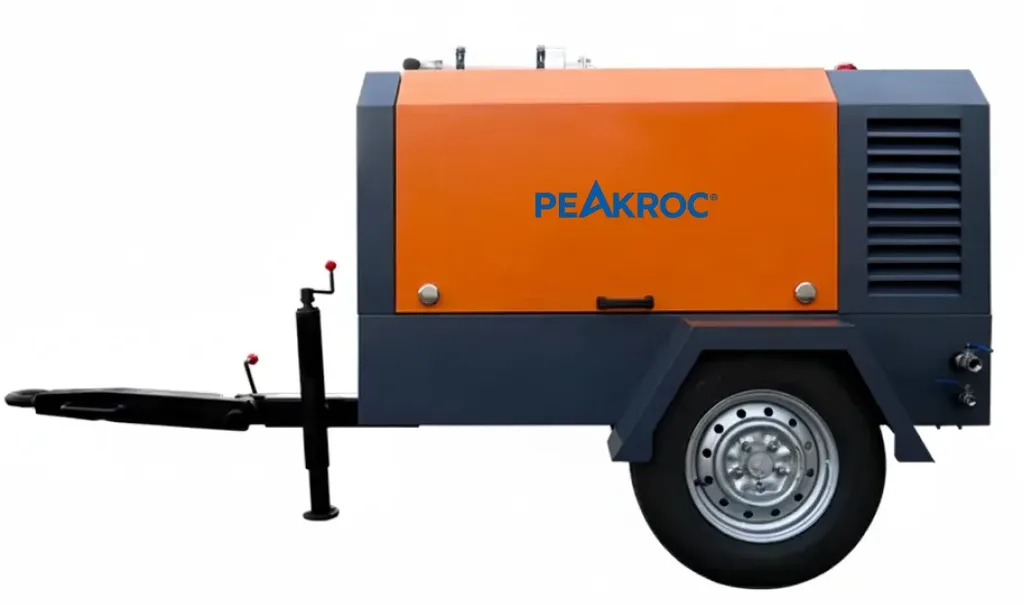
What Makes a Portable Diesel Air Compressor Noisy?
A portable diesel compressor contains several mechanical and aerodynamic noise sources.
The diesel engine produces combustion and mechanical noise. The exhaust system generates additional sound, while the compressor airend, cooling fans and air intake contribute their own frequency characteristics.
Vibration can also transfer through the chassis and enclosure, causing panels or other structures to radiate sound.
The relative contribution of each source depends on equipment design and operating conditions.
Sound-Attenuated Enclosures and Cooling Trade-Offs
A sound-attenuated compressor enclosure can reduce the transmission of mechanical noise, but its performance depends on more than the thickness of the acoustic lining.
Ventilation openings, cooling-air paths, exhaust silencers, access doors, seals and structural vibration all influence the result.
A well-designed enclosure must provide adequate cooling airflow while limiting unnecessary sound transmission.
Adding insulation without checking thermal performance can restrict ventilation and cause excessive operating temperatures, potentially leading to engine derating or compressor shutdown.
Likewise, operating with service doors open can change the noise emission substantially.
Five Noise Sources and Maintenance Checks
- Engine and exhaust system: Check abnormal combustion noise, exhaust leakage, muffler condition and mounting integrity.
- Cooling fans and airflow: Inspect fan condition, radiator restriction, loose shrouds and cooling-air passages.
- Compressor airend and drive: Investigate unusual bearing noise, vibration or mechanical contact according to approved service procedures.
- Acoustic enclosure: Check damaged seals, missing insulation, loose panels and door latches without obstructing required ventilation.
- Chassis and vibration isolation: Inspect engine mounts, supports and components that may transmit mechanical vibration into the enclosure.
Noise reduction should address the actual source rather than rely on adding acoustic material indiscriminately.
For example, a damaged fan or loose exhaust component should be repaired before considering additional enclosure treatment.
Equipment Noise Ratings vs Worker Noise Exposure
A manufacturer’s noise emission rating helps describe the equipment under specified conditions.
It does not automatically indicate the total noise exposure experienced by a worker throughout a shift.
On a construction site, the operator may encounter noise from several compressors, pneumatic tools, drilling equipment, vehicles and other machinery. Exposure also depends on working distance and duration.
Therefore, equipment noise testing and occupational noise assessment are related but separate activities.
In U.S. federal general industry, an eight-hour time-weighted average exposure of 85 dBA is the hearing-conservation action level, while 90 dBA over eight hours is the general permissible exposure limit under the relevant standard.
These are occupational exposure criteria, not interchangeable compressor noise-emission limits. Construction activities and other jurisdictions may have different applicable requirements.
A compressor advertised at 75 dB(A) at 7 meters does not establish that every nearby worker’s noise exposure will remain below an occupational threshold.
Actual exposure must be evaluated according to the applicable workplace requirements.
Technical Field References
The following documented measurements and technical investigations show why standardized test conditions matter when evaluating portable compressor noise.
They are external technical references, not Peakroc® customer projects. Historical results are included to explain measurement principles rather than establish current compressor performance benchmarks.
Field Reference 1: U.S. Federal Testing of Standard and Silenced Portable Compressors
A historical U.S. environmental noise study evaluated 23 portable compressor types using a defined 7-meter measurement approach.
The reported standard compressor configurations produced levels ranging from approximately 81.4 to 92.6 dBA at 7 meters, while the silenced configurations ranged from approximately 70.1 to 78.2 dBA.
The investigation reported that silenced machines were, on average, approximately 10–15 dBA quieter than the standard configurations in the evaluated sample.
Engineering lesson: Acoustic enclosure design can make a substantial measurable difference, but comparisons must use compatible measurement conditions.
These are historical test results, not modern performance guarantees. They do not establish that every current sound-attenuated compressor will achieve the same reduction.
Field Reference 2: Near-Field and Far-Field Measurements of 17 Portable Compressors
A national measurement laboratory investigated sound-pressure measurements and sound-power estimation using 17 portable compressors of different designs.
The research compared near-field measurements on a surface approximately 1 meter from the machines with far-field measurements over a 7-meter measurement surface.
The study evaluated how different spatial measurement arrangements affected sound-power estimation.
Engineering lesson: Sound power can be derived from properly designed spatial measurements, but a single near-field sound pressure reading cannot be treated as equivalent to a far-field measurement or a sound-power declaration.
This research supports the importance of measurement geometry and source size. It does not provide a universal 1-meter-to-7-meter correction applicable to every compressor.
Field Reference 3: Published Noise Specification for a Portable Diesel Screw Compressor
A publicly available product specification for a 20 m³/min, 13 bar portable diesel compressor declares a sound level of 75 dB(A) at 7 meters for its enclosed configuration.
The same product information describes an optional enhanced sound-attenuation package with a lower declared noise figure.
This is an example of how real compressor product pages present noise ratings to international buyers.
Engineering lesson: A stated 7-meter value is useful for preliminary comparison, but buyers should still confirm the measurement method, load condition, sound quantity, configuration and supporting test evidence.
The publicly available information is a manufacturer declaration. A complete independent test report and raw acoustic measurements were not established from the product page, so these values should not be presented as independently verified test results.
How to Verify Compressor Noise Before Shipment
For international equipment purchases, the best time to clarify noise requirements is before the compressor is manufactured or dispatched.
If a project has a contractual noise limit, the purchase agreement should state the required sound quantity, test procedure, configuration and acceptance criteria.
A factory acceptance test may then include the agreed acoustic measurements, provided appropriate instrumentation and facilities are available.
A brief video showing a sound level meter near the compressor can support an inspection, but it does not replace a controlled test when formal noise verification is required.
Five Common Noise-Test Reporting Mistakes
- Reporting dB(A) without a sound quantity: The reader cannot determine whether the figure represents sound pressure or sound power.
- Omitting microphone distance or location: A 1-meter reading cannot be compared directly with a 7-meter measurement.
- Using idle data as full-load performance: The quoted value may not represent normal high-demand operation.
- Ignoring acoustic configuration: An open-frame unit and a sound-attenuated version may have different noise characteristics.
- Providing a result without test evidence: Missing calibration, background noise, operating data or measurement uncertainty limits the credibility of the claim.
These problems are particularly important when a buyer is comparing equipment from several suppliers.
A complete noise declaration makes it easier to identify genuine performance differences and reduces the risk of misunderstandings after delivery.
What Should Buyers Request in a Compressor Noise Test Report?
A useful noise report should allow another qualified person to understand the measurement procedure and identify the equipment that was tested.
The report should also make clear whether the declared result represents a tested machine, a product-family declaration or another approved basis.
Five-Part Compressor Noise Test RFQ Checklist
- Equipment details: Compressor model, serial number or product variant, engine power, rated FAD, pressure and acoustic enclosure configuration.
- Noise measurement requirement: Sound pressure or sound power, A-weighting, applicable standard, specified microphone positions and acceptance limits.
- Operating conditions: Full-load or other defined operating state, engine speed, discharge pressure, airflow and cooling arrangement.
- Test environment and instrumentation: Site characteristics, background noise, weather where relevant, sound level meter, calibration and uncertainty.
- Reporting and acceptance: Individual readings, calculated results, deviations, witness requirements and final documentation.
For example, instead of requesting only “a silent 700 CFM diesel compressor,” a buyer could specify:
Please provide the A-weighted sound pressure level for the offered portable diesel compressor under rated full-load operation, including the measurement distance, applicable test method, acoustic enclosure configuration and supporting noise test report.
For projects requiring compliance with particular environmental regulations, the buyer should additionally request the relevant sound-power declaration, conformity assessment and supporting documents as applicable.
Final Recommendation
Portable diesel air compressor noise should be evaluated using clearly defined acoustic measurements rather than isolated dB(A) figures.
Sound pressure and sound power describe different quantities. Measurements at 1 meter and 7 meters are not directly interchangeable, while idle and full-load operation may produce significantly different results.
ISO 2151 provides an internationally recognized framework for compressor noise testing. Other regulatory procedures may establish specific measurement arrangements, operating conditions and reporting requirements.
For equipment selection, buyers should compare noise data obtained under equivalent conditions and verify that the supplied compressor includes the same acoustic configuration as the tested machine.
The assessment should also consider cooling performance, maintenance access, workplace exposure and the requirements of the intended operating environment.
A credible low-noise compressor specification is not simply a small dB(A) number. It is a clearly identified, appropriately measured and verifiable noise result for the actual equipment and operating conditions.
FAQ
How is portable diesel air compressor noise measured?
Noise is measured using suitable acoustic instrumentation under defined operating and environmental conditions. The applicable method specifies the sound quantity, microphone positions, compressor loading state, background-noise requirements and reporting procedure.
What does dB(A) mean on an air compressor specification?
dB(A) indicates an A-weighted decibel level. It accounts for the frequency sensitivity of human hearing, but it does not identify whether the value represents sound pressure or sound power. The complete acoustic quantity must be stated.
What is the difference between compressor sound pressure and sound power?
Sound pressure describes the acoustic level at a particular measurement location and depends on distance and surroundings. Sound power describes the total acoustic emission of the equipment. The two quantities cannot be compared directly.
Is 75 dB(A) at 7 meters the same as 75 dB(A) at 1 meter?
No. The measurements describe sound pressure at different distances. Actual results depend on source geometry, direction, reflections and measurement conditions. A universal conversion is not reliable for large portable compressors.
Does ISO 2151 require all compressor noise tests to be performed at 7 meters?
No. ISO 2151 specifies methods for determining compressor sound power and emission sound pressure under defined operating conditions. Certain other procedures prescribe 7-meter measurement arrangements, but the two should not be treated as identical.
Should portable compressor noise be tested at full load?
For full-load noise evaluation, the compressor should operate at the specified loaded conditions. Some regulatory procedures explicitly require rated flow, pressure and speed. Idle measurements may provide additional information but should not substitute for required loaded results.
Does a soundproof compressor enclosure always reduce noise without affecting cooling?
No. Acoustic enclosures must allow sufficient ventilation and cooling. Poorly designed insulation or blocked airflow can increase temperatures and compromise machine performance. Noise reduction should be verified under the approved operating conditions.
What should buyers check when comparing low-noise diesel compressors?
Compare the exact models and configurations, sound quantity, measurement method, distance, loaded operating state, test environment and uncertainty. Request supporting noise test records rather than relying solely on marketing figures.
Author

Mark Chen – Senior Mechanical Engineer, Peakroc®
Mark Chen is a senior mechanical engineer at Peakroc®, specializing in compressed air systems and drilling equipment for mining and construction applications. With over 15 years of field experience, he has led multiple projects on optimizing air delivery efficiency, equipment durability, and energy consumption.