
Key Takeaways
- An air compressor and a booster solve different problems. A primary compressor supplies compressed-air capacity, while a booster increases the pressure of an existing air supply. The Peakroc® RC drilling compressor sizing guide explains the broader pressure and airflow requirements of mineral exploration drilling.
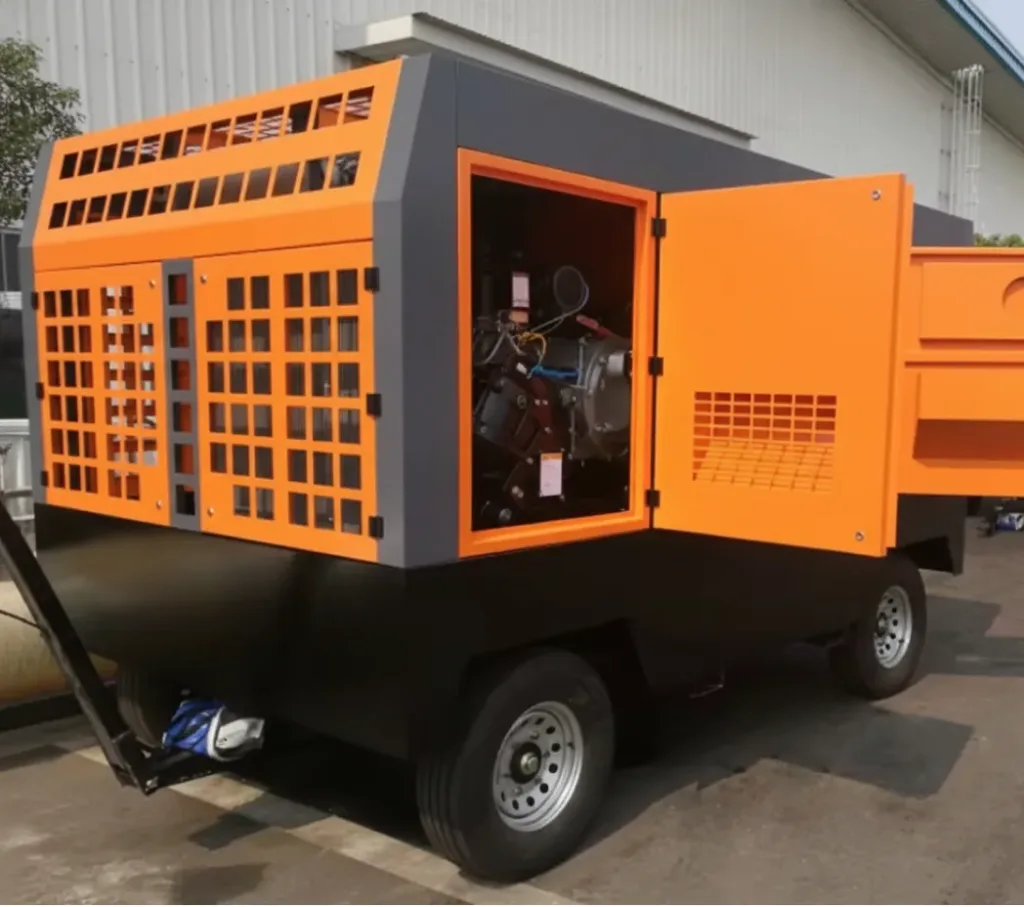
- More CFM is not the same as higher pressure. An additional compressor can increase available FAD when connected through a properly engineered parallel system. The Peakroc® 39 m³/min, 25 bar portable diesel compressor represents a high-flow supply option, subject to the requirements of the complete installation.
- 25–35 bar compressors can serve as primary or supplementary air sources. The Peakroc® 34 m³/min at 25 bar compressor and 33 m³/min at 35 bar compressor illustrate different pressure-flow combinations. Their suitability for a particular booster must be confirmed rather than assumed.
- Booster inlet conditions determine system compatibility. Inlet pressure, actual flow, temperature, allowable compression ratio and discharge pressure must remain within the booster’s approved operating envelope. Pressure losses through the high-pressure compressor air delivery system must also be considered.
- Reliable sample recovery depends on the complete air system. Insufficient airflow, poor pressure regulation, groundwater, leaks or sample-return restrictions can affect drilling productivity and sample quality. Increasing pressure alone is not always the correct solution.
A reverse circulation (RC) drilling contractor may have a high-pressure compressor that performs normally at the surface, yet the drilling system struggles to maintain productivity as conditions become more demanding.
The problem might be insufficient airflow, excessive pressure loss, groundwater backpressure or inadequate pressure capability. Although these symptoms can appear similar, they do not necessarily require the same equipment solution.
Adding another compressor can provide more available air, but it does not automatically increase system pressure. Installing a booster can raise pressure, but it cannot compensate for insufficient air mass flow entering its inlet.
For mineral exploration contractors, the key question is therefore not simply whether a larger compressor is needed.
The practical decision is whether the existing system lacks airflow, pressure or both—and which combination of compressors and boosters can meet the actual operating requirements.
This guide explains the difference between primary compressors and booster compressors, how to evaluate 25–35 bar air supplies, and how to match equipment without unnecessary fuel consumption, excessive pressure or reduced sample recovery.
Air Compressor vs Booster: What Is the Difference in RC Drilling?
A primary air compressor draws in atmospheric air and compresses it to a working pressure suitable for the intended application.
Portable diesel rotary screw compressors are frequently used in mining and drilling because they can provide substantial continuous airflow from a mobile equipment package.
A booster compressor performs an additional compression stage. It receives air that has already been compressed and raises its pressure to a higher level.
Both machines are compressors in the mechanical sense, but they perform different functions within the drilling-air system.
Primary Compressor: Supplying the Required Air Volume
The primary compressor provides the compressed-air supply needed by the drilling equipment.
For RC applications, this air contributes to hammer operation and the movement of rock cuttings through the sampling circuit.
Compressor capacity is commonly expressed as Free Air Delivery (FAD), in CFM or m³/min, at a specified working pressure.
For example, a machine rated at 34 m³/min at 25 bar represents approximately 1,200 CFM at its stated operating point.
A second compressor may be required when the existing machine cannot supply the airflow demanded by the complete system.
However, a second compressor should not be connected merely because the available equipment has a similar outlet size. The machines must operate compatibly in pressure, flow, controls and protective systems.
Booster Compressor: Raising the Pressure of Existing Air
A booster receives compressed air at its inlet and increases its pressure.
The inlet air may come from one primary compressor or from an appropriately engineered multi-compressor arrangement.
Unlike the primary compressor, the booster typically does not draw its main process-air supply directly from atmospheric conditions.
Its performance depends on the pressure, temperature and mass flow of the incoming air.
A booster does not create additional air mass flow. In practical operation, losses, leakage and auxiliary consumption may slightly reduce the mass flow available downstream.
The actual volumetric flow at the booster’s high-pressure discharge is also different from the volume entering its inlet because air density changes with pressure and temperature.
This distinction is important when comparing compressor CFM ratings with booster performance specifications.
How to Know Whether You Need More CFM or More Pressure
The first step is to identify the actual limitation in the drilling-air system.
A compressor that cannot maintain the required airflow presents a different problem from a booster that receives adequate air but cannot achieve the specified discharge pressure.
Before replacing equipment, technicians should compare measured values at several points in the system under representative operating conditions.
Five Warning Signs and What They May Indicate
- The primary compressor cannot maintain its required pressure under full demand: Available FAD may be insufficient, but leakage, engine performance, loading controls or restrictions should also be investigated.
- The primary compressor operates normally, but booster inlet pressure falls: The booster may be drawing more air than the supply arrangement can sustain, or the inlet piping may be restrictive.
- Booster inlet conditions are stable, but discharge pressure remains low: The booster may be operating outside its performance envelope or experiencing mechanical, valve, cooling or control problems.
- Pressure is adequate, but sample returns become irregular: The air system may have insufficient effective circulation, although groundwater, rod leakage or sampling restrictions can create similar symptoms.
- The system frequently loads and unloads despite changing demand: Compressor and booster control settings may not be coordinated, creating unstable operation or unnecessary energy consumption.
These observations provide diagnostic directions rather than definitive fault identification.
For example, a pressure drop at the booster inlet does not automatically mean another compressor must be purchased. The existing machine may have a control fault, while a small manifold or restricted connection can also produce pressure loss under high airflow.
A reliable diagnosis should establish the limiting component before the equipment configuration is changed.
Why CFM/FAD and Booster Inlet Pressure Must Be Matched
A booster cannot be selected from its maximum discharge-pressure rating alone.
The supplier must know how much compressed air enters the machine, at what pressure and temperature, and what discharge pressure is required.
Comparing FAD With Booster Inlet Flow
Consider a hypothetical RC drilling package that requires approximately 2,200 CFM of free-air-equivalent supply at a specified operating condition.
Suppose the existing onboard compressor can deliver 1,000 CFM at that condition.
The preliminary airflow deficit is:
2,200 CFM − 1,000 CFM = 1,200 CFM
An auxiliary compressor capable of providing the missing capacity may be considered.
However, this simple calculation does not verify the final equipment arrangement. Both airflow ratings must use compatible reference conditions, and the compressors must deliver the required air at a compatible pressure under actual site conditions.
The booster must then be checked separately.
Its allowable inlet pressure and inlet flow must accommodate the combined air supply, and its discharge capability must meet the downstream requirement.
A system with sufficient total FAD can still be incompatible with the selected booster.
Why Pressure Ratings Cannot Simply Be Added
Two compressors operating in parallel do not automatically produce the sum of their pressure ratings.
For example, connecting two compressors rated at 25 bar does not create a 50-bar air supply.
A properly designed parallel arrangement may increase total available flow at a compatible delivery pressure.
Raising pressure through sequential compression requires equipment specifically designed and controlled for that function.
Similarly, a compressor rated at 35 bar is not automatically an acceptable inlet source for every booster.
Some booster models have maximum allowable inlet pressures below 35 bar. Others are designed for different pressure and airflow ranges.
The complete operating envelope must always be verified.
Five Booster Inlet Matching Requirements
- Inlet pressure range: Confirm minimum and maximum allowable suction pressures, including pressure fluctuations and transient conditions.
- Inlet mass flow or referenced capacity: Verify the required flow at the specified inlet pressure and temperature, using the manufacturer’s stated reference basis.
- Discharge pressure and compression ratio: Check whether the intended outlet pressure is achievable within the approved operating range and duty cycle.
- Inlet air temperature and quality: Evaluate cooling, moisture, oil carryover, particulate contamination and the need for appropriate upstream separation or filtration.
- Controls and protection: Confirm inlet low-pressure protection, overpressure protection, high-temperature shutdown, unloading or bypass functions and approved isolation arrangements.
Booster selection also requires evaluating the pressure loss between the primary compressor outlet and booster inlet.
A compressor may deliver 25 bar at its own outlet while a restrictive hose or manifold causes the booster to receive less pressure under load.
The compressor outlet rating alone is therefore insufficient for system matching.
Single Compressor vs Parallel Compressors and Booster Configurations
There are several practical ways to configure a compressed-air system for mineral exploration.
The correct arrangement depends on the required pressure-flow operating point, the available equipment and the expected variation in drilling conditions.
Configuration A: Single High-Pressure Compressor
A single compressor may be sufficient when it can deliver the required FAD at the operating pressure without additional boosting.
This arrangement offers relatively simple installation, fewer connections and potentially lower maintenance complexity.
It may be practical for applications where the required working pressure remains within the compressor’s rated operating range.
However, the machine must also provide enough airflow for the complete drilling system, including the intended sampling performance.
Configuration B: Onboard Compressor Plus Auxiliary Compressor
An RC rig may have an onboard compressor that is adequate for ordinary operating conditions but insufficient for a particular project.
An auxiliary compressor can be considered when additional airflow is required.
For example, a system could combine an existing air supply with a portable diesel compressor rated around 34–39 m³/min, provided the machines are compatible and the arrangement is properly engineered.
This does not mean that any two compressor capacities can be added without qualification.
Differences in operating pressure, loading controls, engine response and protection settings may affect how the units share demand.
The delivery manifold and connection equipment must also be suitable for the combined airflow.
Configuration C: Primary Compressor Plus Booster
Where the required operating pressure exceeds the primary compressor’s capability, a booster may provide the necessary additional compression.
The booster must receive adequate inlet air at an approved pressure and temperature.
This configuration introduces additional fuel or power consumption, cooling requirements, maintenance and control-system complexity.
It is justified only when the additional pressure is genuinely required by the application.
Configuration D: Onboard Air Plus Auxiliary Compressor and Booster
A demanding RC exploration project may require both additional airflow and higher pressure.
In this arrangement, one or more compatible compressors supply air to a booster, which raises the pressure to the required level.
This configuration provides flexibility but requires more detailed engineering.
Control coordination becomes especially important when operating demand changes or when one compressor is taken offline.
Five Parallel Compressor System Checks
- Compatible operating points: Confirm that each compressor can contribute the required FAD at a compatible manifold pressure.
- Check valves and reverse-flow protection: Prevent unintended backflow and establish safe isolation of individual machines.
- Coordinated loading controls: Avoid uncontrolled pressure hunting, repeated unloading or operation outside approved compressor limits.
- Manifold and hose capacity: Size distribution components for the combined airflow, pressure, temperature and mechanical loads.
- Protection and shutdown logic: Verify how the system responds to loss of inlet pressure, compressor shutdown, booster faults or sudden changes in air demand.
These arrangements should be approved by qualified personnel and the relevant equipment manufacturers.
High-pressure air systems store significant energy. Improvised manifolds, incompatible couplings or uncontrolled series connections can create serious hazards.
RC Compressor and Booster Troubleshooting Table
The following table is intended to help distinguish airflow limitations, pressure limitations and other faults before changing the equipment configuration.
| Operating Symptom | Possible Cause | What to Verify | Recommended Direction |
|---|---|---|---|
| Primary compressor pressure falls under load | Inadequate FAD, leakage, loading or engine issue | Actual output, operating speed and air demand | Correct fault or evaluate auxiliary capacity |
| Booster inlet pressure is insufficient | Restrictive supply line or inadequate primary air | Pressure and flow at booster inlet | Correct supply restrictions or match additional air |
| Booster discharge pressure remains low | Inlet mismatch, control problem or booster fault | Suction conditions, temperatures and performance curve | Correct booster operation or sizing |
| High-pressure system frequently unloads | Poor control coordination or oversupply | Load/unload settings and demand trends | Review control logic and capacity staging |
| High discharge temperature | Excessive compression ratio, cooling deficiency or inlet condition | Temperature limits, cooling and duty cycle | Restore cooling or reassess operating point |
| Sample return deteriorates despite stable pressure | Inadequate circulation, leakage, groundwater or restriction | Airflow, return-system condition and sampling records | Diagnose the complete air and sample path |
| Fuel consumption rises without better productivity | Oversized equipment, unloaded running or inefficient operation | L/h, operating hours and productive output | Optimize capacity and system configuration |
The table should not be used as a substitute for manufacturer-approved diagnostic procedures.
Pressure and temperature measurements should be taken using properly rated instruments at approved locations. Inspection, repair and connection work must follow isolation and verified depressurization procedures.
How Compressor and Booster Matching Affects Sample Recovery
RC drilling uses compressed air not only to operate the drilling tool but also to support the movement of rock chips through the sample-return system.
If effective circulation becomes inadequate, cuttings may accumulate or return irregularly, potentially reducing recovery and complicating depth attribution.
Insufficient airflow is one possible cause, but it is not the only one.
Groundwater inflow can change the mixture moving through the return circuit. Leakage, restrictions or accumulation of wet material can also affect sample recovery even when surface pressure appears adequate.
For this reason, adding a booster should not be treated as a universal solution to poor sampling performance.
A higher-pressure supply may help when the drilling system genuinely requires additional pressure, but it cannot automatically correct an obstructed return tube or a problem with the sample collection system.
The useful engineering objective is to maintain the correct pressure and air mass flow while preserving reliable circulation under the actual ground conditions.
Why Borehole Depth Is Not a Universal Booster Selection Rule
Deeper drilling can increase the complexity of compressed-air delivery and sample transport.
However, there is no universal depth at which every RC rig must install a booster.
The necessary pressure and flow depend on the hammer, drill-string resistance, water conditions and operating requirements.
A relatively shallow borehole with severe groundwater inflow may create different challenges from a deeper dry hole.
Selection should therefore use equipment performance data and site observations rather than a fixed depth-to-pressure rule.
Technical Field References
Published industry examples illustrate how RC drilling contractors combine onboard compressors, external air supplies and boosters.
The following references are external cases and equipment configurations. They are not Peakroc® customer projects, and their reported operating results should not be treated as universal compressor specifications.
Field Reference 1: Auxiliary Compressor and Booster for 500-Meter RC Sampling in Western Australia
A 2018 supplier-published case study describes a mineral exploration program at a remote lithium mine in Western Australia.
The contractor needed to obtain RC samples from approximately 500 meters below the surface.
Although the drilling rig already had an onboard compressor and booster, additional airflow was required for the project.
A standalone high-pressure portable compressor was added to the existing air supply.
According to the published report, the combined system supplied approximately 2,500 CFM at 30 bar before entering the booster. The booster then increased the pressure to approximately 69 bar.
The supplier reported that the contractor completed the required sampling work.
Engineering lesson: Adding auxiliary compressor capacity and using a booster are complementary decisions. The auxiliary machine addresses the air-supply requirement, while the booster provides the additional pressure required by the particular system.
The reported 2,500 CFM belongs to the pre-booster supply condition. It should not automatically be represented as the actual volumetric flow at 69 bar.
The case also does not establish that every 500-meter RC project requires the same pressures or airflow.
Field Reference 2: RC Drilling Contractor’s Auxiliary Air and Booster Fleet in Namibia
A mineral exploration drilling contractor in Namibia publicly lists an RC rig with approximately 900 CFM of onboard air at 350 PSI.
The contractor separately identifies an auxiliary air and booster truck equipped with an approximately 1,170 CFM compressor at 350 PSI and a high-pressure booster.
This configuration demonstrates how a drilling company can retain onboard compressed-air capability while transporting additional air and boosting equipment on a separate support vehicle.
Engineering lesson: Auxiliary compressor packages provide operational flexibility when project requirements exceed the onboard system’s capability.
The published equipment listing confirms the fleet configuration but does not provide a full booster performance curve, actual combined delivery or measured drilling productivity. Those values should not be inferred by simply adding the advertised equipment ratings.
Field Reference 3: Heli-Portable Compressors and Boosters for Remote Mineral Exploration
A Canadian compressed-air equipment manufacturer publicly documents modular, helicopter-portable primary compressors and booster compressors for remote mineral exploration, including RC drilling applications.
One published lightweight primary compressor configuration is rated at approximately 285 SCFM and 200 PSIG.
A separate helicopter-portable booster model is specified at approximately 700 SCFM, with a maximum suction pressure of 125 PSIG and a discharge-pressure rating of 350 PSIG.
The equipment is intended for locations where heavy conventional machinery is difficult to transport.
Engineering lesson: Compressor and booster selection depends not only on pressure and flow but also on access, transport weight, modular assembly and site conditions.
The listed primary compressor and booster specifications represent separate equipment examples. They are not automatically a matched pair, because the stated booster capacity and inlet-pressure limits must still be reconciled with the actual supply.
The public product information demonstrates available engineering configurations, not a measured performance result from one named drilling project.
Operating Cost: Is More Compressor Capacity Always Worth It?
Additional compressors and boosters increase available equipment capability, but they also increase capital and operating costs.
An auxiliary compressor introduces additional engine fuel consumption, servicing, transport and maintenance requirements. A booster adds compression work, cooling demand and its own mechanical components.
These costs may be justified when the configuration enables drilling that could not otherwise be completed or improves productive performance.
However, an oversized system may spend substantial time operating inefficiently or unloading when demand is lower than the installed capacity.
The correct economic comparison should consider the output achieved, not simply the combined horsepower of the machines.
A useful project metric is:
Compressed-Air Fuel Cost per Drilled Meter = Total Compressor and Booster Fuel Cost / Successfully Drilled Meters
For mineral exploration, cost per accepted sampling interval may also be relevant.
Five Operating-Cost Questions Before Adding a Booster
- Is the limitation actually pressure-related? Verify the required pressure at the drilling tool and the existing system’s actual pressure losses.
- Can the current compressors provide sufficient inlet air? An inadequate supply may make the booster inefficient or prevent it from operating correctly.
- How often is additional pressure required? Continuous high-pressure demand may justify a different package from occasional peak requirements.
- What are the added operating expenses? Account for fuel, maintenance, mobilization, cooling and inspection requirements.
- Will the configuration improve productive output? Compare drilling progress, sample recovery, interruptions and equipment utilization under representative conditions.
A larger system is economically justified when its additional capability produces measurable value under the project conditions.
The decision should account for both the technical need and the complete cost of providing the required compressed air.
What Information Is Needed for Compressor and Booster Selection?
A useful quotation request should describe the existing equipment and the specific problem that needs to be solved.
A request stating only “We need a 1,200 CFM booster” is insufficient because it does not establish whether the customer needs an auxiliary compressor, a pressure booster or both.
Five-Part RC Compressor and Booster RFQ Checklist
- Existing air supply: Identify onboard and auxiliary compressors, rated FAD, working pressure, control characteristics and actual performance where available.
- Required operating conditions: State the necessary pressure, airflow, expected duty cycle and relevant drilling-tool requirements.
- Booster requirements: Provide allowable inlet pressure, required inlet flow, target discharge pressure, compression limits and the existing booster model if applicable.
- Site and installation conditions: Include maximum ambient temperature, altitude, hose lengths, manifold arrangement, available space and transport restrictions.
- Commercial and support requirements: Confirm equipment quantity, maintenance capability, required documentation, delivery location, spare-parts availability and operating schedule.
For example, a useful inquiry might state:
We operate an RC exploration rig with an onboard compressor rated at approximately 1,000 CFM. Our current project requires higher airflow and possibly additional pressure. We need to evaluate an auxiliary diesel compressor and determine whether our existing booster can handle the combined air supply. We can provide the rig, compressor and booster specifications for technical review.
This information allows the supplier to begin evaluating the system without assuming that a higher-pressure machine is always the correct purchase.
Final equipment selection requires the actual performance curves and relevant engineering data for the connected machines.
Final Recommendation
The decision between an RC drilling air compressor and a booster begins with identifying whether the drilling system needs additional airflow, higher pressure or both.
A primary compressor supplies the compressed-air capacity. An auxiliary compressor can increase available FAD through an approved parallel arrangement. A booster raises the pressure of an existing air supply within its allowable inlet and discharge conditions.
For RC exploration projects, 25–35 bar portable diesel compressors can serve as candidate supply equipment, but their compatibility with any booster must be verified.
The complete system must also account for pressure losses, operating temperature, controls, cooling, protection and actual jobsite conditions.
Finally, equipment selection should consider sample recovery, drilling productivity, fuel consumption and maintenance—not simply maximum pressure or advertised CFM.
The most effective RC compressed-air system is not necessarily the one with the highest pressure or greatest installed capacity. It is the correctly matched combination that delivers the required air mass flow and pressure reliably, safely and economically.
FAQ
What is the difference between an RC drilling air compressor and a booster?
A primary air compressor supplies compressed air at its rated flow and pressure. A booster receives already-compressed air and increases its pressure. An auxiliary compressor may increase the available air supply, while a booster provides additional pressure when required.
Does a booster increase CFM in RC drilling?
A booster does not create additional air mass flow. It increases pressure, changing the density and actual volumetric flow of the air. Compressor FAD and booster inlet or discharge flow must be compared using consistent reference conditions.
Can a 25-bar air compressor supply an RC drilling booster?
Possibly, but only when the compressor’s operating pressure and available airflow meet the booster’s approved inlet requirements. The booster’s maximum suction pressure, inlet temperature, capacity and control limits must be verified before connection.
Can a 35-bar compressor replace a high-pressure booster?
A 35-bar compressor may eliminate the need for boosting when the complete drilling system can operate within its available pressure and FAD. If higher pressure is required, a compatible booster or another engineered solution may still be necessary.
Can two portable diesel compressors be connected in parallel?
Yes, when the compressors and distribution system are designed for compatible parallel operation. Pressure settings, check valves, manifold capacity, loading controls and protective devices must be properly coordinated. Parallel connection does not automatically add the machines’ pressure ratings.
What happens if booster inlet pressure is too low?
Insufficient inlet pressure can prevent a booster from reaching its intended output or trigger protective shutdowns. The cause may be inadequate compressor supply, pressure loss, leakage or incorrect operating conditions. The inlet requirements should be checked before changing equipment.
Will a larger booster improve RC drilling sample recovery?
Not necessarily. Greater pressure may help when the drilling system genuinely requires it, but poor sample recovery can also result from inadequate airflow, groundwater, leaks or return-system restrictions. The complete air and sampling circuit must be assessed.
What information is needed to size an RC drilling compressor and booster?
The main requirements include compressor FAD, working pressure, existing booster specifications, required discharge pressure, drilling-tool air demand, site conditions, hose and manifold details, expected duty cycle and available maintenance support. Manufacturer performance curves are necessary for final matching.
Author

Mark Chen – Senior Mechanical Engineer, Peakroc®
Mark Chen is a senior mechanical engineer at Peakroc®, specializing in compressed air systems and drilling equipment for mining and construction applications. With over 15 years of field experience, he has led multiple projects on optimizing air delivery efficiency, equipment durability, and energy consumption.