
Key Takeaways
- Diesel fuel consumption depends on more than compressor size. Engine power, working pressure, delivered airflow, load factor, idle time and site conditions all influence actual fuel use. The Portable Diesel Air Compressor Buyer’s Guide explains how to match compressor capacity to the application before comparing operating costs.
- Compare fuel consumption at the same FAD and working pressure. A compressor delivering 700 CFM at 7 bar is performing a different duty from one delivering 700 CFM at 25 bar. Understanding CFM, FAD, SCFM and ACFM helps prevent misleading comparisons between quotations.
- Load factor and idle time can significantly change cost per shift. For example, the Peakroc 10 m³/min / 10 bar Portable Diesel Compressor has a published indicative consumption range of 12–16 L/h, but actual fuel usage must be evaluated under the site’s working conditions.
- Fuel cost per productive unit is often more useful than L/h alone. For drilling, compare liters per meter drilled; for sandblasting, consider fuel consumed per completed surface area. The 1100–1200 CFM High-Flow Compressor Guide explains this approach for large mining and drilling applications.
- Total Cost of Ownership (TCO) includes more than fuel. Maintenance, lubricants, repairs, downtime, transport and resale value also matter. Where reliable electrical power is available, the Electric vs Diesel Portable Air Compressor Guide provides a broader cost comparison.
Fuel consumption is one of the most important operating expenses for portable diesel air compressors used in construction, mining, quarrying, drilling and sandblasting. A compressor may operate for hundreds or thousands of hours each year, so even a small difference in fuel consumption can become significant over the equipment’s working life.
However, choosing the compressor with the lowest published liters-per-hour figure does not necessarily produce the lowest operating cost. A smaller machine may consume less fuel per hour but take longer to complete the work, while a larger machine may finish the same task faster.
For a useful comparison, start with three questions: How much diesel does the compressor consume, how much productive work does it deliver, and what does the entire operating cycle cost?
The practical evaluation sequence is:
Required FAD & Pressure → Engine Load → Fuel Consumption (L/h) → Operating Hours → Cost per Shift → Productive Output → Total Cost of Ownership
How Much Diesel Does a Portable Air Compressor Use Per Hour?
There is no universal fuel-consumption figure for a particular CFM class. Actual diesel use depends on the engine, compressor efficiency, working pressure, operating speed and load condition.
For instance, a portable compressor delivering approximately 10 m³/min at 8–10 bar will generally require less engine power than a much larger machine delivering 30–40 m³/min at higher pressure. However, equipment from different manufacturers can have different fuel consumption even when their nominal FAD and working pressure are similar.
More importantly, fuel consumption varies during the working cycle.
| Operating Condition | What Happens | Effect on Fuel Use |
|---|---|---|
| Full load | Compressor supplies its rated airflow at the specified duty point | Generally near the highest continuous operating fuel rate |
| Part load | Air demand is below rated capacity | Fuel use may fall, depending on compressor and engine controls |
| Unloaded running | Engine continues running with little or no useful air delivery | Diesel is still consumed |
| Engine stopped | No engine combustion during the stopped period | No ongoing engine fuel consumption |
This explains why a manufacturer may publish separate fuel-consumption values for full load and partial load.
For a useful real-world reference, a published high-pressure portable compressor specification lists approximately 50.0 L/h at 100% FAD and 37.5 L/h at 75% FAD, at the stated maximum working-pressure test condition.
The reduction is meaningful, but these figures belong to that particular compressor and operating condition. They should not be used as standard fuel-consumption values for every machine of a similar size.
A reliable comparison should always request fuel consumption at the actual working pressure, preferably with full-load, partial-load and unloaded operating data.
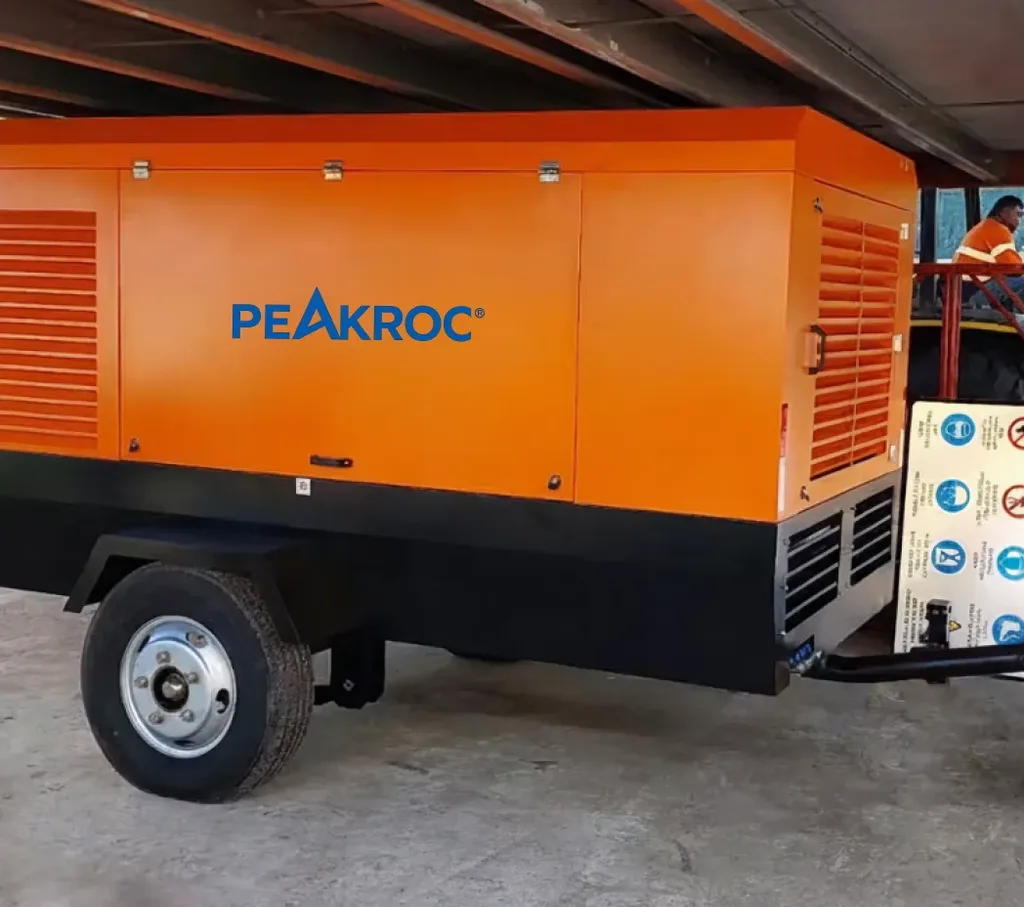
How to Calculate Diesel Compressor Fuel Consumption
The most practical fuel estimate comes from measured fuel use or the manufacturer’s engine fuel-consumption data. Where those figures are not available, a preliminary calculation can be made using engine power and Brake Specific Fuel Consumption (BSFC).
Method 1: Calculate L/h From Engine Power and BSFC
BSFC describes the mass of fuel required to produce one kilowatt of mechanical engine output for one hour. It is normally expressed in grams per kilowatt-hour (g/kWh).
The formula is:
Fuel Consumption (L/h) = Engine Output (kW) × BSFC (g/kWh) ÷ [1,000 × Diesel Density (kg/L)]
For example, assume an engine produces 100 kW of mechanical output at a particular operating point, with a BSFC of 210 g/kWh and diesel density of 0.84 kg/L.
The estimated fuel consumption is:
100 × 210 ÷ (1,000 × 0.84) = 25 L/h
This is a theoretical example rather than a published Peakroc fuel specification.
The calculation is useful because it connects fuel consumption to the actual mechanical power being produced. However, the engine’s rated maximum power should not automatically be used as its actual operating output.
BSFC also changes with engine speed and load. A compressor operating at half its rated air demand may not consume half the full-load fuel, because the diesel engine still has internal friction, auxiliary loads and other operating losses.
For accurate calculations, use the engine manufacturer’s BSFC map or compressor-package fuel-consumption curve at the relevant duty point.
Method 2: Estimate Fuel Use From Measured Operating Hours
For an existing compressor, a practical field method is to measure fuel consumption over a representative operating period.
Average Fuel Consumption (L/h) = Total Diesel Consumed (L) ÷ Engine Running Hours
Suppose a compressor consumes 168 liters during an eight-hour shift.
Its average fuel consumption is:
168 ÷ 8 = 21 L/h
This average includes both productive and nonproductive engine-running time. It does not reveal how much fuel was used during full load, part load or unloaded running, but it gives a useful baseline for comparison.
For more detailed analysis, record the loaded and unloaded hours separately and calculate the fuel used in each operating state.
Load Factor, Idle Fuel Use and Cost per Shift
Load factor is one of the most important variables in portable compressor economics, but it needs to be defined carefully.
A machine operating at 75% of rated FAD is not necessarily the same as a compressor spending 75% of its time at full load and 25% unloaded. The two patterns can produce different fuel consumption because engine speed and compressor-control behavior differ.
An example shows why this matters.
Consider an eight-hour construction shift with the following illustrative, not model-specific conditions:
| Parameter | Example Value |
|---|---|
| Shift duration | 8 hours |
| Fully loaded operation | 6 hours |
| Unloaded running | 2 hours |
| Loaded fuel consumption | 25 L/h |
| Unloaded fuel consumption | 9 L/h |
| Diesel price | $1.20/L |
The total fuel consumed is:
(6 × 25) + (2 × 9) = 168 liters
Fuel cost per shift:
168 × $1.20 = $201.60
Average fuel consumption across the shift:
168 ÷ 8 = 21 L/h
Now suppose the contractor changes the work schedule so that 1.5 hours of unnecessary unloaded running can be eliminated through shutdowns permitted by the equipment operating procedure.
The productive six-hour loaded period remains unchanged, but unloaded running falls to 0.5 hour.
Revised fuel consumption:
(6 × 25) + (0.5 × 9) = 154.5 liters
The potential saving is:
13.5 liters per shift, or $16.20 per shift.
Over 200 comparable shifts, that represents approximately 2,700 liters and $3,240 in avoided fuel purchases.
These savings are illustrative and exclude restart fuel, additional maintenance, labor changes and any productivity effects. Frequent stopping and restarting should only be considered where the manufacturer permits it and the required air supply can be maintained safely.
The broader lesson is that engine-running hours and productive operating hours are not the same thing.
What Changes Fuel Consumption on a Real Jobsite?
Several factors explain why the same compressor can consume different amounts of diesel on different projects.
- Working pressure: Increasing discharge pressure generally requires more compression work. Operating above the pressure actually needed by the tool can waste energy, although the exact fuel penalty depends on the machine and control system.
- CFM/FAD demand: A larger DTH hammer, an additional pneumatic tool or a larger blasting nozzle increases air demand. Fuel consumption must be considered against the actual FAD required at the tool.
- Load and idle behavior: Frequent unloaded running, poor equipment scheduling and excessive standby time can increase fuel consumed per productive hour.
- Altitude and temperature: Lower atmospheric density and high ambient temperature can affect diesel-engine power, cooling performance and available compressor output. The actual effect depends on the machine’s altitude and temperature ratings.
- Maintenance and air-system condition: Clogged filters, dirty coolers, air leaks, worn components and restrictive hoses can reduce useful output or make the machine operate longer to complete the same job.
These factors often interact.
For example, a DTH contractor operating at high altitude may need more operating margin because the engine and air supply perform differently from sea-level conditions. At the same time, an undersized hose may reduce the pressure reaching the hammer, slowing drilling and increasing fuel consumption per meter.
The compressor may still show an acceptable liters-per-hour figure, but the job can become more expensive because fewer meters are completed during each shift.
This is why field efficiency should be evaluated using fuel consumption together with productive output, rather than fuel consumption alone.
Field Experience & Project Lessons
The following examples are drawn from published compressor tests and project reports. They illustrate practical fuel-consumption and operating-cost principles; the reported results should not be treated as universal performance guarantees for different machines or jobsite conditions.
Field Experience 1: Same Drilling Distance, Different Fuel Consumption
A published drilling field comparison evaluated three high-pressure portable compressor configurations by recording drilling distance, operating time and total diesel consumed.
The reported results were:
| Compressor | Drilling Distance | Time | Diesel Consumed |
|---|---|---|---|
| X-Air+ 750-25 | 250 m | 6.5 h | 290 L |
| Y35 | 400 m | 8 h | 587 L |
| X-Air+ 1200-40 | 400 m | 7.5 h | 529 L |
The two machines completing 400 m provide the most directly comparable output measure. The Y35 consumed approximately 1.47 L per meter drilled, while the X-Air+ 1200-40 consumed approximately 1.32 L per meter.
The second machine completed the same drilling distance 30 minutes faster while consuming 58 fewer liters.
Experience gained: Fuel consumption per hour is not the only meaningful efficiency metric. The productive result matters. In this comparison, the machine with the lower total fuel consumption also finished sooner. The result supports measuring liters per meter drilled, while recognizing that the compressor designs and available operating pressures differed.
Field Experience 2: A Geotechnical Contractor Reports More Than 20% Fuel Savings
Cimentaciones Abando, a geotechnical drilling contractor in Spain, evaluated a replacement high-pressure compressor against equipment already used in its operations.
Before purchasing, the contractor tested the new compressor over several weeks while monitoring fuel consumption, performance, operation and maintenance access.
According to the company’s fleet manager, the trial indicated fuel savings exceeding 20% over the operating cycle, with greater savings reported under some partial-load conditions.
The contractor subsequently ordered two replacement machines.
Experience gained: Compressor efficiency should be evaluated under the contractor’s actual duty cycle rather than from a full-load brochure figure alone. A machine that frequently operates below rated capacity may benefit from better load management, while service accessibility and reliable local support can influence the overall purchasing decision.
The reported percentage is specific to the contractor’s trial and should not be assumed for other equipment comparisons.
Field Experience 3: Idle Fuel Consumption at a Remote Water-Well Site
A documented water-well drilling project in rural Spain used a high-pressure portable compressor for work in difficult terrain with limited access to refueling.
The equipment was reported to consume approximately 15–18 L/h during idle operation, while fuel consumption during the reported project operating conditions reached about 38 L/h. The manufacturer separately publishes fuel-consumption figures for defined full-FAD and partial-FAD conditions.
The project also used remote monitoring to help operators track operating status, fuel levels and maintenance requirements.
Experience gained: Unloaded or idle operation is not free. Even when useful compressed-air delivery is low, the diesel engine can consume a substantial amount of fuel. Recording operating states and avoiding unnecessary running time can therefore improve fuel planning and reduce nonproductive consumption.
It is also important not to mix fuel-consumption values from different operating points. A field-reported working rate and a catalog full-load test rate may differ because the compressor was operating at a different pressure, flow or engine setting.
Cost per Productive Unit and Total Cost of Ownership
The most useful fuel metric depends on what the compressor actually produces.
For general construction, fuel cost per operating shift may be sufficient for budgeting. For drilling, liters per meter drilled often provides a clearer comparison. In sandblasting, fuel cost per square meter of completed surface preparation may be more meaningful, provided the surface condition, blasting specification and quality requirements are comparable.
For drilling:
Fuel per Meter Drilled = Total Fuel Consumed ÷ Total Meters Drilled
Using the earlier illustrative eight-hour shift, suppose the crew completes 72 m of acceptable drilling.
The compressor consumes 168 liters during the shift.
Fuel consumption per meter becomes:
168 ÷ 72 = 2.33 L/m
At $1.20 per liter:
Fuel Cost per Meter = $2.80/m
This gives the contractor a more useful productivity measure than the average fuel rate of 21 L/h alone.
The same principle applies when evaluating compressor air delivery. Fuel consumed per cubic meter of delivered free air can be useful for comparing compression efficiency, but it requires properly defined airflow and a consistent measurement period. Simply dividing L/h by a catalog m³/min figure without accounting for time and actual output does not provide a valid liters-per-cubic-meter result.
Fuel is only one component of ownership cost.
A practical TCO calculation is:
TCO = Acquisition Cost + Fuel + Maintenance + Repairs + Operating Consumables + Transport + Downtime Costs − Residual Value
Depending on the compressor and market, consumables may include engine oil, compressor lubricant, coolant, filters and Diesel Exhaust Fluid (DEF) for engines equipped with an SCR system.
Two compressors with similar purchase prices may therefore have different lifetime costs because of their fuel consumption, repair frequency, service access, parts availability or residual value.
For example, a machine that saves a small amount of diesel every hour can provide substantial long-term savings when annual usage is high. However, a lower fuel rate has limited value if insufficient compressor capacity delays drilling or prevents the required pressure from reaching the tool.
The correct purchasing decision should compare cost per productive unit and total ownership cost, not simply purchase price or published fuel consumption.
Common Fuel-Efficiency Mistakes
- Comparing L/h at different working pressures: Fuel figures are meaningful only when FAD, pressure and test conditions are comparable.
- Assuming part-load fuel use falls linearly: A compressor delivering half its rated air does not necessarily consume half its full-load diesel.
- Ignoring idle hours: Long unloaded periods can create substantial nonproductive fuel expense.
- Oversizing for maximum theoretical demand: Excess capacity may increase fuel consumption if the machine regularly operates inefficiently at part load.
- Undersizing to minimize L/h: A smaller compressor may consume less per hour but take longer to complete the required work.
- Ignoring pressure losses and maintenance: Leaking hoses, clogged filters and inefficient air delivery can increase fuel consumed per productive task.
Practical Fuel Consumption & TCO Checklist
Before comparing portable diesel compressors, request or record:
- Rated FAD and working pressure: m³/min or CFM at the required bar/PSI.
- Engine and compressor details: Model, rated power, operating speed and compression configuration.
- Fuel consumption: Full load, relevant partial-load operating point and unloaded running where available.
- Actual duty cycle: Loaded, part-loaded, unloaded and stopped hours.
- Diesel cost: Local fuel price, delivery costs and refueling conditions.
- Site conditions: Altitude, maximum temperature, dust and other derating considerations.
- Application output: Meters drilled, blast area completed, tool hours or another productive measure.
- Operating expenses: Maintenance intervals, consumables, repairs, transport and downtime.
- Service life and resale assumptions: Expected annual hours, ownership period and residual value.
For example, a drilling contractor might request:
“We require approximately 20 m³/min FAD at 13 bar for DTH drilling. The compressor will operate at 2,000 m altitude, with ambient temperatures up to 40°C and approximately 2,500 engine-running hours annually. Please provide full-load, partial-load and unloaded fuel-consumption data, as well as recommended maintenance intervals.”
This provides a much stronger basis for comparing operating costs than asking only for the diesel consumption of a 700 CFM compressor.
Final Recommendation
Portable diesel compressor fuel consumption should be evaluated as part of a complete operating-cost calculation.
Engine power and BSFC provide a useful first estimate of fuel use, but actual consumption depends on load, pressure, speed, control behavior and environmental conditions. For accurate project budgeting, measured fuel consumption or manufacturer performance curves should take priority over generic estimates.
The most useful calculation sequence is:
Required FAD & Pressure → Actual Load Profile → Fuel Consumption → Shift Cost → Productive Output → TCO
For intermittent construction work, reducing unnecessary unloaded running may be an important opportunity. For continuous drilling, maintaining the correct pressure and airflow while improving productive output can be more valuable than simply minimizing liters per hour.
The best compressor is not necessarily the one that consumes the least diesel in an hour.
It is the compressor that completes the required work reliably at the lowest practical total cost, while delivering the required air volume and working pressure under actual site conditions.
FAQ
How many liters of diesel does a portable air compressor use per hour?
Fuel consumption varies widely with compressor size, engine design, working pressure and operating conditions. Smaller portable units may consume only several liters per hour under some conditions, while large high-pressure drilling machines can consume several dozen liters per hour. Use model-specific fuel-consumption data rather than a generic figure for the entire category.
How do I calculate diesel compressor fuel consumption from engine power?
A preliminary estimate can be calculated from engine output, BSFC and fuel density:
Fuel (L/h) = Engine Output (kW) × BSFC (g/kWh) ÷ [1,000 × Diesel Density (kg/L)]
The result should be checked against actual engine operating conditions and the manufacturer’s fuel map.
Does a compressor consume less diesel at lower pressure?
Generally, lower discharge pressure reduces compression work when all other relevant conditions are comparable. However, actual fuel savings depend on compressor controls, efficiency and load. Working pressure should not be reduced below the tool’s required pressure.
Does 50% compressor load mean 50% fuel consumption?
No. Engine and compressor efficiency change with operating point, and unloaded running still consumes fuel. The fuel-versus-load relationship should be taken from the specific compressor’s performance data.
How do I calculate diesel cost per shift?
Multiply fuel consumed during each operating state by its duration, add the results and multiply by the diesel price. For accurate results, account separately for loaded, part-loaded and unloaded running.
Is a smaller diesel air compressor always cheaper to operate?
Not necessarily. A smaller machine may consume less fuel per hour but lack the airflow or pressure needed to complete the job efficiently. Compare fuel cost against productive output, operating time and overall TCO.
What is the best fuel-efficiency metric for DTH drilling?
Liters per meter drilled is often one of the most useful field measures, provided the drilling conditions, hole diameter, geology and work quality are comparable. It connects fuel consumption directly with useful production.
What should be included in portable compressor TCO?
TCO should include acquisition, fuel, maintenance, repairs, consumables, transport, downtime and residual value. The appropriate comparison period should reflect the expected ownership life and operating hours.
Author

Mark Chen – Senior Mechanical Engineer, Peakroc®
Mark Chen is a senior mechanical engineer at Peakroc®, specializing in compressed air systems and drilling equipment for mining and construction applications. With over 15 years of field experience, he has led multiple projects on optimizing air delivery efficiency, equipment durability, and energy consumption.