
Key Takeaways
- 1100–1200 CFM equals approximately 31–34 m³/min, but airflow alone does not determine whether a compressor is suitable for a project.
- A 1200 CFM compressor working at 10 bar serves a very different application from a 1200 CFM unit working at 25, 35, or 40 bar.
- Mining, DTH drilling, water-well drilling, geothermal drilling, and pipeline work require different combinations of airflow, working pressure, cooling capacity, and air treatment.
- Buyers should compare FAD at the required pressure, not theoretical displacement or maximum pressure shown without airflow data.
- Fuel consumption should be evaluated by cost per productive hour, meter drilled, borehole completed, or pipeline section processed—not only liters per hour.
- Hose diameter, elevation, ambient temperature, groundwater, hole diameter, hammer size, and maintenance support can materially change the required compressor capacity.
The 1100–1200 CFM class sits near the upper end of many portable diesel compressor fleets. These machines are selected when a smaller compressor cannot provide enough flushing air, hammer energy, continuous pipeline airflow, or production capacity.
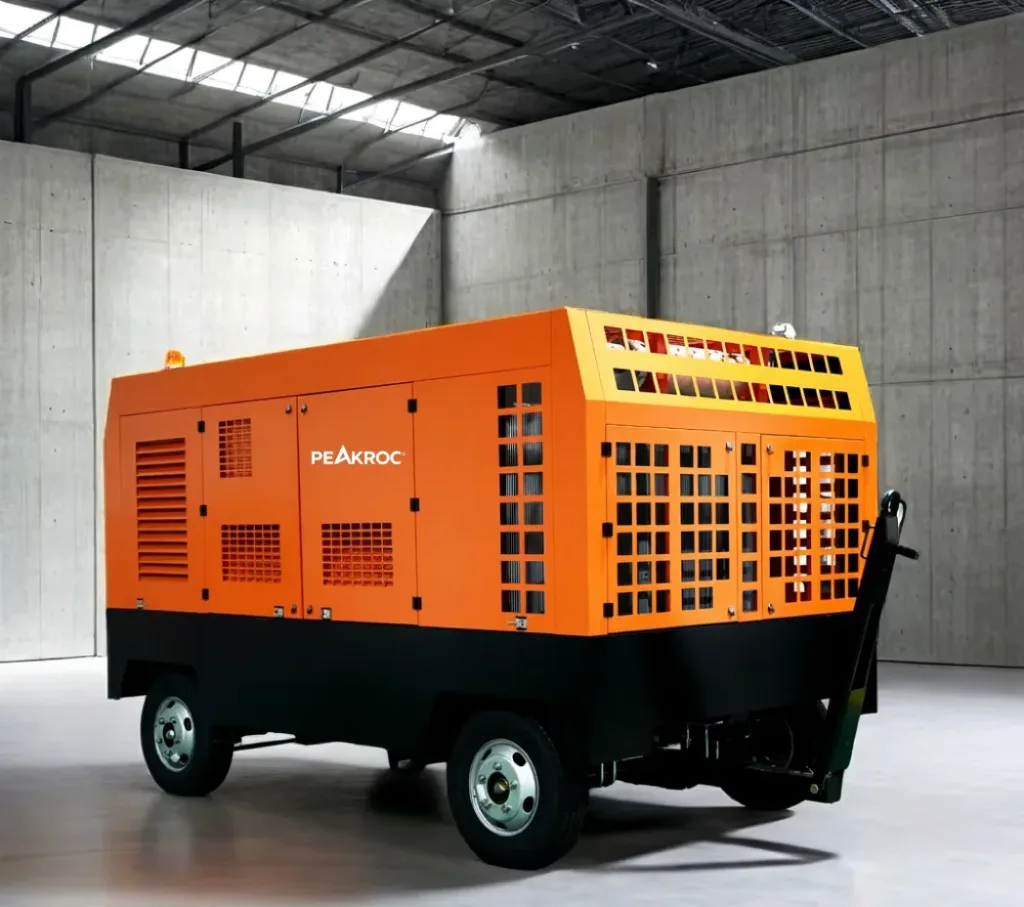
Peakroc® offers several related portable diesel screw compressor solutions, including a 32 m³/min, 10 bar compressor for mining and large drilling projects, a 34 m³/min, 25 bar high-pressure drilling compressor, and a 33 m³/min, 35 bar compressor for deep drilling.
The important point is not to begin with a model. Begin with the application.
What Is a 1100–1200 CFM Portable Compressor?
A 1100–1200 CFM portable compressor is a large mobile air compressor capable of delivering approximately:
| Imperial capacity | Metric capacity |
|---|---|
| 1100 CFM | 31.1 m³/min |
| 1150 CFM | 32.6 m³/min |
| 1170 CFM | 33.1 m³/min |
| 1200 CFM | 34.0 m³/min |
CFM should normally refer to Free Air Delivery, or FAD, under stated reference conditions. CAGI defines FAD as air delivered at the compressor outlet and referenced to ambient inlet conditions. Therefore, capacity comparisons should include both the measurement standard and the rated pressure.
A compressor described only as “1200 CFM” is not sufficiently specified.
The buyer still needs to know:
- 1200 CFM at what working pressure?
- Is that flow guaranteed as FAD?
- Is the compressor single-stage or two-stage?
- What happens to airflow when pressure increases?
- What is the allowable ambient temperature?
- How is output derated at high elevation?
- Is the airflow continuous or available only as a temporary boost?
Current commercial products show how wide the specification range can be. Doosan lists large portable units at 1150 CFM and 21.7 bar, 1170 CFM and 25.1 bar, and 1200 CFM at approximately 22–23 bar. Sullair publishes a 1150 CFM configuration at 350 psi, or approximately 24.1 bar.
Atlas Copco’s wider DrillAir range covers 19–44 m³/min and 13–40 bar, illustrating that large-flow drilling compressors can be configured for significantly different pressure requirements.
Why Pressure Is as Important as CFM
Airflow clears cuttings, carries debris out of the borehole, supplies pneumatic tools, and maintains velocity through hoses or pipelines.
Pressure performs a different function. In DTH drilling, it supports hammer operation and must overcome:
- Hammer working resistance
- Borehole back pressure
- Water column pressure
- Hose and pipe losses
- Depth-related restrictions
- Pressure losses through valves and manifolds
More airflow cannot always compensate for insufficient pressure. Similarly, excessive pressure does not solve a lack of flushing volume.
A 32 m³/min compressor at 10 bar can be well suited to large pneumatic tools, quarry work, air flushing, certain pipeline operations, and lower-pressure drilling. It is not automatically suitable for a deep water well using a high-pressure DTH hammer.
A 34 m³/min compressor at 25 bar is aimed at a different duty point. It can support deeper DTH work, larger hammers, stronger groundwater conditions, and applications where the pressure available at the hammer must remain substantially above a typical construction-air level.
General Selection Direction
The following ranges are application directions, not universal design rules:
| Application | Airflow priority | Pressure direction |
|---|---|---|
| Large pneumatic tools and industrial cleaning | High continuous flow | Commonly lower or medium pressure |
| Quarry air flushing and production support | High flow | Depends on drill and tool |
| Blast-hole DTH drilling | High flow and stable pressure | Medium to high pressure |
| Deep water-well drilling | High flow and high pressure | Often 20 bar and above |
| Geothermal drilling | Stable high flow and pressure | Often high-pressure duty |
| Pipeline blowing or drying | High sustained flow | Project-specific pressure |
| Deep hard-rock drilling | High flow, high pressure, strong cooling | May require 25–35 bar or more |
Actual selection must come from the drill rig, hammer, hole diameter, drilling depth, formation, water conditions, and project procedure.
Mining and Quarry Applications
Large mines and quarries use compressed air for more than one task. A 1100–1200 CFM compressor may support drilling, secondary cleaning, dewatering assistance, equipment maintenance, pneumatic tools, pipeline purging, or temporary plant air.
Blast-Hole and DTH Drilling
For DTH drilling, the compressor must supply enough pressure to operate the hammer and enough airflow to evacuate cuttings.
Insufficient airflow can cause:
- Poor hole cleaning
- Regrinding of cuttings
- Reduced penetration rate
- Increased bit and hammer wear
- Higher risk of tool sticking
- Longer compressor operating time
Insufficient pressure can reduce hammer impact energy, particularly as depth, back pressure, or groundwater increases.
Atlas Copco positions its DrillAir range for ground engineering, drill-and-blast, water-well, and geothermal drilling. It also promotes temporary additional airflow during flushing and drill-stem refill, showing that drilling productivity depends on different phases of the cycle rather than one static airflow number.
Open-Pit Mine Support
A 1100–1200 CFM unit can also provide temporary compressed air when a mine’s main system is unavailable or when work moves beyond the fixed air network.
In this role, selection should consider:
- Number and type of simultaneous tools
- Required pressure at the farthest outlet
- Total hose or pipe length
- Dust concentration
- Refueling logistics
- Shift length and expected load factor
- Mobility between work areas
For a mine that primarily needs high-flow air at approximately 10 bar, a lower-pressure 32 m³/min configuration can be more economical than purchasing a 25- or 35-bar drilling compressor and operating it far below its intended duty point.
Pipeline Blowing, Drying, and Service Work
High-flow portable compressors are commonly considered for pipeline construction and maintenance because large internal pipe volumes require sustained airflow.
Potential uses include:
- Removing loose debris
- Air blowing after fabrication
- Drying after hydrostatic operations
- Supporting cleaning or pigging procedures
- Supplying temporary pneumatic equipment
- Providing controlled air for project-specific testing procedures
The compressor should not be selected by pipeline diameter alone. Pipe length, target air velocity, allowable pressure, required dryness, elevation profile, fittings, discharge method, and completion time all influence the requirement.
Air Quality Matters
Pipeline work may require more than raw compressor output.
Depending on the project, the air package may need:
- Aftercooler
- Water separator
- Coalescing filtration
- Desiccant dryer
- Condensate management
- Dew-point monitoring
For drying duty, a high CFM rating without moisture control may extend the job rather than shorten it. Warm, moisture-laden air can introduce additional water into a line if the compressor package and downstream treatment are not designed correctly.
Pneumatic pressure testing also contains substantial stored-energy risk. Pressure, exclusion zones, test media, inspection procedures, and allowable methods must be determined by the project engineer and applicable code. A portable compressor should never be selected as the only basis for defining a pressure-test procedure.
DTH and Large-Diameter Drilling
The 1100–1200 CFM class becomes relevant when the DTH hammer, hole diameter, depth, or formation demands more air than a 600–850 CFM machine can reliably deliver.
Hammer Size and Air Consumption
Every DTH hammer has a recommended pressure and airflow range. The compressor should be matched to the manufacturer’s consumption data at operating pressure.
The sizing process should include:
- Hammer airflow at target pressure
- Flushing reserve for cuttings
- Hose and manifold pressure loss
- Altitude and temperature derating
- Leakage and connection losses
- A reasonable operating margin
Avoid choosing an excessive margin without a reason. Oversizing increases capital cost, transportation weight, fuel consumption at partial load, and maintenance expense.
Drilling Depth and Water Column
As a borehole becomes deeper, the air path becomes longer and pressure losses increase. Groundwater can create additional back pressure and increase the air demand required to keep the hole clean.
A compressor that performs well in a dry 100-meter borehole may behave differently in a deep, water-producing formation.
Field information should therefore include:
- Final drilling depth
- Casing diameter
- Open-hole diameter
- Hammer model
- Drill-pipe internal diameter
- Expected water conditions
- Formation hardness
- Site elevation
Atlas Copco reports a water-well application in which an X-Air⁺ 1200-25 was used for drilling beyond 2,000 feet. The manufacturer’s customer example also reports a drilling rate of 85–90 feet per hour and a claimed fuel reduction of approximately 10 liters per hour for that particular project. These figures are a case-specific manufacturer report, not a universal performance guarantee, but they illustrate why productivity and fuel must be evaluated across the complete drilling cycle.
Water-Well and Geothermal Drilling
Water-well and geothermal drilling are among the most demanding applications for high-flow portable diesel screw compressors.
Both may involve:
- Deep boreholes
- Long operating shifts
- High-pressure DTH hammers
- Hard or fractured formations
- Groundwater inflow
- Remote operating locations
- Limited access to spare parts
Doosan identifies its 1170 CFM, 25.1 bar compressor for geothermal, water-well, and shallow oil-and-gas drilling. Its wider regional range also includes 1150–1200 CFM machines at approximately 21.7–23.1 bar.
This confirms an important selection principle: 1100–1200 CFM is a capacity class, not one fixed pressure class.
A contractor drilling relatively shallow, large-diameter holes may need greater flushing volume but moderate pressure. A deep hard-rock water well may require both high flow and 25 bar or more. Geothermal drilling may justify an even broader pressure range, especially where one compressor must handle overburden and deeper rock sections.
How to Size a 1100–1200 CFM Compressor
Step 1: Confirm Required FAD
Obtain the airflow requirement from the hammer, rig, pneumatic tool, or pipeline calculation.
Do not use theoretical compressor displacement. Request FAD at the intended working pressure.
Step 2: Establish Pressure at the Tool
The compressor outlet pressure is not the same as pressure at the hammer or nozzle.
Account for:
- Hose length
- Hose internal diameter
- Couplings
- Check valves
- Manifolds
- Air treatment
- Elevation changes
- Borehole back pressure
If 25 bar is needed at the hammer, a compressor producing exactly 25 bar at its outlet may not be sufficient.
Step 3: Correct for Site Conditions
High elevation reduces air density and engine output. High ambient temperature increases the cooling load and can reduce available performance.
The supplier should confirm:
- Maximum ambient operating temperature
- Altitude derating curve
- Engine derating
- Cooling-system design
- Dust-protection package
- Cold-start options where applicable
Step 4: Review the Duty Cycle
A compressor used for continuous drilling should be evaluated differently from one used intermittently for pipeline blowing.
Ask how many hours per shift the machine will operate:
- Fully loaded
- Partially loaded
- Unloaded
- Idling during rod changes or setup
This data is necessary for fuel-cost and thermal-load calculations.
Single-Stage vs Two-Stage Compression
Large portable compressors may use single-stage or two-stage screw compression, depending on the target pressure.
Single-stage compression is commonly used where the required pressure remains moderate. It can offer simpler packaging and lower initial cost.
Two-stage compression is often preferred for high-pressure applications because the total pressure ratio is divided between stages. This can improve discharge-temperature management and efficiency at demanding pressure points.
However, stage count should not be treated as a marketing shortcut. Buyers should compare:
- Guaranteed FAD
- Fuel consumption
- Outlet temperature
- Compressor speed
- Cooling capacity
- Maintenance requirements
- Performance at the actual duty point
A well-designed single-stage machine at a moderate pressure can be more appropriate than an unnecessarily complex two-stage unit. At 25–35 bar, two-stage technology commonly becomes more relevant.
Fuel Efficiency and Cost per Productive Unit
Fuel consumption in liters per hour is important, but it is not the only measure of efficiency.
The more useful calculations are:
Fuel cost per shift =
Average fuel consumption × Loaded operating hours × Diesel price
Compressor cost per meter drilled =
Fuel + maintenance + ownership + downtime cost
÷
Meters drilledA machine using less fuel per hour can still cost more per meter if its airflow or pressure reduces penetration and extends drilling time.
Conversely, a larger compressor may use more fuel each hour but complete the hole sooner.
Sullair publishes full-load consumption figures of roughly 91–93 liters per hour for its 900/1150 CFM high-pressure series and claims lower part-load and overall fuel consumption than the preceding models. These figures are model-specific, but they show why buyers should request both full-load and partial-load data.
Atlas Copco similarly reports that its X-Air⁺ 1200-40 pressure-optimization system lowers pressure during no-air periods and claims an average 11% fuel saving over the complete drill cycle compared with its stated reference machine. Again, this is a manufacturer comparison, but the operating principle is relevant: unloading strategy and pressure control matter during rod handling and other non-drilling periods.
Engine, Cooling, and Fuel-System Selection
A 1100–1200 CFM compressor requires a large industrial diesel engine. Engine power should be matched to the required airflow and pressure rather than chosen by brand name alone.
Buyers should evaluate:
- Engine model and rated power
- Emissions stage
- Local dealer and parts availability
- Fuel quality tolerance
- Cooling-system capacity
- Fuel-filter and water-separator design
- Service interval
- Electronic diagnostic support
A well-known engine can simplify service, but the compressor airend, controller, regulating valves, cooler, separator vessel, and wiring remain equally important.
Hot and Dusty Sites
Mining and drilling locations frequently combine high dust with high ambient temperatures.
The package should provide:
- Easy-to-clean coolers
- Heavy-duty air filtration
- Adequate air-intake separation
- High-temperature shutdown protection
- Accessible daily-service points
- Sufficient space around coolers and fan systems
Blocked coolers or filters increase temperature, restriction, fuel use, and shutdown risk.
Trailer, Skid, or Truck-Mounted Configuration
The correct chassis depends on how the compressor moves and operates.
| Configuration | Best suited to |
|---|---|
| Highway-towable trailer | Frequent road transport where legally certified |
| Site trailer | Movement within mines, quarries, and construction areas |
| Skid-mounted | Permanent or semi-permanent project installation |
| Truck-mounted | Water-well and drilling contractors moving as one package |
| Support-mounted | OEM integration or custom transport platform |
A 1200 CFM compressor is a substantial machine. Before ordering, confirm:
- Wet operating weight
- Lifting points
- Transport dimensions
- Axle and tire rating
- Towing approval
- Ground clearance
- Fuel-tank capacity
- Access for service doors
A compact package can reduce logistics cost, but serviceability should not be sacrificed to achieve a smaller footprint.
Peakroc® Product Direction
Peakroc’s current published range includes several machines near or above the 1100–1200 CFM class. The correct choice depends mainly on pressure.
| Nominal Peakroc® option | Approximate capacity | Application direction |
|---|---|---|
| 32 m³/min at 10 bar | About 1,130 CFM | Mining support, quarry work, large lower-pressure drilling and industrial air |
| 34 m³/min at 25 bar | About 1,200 CFM | DTH drilling, deeper water wells and high-pressure drilling |
| 33 m³/min at 35 bar | About 1,165 CFM | Deep hard-rock, high-pressure and demanding drilling |
| 39 m³/min at 25 bar | About 1,375 CFM | Larger hammer, deeper borehole or additional airflow reserve |
These options are listed in the current Peakroc product sitemap.
A 32 m³/min, 10 bar machine should not be presented as equivalent to a 34 m³/min, 25 bar machine simply because both are close to 1200 CFM. The engine power, airend design, compression stages, operating cost, weight, and target tools will be very different.
Use the compressor selection service when the project requirement is not yet fully defined.
Maintenance Planning for Remote Projects
Large compressors should be supplied with a maintenance plan before arriving on site.
A recommended initial spare package normally includes:
- Engine oil and fuel filters
- Air-intake filters and safety elements
- Compressor oil filters
- Air-oil separator elements
- Compressor lubricant
- Belts and hoses
- Pressure and temperature sensors
- Solenoid and regulating-valve service parts
Maintenance frequency must reflect the environment. Dusty drilling and mining sites may require air-filter inspection and cooler cleaning more frequently than the standard calendar schedule.
Daily records should include:
- Engine and compressor oil levels
- Coolant level
- Fuel contamination
- Air-filter restriction
- Discharge temperature
- Operating pressure
- Hose or connection leaks
- Warning and shutdown history
Common Selection Mistakes
Choosing by CFM Alone
A 1200 CFM, 10 bar unit and a 1200 CFM, 25 bar unit are not interchangeable.
Ignoring FAD
Compare verified air delivery at rated pressure, not compressor displacement.
Selecting Excessive Pressure
Running a high-pressure compressor for a low-pressure task can increase purchase price and operating cost.
Ignoring Hose Loss
An undersized discharge hose can waste the capacity of an otherwise correctly selected compressor.
Forgetting Altitude and Temperature
Catalog performance at standard conditions may not represent a high-altitude mine or hot desert drilling site.
Buying Without Spare Parts
A low-cost filter or sensor can stop a high-value drilling project if it is unavailable locally.
Practical Buying Checklist
Before requesting a final quotation, provide the supplier with:
- Application and operating method
- Required FAD in CFM or m³/min
- Required pressure at the tool
- Drill rig and DTH hammer model
- Hole diameter and maximum depth
- Rock formation and groundwater conditions
- Pipeline diameter and length where applicable
- Site elevation and temperature range
- Hose diameter and total length
- Operating hours per shift
- Required emissions standard
- Trailer, skid, or truck-mounted preference
- Delivery country, port, or final address
- Required startup and two-year spare-parts package
The supplier should then confirm rated FAD, normal working pressure, full- and partial-load fuel use, engine model, compressor stages, ambient rating, service intervals, included options, warranty, and delivery schedule.
Final Recommendation
A 1100–1200 CFM portable diesel screw air compressor is appropriate when the project requires sustained high airflow that smaller machines cannot provide.
It is commonly considered for large drilling projects, mining and quarry production, pipeline blowing and drying, deep water wells, geothermal drilling, and high-pressure DTH applications. However, the CFM class does not define the application by itself.
The final decision must match:
- FAD at the required pressure
- DTH hammer or tool demand
- Hole diameter and depth
- Water and formation conditions
- Pipeline volume and air-quality requirement
- Elevation and ambient temperature
- Fuel cost and duty cycle
- Transport and maintenance support
For lower-pressure high-volume work, a 32 m³/min, 10 bar compressor may be appropriate. For deeper DTH or water-well drilling, 34 m³/min at 25 bar may be a better direction. For demanding deep-rock applications, a 33 m³/min, 35 bar unit may be justified.
The right compressor is not the machine with the largest number on the data sheet. It is the machine that delivers the required air at the tool while producing the lowest cost per productive hour or meter drilled.
FAQ
What is a 1100–1200 CFM portable air compressor?
It is a large portable compressor delivering approximately 31–34 m³/min of free air. Depending on its design, it may operate at low, medium, or high pressure for mining, pipeline, construction, and drilling applications.
Is 1200 CFM enough for DTH drilling?
It may be sufficient, but the answer depends on the DTH hammer, required pressure, hole diameter, depth, groundwater, pipe size, and site elevation. Hammer airflow data must be checked before selecting the compressor.
What pressure should a 1200 CFM drilling compressor provide?
There is no single correct pressure. Lower-pressure projects may use approximately 10–14 bar, while deep water-well and DTH drilling may require 20–25 bar or more. Difficult deep-rock projects may require 30–35 bar.
What is the difference between 1200 CFM at 10 bar and 1200 CFM at 25 bar?
Both provide similar nominal airflow, but the 25 bar machine requires substantially more engine power and a different compression system. It is designed to overcome greater drilling resistance and borehole back pressure.
Can a 1200 CFM compressor be used for pipeline drying?
Yes, high airflow can be useful for pipeline blowing and drying, but the complete package must be selected according to pipeline volume, target velocity, allowable pressure, moisture level, dryer capacity, and project procedure.
Is a two-stage compressor better for 1200 CFM high-pressure drilling?
Two-stage compression is often advantageous at high pressure because it divides the compression ratio and can improve temperature control and efficiency. The decision should still be based on verified FAD, fuel consumption, reliability, and maintenance requirements.
How much fuel does a 1200 CFM diesel compressor use?
Consumption varies significantly with pressure, engine, load factor, altitude, and compressor design. Buyers should request fuel consumption at full load, partial load, and unloaded operation rather than relying on one general estimate.
What information is needed to select a Peakroc® 1100–1200 CFM compressor?
Provide the application, required flow and pressure, rig and hammer model, hole diameter, maximum depth, rock and water conditions, site altitude, ambient temperature, hose size, operating hours, chassis preference, and delivery location.
Author

Mark Chen – Senior Mechanical Engineer, Peakroc®
Mark Chen is a senior mechanical engineer at Peakroc®, specializing in compressed air systems and drilling equipment for mining and construction applications. With over 15 years of field experience, he has led multiple projects on optimizing air delivery efficiency, equipment durability, and energy consumption.