
Key Takeaways
- CFM and m³/min are airflow units, while FAD, SCFM and ACFM describe the basis or conditions behind the airflow value. If you are new to portable compressor sizing, the Portable Diesel Air Compressor Buyer’s Guide explains why airflow and working pressure must always be considered together.
- For portable compressor comparison, FAD at the required working pressure is usually much more useful than a bare CFM number. The 10–15 Bar Medium-Pressure Portable Air Compressor Guide shows why similar pressure ratings can still represent very different compressor capacities.
- A high CFM number does not define the application by itself. A 1,200 CFM compressor at 10 bar serves a very different duty from a 1,200 CFM compressor at 25 bar. The 1100–1200 CFM High-Flow Portable Compressor Guide explains this relationship in practical drilling, mining and pipeline applications.
- Unit conversion does not convert reference conditions.
1 m³/min ≈ 35.31 CFM, but converting 20 m³/min to approximately 706 CFM does not tell you whether the figure is FAD, SCFM, ACFM or theoretical displacement. - Altitude, temperature, hose loss and point-of-use pressure can all affect real field performance. The Compressed Air System Design Guide explains why compressor capacity and the air-delivery system should be considered together.
Portable compressor specifications often look simple:
20 m³/min @ 13 bar
or:
710 CFM @ 189 PSI
But when quotations from several suppliers are placed side by side, additional terms start appearing:
CFM, FAD, SCFM, ACFM, m³/min
They are often treated as if they were five competing measurements of compressor capacity. That is not quite correct.
The easiest way to understand them is to separate units from rating conditions.
CFM and m³/min tell you how much volume moves per unit time.
FAD, SCFM and ACFM help explain what conditions that volume represents.
This distinction matters because air density changes with pressure, temperature, humidity and altitude. Therefore, two specifications showing the same numerical airflow may not represent the same amount of usable air unless their rating basis is comparable.
For portable compressor buyers, a better question than:
“How many CFM is this compressor?”
is:
“What FAD does it deliver at my required working pressure, and under what rating conditions?”
CFM, FAD, SCFM, ACFM and m³/min: The Basic Difference
The terminology becomes much easier when organized in one table.
| Term | Meaning | Practical Use |
|---|---|---|
| CFM | Cubic feet per minute | Imperial unit of volumetric airflow |
| m³/min | Cubic meters per minute | Metric unit of volumetric airflow |
| FAD | Free Air Delivery | Delivered compressor capacity referred back to defined free-air conditions |
| ACFM | Actual cubic feet per minute | Airflow expressed at stated actual conditions |
| SCFM | Standard cubic feet per minute | Airflow converted to specified standard conditions |
The first important lesson is:
CFM alone is only a volume-flow unit.
A quotation saying:
700 CFM
does not tell you enough.
A more useful specification is:
700 CFM FAD @ 13 bar
because it tells you both how much usable airflow the compressor delivers and at what working pressure.
If the manufacturer also states the measurement standard and reference conditions, the specification becomes much easier to compare with another supplier.
CFM vs m³/min: Converting the Unit
This is the simplest part.
The commonly used conversion is:
1 m³/min ≈ 35.31 CFM
and:
1 CFM ≈ 0.02832 m³/min
A few useful examples are:
| m³/min | Approx. CFM |
|---|---|
| 5 | 177 |
| 10 | 353 |
| 15 | 530 |
| 20 | 706 |
| 25 | 883 |
| 30 | 1,059 |
| 34 | 1,201 |
| 45 | 1,589 |
Manufacturers may round these figures for product naming. A 20 m³/min compressor might therefore be described as approximately 700 CFM or 710 CFM.
That small difference is normally not the problem.
The real mistake is assuming that converting the unit also changes the rating basis.
For example:
20 m³/min FAD ≈ 706 CFM FAD
is a valid unit conversion.
But:
20 m³/min ACFM = 706 SCFM
cannot be assumed without knowing the actual and standard conditions.
The conversion changes the unit, not the physical reference conditions behind the airflow.
Why FAD Is Important for Portable Compressor Buyers
A rotary screw compressor does not deliver exactly the theoretical geometric displacement of its airend.
Real compressor output is influenced by internal leakage, pressure ratio, temperature, rotational speed, package design and operating conditions.
This is why delivered capacity matters more than theoretical displacement.
FAD represents the compressor’s actual delivered airflow expressed back to defined free-air conditions. When measured under a recognized method, it gives buyers a much more useful way to compare compressor packages.
This distinction is particularly important with portable compressors.
Suppose one quotation states:
20 m³/min theoretical displacement
while another states:
20 m³/min FAD
Those two numbers should not automatically be treated as equal.
The second supplier is describing delivered package output. The first may only be describing theoretical airend capacity unless further information is provided.
For procurement, the preferred question is:
What is the guaranteed FAD of the complete compressor package?
FAD Must Always Be Read Together With Working Pressure
Even FAD alone is incomplete.
The same compressor platform may provide different airflow at different pressure settings because compressing air to a higher pressure requires more work.
A published high-flow portable compressor specification provides a useful real-world example:
| Working Pressure | Published FAD |
|---|---|
| 100 PSI | 1,764 CFM |
| 150 PSI | 1,618 CFM |
| 200 PSI | 1,363 CFM |
| 225 PSI | 1,205 CFM |
The same compressor platform therefore does not have one universal “CFM rating.”
At approximately 100 PSI it can deliver substantially more air than at 225 PSI.
This is why describing a machine simply as:
“a 1,700 CFM compressor”
can be misleading.
The more meaningful description is:
FAD at the required operating pressure.
This is especially important for drilling compressors, where the same general machine size may be offered in different pressure classes.
A contractor needing 1,200 CFM at 25 bar cannot simply choose another compressor because its brochure says 1,300 CFM at 10 bar.
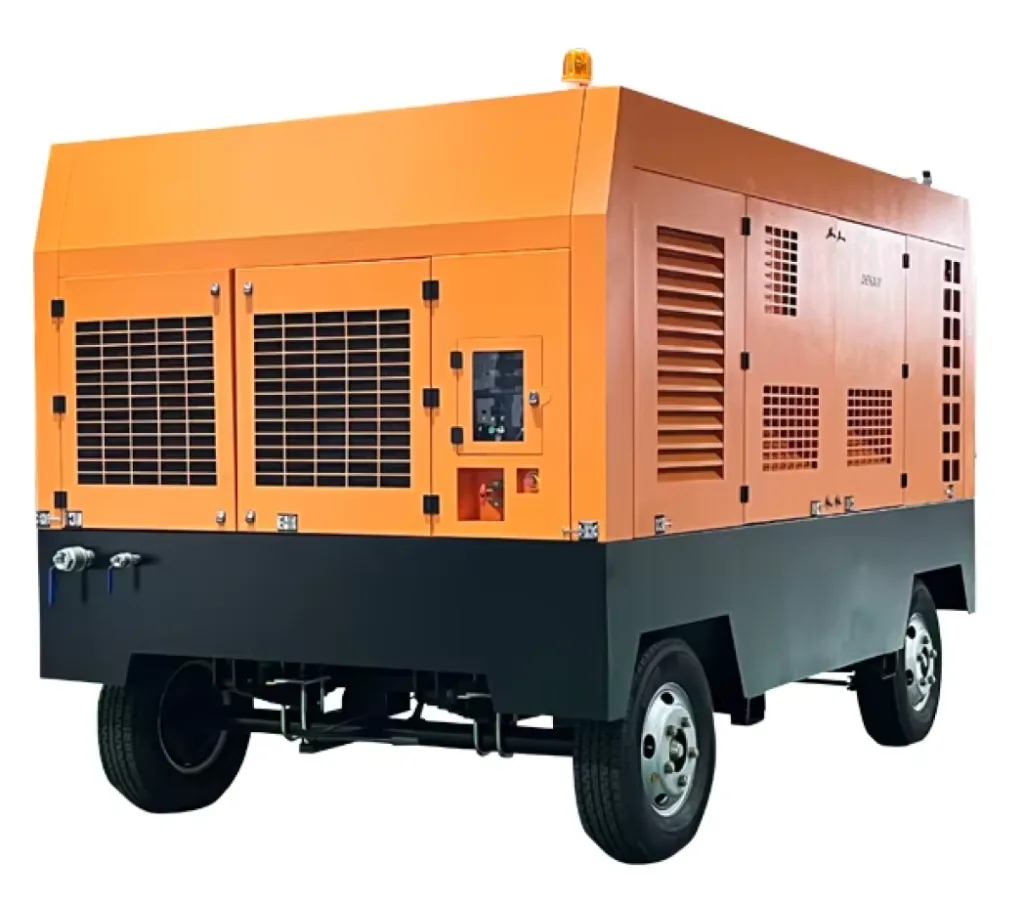
Both the airflow and pressure requirement must be met simultaneously.
What Does SCFM Mean?
SCFM means:
Standard Cubic Feet per Minute
The purpose is to express airflow after converting it to a defined set of standard pressure and temperature conditions.
This sounds straightforward, but there is an important detail:
Not every document uses exactly the same “standard” conditions.
Industry specifications may use slightly different standard temperatures, pressures and humidity assumptions.
Examples seen in compressed-air engineering include reference temperatures around:
60°F
68°F
or:
70°F
with specified atmospheric pressure and humidity.
Metric documents can likewise use several different “normal” conditions for Nm³/h or Nm³/min.
Therefore:
1,000 SCFM
is much more useful when the supplier also states the standard conditions used to calculate that number.
For normal portable compressor purchasing, FAD at working pressure is often easier to use. SCFM becomes particularly useful when the customer’s process-air requirement is already specified on a standardized mass-equivalent basis.
What Does ACFM Mean?
ACFM means:
Actual Cubic Feet per Minute
It describes airflow based on actual conditions at the stated reference point.
Those conditions matter because air density changes.
Consider air at:
sea level, 20°C
and the same mass of air at:
a high-altitude, hot mine site.
The second condition contains less dense air.
Therefore, a larger actual volume must be handled to provide the same mass of air.
ACFM becomes useful when engineering calculations need to account for:
site altitude
ambient temperature
humidity
and:
actual inlet conditions.
The critical rule is:
Never use an ACFM value without knowing the conditions attached to it.
An actual airflow number without temperature and pressure context is incomplete.
Real Example: Why 1,000 SCFM Can Become More Than 1,300 ACFM
A published compressed-air sizing example demonstrates this clearly.
The required process airflow is:
1,000 SCFM
The jobsite conditions are approximately:
5,000 ft elevation
100°F maximum ambient temperature
50% relative humidity
After correcting for lower atmospheric pressure, higher temperature and moisture conditions, the calculated requirement becomes approximately:
1,311 ACFM
The process did not suddenly begin consuming 31% more air mass.
Instead, the ambient air became less dense.
A larger actual volume of air is required to provide the same standardized amount.
This is one of the most useful concepts for portable compressor buyers working at high-altitude mines, quarries or drilling sites.
A catalogue airflow rating should never be applied blindly to a difficult high-altitude environment.
How Altitude Affects Portable Compressor Selection
Atmospheric pressure decreases with altitude.
That means the compressor begins with lower-density inlet air.
For a diesel portable compressor, altitude may affect more than the compressor element. The engine also receives less oxygen, which can reduce available engine power unless the engine and control system compensate within their designed altitude range.
Cooling conditions can change as well.
For this reason, compressor selection for a high-altitude project should include:
site elevation
required FAD
working pressure
engine altitude capability
ambient temperature
and:
manufacturer derating data
rather than applying a universal percentage correction to every machine.
A compressor designed and calibrated for high-altitude operation may behave differently from another machine with the same nominal sea-level specification.
Temperature Changes Air Density Too
Altitude is not the only environmental factor.
Hot air is less dense than cold air.
A portable compressor may therefore experience very different intake conditions at:
10°C
compared with:
45°C
even at the same location.
High ambient temperature also places more load on:
engine cooling
compressor oil cooling
aftercooling
and:
electrical or control components.
This is why a serious RFQ should give the supplier the project’s maximum expected ambient temperature, not only the annual average.
The compressor needs to perform during the difficult afternoon shift—not only during ideal test conditions.
FAD vs SCFM vs ACFM: Which One Should You Use?
The terms do not need to compete with one another. They answer different questions.
| Situation | Most Useful Specification |
|---|---|
| Comparing portable compressor output | FAD at working pressure |
| Specifying standardized process demand | SCFM |
| Correcting for actual site conditions | ACFM |
| Comparing international product capacity | m³/min or CFM with rating basis stated |
| Converting metric and imperial units | m³/min ↔ CFM |
For most portable compressor inquiries, something like:
Required FAD: 20 m³/min at 13 bar
is much more useful than:
Need 700 CFM.
It becomes even better when the buyer adds:
Altitude: 2,000 m
Maximum ambient temperature: 42°C
Now the supplier can evaluate both rated compressor capacity and actual project conditions.
How to Compare Two Compressor Specifications
Before deciding that one compressor has more capacity than another, put both specifications on the same basis.
| What to Compare | What to Check |
|---|---|
| Airflow | CFM or m³/min |
| Rating basis | FAD, SCFM, ACFM, inlet flow or displacement |
| Working pressure | bar / PSI at the quoted airflow |
| Measurement method | Recognized compressor performance standard |
| Reference conditions | Temperature, pressure and humidity |
| Altitude suitability | Maximum project elevation |
| Temperature suitability | Maximum ambient temperature |
| Package output | Complete compressor rather than theoretical airend displacement |
| Options | Whether coolers, filters or other equipment affect net delivery |
This comparison becomes particularly important with large drilling compressors.
A quotation may show:
1,200 CFM @ 25 bar
while another shows:
1,300 CFM
If the second supplier does not state pressure or rating basis, the larger number does not prove that the second machine is more capable.
The specifications are not yet comparable.
Common Mistakes When Comparing Airflow
Several errors appear repeatedly when compressor quotations are compared:
- Treating CFM and FAD as identical terms. CFM is a unit; FAD describes delivered compressor capacity on a defined basis.
- Assuming all SCFM values use identical standard conditions. Confirm the reference pressure, temperature and humidity.
- Converting m³/min to CFM and assuming the rating basis has also changed. Only the unit changes.
- Comparing airflow at different working pressures. Always compare FAD at the pressure required by the application.
- Using theoretical displacement as delivered airflow. Request package FAD.
- Ignoring altitude and temperature. Field conditions can materially change compressor suitability.
- Choosing the highest CFM number without checking the tool requirement. More airflow at the wrong pressure does not solve the application.
Practical RFQ Checklist
For a portable air compressor quotation, provide:
- Required airflow: CFM or m³/min.
- Preferred airflow basis: FAD where available.
- Working pressure: bar or PSI.
- Application: DTH drilling, construction, sandblasting, pipeline, tunneling or another process.
- Tool details: Hammer, nozzle or pneumatic equipment model.
- Simultaneous users: Number of tools operating at the same time.
- Site altitude: meters or feet above sea level.
- Maximum ambient temperature: expected project maximum.
- Humidity or unusual environment: if relevant.
- Duty cycle: continuous or intermittent.
- Air treatment: aftercooler, moisture separator, filters or dryer if required.
- Hose length and diameter: especially for high-flow field applications.
A good RFQ might read:
We require approximately 20 m³/min FAD at 13 bar for DTH drilling. The site elevation is 2,000 m, maximum ambient temperature is 40°C, and the compressor-to-rig hose is approximately 30 m.
That gives a compressor supplier enough information to start a meaningful selection.
Final Recommendation
The difference between CFM, FAD, SCFM, ACFM and m³/min becomes much easier once the terms are separated into two categories.
CFM and m³/min are volume-flow units.
FAD, SCFM and ACFM describe the basis or conditions associated with that airflow.
For most portable compressor comparisons, the best starting point is:
Guaranteed FAD at the required working pressure
followed by:
reference conditions + altitude + maximum temperature + actual application
Remember:
1 m³/min ≈ 35.31 CFM
is only a unit conversion.
It does not automatically make two compressor ratings equivalent.
When comparing quotations, do not ask only:
“Which compressor has more CFM?”
Ask:
“Which compressor delivers the FAD I need at my required working pressure and under conditions appropriate for my jobsite?”
That question produces a far more reliable compressor selection.
FAQ
Is FAD the same as CFM?
No. CFM is a unit of volumetric airflow. FAD describes the delivered capacity of a compressor on a defined free-air basis and may be expressed in either CFM or m³/min.
Is SCFM the same as CFM?
No. SCFM is airflow converted to specified standard pressure and temperature conditions. A plain CFM number does not tell you whether those standard conditions have been applied.
Is ACFM the same as FAD?
The terms can overlap in some industry documents because FAD may be expressed at compressor inlet or ambient free-air conditions. However, their exact usage can depend on the rating method and reference point. Always check the stated definition rather than assuming they are interchangeable.
How many CFM is 1 m³/min?
Approximately 35.31 CFM. Therefore, 10 m³/min is approximately 353 CFM, 20 m³/min approximately 706 CFM and 34 m³/min approximately 1,201 CFM.
Why is FAD better than theoretical displacement?
Theoretical displacement describes the geometric air-moving capability of the compressor element. FAD describes usable delivered package capacity and therefore provides a more practical basis for compressor comparison.
Does altitude reduce portable compressor performance?
Altitude reduces atmospheric pressure and air density. The actual effect depends on compressor design, prime mover, controls and manufacturer limits. High-altitude projects should be checked using manufacturer performance or derating data rather than one universal correction factor.
Why can compressor FAD decrease as working pressure increases?
Higher discharge pressure requires greater compression work. On compressor platforms designed for several pressure settings, available airflow may therefore decrease as operating pressure rises.
What should I specify when requesting a compressor quotation?
Specify the required FAD at working pressure, together with application, altitude, maximum temperature, tool or hammer details and simultaneous air demand.
Author

Mark Chen – Senior Mechanical Engineer, Peakroc®
Mark Chen is a senior mechanical engineer at Peakroc®, specializing in compressed air systems and drilling equipment for mining and construction applications. With over 15 years of field experience, he has led multiple projects on optimizing air delivery efficiency, equipment durability, and energy consumption.