
Key Takeaways
- Electric and diesel portable air compressors can both provide reliable compressed air. The main difference is how they get their power. Electric compressors need a suitable electrical supply, while diesel compressors carry their own engine and fuel.
- Before comparing electric and diesel, first confirm the required CFM/FAD and working pressure. These determine whether the compressor can actually run your tools or equipment.
- Electric portable compressors are usually attractive for factories, tunnels, underground projects and other sites where reliable power is available. They generally offer lower noise, no local diesel-engine exhaust and less engine-related maintenance.
- Diesel portable compressors are usually better suited to remote drilling, mining, quarrying, road work and other jobs where electricity is unavailable or the compressor must move frequently.
- Peakroc offers both portable air compressor solutions. Buyers working on grid-connected projects can also review our VSD Portable Compressor Guide, while remote-site operators may find the Off-Road Diesel Air Compressor Guide more useful.
- If you already know your required pressure and airflow, the Peakroc Compressor Finder can help narrow down suitable models.
The choice between an electric and diesel portable air compressor may look complicated, but the basic difference is actually very simple.
An electric compressor needs electricity.
A diesel compressor produces its own power with a diesel engine.
Both can use a rotary screw airend. Both can deliver compressed air for pneumatic tools, construction, mining and industrial work.
The better choice depends mainly on where the compressor will work and how it will be used.
What Is the Difference Between an Electric and Diesel Portable Air Compressor?
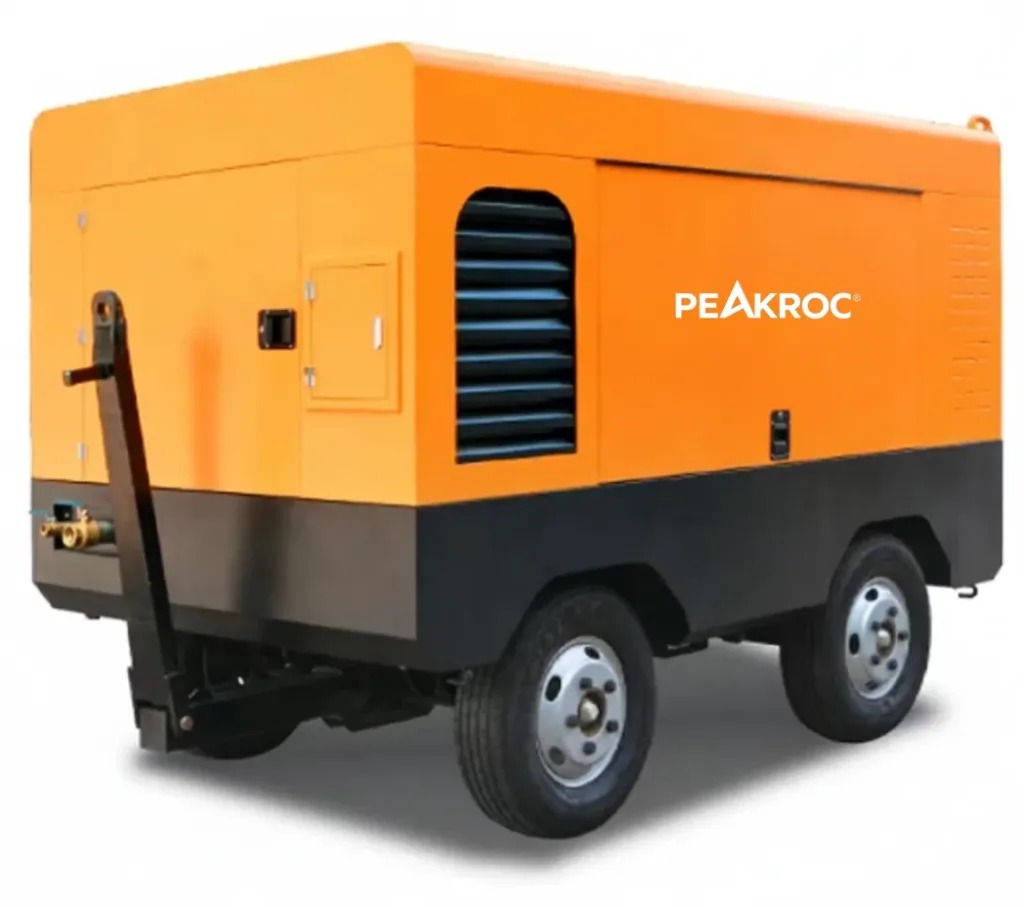
A diesel portable air compressor combines a diesel engine and compressor in one self-contained package.
Add fuel, connect the air hose and the machine can work almost anywhere.
That independence is why diesel portable compressors are so common in:
- mining;
- quarrying;
- water-well drilling;
- road construction;
- pipeline work;
- remote infrastructure projects.
An electric portable compressor replaces the diesel engine with an electric motor.
It therefore needs a suitable electrical supply, usually industrial three-phase power for larger machines.
Once power is available, however, electric operation has several advantages.
There is no diesel engine running beside the compressor, which means no local engine exhaust, less fuel handling and generally lower noise.
This makes electric portable compressors particularly attractive for:
- factories;
- tunnels;
- underground projects;
- batching plants;
- indoor construction;
- long-term industrial sites.
CAGI recognizes both engine-driven and electric-motor-driven portable compressors. It notes that diesel-driven portable compressors are common where external power is unavailable, while electric portable compressors can be connected to an appropriate site power source or generator.
The real question is therefore not:
Is electric better than diesel?
A better question is:
Which power source works better at my jobsite?
First Compare CFM/FAD and Working Pressure
Before deciding between electric and diesel, make sure the compressor has enough air.
Two numbers matter most:
Airflow — CFM or m³/min
and:
Working pressure — PSI or bar
Airflow tells you how much compressed air the compressor can deliver.
Pressure tells you whether that air is supplied at enough pressure for the equipment.
For example, imagine your tools require:
10 m³/min at 8 bar
A compressor supplying:
6 m³/min at 8 bar
does not provide enough air.
Likewise:
10 m³/min at 7 bar
may not provide enough pressure.
So the correct compressor needs to satisfy:
Required airflow + Required pressure
at the same time.
Peakroc’s current portable range illustrates how different applications require very different combinations. The website includes portable electric configurations around 6.2–22.5 m³/min at 7–18 bar, while diesel models extend from smaller construction compressors to high-pressure machines for deep drilling and mining.
Do not choose the power source first and try to make the airflow fit afterward.
Size the air requirement first. Then choose electric or diesel.
When Should You Choose an Electric Portable Air Compressor?
Electric is usually worth considering when reliable electricity is already available.
Imagine a compressor working beside a concrete batching plant.
It may remain in approximately the same location for months.
There is already industrial electricity nearby.
In this situation, there may be little benefit in continuously transporting and burning diesel fuel just to power the compressor.
Electric can also be attractive in tunnels and underground construction.
A diesel engine produces exhaust and additional heat inside the work area. Underground, that exhaust must be handled by the site’s ventilation system.
An electric motor does not produce diesel-engine exhaust at the compressor.
This does not mean the compressor produces no heat or has “zero emissions” in the broad environmental sense. The compression process still produces heat, and electricity may be generated elsewhere from different energy sources.
The accurate advantage is:
No local diesel-engine exhaust at the compressor.
Peakroc’s VSD portable compressor guidance identifies tunneling, factories, urban projects and other grid-connected sites as applications where electric portable compressors can be particularly useful.
Electric is therefore usually strongest when you have:
Reliable Power + Long Operating Hours + Relatively Stable Location
When Should You Choose a Diesel Portable Air Compressor?
Now imagine a water-well drilling contractor.
The drilling rig moves from village to village.
Some sites may be tens of kilometers away from reliable three-phase power.
An electric compressor might provide enough CFM and pressure, but supplying electricity becomes another project.
You may need:
generator + fuel + electrical cable + electric compressor
Instead, a diesel compressor already contains its own power source.
The contractor can:
tow the compressor to the drilling site → connect the hose → start the machine
This is why diesel remains extremely practical for mobile field work.
CAGI’s rotary compressor guidance specifically identifies combustion-engine-driven compressors as suitable for remote locations without a source of power, including construction and road-work applications.
Typical diesel applications include:
Water-Well Drilling
DTH Drilling
Open-Pit Mining
Quarries
Road Construction
Pipeline Construction
Remote Infrastructure
For these jobs, energy independence can be more important than electricity cost.
Electric vs Diesel Portable Air Compressor Comparison
| Factor | Electric Portable Compressor | Diesel Portable Compressor |
|---|---|---|
| Power Source | Electricity | Diesel fuel |
| Requires Site Power | Yes | No |
| Remote Jobsite | Depends on power availability | Excellent |
| Frequent Relocation | Cable/power connection can limit flexibility | Very convenient |
| Local Engine Exhaust | None | Present |
| Noise | Generally lower | Generally higher |
| Engine Maintenance | No diesel engine | Diesel engine requires servicing |
| Fuel Handling | No diesel fuel for compressor | Required |
| Long Fixed Operation | Often attractive | Possible |
| Tunnel / Indoor Work | Often attractive | Ventilation needs more attention |
| Remote Mining / Drilling | Limited without power | Strong fit |
There is no universal winner.
The correct answer changes with the jobsite.
Which Costs Less: Electric or Diesel?
This is one of the most common questions.
In many locations, grid-powered electric compressors can cost less to operate over long running hours.
But this does not mean electric is automatically cheaper for every project.
The electricity itself is only part of the cost.
An electric installation may require:
- electrical cable;
- switchgear;
- transformer capacity;
- suitable connection points;
- electrical installation.
A diesel compressor has different costs:
- diesel fuel;
- fuel transportation;
- refueling;
- engine oil;
- fuel filters;
- engine servicing.
Instead of comparing only:
Electricity Price vs Diesel Price
compare:
Total Cost of Ownership
or TCO.
In simple terms:
TCO = Purchase + Energy/Fuel + Maintenance + Infrastructure + Downtime
You do not need a complicated engineering calculation to understand the principle.
Consider two very different jobs.
Example 1: Three-Month Remote Road Project
There is no suitable electricity near the work area.
Installing temporary electrical infrastructure would cost money and take time.
A diesel compressor may be the simpler and less expensive overall solution even if grid electricity itself would normally cost less than diesel fuel.
Example 2: Factory Running 4,000 Hours per Year
The factory already has sufficient electrical infrastructure.
The compressor stays in one location.
Fuel trucks and engine servicing add unnecessary cost.
In this situation, electric becomes much more attractive.
That is why the answer depends on the whole project, not just energy price.
Which One Is Quieter?
Electric portable compressors are generally quieter because there is no diesel engine running inside the package.
This can matter around:
residential areas
hospitals
schools
factories
tunnels
indoor projects
Modern diesel compressor enclosures can reduce noise significantly, so you should always check the manufacturer’s actual sound specification for the model you are buying.
Still, if two similar compressors deliver the same airflow and pressure, removing the diesel engine normally makes electric the easier starting point for noise-sensitive work.
For a remote mine or quarry, however, this advantage may be less important than mobility.
Again, the site determines which factor matters most.
Which Requires Less Maintenance?
Electric compressors generally remove several diesel-engine service items.
A diesel compressor may require maintenance of:
engine oil
fuel filters
coolant
fuel system
belts and engine-related components
depending on the engine design.
An electric compressor does not have these diesel-engine components.
But this does not mean an electric compressor is maintenance-free.
The compressor itself still contains components that require service, such as:
air filters
compressor lubricant
oil separator
cooler
screw airend
electric motor
controls
and, on VSD models:
variable-speed drive components
So the correct statement is:
Electric normally reduces prime-mover maintenance. It does not eliminate compressor maintenance.
This distinction is important for buyers comparing long-term maintenance costs.
Mobility Is More Than Having Wheels
Many electric and diesel portable compressors can both be installed on a trailer or movable chassis.
But practical mobility is different.
A diesel compressor may only need:
fuel + air hose
An electric compressor also needs access to:
suitable electrical power + cable
If the machine stays beside the same tunnel heading, batching plant or factory for several months, that may not be a problem at all.
If the machine moves several times every day, the electrical connection becomes much more important.
This is why diesel has remained popular in drilling and mining even when electric motors may offer lower operating costs in other environments.
The question is not simply:
“Does the compressor have wheels?”
Ask:
How often will I actually move it, and will power be available at every new location?
What About VSD Electric Portable Compressors?
Some portable electric compressors use a Variable Speed Drive, or VSD.
The idea is easy to understand.
Imagine your compressed-air demand changing during the day:
100% → 70% → 50% → 80%
A VSD compressor can reduce motor speed when less air is required and increase speed when demand rises.
This can be useful when air consumption changes frequently.
For example, one compressor may supply several tools that do not all operate at the same time.
However, VSD is not automatically necessary for every project.
If a compressor works near full load for almost the entire shift, there may be less opportunity to reduce speed.
The main question is:
Does my air demand change significantly during operation?
If yes, VSD deserves consideration.
If no, a correctly sized fixed-speed machine may also be a good solution.
Peakroc Case: Why the Jobsite Matters More Than the Power Source
A Peakroc project in the Pilbara region of Western Australia provides a useful example.
The customer operated four blasthole drill rigs in an open-pit iron ore mine.
Previously, the contractor used:
3 × 15 m³/min diesel compressors
running in parallel.
This created three fuel supplies, three service schedules and a more complicated compressed-air distribution system.
Peakroc supplied one:
PRMD-4510 — 45 m³/min at 10 bar
to replace the three smaller compressors.
According to the published project results after the documented operating period:
- combined fuel use fell from approximately 75–85 L/h to 35–42 L/h;
- maintenance downtime was reduced;
- recorded uptime increased from 91.2% to 96.8%;
- the customer retained one older compressor as emergency backup.
This case does not prove that diesel is better than electric.
That would be the wrong conclusion.
The useful lesson is:
The correct compressor depends on the actual jobsite.
This project involved:
open-pit mining + large airflow + several drill rigs + outdoor operation + mobile field conditions
A correctly sized diesel compressor was therefore a practical solution.
If the same airflow demand existed inside a factory with stable industrial electricity, the correct answer might be completely different.
That is exactly why electric versus diesel should always be evaluated together with the application.
Electric or Diesel? Start With These Five Questions
You can make the choice much easier by answering five simple questions.
1. How Much Air Do You Need?
Find the total:
CFM or m³/min
required by all tools that may operate at the same time.
2. What Pressure Do You Need?
Check the equipment specification for:
bar or PSI
Do not choose extra pressure simply because a larger number appears better.
3. Is Reliable Power Available?
If sufficient industrial electricity is already available, electric deserves consideration.
If there is no reliable power, diesel is normally simpler.
4. How Often Will the Compressor Move?
A compressor that moves five times per day has very different requirements from one that moves twice per year.
5. Where Will It Work?
Consider:
indoor or outdoor
remote or urban
open-pit or underground
short project or permanent site
These conditions often make the answer obvious.
Which Compressor Is Better for Common Applications?
Construction
Both can work.
Use electric when suitable power is available and noise or local exhaust matters.
Use diesel for changing and remote construction sites.
Mining and Quarrying
Diesel is usually a strong starting point for open-pit and mobile work because of power independence.
Electric may be attractive for semi-fixed mine infrastructure or underground operations with established electrical supply.
Water-Well and DTH Drilling
Diesel is normally more practical because drilling sites frequently move and may be far from reliable power.
Tunneling and Underground Work
Electric deserves serious consideration where suitable power is available because there is no local diesel-engine exhaust.
Factory Temporary Air
Electric can make sense when the factory has sufficient electrical capacity.
Diesel remains useful for emergency backup or shutdown work where electrical supply is unavailable or uncertain.
Final Recommendation
Choosing between an electric and diesel portable air compressor does not need to be complicated.
Remember one simple rule:
Electric is strongest where reliable power is available. Diesel is strongest where power independence and mobility matter.
But always select the compressor in the correct order:
Airflow → Working Pressure → Power Availability → Mobility → Jobsite Conditions → Operating Cost
Do not buy electric only because electricity sounds cheaper.
Do not buy diesel simply because portable compressors have traditionally used diesel engines.
For a long-term factory, tunnel or semi-fixed project with reliable electrical power, an electric portable compressor may provide a quieter, simpler and economical solution.
For water-well drilling, open-pit mining, quarrying, road construction or other remote work, a diesel compressor may be much easier to operate.
The best compressor is not automatically electric or diesel.
It is:
the compressor that delivers the airflow and pressure your equipment needs, using the power source that makes the most sense at your actual jobsite.
FAQ
Is an electric portable air compressor better than a diesel compressor?
Not always. Electric is usually attractive where reliable electrical power is available, especially for factories, tunnels and long-term semi-fixed projects. Diesel is usually more practical for remote or frequently moving jobs.
Is an electric air compressor cheaper to run than diesel?
It can be when grid electricity is available and operating hours are high. However, electrical installation, cables, transformer capacity and other infrastructure should also be included when comparing total cost.
Can an electric portable compressor be used for mining?
Yes. Electric compressors can be useful in underground or semi-fixed mining operations where reliable electrical power is available. Remote open-pit and drilling operations often favor diesel because it does not depend on grid power.
Why are diesel compressors commonly used for drilling?
Drilling sites frequently move and are often located far from reliable electrical infrastructure. A diesel compressor carries its own power source and can move with the drilling rig.
Are electric portable compressors quieter?
Generally, yes, because they do not have a diesel engine running inside the compressor package. Actual sound levels still depend on the individual compressor design and enclosure.
Does an electric compressor require no maintenance?
No. It still requires compressor maintenance, including filters, separator, lubricant, cooling system and controls. It simply removes many diesel-engine-related maintenance items.
What specifications should I check before choosing electric or diesel?
Start with required airflow in CFM or m³/min and working pressure in bar or PSI. Then consider electrical supply, mobility, operating environment, annual running hours and total cost of ownership.
Author

Mark Chen – Senior Mechanical Engineer, Peakroc®
Mark Chen is a senior mechanical engineer at Peakroc®, specializing in compressed air systems and drilling equipment for mining and construction applications. With over 15 years of field experience, he has led multiple projects on optimizing air delivery efficiency, equipment durability, and energy consumption.