
Key Takeaways
- Pressure dew point (PDP) is the temperature at which water vapor begins to condense while compressed air remains at its specified pressure. A lower PDP means drier compressed air.
- A +3°C PDP is commonly associated with refrigerated drying and can be suitable for many indoor industrial systems where downstream piping remains safely above that temperature. A −40°C PDP is commonly associated with regenerative desiccant drying for much drier air, outdoor winter piping, instrument air, and moisture-sensitive processes.
- ISO 8573-1 provides useful water classes: Class 2 corresponds to −40°C maximum PDP, Class 3 to −20°C, and Class 4 to +3°C.
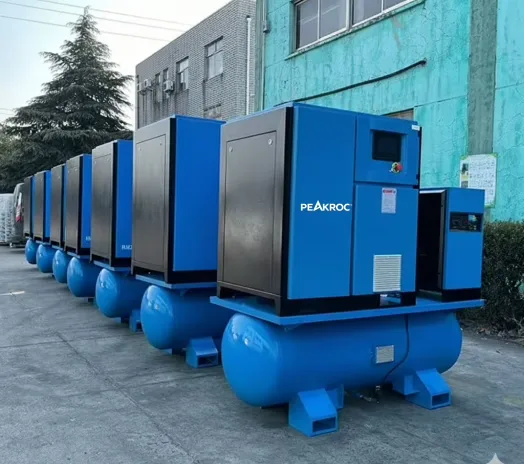
- Peakroc®’s 16–20 Bar Integrated 4-in-1 Air Compressor combines a compressor, receiver, refrigerated dryer, and precision filtration where that treatment architecture matches the process requirement.
- Do not specify the lowest PDP available simply because “drier is better.” Select PDP from the process requirement and coldest downstream temperature, then choose the dryer technology capable of meeting it reliably.
“Dry compressed air” sounds simple.
In practice, it is not a useful engineering specification.
One plant may only need enough drying to prevent liquid water forming in indoor piping. Another may have instrument-air lines outdoors in winter. A precision process may require much tighter moisture control regardless of ambient temperature.
The number that connects these applications is pressure dew point, or PDP.
Understanding PDP makes it much easier to answer three practical questions:
How dry does the air actually need to be?
When will condensation form?
Do we need a refrigerated dryer or a desiccant dryer?
What Pressure Dew Point Actually Means
Pressure dew point is the temperature at which the water vapor contained in compressed air becomes saturated and begins to condense at the stated pressure.
If compressed air has a:
+3°C PDP
then, while the air remains at that pressure, cooling it toward +3°C eventually reaches the point where water vapor can begin turning into liquid water.
If the same system has a:
−40°C PDP
the air can cool much further before reaching saturation.
That is why:
lower PDP = lower remaining water-vapor content
but PDP should always be stated together with the pressure condition.
Pressure Dew Point Is Not Atmospheric Dew Point
This distinction is easy to miss.
Atmospheric dew point describes moisture behavior in air at approximately atmospheric pressure.
Pressure dew point describes moisture behavior while air is compressed.
The same moisture content can therefore correspond to different dew-point temperatures depending on pressure.
When compressed air expands from a pressurized system toward atmospheric pressure, its atmospheric dew point is generally lower than its PDP.
So a specification such as:
“Dew point: +3°C”
is incomplete if nobody knows whether it refers to:
pressure dew point
or:
atmospheric dew point.
For compressed-air treatment, PDP is normally the more useful engineering value because it describes moisture conditions inside the pressurized distribution system.
CAGI defines pressure dew point as the temperature at which water begins to condense from air at a given pressure.
Condensation Depends on PDP and the Coldest Downstream Temperature
A dryer does not need to produce the lowest possible dew point.
It needs to keep the compressed air sufficiently dry for every condition the air will encounter.
Consider two systems.
Indoor Factory
Pressure dew point:
+3°C
Lowest downstream pipe temperature:
+15°C
The pipe remains well above the PDP.
Under normal conditions, the air does not cool to its saturation point, so condensation caused by downstream cooling is unlikely.
Outdoor Winter Line
Pressure dew point:
+3°C
Outdoor piping:
−5°C
Now the air can cool far below its PDP.
Water vapor may condense, and in sufficiently cold locations that liquid can freeze.
The result can include:
corrosion, blocked drains, frozen regulators, slow pneumatic tools, stuck control valves, and unstable airflow.
This is why dryer selection should normally work backward from the coldest downstream condition, not the average temperature inside the compressor room.
CAGI recommends considering a PDP approximately 20°F, or about 11°C, below the lowest ambient temperature encountered where condensation and freezing need to be avoided. It also warns that specifying unnecessarily low winter dew point for a system that only sees warm conditions adds capital and operating cost without useful benefit.
This leads to a useful design rule:
Required PDP should be low enough to protect the process under the coldest credible condition—but not dramatically lower without a reason.
+3°C, −20°C, or −40°C? Use ISO 8573-1 as a Common Language
Terms such as:
“dry air”
“very dry air”
and:
“moisture-free air”
are difficult to use in an RFQ.
ISO 8573-1 gives buyers and suppliers a clearer way to define moisture requirements.
Common water classes include:
| ISO 8573-1 Water Class | Maximum Pressure Dew Point |
|---|---|
| Class 1 | −70°C |
| Class 2 | −40°C |
| Class 3 | −20°C |
| Class 4 | +3°C |
| Class 5 | +7°C |
| Class 6 | +10°C |
This immediately makes the specification more useful.
Instead of saying:
“We need a good air dryer.”
the buyer can state:
Required water quality: ISO 8573-1 Class 4, maximum +3°C PDP at the specified operating condition.
Or:
Required water quality: ISO 8573-1 Class 2, maximum −40°C PDP.
The dryer supplier now knows what moisture level the process actually requires.
When +3°C PDP Is Often Enough
Around +3°C PDP can be appropriate for many general factory-air systems when:
- the distribution system remains indoors;
- downstream temperatures stay safely above freezing;
- the process is not highly moisture-sensitive;
- there is no special instrument-air requirement.
This is why refrigerated drying is widely used in general industrial compressed-air systems.
Peakroc’s existing Refrigerated vs Desiccant Air Dryer Guide explains this technology comparison in more detail. Peakroc’s current technical guidance places conventional refrigerated drying broadly around the low positive Celsius range, while desiccant systems are used where much lower PDP is required.
When −20°C or −40°C Becomes More Appropriate
Lower PDP may become necessary for:
outdoor winter piping, instrument air, pipeline drying, moisture-sensitive processing, or equipment where small quantities of water vapor create reliability problems.
A −40°C target does not automatically mean every system should use it.
It simply provides substantially more protection against moisture condensation at low temperatures.
The correct question is:
What is the highest PDP that still protects the process under the worst credible operating condition?
That usually produces a more economical design than asking:
“What is the driest air we can buy?”
PDP Should Choose the Dryer—not the Other Way Around
One of the most common specification errors is selecting the dryer technology first.
For example:
“We always use refrigerated dryers.”
or:
“Desiccant must be better because −40°C is drier.”
Both approaches start from equipment instead of the process.
A better sequence is:
Application → Coldest Temperature → Required PDP → ISO Water Class → Dryer Technology → Corrected Capacity → Operating Cost
A refrigerated dryer removes moisture by cooling compressed air until water vapor condenses, then separating and draining the liquid.
Typical refrigerated dryer PDP is roughly:
+2°C to +10°C
depending on design and operating conditions.
A regenerative desiccant dryer works differently.
Water vapor is adsorbed onto desiccant material, allowing the dryer to reach much lower dew points such as:
−20°C, −40°C, or lower.
But that lower PDP normally comes with additional considerations:
purge-air consumption, regeneration energy, switching valves, filtration, desiccant maintenance, and capital cost.
So lower PDP is not free.
CAGI specifically states that specifying a dew point lower than required is not good engineering practice because it can increase equipment cost and operating expense.
This also explains why a filter cannot replace a dryer.
A separator can remove bulk liquid water.
A coalescing filter can remove finer liquid droplets and aerosols.
But water vapor remains in the air.
CAGI explicitly notes that compressed-air filters do not significantly reduce vapor-phase moisture or lower pressure dew point.
For the complete contamination-control sequence, see Peakroc’s Compressed Air Filter Selection Guide.
Peakroc Field Experience: Moisture Problems Show Up at the Point of Use
PDP can appear abstract until moisture begins affecting real production.
Peakroc’s field experience shows why moisture control should always be tied to the application rather than treated as an optional accessory.
Peakroc Client Case: Preventing Wet Abrasive in Sandblasting
A Peakroc mobile surface-preparation customer used a 5 m³/min, 7 bar portable diesel compressor for blasting municipal steel structures before repainting.
The requirement was not simply stable airflow.
Moisture reaching the blasting system could contribute to wet abrasive, inconsistent abrasive flow, and coating-preparation problems.
The project therefore used an aftercooler and water separator to remove condensed bulk moisture before the air reached the blasting equipment.
Peakroc’s published project outcome reported more consistent blasting quality, fewer wet-media interruptions, and stable productivity.
This was not a −40°C PDP drying project, and it should not be described as one.
The useful engineering lesson is:
Start by identifying what moisture is doing to the process.
For this application, bulk-water control was sufficient.
If the same air system had outdoor sub-zero piping or a process requiring a defined low moisture-vapor level, an actual dryer and PDP specification would become necessary.
Peakroc Application Example: Precision Laser Cutting
Peakroc’s PRMEL 16–20 bar integrated laser-cutting air system takes moisture control another step.
The package combines:
compressor + receiver + refrigerated dryer + precision filtration
because laser cutting requires stable, dry compressed air rather than pressure alone.
The published system range is 1.05–3.9 m³/min at 16–20 bar, with the dryer and filtration integrated into the machine.
The design principle is relevant well beyond laser cutting:
The air-treatment system should be selected from what the production equipment requires at the point of use.
If the process target can be achieved with refrigerated drying, there is little engineering benefit in automatically specifying −40°C PDP.
If the process or environment genuinely requires much drier air, then the system should move toward the appropriate desiccant technology.
Measure PDP Where It Matters
A dryer specification is only useful if the delivered air actually meets it.
That is why dew-point monitoring becomes important in moisture-sensitive compressed-air systems.
The reference article emphasizes that modern dew-point sensors can provide real-time monitoring and alerts when moisture levels begin moving away from the required condition.
But sensor location matters.
A dew-point reading taken near the dryer outlet tells you how the dryer is performing.
A measurement farther downstream tells you what the process is actually receiving.
Those numbers can differ if the distribution system contains:
wet receiver tanks, malfunctioning drains, bypass valves, poorly isolated backup lines, or moisture already accumulated inside the piping.
For critical systems, the most useful measurement point is often close enough to the process to confirm the required quality actually reaches the user.
The PDP meter itself also needs to operate within its specified pressure, temperature, and measurement range.
A good moisture-control program therefore connects:
dryer performance + drain condition + PDP monitoring + distribution system condition
rather than assuming a dryer installed years ago must still be producing its nameplate dew point.
Final Recommendation
Pressure dew point becomes much easier to understand when it is treated as a condensation threshold, not merely a dryer specification.
A +3°C PDP means the compressed air can cool to approximately that temperature at the specified pressure before reaching saturation.
A −40°C PDP means the air contains much less water vapor and can tolerate much colder conditions before condensation begins.
Neither value is universally better.
The right design process is:
Identify the Process → Find the Coldest Downstream Temperature → Define Required PDP → Select ISO 8573-1 Water Class → Choose Dryer Technology → Size for Actual FAD & Conditions → Measure PDP in Operation
For warm indoor factory air, +3°C may be entirely appropriate.
For exposed winter piping or sensitive instrument air, −20°C or −40°C may be necessary.
For highly demanding processes, even lower values can be justified.
The important principle is:
Do not buy the lowest dew point available. Buy the dew point the application actually needs—with enough margin to remain reliable under the worst realistic operating condition.
That gives the factory dry enough air without paying permanently for unnecessary drying.
FAQ
What is pressure dew point in compressed air?
Pressure dew point is the temperature at which water vapor in compressed air becomes saturated and begins to condense while the air remains at the specified pressure.
Is +3°C pressure dew point considered dry compressed air?
For many indoor general-industrial applications, +3°C PDP can be sufficient if downstream equipment and piping remain safely above that temperature. More demanding or colder applications may require a lower PDP.
What does −40°C PDP mean?
It means the compressed air contains sufficiently little water vapor that condensation would not begin until the air cools to approximately −40°C at the specified pressure. It is commonly associated with ISO 8573-1 Water Class 2.
What is the difference between atmospheric dew point and pressure dew point?
Atmospheric dew point refers to air near atmospheric pressure. Pressure dew point refers to compressed air at a stated pressure. The same moisture content can therefore correspond to different dew-point temperatures depending on pressure.
Does a compressed-air filter lower pressure dew point?
No. Filters and separators can remove liquid water and water aerosols, but vapor-phase moisture requires drying if the PDP must be reduced.
Should every factory specify −40°C PDP?
No. A −40°C PDP is valuable where the process or low-temperature environment requires it, but specifying much drier air than necessary increases system cost and may increase energy use.
Author

Mark Chen – Senior Mechanical Engineer, Peakroc®
Mark Chen is a senior mechanical engineer at Peakroc®, specializing in compressed air systems and drilling equipment for mining and construction applications. With over 15 years of field experience, he has led multiple projects on optimizing air delivery efficiency, equipment durability, and energy consumption.