
Key Takeaways
- Size temporary compressed air from the essential simultaneous demand during the maintenance shutdown, not simply from the nameplate capacity or motor kW of the permanent compressor being serviced.
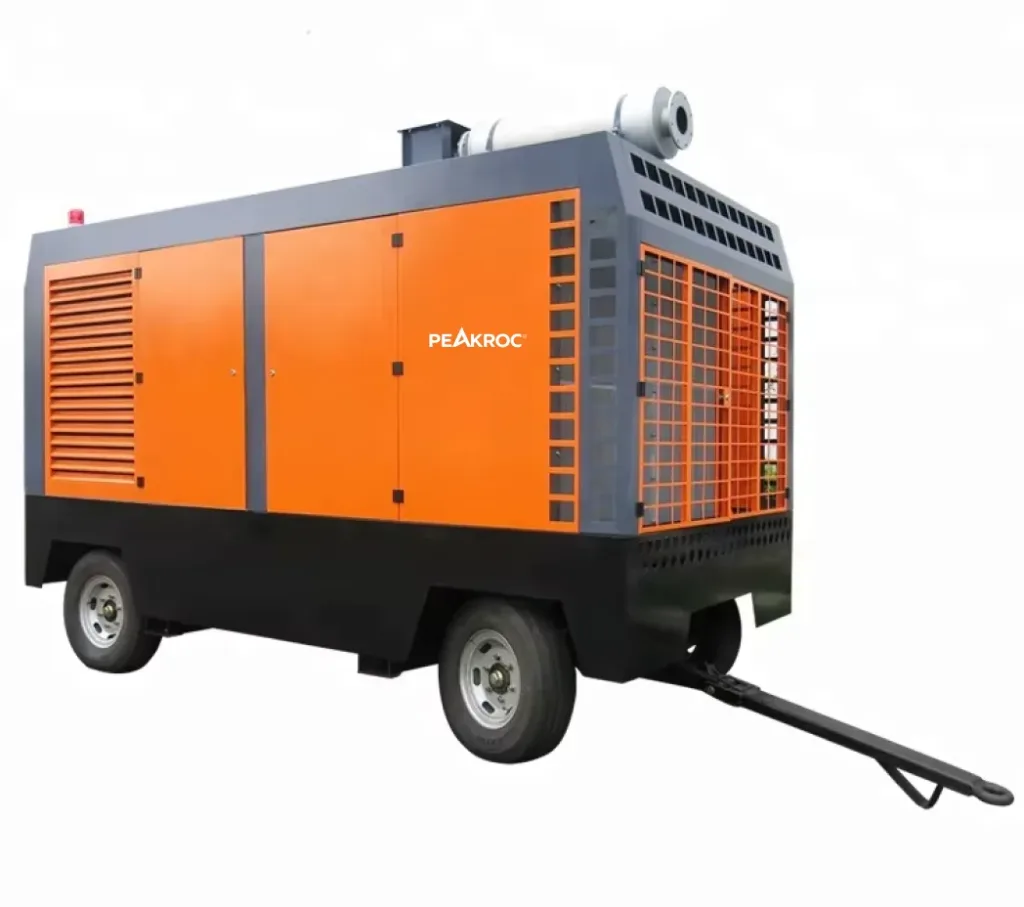
- For standard-pressure temporary factory air, the Peakroc® 10 m³/min 8 bar portable diesel air compressor provides approximately 375 CFM for applications where the required plant pressure remains within the normal 6–8 bar range.
- When the shutdown system requires additional pressure margin for temporary hoses, treatment equipment, or higher-pressure users, the Peakroc® 10 m³/min 10 bar portable diesel air compressor provides the same 10 m³/min airflow at a higher working pressure.
- Larger shutdowns requiring higher flow can evaluate the Peakroc® 20 m³/min 13 bar portable diesel air compressor. Peakroc application records include emergency industrial backup and valve-actuator testing and maintenance-shutdown work in refinery and chemical-plant environments.
- Do not select any of these models from nominal CFM alone. Confirm the required FAD, header pressure, temporary hose pressure loss, dryer/filter pressure drop, air quality, operating hours, and backup strategy before finalizing the temporary system.
- Commission the complete temporary system before isolating the permanent system. Pneumatic stored energy, electrical supply, isolation, depressurization, lockout/tagout, and re-energization must follow the facility’s approved safety procedures. OSHA identifies pneumatic pressure as stored hazardous energy that must be properly controlled during servicing.
Why a Planned Shutdown Needs Its Own Compressed-Air Plan
A planned maintenance shutdown is different from an unexpected compressor failure.
The good news is that the maintenance team knows approximately when the permanent equipment will become unavailable.
That gives the factory time to calculate demand, prepare temporary connections, arrange compressors and treatment equipment, test the system, and establish a controlled changeover procedure.
But there is also a common mistake.
Some shutdown plans treat temporary compressed air as:
“Rent a compressor with roughly the same CFM and connect a hose.”
That approach ignores the rest of the system.
During shutdown maintenance, the unavailable equipment may include not only the compressor but also:
- aftercoolers and moisture separators;
- dryers;
- filters;
- receiver tanks;
- main valves;
- electrical controls;
- sections of the plant distribution network.
Temporary compressed air therefore needs to be planned as a temporary air system, not simply a temporary compressor.
The objective is to maintain:
required airflow + required pressure + required air quality
at the production equipment that must remain operational.
Step 1: Decide What Actually Needs Air During the Shutdown
Start from production.
Do not start from the compressor room.
The existing factory may normally consume 2,000 CFM, but a planned shutdown might stop half of the production lines.
Only certain equipment may need to remain online, such as:
- pneumatic actuators and process valves;
- packaging or assembly equipment;
- critical instruments;
- control air;
- cleaning or maintenance tools;
- essential process utilities.
The first calculation should therefore establish the essential shutdown demand.
A practical relationship is:
Required Temporary FAD = Essential Simultaneous Shutdown Demand − Dependable Permanent Capacity Remaining Online + Justified Reserve
Example
Suppose a plant normally reaches:
1,500 CFM peak demand
during full production.
During a planned shutdown:
- several production lines will stop;
- essential equipment requires about 850 CFM;
- one permanent compressor providing 250 CFM will remain available.
The temporary base requirement is therefore approximately:
850 − 250 = 600 CFM
The shutdown team can then decide whether additional contingency capacity is justified.
That reserve should reflect real operational risk rather than an automatic percentage.
Important factors include:
measurement uncertainty, expected leakage, temporary tool use, load variation, shutdown duration, and the consequences of temporary compressor failure.
Average Demand and Peak Demand Are Different Problems
Assume the shutdown base load is approximately:
500 CFM
but several pneumatic actuators occasionally operate simultaneously, increasing demand to:
800 CFM for 10 seconds.
That does not necessarily mean the factory needs an 800 CFM compressor running continuously.
Short peaks can sometimes be supported by:
receiver storage + adequate distribution capacity + a correctly controlled compressor
while sustained 800 CFM production requires actual continuous compressor capacity.
This distinction can significantly affect:
- rental cost;
- fuel or electricity use;
- temporary pipe size;
- receiver requirements;
- number of temporary compressors.
For a deeper explanation of how airflow, storage, and distribution interact, see Peakroc’s compressed-air system design guide. Peakroc’s system-design guidance similarly emphasizes that compressor nameplate capacity is only useful if hoses and distribution components can deliver that capacity to the load.
Step 2: Calculate the Pressure Required at the Temporary Compressor
Knowing the plant requires “7 bar air” is not enough.
You need to know where that 7 bar is required.
If a production machine requires:
6.5 bar minimum inlet pressure
and the temporary compressor is located outside the factory, compressed air may have to pass through:
temporary hose → aftercooler → dryer → filters → manifold → connection valve → factory header
before reaching production.
Every component can consume pressure.
A simplified pressure budget is:
Required Temporary Compressor Pressure = Minimum Point-of-Use Pressure + Treatment Loss + Temporary Piping Loss + Valve/Connection Loss
Example Pressure Budget
Assume:
- minimum factory header pressure: 6.5 bar;
- dryer and filtration loss: 0.25 bar;
- temporary hose loss: 0.35 bar;
- valves and connection loss: 0.15 bar.
The compressor would need to supply approximately:
7.25 bar at the required flow
before allowing an appropriate control margin.
That is very different from automatically choosing a 13-bar compressor.
Higher maximum pressure is useful only when the application needs it.
Running the complete system at unnecessarily high pressure increases energy use and can increase leakage and artificial demand.
CAGI recommends minimizing unnecessary compressed-air pressure and pressure drop throughout the system.
Peakroc Client Experience: Why We Review the Air Pipeline, Not Only the Compressor
One Peakroc industrial customer operates a cement plant where compressors must work under high dust and elevated temperature conditions.
The customer needed reliable compressed-air supply, but stable compressor operation was only one part of the requirement.
Peakroc engineers also worked with the customer on optimization of the compressed-air pipeline system.
The customer later specifically highlighted both stable compressor performance and the pipeline optimization support provided by Peakroc.
What problem were we helping address?
The important question was not simply:
“Can the compressor produce enough air?”
It was:
“Can the plant deliver enough air to the operating equipment without excessive pressure loss?”
This same question becomes even more important during maintenance shutdowns.
The permanent compressor room may have a properly engineered large-diameter header.
A temporary system may instead introduce:
long hoses + quick couplings + temporary manifolds + additional valves + smaller connection points
between compressor and plant.
If those components become the bottleneck, simply installing a larger compressor may not restore the required pressure.
Engineering Lesson
Before Peakroc recommends a temporary shutdown configuration, useful project information includes:
temporary connection diameter, hose diameter, hose length, peak flow, required header pressure, and distance from the temporary compressor to the critical load.
The compressor and temporary distribution path must be evaluated together.
Step 3: Determine Whether the Permanent Air Treatment Will Remain Available
A factory shutdown may isolate the permanent:
dryer, filters, separator, or condensate-management system.
If so, the temporary compressor must not automatically be connected directly to the production header.
The required air quality still depends on the process.
ISO 8573-1 classifies compressed-air purity according to:
particles + water + oil
which makes it a useful basis for defining temporary air requirements.
Temporary air supplying basic pneumatic tools may require relatively simple treatment.
Temporary air serving sensitive production may require much tighter moisture and contamination control.
Examples can include:
- instrumentation;
- coating and painting;
- laser cutting;
- electronics manufacturing;
- certain food processes;
- selected pharmaceutical or chemical processes.
The important question is:
What quality of air normally arrives at the point of use?
The temporary system should be designed to maintain that requirement.
Refrigerated or Desiccant Dryer?
Dryer selection depends primarily on the required pressure dew point.
For many general indoor industrial applications, a refrigerated dryer around +3°C PDP may be sufficient.
Applications requiring very dry air, low-temperature outdoor piping, or significantly lower dew points may require regenerative desiccant drying.
This should be decided from the process rather than assuming that “drier is always better.”
For the detailed comparison, see Peakroc’s Refrigerated vs Desiccant Air Dryer selection guide.
A temporary system requiring very low dew point also needs to account for the dryer itself when calculating compressor capacity.
Heatless regenerative desiccant dryers can consume a portion of the compressed air as purge during regeneration.
Therefore:
1,000 CFM required downstream does not always mean 1,000 CFM is enough upstream.
The purge requirement, corrected dryer capacity, filtration losses, and expected peak demand must be included.
Step 4: Decide Where Temporary Receiver Storage Belongs
An air receiver does not replace insufficient compressor capacity.
It stores compressed air so that the system can respond to temporary demand changes.
Storage can be valuable during shutdowns because maintenance and production demand may be less predictable than normal plant operation.
For example, several maintenance teams may briefly operate pneumatic tools at the same time while process actuators also cycle.
Receiver storage can help reduce the resulting pressure fluctuation.
Storage Before or After the Dryer?
Location matters.
If a large receiver is upstream of the dryer, a sudden demand event may release stored air through the dryer at a flow greater than the dryer rating.
That can reduce drying performance or increase pressure loss.
When storage is positioned downstream of the dryer, the system can supply a short peak using already treated air.
The final arrangement depends on the specific system, but temporary-air planning should consider:
compressor → treatment → storage → factory header
as one integrated flow path.
Step 5: Temporary Hose and Piping Can Determine Whether the System Works
One of the easiest shutdown mistakes is connecting a large temporary compressor through an undersized hose.
Compressor capacity does not eliminate friction.
Pressure drop increases as:
- airflow increases;
- hose diameter decreases;
- hose length increases;
- fittings and couplings become more restrictive.
Peakroc’s compressed-air system guidance highlights hose diameter and length as major causes of pressure loss between a compressor and the actual load.
Therefore, temporary hose should be sized according to:
maximum simultaneous flow + hose length + working pressure + acceptable pressure drop
not merely according to the thread size of whichever coupling happens to be available.
Example
A factory rents a 1,000 CFM compressor.
The compressor gauge looks normal.
Production pressure still falls whenever several machines operate.
Before ordering another compressor, inspect:
temporary hose ID → total hose length → couplings → manifold → dryer/filter → plant connection → existing header
The smallest restriction in the route may determine the effective system capacity.
Design a Permanent Temporary-Air Connection Before You Need It
A well-prepared factory does not need to improvise a connection every time the compressor room is serviced.
Where appropriate to the facility design, a dedicated temporary-air connection can simplify future shutdown work.
The engineering team may consider features such as:
- correctly sized connection capacity;
- isolation;
- check/non-return protection;
- pressure indication;
- safe condensate management;
- clearly identified connection and flow direction.
All components must be properly pressure rated and incorporated into the site’s engineering and safety procedures.
The important sizing principle is:
the emergency connection should be sized for the air that may actually need to pass through it.
A convenient small maintenance connection can become a serious restriction when several hundred or several thousand CFM must pass through it.
Peakroc Shutdown Application Experience: Temporary Industrial Air Supply
Peakroc’s 20 m³/min, 13 bar portable platform has been deployed beyond drilling and construction.
Published Peakroc application information includes:
emergency compressed-air backup for industrial facilities and valve-actuator testing and maintenance-shutdown support in refinery and chemical-plant environments.
This type of project illustrates why diesel portable compressors can be useful during planned maintenance.
The temporary machine can operate independently of the factory’s normal compressor electrical supply and can be positioned externally while air is routed to the required plant connection.
Why We Would Not Automatically Recommend the Same Machine to Every Factory
A refinery shutdown requiring high flow and elevated pressure is different from a packaging factory needing 300 CFM at 7 bar.
Using a 13-bar, 710-CFM machine for a much smaller standard-pressure requirement could add unnecessary:
fuel consumption, equipment cost, hose requirements, and control complexity.
Peakroc therefore works backward from:
required shutdown FAD → minimum pressure → hose losses → treatment requirement → duration → redundancy
before matching compressor capacity.
The Case demonstrates an application—not a universal sizing rule.
Step 6: Diesel or Electric Temporary Compressed Air?
Both can work.
Diesel Portable Compressor
A diesel machine is particularly useful when:
- temporary electrical capacity is unavailable;
- the compressor must operate independently from equipment being serviced;
- rapid outdoor deployment is important;
- the compressor is located remotely from the compressor room.
Fuel supply, exhaust, noise, ventilation, and site environmental rules must be planned.
Portable Electric or VSD Compressor
Electric temporary compression can be attractive when suitable electrical infrastructure is available.
Peakroc’s VSD guidance specifically identifies industrial maintenance, expansion, shutdowns, and compressor-room repairs as temporary plant-air applications.
Variable-speed operation can also fit shutdown environments where demand changes throughout the maintenance period because equipment is repeatedly connected and disconnected.
The decision should follow:
site power + operating hours + load profile + installation location + local emissions/noise requirements + total operating cost
rather than assuming diesel or electric is always superior.
Step 7: Decide Whether One Compressor Is Enough From a Reliability Perspective
Capacity and redundancy are separate questions.
A temporary compressor may have enough CFM.
But what happens if that compressor trips?
For non-critical maintenance tools, a short interruption may be acceptable.
For a production process where loss of air immediately stops the line, it may not be.
The shutdown team should define:
How much production is lost if the temporary air source fails?
One Temporary Compressor
Advantages include simpler installation, fewer hoses, fewer fuel/electrical connections, and easier operation.
The main disadvantage is obvious:
one machine may become a single point of failure.
Multiple Temporary Compressors
Parallel machines can provide:
base + trim + standby
capacity.
They also allow part of the temporary system to remain available if one machine needs maintenance.
The trade-off is increased complexity:
manifold design, isolation, controls, synchronization, space, fuel/electrical supply, and operator coordination.
There is no universal “N+1” rule for every shutdown.
The correct redundancy level follows the production consequence of failure.
Step 8: Commission the Temporary System Before Isolating the Permanent System
The safest time to discover a temporary compressor is too small is before the permanent system has been shut down.
Where plant architecture permits, connect and load-test the temporary system in advance.
A practical commissioning sequence should verify:
- compressor output under realistic demand;
- pressure at the temporary plant connection;
- pressure at the critical point of use;
- dryer and filtration performance where required;
- receiver, drains, valves, and check devices;
- temporary hose and coupling integrity;
- control response during peak demand;
- contingency response if one temporary compressor stops.
The actual isolation and changeover procedure must be determined by the facility’s qualified engineering and safety personnel.
Pneumatic Systems Contain Stored Hazardous Energy
Compressed air deserves the same seriousness as other hazardous energy sources.
OSHA specifically recognizes pneumatic pressure and compressed air as forms of stored energy.
Lockout/tagout principles require energy to be isolated and stored energy to be dissipated or restrained before maintenance begins.
This becomes especially important during temporary-air changeover.
A valve marked “closed” does not by itself prove that a section of equipment is depressurized.
Depending on the system, safe maintenance may require:
isolation + lockout/tagout + venting/bleeding + pressure verification + protection against re-pressurization
before work begins.
Temporary air should never become an improvised bypass around an approved energy-control procedure.
The facility’s qualified personnel must determine the appropriate shutdown, commissioning, isolation, and re-energization procedure under applicable laws and site requirements.
Five Common Temporary-Air Shutdown Mistakes
1. Matching the Permanent Compressor Nameplate
The permanent compressor may serve equipment that will not operate during shutdown.
Calculate essential shutdown demand instead.
2. Measuring Pressure Only at the Temporary Compressor
The important pressure is at the plant header and critical equipment during peak flow.
3. Forgetting Air Treatment
If the permanent dryer and filters are offline, the temporary compressor may supply unsuitable air quality unless treatment is provided.
4. Connecting a Large Compressor Through a Small Hose
The temporary distribution path can become the bottleneck even when compressor FAD is sufficient.
5. Having No Backup Plan
If temporary compressed air becomes a critical production utility, determine what happens if that system fails before maintenance starts.
Temporary Factory Air RFQ Checklist
| Information | Required Project Detail |
|---|---|
| Essential air demand | Minimum, normal and peak CFM/FAD |
| Permanent supply remaining | Capacity that stays online |
| Required pressure | Minimum pressure at critical use point |
| Shutdown duration | Hours, days or weeks |
| Air quality | Particle, water and oil requirements |
| Required dew point | Refrigerated or desiccant requirement |
| Temporary piping | Diameter, length and routing |
| Plant connection | Diameter, fitting and pressure rating |
| Compressor location | Distance from factory connection |
| Power | Voltage/frequency/kW or diesel requirement |
| Existing storage | Receiver volume and pressure |
| Criticality | Consequence if temporary supply fails |
| Ambient conditions | Temperature, dust and weather exposure |
The better this information is before the shutdown, the easier it becomes to design the correct compressor, treatment, piping, and redundancy configuration.
Final Recommendation
Temporary compressed air during a planned factory shutdown should be designed as a temporary utility system, not treated as an isolated rental machine.
Start by identifying which production loads must remain operational.
Calculate their simultaneous FAD.
Then determine the minimum pressure that must reach the critical production equipment.
Work backward through:
factory header → temporary connection → temporary piping → dryer/filter → compressor
to establish the required discharge conditions.
If the permanent air-treatment equipment will be unavailable, make sure the temporary system maintains the required moisture, oil, and particulate control.
Check temporary piping carefully.
A correctly sized compressor connected through an undersized hose is still an incorrectly sized system.
Decide whether short demand peaks should be handled by compressor capacity, storage, or a combination of both.
Then decide whether a single temporary compressor provides sufficient reliability or whether standby capacity is required.
Finally, connect and commission the temporary system before isolating the permanent equipment whenever the plant design and approved procedure allow it.
Peakroc’s industrial experience reinforces a consistent engineering principle:
what reaches production matters more than what appears on the compressor nameplate.
For a planned maintenance shutdown, a successful temporary-air system should deliver:
the required FAD + stable point-of-use pressure + appropriate air quality + low-loss distribution + sufficient reliability + a controlled and safe changeover.
That preparation is what separates a planned temporary-air system from an emergency workaround.
FAQ
How do I size a temporary compressor for a factory shutdown?
Calculate the essential simultaneous air demand during the shutdown, subtract dependable permanent compressor capacity that remains online, and add only the reserve justified by uncertainty and production risk.
Should temporary compressor sizing use CFM or motor kW?
Use actual air delivery—CFM, m³/min, or preferably verified FAD—at the required working pressure. Motor kW alone does not define usable compressed-air capacity.
Do I need a dryer with a temporary factory compressor?
If the permanent dryer will be unavailable and the process requires controlled moisture or pressure dew point, the temporary system needs appropriate drying.
Why is factory pressure low even when the temporary compressor has enough CFM?
Pressure may be lost through long or undersized hoses, filters, dryers, valves, fittings, manifolds, or an undersized plant connection.
Is diesel or electric better for a factory shutdown?
Diesel offers independent power and flexible outdoor deployment. Electric or VSD compression can be attractive when suitable electrical capacity is available. The best option depends on the site and load profile.
Can a receiver replace a larger temporary compressor?
A receiver can support short demand peaks, but it cannot replace insufficient continuous FAD when plant demand remains high for extended periods.
Should a planned shutdown use a standby compressor?
If failure of the temporary compressor would stop critical production or create unacceptable process risk, standby or parallel capacity should be evaluated.
What should be tested before switching to temporary compressed air?
Verify flow under realistic demand, pressure at critical use points, treatment performance, storage and controls, valves and drains, hose integrity, and the facility’s approved isolation and changeover procedure.
Author

Mark Chen – Senior Mechanical Engineer, Peakroc®
Mark Chen is a senior mechanical engineer at Peakroc®, specializing in compressed air systems and drilling equipment for mining and construction applications. With over 15 years of field experience, he has led multiple projects on optimizing air delivery efficiency, equipment durability, and energy consumption.