
Key Takeaways
- Temporary factory air should be sized from measured or documented plant demand, not simply from the motor kW of the compressor being repaired.
- Confirm the required FAD and factory header pressure together. A rental compressor with adequate CFM can still fail if treatment equipment and temporary piping cause excessive pressure drop.
- For smaller general factory-air requirements, the Peakroc® 5 m³/min, 7 bar portable diesel compressor provides a possible starting point, while larger temporary systems can be built around the 10 m³/min, 10 bar portable compressor or higher-flow configurations. Final sizing must follow actual plant demand.
- Large factories requiring substantial temporary airflow can consider high-flow platforms such as the 45 m³/min, 10 bar Peakroc® portable compressor or multiple compressors operated in parallel.
- Temporary air must maintain the process air-quality requirement. ISO 8573-1:2010 classifies compressed-air purity in terms of particles, water and oil; the temporary system should not introduce poorer air than the production process can accept.
- A contingency plan should define the required capacity, connection point, hoses or piping, dryer and filters, fuel or electrical supply, installation space, startup procedure and changeover sequence before an unexpected compressor failure occurs. Industrial rental guidance identifies emergency breakdowns, maintenance projects and short-term capacity increases as three core reasons for temporary compressed-air systems.
Compressed air is often one of the least visible utilities in a factory until it disappears.
A failed compressor can stop pneumatic actuators, packaging machines, process valves, conveying equipment, instrumentation, cleaning stations and production lines within minutes. Planned compressor overhauls create a similar problem: maintenance may be scheduled, but the rest of the factory may still need air.
Temporary compressed air solves that gap, but only when it is treated as an engineered factory utility system rather than a portable compressor parked beside the building.
The temporary package must deliver enough air, at the correct pressure and air quality, through a distribution system that can be safely connected to the plant header.
When Does a Factory Need Temporary Compressed Air?
Most projects fall into three categories.
Emergency backup begins with an unexpected failure. Speed matters, and the first goal is often to restore essential production rather than recreate every part of the permanent compressor room.
Planned maintenance or shutdown support provides more engineering time. The temporary system can be sized, installed and tested before the permanent equipment is isolated.
Peak production support is different again. The permanent compressor system remains operational, but seasonal demand, a new production line or a short-term order temporarily exceeds available capacity. Rental-industry guidance identifies all three situations as common reasons for temporary air supply.
The sizing method should therefore answer two questions:
How much of the permanent system will remain available?
and
How much air must the temporary system replace or supplement?
Step 1: Determine the Real Factory Air Demand
The first mistake is assuming that a failed 110 kW compressor must be replaced by another 110 kW machine.
Motor power is not air demand.
A factory may have several compressors operating in sequence, and the failed machine may have spent much of its time unloaded. Alternatively, one relatively small machine may have been carrying an unusually high continuous load.
A better temporary-air calculation is:
Required temporary FAD = peak simultaneous plant demand − dependable remaining permanent capacity + justified operating reserve
Use actual flow measurements where possible. If a plant has a flow meter or compressor-control history, review the highest normal production demand rather than adding every compressor nameplate capacity together.
Before sizing, record:
- Normal and peak factory airflow
- Minimum acceptable plant-header pressure
- Which permanent compressors will remain available
- Critical production areas that must continue operating
- Large intermittent air users
- Expected project duration and operating hours
An illustrative example shows why this matters.
Suppose measured production demand peaks at 1,000 CFM. During maintenance, one permanent compressor capable of reliably supplying 250 CFM remains available.
The temporary system must therefore replace approximately 750 CFM before the engineering team adds whatever reserve is justified for load variation, leakage and uncertainty.
That is a very different requirement from renting the combined capacity of every compressor in the original room.
Step 2: Size for Pressure at the Factory Header
Airflow alone is not enough.
A factory may normally operate its header at 7 bar, but that does not mean a temporary compressor delivering exactly 7 bar at its discharge will maintain 7 bar inside the plant.
Pressure is lost through:
Compressor → aftercooler → dryer → filters → temporary hose → isolation valves → plant connection → factory distribution system
A practical pressure relationship is:
Required temporary compressor pressure = required factory header pressure + temporary treatment losses + hose/piping losses + controlled regulation allowance
The distribution system can become the limiting factor.
A U.S. Department of Energy case study documented a dairy facility where compressors were discharging at about 104 psig while production areas received only approximately 87–97 psig. Engineers identified distribution restrictions and enlarged part of the header from 4 inches to 6 inches, improving pressure stability and enabling lower compressor discharge pressure.
The lesson for temporary air is important:
Do not compensate for an undersized temporary hose by continuously increasing compressor pressure.
Peakroc’s compressed-air system design guide explains the same principle for mobile systems: hose diameter, length and fittings determine how much of the compressor’s rated pressure actually reaches the point of use.
Step 3: Decide Whether the Temporary Compressor Should Be Diesel or Electric
Both can work, but they solve different problems.
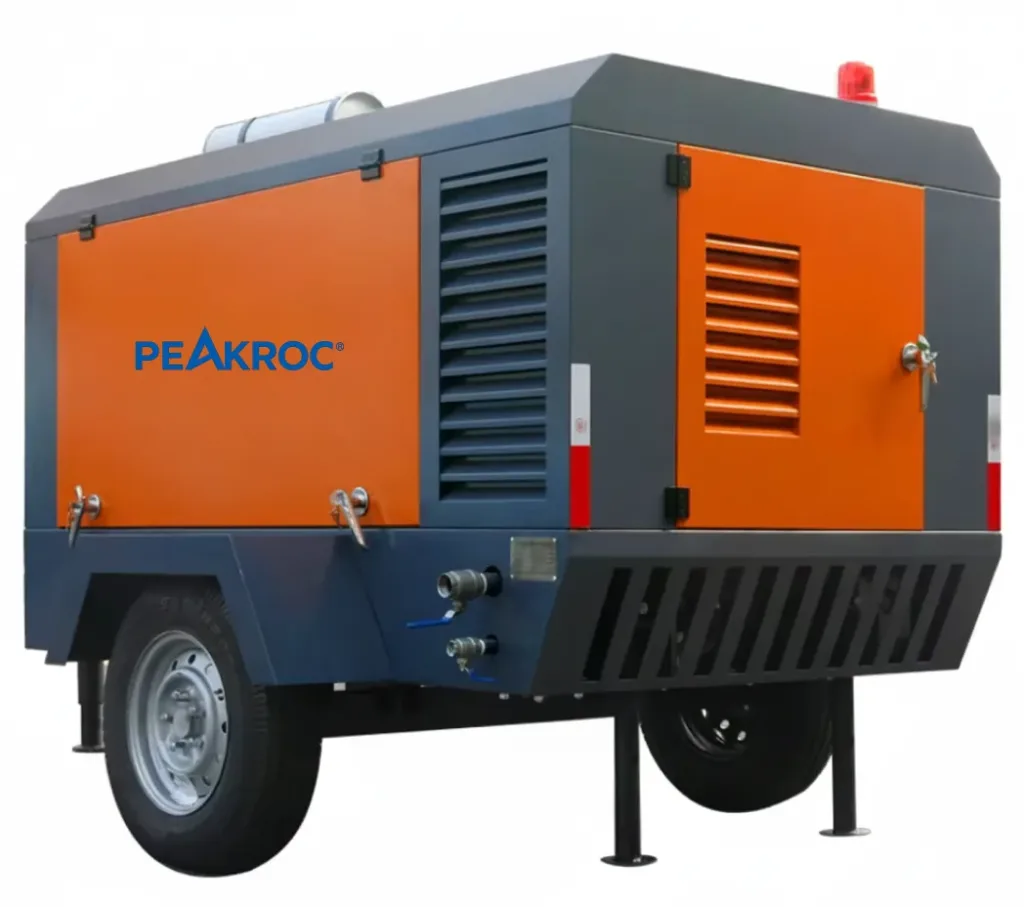
Diesel Drive
Diesel is usually easier to deploy quickly because it does not depend on spare electrical capacity inside the factory.
It can be positioned outside and used during:
- Sudden compressor-room failures
- Electrical work affecting the compressor room
- Remote production areas
- Short outages
- Projects where electrical installation would delay startup
Rental-industry operating guidance notes that diesel-driven systems are often the fastest way to restore supply after an emergency because they are independent of the plant grid.
The disadvantages are fuel logistics, local exhaust emissions, engine maintenance and usually higher noise.
A diesel compressor must also remain in a location with suitable ventilation and exhaust separation; the air intake must not pull contaminated engine exhaust into the compressed-air stream.
Electric Drive
For a longer project, electric drive can become more attractive when sufficient grid power is available.
It eliminates local diesel exhaust, reduces fuel handling and can lower noise and operating complexity. Rental-industry guidance suggests that when temporary operation extends beyond a short emergency period and a suitable grid connection exists, electric equipment can become the more practical configuration.
Peakroc’s current portable range includes electric configurations from approximately 6.2 to 22.5 m³/min across 7–18 bar, alongside diesel-driven units.
For either option, the electrical or fuel infrastructure must be treated as part of the temporary-air project rather than addressed after the compressor arrives.
Oil-Free or Oil-Injected Temporary Air?
The answer depends on what the factory uses compressed air for.
If air only powers conventional pneumatic cylinders or non-critical workshop tools, an oil-injected compressor with appropriate downstream treatment may be acceptable.
If compressed air contacts product, packaging, sensitive instrumentation or a process with strict contamination limits, the temporary supply must preserve the required air-quality specification.
ISO 8573-1:2010 provides the internationally recognized framework for expressing compressed-air purity according to particles, water and oil. The standard applies independently of where in the compressed-air system the quality is specified or measured.
Therefore, an RFQ should not simply say:
“We need clean temporary air.”
It should say something closer to:
“The temporary system must meet the required particle, water and oil limits at the factory connection point.”
That distinction is especially important for food, beverage, pharmaceutical, electronics, chemical and precision-manufacturing applications.
Case: Maintaining Production During a Beverage-Plant Shutdown
A supplier-published 2026 case describes a beverage facility planning a 10-day maintenance period in which the permanent utility equipment had to be taken offline.
The temporary package supplied 300 CFM of Class 0 oil-free air at 5 bar, together with other temporary utilities. It was installed and load-tested before production continued. The case reports that the facility maintained filling and packaging operations and estimated avoided downtime losses at approximately USD 1.4 million.
Because this is a supplier-published customer case rather than an independent controlled study, its financial result should not be applied to another factory.
The useful engineering lesson is simpler:
The temporary compressor was specified by flow, pressure and air quality—not by the size of the permanent machine being serviced.
Dryer and Filtration Should Be Sized as Part of the Package
A portable compressor producing the correct pressure and FAD may still be unsuitable if the plant requires dry process air.
Temporary treatment can include:
Aftercooling → bulk-water separation → dryer → particulate/coalescing filtration → final plant connection
The required dryer depends on the pressure dew point expected by the process.
A refrigerated dryer may be sufficient for many general factory-air systems. Processes requiring much drier air may require a desiccant system.
The key point is that the dryer and filters must be rated for:
- Actual temporary airflow
- Temporary operating pressure
- Maximum ambient conditions
- Required pressure dew point
- Required particle and oil limits
- Acceptable pressure drop
Treatment equipment adds resistance, so its pressure drop must also be included when setting compressor discharge pressure.
Case: Temporary Air During a Critical Electrical Shutdown
A 2026 chemical-industry case documented a large temporary oil-free system used while electrical work affected a critical plant utility.
The temporary installation delivered approximately 9,000 m³/h at 6.5 bar with a –40°C pressure dew point and used several compressors and dryers operating together.
Again, this is a supplier-reported project rather than an independent test.
Its transferable lesson is that large factory contingency systems may require multiple compressors plus engineered drying, rather than one oversized machine connected directly to the factory header.
Temporary Piping Can Make or Break the Project
Factories often position rental equipment outside the compressor room because of space, exhaust, heat, noise or installation access.
That can create 20, 50 or even 100 metres of temporary distribution before the air reaches the plant header.
Long, undersized hoses can create substantial pressure loss.
A temporary connection should be designed around:
- Required FAD through each pipe or hose section
- Maximum working pressure and temperature
- Suitable compressed-air-rated piping materials
- Full-bore valves and low-restriction fittings
- Drain points and condensate management
- Safe physical protection against vehicles and plant traffic
Do not use ordinary rigid PVC water pipe as an improvised compressed-air header. OSHA enforcement records document serious struck-by hazards from PVC piping failures in compressed-air service and identify metal or otherwise appropriately rated materials as safer alternatives.
For large temporary systems, several smaller hoses in parallel may sometimes be more practical than one very large temporary line, but the final arrangement should be engineered for flow balance and safe pressure rating.
Single Large Compressor or Multiple Smaller Compressors?
A single compressor simplifies controls, fuel supply and maintenance.
Multiple compressors provide flexibility.
For example, a factory needing approximately 30 m³/min may use one large machine or several smaller units in parallel depending on availability and risk tolerance.
Parallel compressors can provide:
Base capacity + trim capacity + standby capacity
This is valuable where a production shutdown would cost much more than the additional rental equipment.
A U.S. Department of Energy manufacturing case demonstrates the broader system principle: adding storage, pressure/flow control and a trim compressor helped stabilize plant pressure under varying demand. The factory eventually reduced operating pressure while maintaining production.
For temporary systems, multiple units also make maintenance easier because one machine can sometimes be isolated while the others continue supporting critical demand.
However, several compressors should not simply be connected together without a control strategy. Check valves, isolation valves, capacity control and pressure settings should prevent one machine from fighting another.
Test the System Before the Permanent Compressor Is Removed
A planned shutdown provides one major advantage over an emergency: time.
Use it.
The temporary package should ideally be connected and tested before the permanent system is isolated.
A commissioning test should verify:
- Temporary compressors can achieve the required header pressure under real demand.
- Flow remains adequate during major simultaneous production loads.
- Dryer and filtration performance meet the required process specification.
- Automatic drains, isolation valves and non-return valves operate correctly.
- The plant can switch between permanent and temporary supply without uncontrolled pressure loss.
- Operators know what to do if one temporary compressor stops.
Supplier-reported shutdown cases repeatedly emphasize installation, load testing and integration before production relies entirely on the rental utilities.
Emergency projects may not have this luxury, which is why a pre-engineered contingency plan is so valuable.
Build a Compressed-Air Contingency Plan Before the Breakdown
The best time to identify a temporary compressor connection is not while production is already stopped.
A contingency plan should document the minimum information required to deploy a replacement system quickly.
Record:
- Normal and peak FAD
- Minimum acceptable factory pressure
- Required ISO 8573-1 air quality and pressure dew point
- Preferred temporary compressor location
- Existing emergency connection size and flange or coupling
- Temporary pipe or hose route
- Available electrical power or diesel-fuel arrangements
- Required receiver, dryer and filtration
- Maximum acceptable downtime
- Startup, isolation and return-to-normal procedure
Industrial rental guidance specifically recommends contingency planning so that system requirements and risk can be evaluated before an emergency occurs.
For factories where one hour of lost production is extremely expensive, installing a permanent emergency connection point can be a relatively small investment compared with trying to modify the factory header during a breakdown.
Common Temporary Air Sizing Mistakes
Avoid these mistakes:
- Replacing compressor motor kW instead of calculating plant FAD.
- Adding every permanent compressor capacity together even though they never operate simultaneously.
- Selecting exactly the normal header pressure without allowing for temporary piping and treatment losses.
- Connecting process equipment to temporary air without verifying the required air-quality class.
- Assuming a receiver tank can make up for insufficient continuous compressor capacity.
- Waiting until the compressor fails before deciding where a temporary air system can be connected.
Temporary compressed air works best when the compressor is only one part of a planned system.
Practical RFQ Checklist
Provide the temporary compressor supplier with:
| RFQ information | Why it matters |
|---|---|
| Normal and peak air demand | Determines required FAD |
| Minimum factory-header pressure | Determines compressor pressure |
| Remaining permanent capacity | Prevents oversizing |
| Required air purity | Defines oil-free requirement and filtration |
| Required pressure dew point | Defines dryer technology |
| Project duration | Helps compare diesel and electric drive |
| Daily operating hours | Determines fuel/power and service planning |
| Temporary pipe length and size | Determines pressure loss |
| Connection type | Determines manifolds and adapters |
| Ambient conditions | Affects compressor and dryer performance |
| Electricity available | Determines electric-drive feasibility |
| Production criticality | Determines standby or N+1 strategy |
Peakroc’s Compressor Finder can be used to shortlist compressors by pressure, FAD and drive type before the complete temporary-air package is finalized.
Final Recommendation
Temporary factory compressed air should be engineered from the production process backward.
First determine how much air the operating factory actually needs.
Then subtract the dependable permanent capacity that will remain online.
Specify the minimum plant-header pressure and calculate pressure loss through the temporary dryer, filters, hoses and connection hardware.
Match air quality to the production process using measurable particle, water and oil requirements.
Choose diesel when rapid, independent deployment is the priority. Consider electric drive when the project is longer and adequate grid capacity is available.
Finally, design and test the connection, controls, isolation valves and changeover procedure before the factory depends on the temporary system.
The most useful question is not:
“What size rental compressor replaces our broken compressor?”
It is:
“What temporary compressed-air system will maintain the required FAD, pressure and air quality at the production header throughout the entire shutdown or emergency?”
That question leads to a far more reliable solution.
FAQ
How do I size a temporary air compressor for a factory?
Start with measured peak factory airflow, subtract the dependable capacity of permanent compressors that remain online, then add an engineering reserve appropriate to demand variation and risk. Select the temporary compressor by FAD at the required working pressure.
Can a portable diesel compressor supply a factory?
Yes, when its FAD, pressure and air quality are suitable and it is connected through correctly sized treatment equipment and compressed-air-rated piping. Diesel units are especially useful where rapid deployment or independence from plant electricity is required.
What pressure should a temporary factory compressor provide?
It must provide enough pressure to maintain the minimum required factory-header pressure after losses through dryers, filters, hoses, valves and temporary piping.
Does temporary factory air need to be oil-free?
Not always. It depends on the process. Product-contact, food, pharmaceutical, chemical, electronics and other contamination-sensitive applications may require oil-free air or a specified ISO 8573-1 purity class.
Do I need a dryer with a temporary compressor?
Use a dryer whenever the factory process requires a controlled pressure dew point. The temporary system should provide at least the same moisture quality required by the production process.
Can one large compressor replace several factory compressors?
Sometimes. However, multiple temporary compressors can offer staged capacity, better turndown and backup if one unit stops. The best arrangement depends on demand profile and the cost of downtime.
How far can a temporary compressor be installed from the factory?
There is no universal distance. Longer pipe or hose runs increase pressure loss, so diameter and layout must be sized for the required FAD. Measure pressure at the factory connection under full demand rather than relying only on the compressor gauge.
What should a factory compressed-air contingency plan include?
It should define required FAD, pressure, air quality, connection point, temporary piping route, compressor location, fuel or electrical supply, dryer and filters, commissioning procedure, standby strategy and changeover instructions.
Author

Mark Chen – Senior Mechanical Engineer, Peakroc®
Mark Chen is a senior mechanical engineer at Peakroc®, specializing in compressed air systems and drilling equipment for mining and construction applications. With over 15 years of field experience, he has led multiple projects on optimizing air delivery efficiency, equipment durability, and energy consumption.