
Key Takeaways
- 35 bar is approximately 508 PSI, but maximum pressure alone does not determine drilling performance. The compressor must also provide sufficient FAD at the required pressure.
- A 25 bar compressor may already be adequate for many water-well and DTH projects. Moving to 35 bar is normally justified by greater depth, groundwater back pressure, hard formations, larger hammers, or demanding hole-cleaning requirements.
- A 35 bar compressor should not automatically operate at maximum pressure from the surface. The correct pressure should follow the hammer specification, drilling depth, formation, and borehole conditions.
- Two-stage rotary screw compression is commonly used in the 35 bar class to manage the high compression ratio, temperature, efficiency, and continuous-duty requirements.
- Fuel consumption per hour is only one cost measure. Drilling contractors should also calculate fuel and compressor cost per meter drilled, per borehole, and per productive shift.
High-pressure drilling is not simply a matter of selecting the compressor with the highest bar rating. The compressor, DTH hammer, drill pipe, rig rotation system, hole diameter, formation, groundwater, hose layout, and operator settings must work as one system.
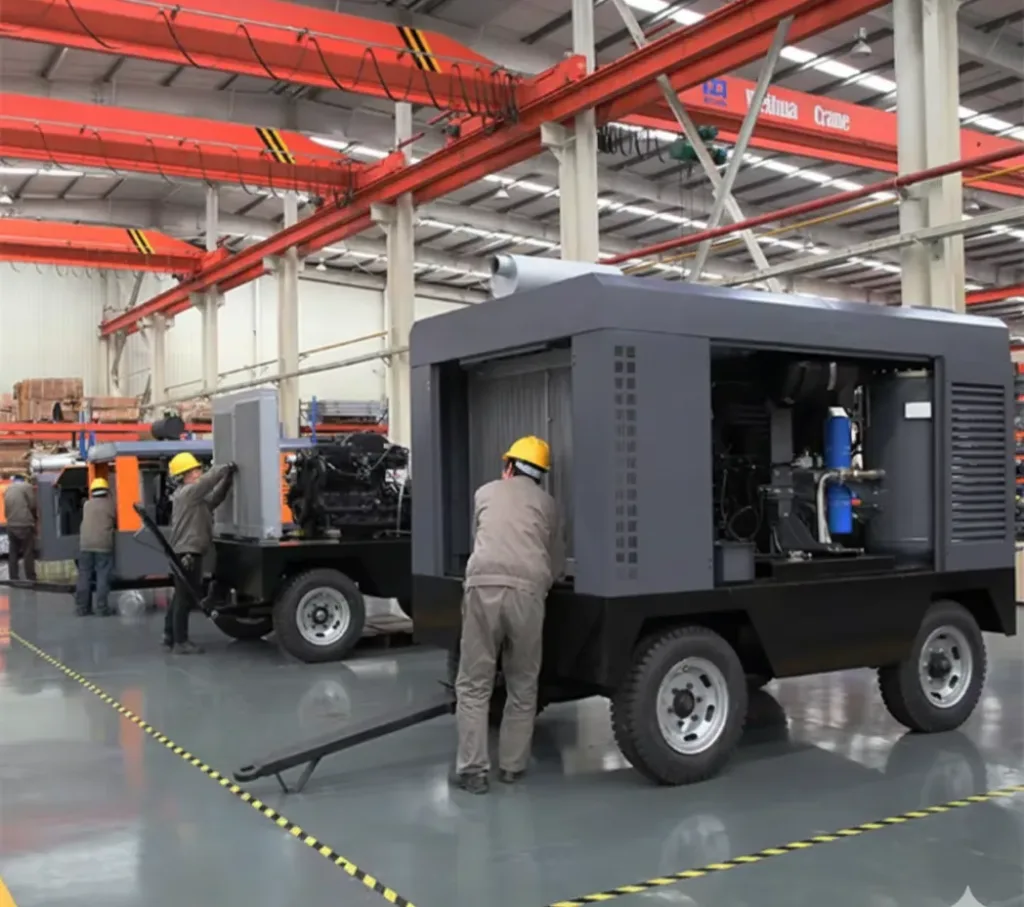
Peakroc® provides a range of portable diesel screw air compressors for mining, water wells, geothermal projects, quarrying, and foundation engineering. For demanding projects, buyers can compare the 34 m³/min, 25 bar portable diesel compressor with the 33 m³/min, 35 bar high-pressure compressor.
The correct choice begins with one question:
What resistance must the compressed air overcome before it reaches and exits the DTH hammer?
What Does a 35 Bar Portable Compressor Actually Provide?
A 35 bar portable compressor is designed to deliver compressed air at approximately 508 PSI. That places it above the common 20–25 bar class used in many conventional water-well and DTH projects.
Atlas Copco’s DrillAir portfolio covers approximately 13–40 bar and 19–44 m³/min, with applications including water wells, geothermal drilling, drill-and-blast, and ground engineering. Its Y35 product is a two-stage rotary screw compressor capable of producing air at 35 bar, while Sullair offers a 900 CFM model rated at 500 PSI, or about 34.5 bar.
However, the term “35 bar compressor” is incomplete unless the quotation also states:
FAD at 35 bar.
A compressor may produce a high flow at 15 or 20 bar but deliver less airflow when the pressure setting is increased. For example, the published Atlas Copco Y35 data shows about 659 l/s at 15 bar and about 580 l/s at 35 bar. This is why buyers must compare the complete pressure-and-flow curve rather than a maximum CFM figure taken from a lower pressure setting.
Why 25 Bar Is Often Enough
A 25 bar compressor provides approximately 363 PSI and can be a practical choice for many medium and deep water-well projects, quarry DTH work, foundation drilling, and geothermal boreholes.
The Peakroc® PRMD-3425, for example, is rated at 34 m³/min and 25 bar, equivalent to approximately 1,200 CFM at 363 PSI. It uses a 410 kW Cummins engine and is positioned for water wells, geothermal projects, high-pressure DTH drilling, oilfield operations, and foundation engineering.
A 25 bar compressor may remain the more economical choice when the hammer performs efficiently below that pressure, borehole back pressure remains manageable, hole cleaning is stable, and the project does not regularly encounter strong groundwater or exceptional depth.
The fact that a project is called “deep drilling” does not automatically mean it needs 35 bar. Hammer size, hole diameter, water conditions, pipe losses, and formation resistance matter more than a general depth label.
For a more detailed explanation of the 25 bar class, see why 25 bar portable diesel compressors are widely used for deep boreholes.
When 25 Bar Is Not Enough
The upgrade to 35 bar becomes reasonable when pressure available at the hammer falls below the level needed to maintain impact performance and clear the hole efficiently.
| Project condition | Why 25 bar may become limiting | What 35 bar can provide |
|---|---|---|
| Deep borehole with high back pressure | Pressure is lost through pipe friction, depth, water, and the hammer | Additional pressure reserve at the hammer |
| Strong groundwater inflow | The compressor must overcome water-column pressure while flushing cuttings | Better ability to maintain hammer operation and air lift |
| Extremely hard or abrasive rock | The hammer may need higher percussion pressure to sustain penetration | Greater available impact energy when the hammer permits it |
| Larger DTH hammer or wider hole | Larger tools may require both more flow and more pressure | Higher-pressure operating envelope with suitable FAD |
| Geothermal or deep foundation drilling | Formation changes and increasing depth create variable resistance | Greater flexibility across different drilling stages |
| RC or mineral exploration drilling | Sample return and deep-hole cleaning can demand sustained high pressure | Improved pressure margin before adding a booster |
These are selection directions rather than universal thresholds. A 35 bar machine cannot compensate for an incorrectly sized hammer, insufficient airflow, undersized drill pipe, damaged bit, poor rotation settings, or unstable rig feed.
Maximum Pressure Is Not the Correct Starting Pressure
One of the most important operating principles is that a 35 bar compressor does not need to run at 35 bar from the moment drilling begins.
Epiroc’s COP M6 operating guidance explains that percussion impact becomes faster and harder as pressure increases. It also warns that the full output of a modern 35 bar compressor may be excessive near the surface and could damage equipment; operators normally begin at lower pressure and increase it as drilling depth and counter-pressure rise.
This distinction matters because excessive pressure can create unnecessary stress on the hammer, bit, drill string, hoses, couplings, separator vessel, and compressor package. It can also increase fuel consumption without improving the penetration rate.
A high-pressure compressor should therefore be treated as a machine with available pressure reserve, not as a machine that must always operate at its maximum setting.
Variable-pressure control is especially useful for projects that move through loose overburden before entering competent rock. Atlas Copco’s Extended Pressure Range system, for example, allows selected high-pressure compressors to operate from approximately 15 to 35 bar, enabling lower pressure during overburden work and higher pressure as the hole becomes deeper.
Pressure and Airflow Perform Different Jobs
Pressure and airflow are related, but they are not interchangeable.
Pressure drives the hammer piston and helps overcome borehole resistance. Airflow carries cuttings from the bit face to the surface, cools the bit, cleans the hole, and supports air lifting in water-producing formations.
A compressor with sufficient pressure but inadequate flow may operate the hammer while failing to clean the borehole. Cuttings can accumulate around the bit, be reground repeatedly, increase wear, and eventually contribute to a stuck drill string.
A compressor with high flow but inadequate pressure may flush the upper section of the borehole effectively but fail to maintain hammer energy as depth and water back pressure increase.
Atlas Copco describes drilling performance as a balance between pressure and flow, while Epiroc’s hammer guidance states that an efficient compressed-air system requires sufficient volume and pressure, minimal pressure loss, the correct hose size, and minimal leakage between couplings.
The correct question is therefore not:
Do I need 25 bar or 35 bar?
It is:
How much FAD must reach this specific hammer at the required operating pressure under actual borehole conditions?
Why Two-Stage Compression Is Used at 35 Bar
Producing 35 bar continuously creates a much higher compression ratio than producing standard construction air at 7–10 bar.
In a two-stage rotary screw compressor, the total pressure increase is divided between two compression elements. This allows the package to manage high-pressure operation more effectively than simply forcing the entire pressure rise through one conventional stage.
The benefits can include improved temperature management, more appropriate rotor loading, stable high-pressure output, and better efficiency at demanding operating points. The exact result still depends on airend design, cooling, controls, engine matching, and maintenance.
Atlas Copco’s Y35 is officially described as a two-stage, oil-injected rotary screw compressor. Its published specification lists two compression stages, approximately 580 l/s at 35 bar, a 450 kW engine, and a maximum standard ambient rating of 47°C.
Epiroc also equips its Explorac 235 RC drilling rig with a two-stage compressor rated at 35 bar and 555 l/s, or approximately 1,250 CFM at 510 PSI. This demonstrates the use of two-stage compression in equipment designed for deep mineral exploration and high-productivity RC drilling.
Buyers should nevertheless confirm the exact stage count in the supplier’s technical sheet. The words “high-pressure screw compressor” do not automatically prove that a machine uses two stages.
Matching a 35 Bar Compressor to the DTH Hammer
The DTH hammer manufacturer’s performance data should be the primary sizing reference.
The chart should identify the hammer’s recommended pressure range and air consumption at each operating pressure. Air consumption often rises as pressure increases, so a compressor that appears adequate at 20 bar may not supply enough FAD at 30–35 bar.
Hammer selection also affects the drill rig. Higher percussion pressure must be matched with suitable rotation speed, rotation torque, feed force, pullback capacity, drill-pipe diameter, lubrication, and hose ratings.
Epiroc describes four primary DTH operating parameters: impact, feed, rotation, and flushing. These settings must work together; increasing pressure alone does not guarantee stable drilling.
The compressor sizing margin should cover real losses and changing conditions, but it should not be arbitrary. Excessive oversizing adds engine power, fuel consumption, transport weight, purchase cost, and maintenance expense.
Deep Water-Well Drilling
Deep water-well drilling is one of the main applications for 35 bar portable compressors.
As a borehole becomes deeper, the air travels through a longer drill string, encounters more friction, and must lift cuttings over a greater vertical distance. Groundwater adds back pressure and can make hole cleaning increasingly difficult.
At that stage, a compressor with additional pressure reserve can help maintain effective hammer operation. The extra pressure is especially valuable when the static water level rises, the formation produces large amounts of water, or the borehole diameter requires a high upward air velocity.
However, hole depth alone does not determine the compressor. A dry, narrow hole in competent rock can have different requirements from a shallower but wide, heavily water-producing borehole.
Atlas Copco positions its high-pressure DrillAir range for water-well and geothermal drilling and states that the product family reaches working pressures up to 40 bar. The company also emphasizes that the correct machine depends on drilling depth and hammer size rather than using one compressor for every project.
Hard Rock and Mining DTH Applications
Hard and abrasive formations place heavy demands on the complete drilling system. The hammer needs enough pressure to deliver useful impact energy, while the compressor must provide sufficient airflow to remove dense cuttings from the bottom of the hole.
Higher pressure can increase penetration when the hammer and bit are designed for it, but performance also depends on bit condition, button geometry, rotation, feed, flushing, and rock characteristics.
In one manufacturer-reported Epiroc comparison, a COP M6 hammer using a 165 mm bit maintained approximately 28 bar in extremely hard and abrasive rock. The reported penetration rate was 18.76 m/h, nearly 20% higher than the comparison hammer during that particular test. This is a product-specific field result rather than a universal guarantee, but it illustrates the importance of stable operating pressure and correct hammer matching.
A 35 bar compressor may therefore be valuable in hard-rock production drilling even when the hammer normally operates below the full 35 bar setting. The extra capacity gives the operator room to maintain pressure as depth, formation resistance, and system losses increase.
Geothermal, Foundation, and Exploration Drilling
Geothermal drilling often moves through several types of formation and may require different pressure settings during one borehole. Lower pressure can be preferable through unstable overburden, while higher pressure may become useful in deep competent rock or water-producing sections.
Foundation drilling, micropiles, anchors, and jet-grouting support can also require high pressure, but flow and air treatment depend strongly on the drilling method and tooling.
In RC mineral exploration, high-pressure air is used to return samples through the inner tube. Epiroc’s Explorac 235 combines a 35 bar, 1,250 CFM two-stage compressor with a system intended for RC drilling to depths of up to approximately 450 meters under stated conditions.
| Application | Main reason for considering 35 bar | Additional sizing factor |
|---|---|---|
| Deep water wells | Water and depth-related back pressure | Hole diameter, water yield, pipe ID |
| Hard-rock DTH drilling | Maintaining percussion pressure | Hammer rating, bit size, rock abrasiveness |
| Geothermal drilling | Variable formations and deep competent rock | Overburden control, final borehole depth |
| RC exploration | Deep sample return and hole cleaning | Inner tube, sample system, borehole diameter |
| Foundation engineering | High resistance and specialist tooling | Drilling method, tooling, grout procedure |
Hose, Coupling, and Drill-Pipe Pressure Loss
A compressor producing 35 bar at its outlet does not guarantee 35 bar at the hammer.
Pressure is lost through the main hose, couplings, swivels, valves, lubricator, drill pipe, and internal passages of the hammer. The longer and smaller the flow path, the greater the potential restriction.
Epiroc’s operating instructions emphasize correct hose sizing, secure connections, minimal leakage, and compliance with local high-pressure hose regulations. The guidance specifically highlights additional safety requirements when operating DTH equipment above 10 bar.
For a high-flow 35 bar system, adapting a large compressor outlet to a small hose can waste much of the compressor’s capability. Increasing the pressure setting to compensate may only increase fuel consumption and stress upstream components.
The hose, manifold, lubricator, valves, and drill-pipe internal diameter should all be checked against the expected FAD.
Fuel Consumption and Cost per Meter
A 35 bar compressor requires substantial engine power. Fuel consumption can therefore be one of the largest project costs.
Sullair’s published specification for its 900 CFM, 500 PSI model lists full-load fuel consumption of approximately 90.8 L/h. Its 1,150 CFM, 350 PSI version is listed at approximately 92.7 L/h. These values are specific to those configurations and should not be applied directly to another brand or model.
Atlas Copco reports that its Y35 can operate from 15 to 35 bar and presents a manufacturer claim of less than 2.2 liters of fuel per meter drilled, depending on operating parameters. This metric is more useful than liters per hour because it connects fuel cost to drilling productivity, although the result will vary with depth, formation, operator technique, hammer, and borehole size.
The most useful project calculation is:
Compressor cost per meter drilled =
Fuel cost
+ scheduled maintenance
+ wear parts
+ ownership cost
+ downtime cost
÷ total productive meters drilled
A 35 bar compressor that uses more fuel per hour can still reduce cost per meter if it improves penetration, hole cleaning, and borehole completion time.
The opposite is also true. Running a large 35 bar machine on a project that only needs 20–25 bar can increase cost without producing a measurable productivity benefit.
Peakroc® 25 Bar vs 35 Bar Product Direction
Peakroc® currently publishes a 34 m³/min, 25 bar model and a 33 m³/min, 35 bar model for demanding drilling applications.
| Peakroc® model direction | FAD and pressure | Engine | Best-fit direction |
|---|---|---|---|
| PRMD-3425 portable compressor | 34 m³/min at 25 bar; approximately 1,200 CFM at 363 PSI | 410 kW Cummins | Deep water wells, geothermal work, high-pressure DTH, oilfield and foundation projects |
| PRMD-3335 high-pressure compressor | 33 m³/min at 35 bar; approximately 1,160 CFM at 508 PSI | 522 kW Cummins | Deeper wells, hard-rock DTH, geothermal, RC-related support and high-back-pressure drilling |
The 25 bar model actually provides slightly more nominal airflow, while the 35 bar model provides substantially greater pressure and uses a larger engine. This demonstrates why buyers should not assume that the more powerful machine always has the highest m³/min figure.
The 35 bar model is the better direction only when the project can use the additional pressure. For many conventional wells, the 25 bar unit may deliver a lower purchase price, lower transport weight, and lower operating cost.
Cooling, Filtration, and Remote-Site Maintenance
High-pressure compression creates a demanding thermal load. Cooling-system cleanliness is therefore critical.
Dust on the radiator or oil cooler reduces heat transfer and can lead to higher discharge temperature, lubricant degradation, alarms, and shutdowns. Intake-filter restriction can reduce available airflow and increase fuel consumption.
Atlas Copco’s Y35 reference data lists a maximum standard ambient rating of approximately 47°C, reducing to 45°C with the aftercooler configuration. The same document describes electronic regulation of inlet-valve position, engine speed, pressure, flow, and blow-off control.
Remote projects should not wait for a failure before ordering service components. Filters, separator elements, compressor lubricant, engine service parts, sensors, valves, hoses, and suitable high-pressure fittings should be planned before mobilization.
The correct service interval depends on the manufacturer’s instructions and the environment. Dust, heat, poor diesel quality, long operating shifts, and delayed cooler cleaning can require shorter inspection intervals than clean standard conditions.
Common Selection Errors
One common mistake is choosing 35 bar solely because the borehole is described as deep. Depth is important, but the hammer, hole diameter, groundwater, pipe size, and formation determine whether the additional pressure is useful.
Another mistake is comparing airflow at different pressures. A supplier may promote a high CFM figure measured at a lower pressure even though the project requires the machine to operate near 35 bar.
Some contractors also attempt to compensate for a small hose or leaking connections by raising the compressor pressure. This increases fuel consumption while leaving the real restriction unchanged.
Running maximum pressure too early is another risk. As Epiroc’s operating guidance notes, excessive impact energy near the surface may damage equipment. Pressure should be increased according to actual drilling resistance rather than set permanently at the compressor’s limit.
Practical Buying Checklist
| Information required | Why it matters |
|---|---|
| DTH hammer brand and model | Confirms pressure and air-consumption range |
| Hole diameter and maximum depth | Influences flushing volume and back pressure |
| Rock formation | Affects penetration, bit wear, and pressure requirement |
| Expected groundwater conditions | Determines water-column resistance and air-lift demand |
| Drill-pipe inside diameter | Influences pressure loss and usable FAD |
| Hose diameter and total length | Identifies distribution loss before the rig |
| Site elevation and temperature | Allows engine and airflow derating |
| Required FAD at 25, 30, and 35 bar | Enables an equal technical comparison |
| Fuel use at full and partial load | Supports cost-per-meter calculation |
| Compression stages and airend design | Confirms suitability for continuous high-pressure duty |
| Included service parts | Reduces downtime after delivery |
| Final delivery location and chassis | Determines transport and site mobility |
The final quotation should also state the engine model, emissions standard, operating weight, fuel-tank capacity, outlet sizes, ambient-temperature rating, separator-vessel certification, warranty procedure, commissioning scope, and recommended spare-parts package.
Use Peakroc’s compressor selection support to compare pressure, FAD, hammer demand, drilling conditions, and transport requirements before placing an order.
Final Recommendation
A 35 bar portable diesel screw compressor is not simply a larger version of a 25 bar machine. It belongs to a more demanding operating class involving higher compression ratios, greater engine power, stronger high-pressure components, and often two-stage compression.
Choose 35 bar when the project genuinely requires additional pressure reserve for deep boreholes, strong groundwater, hard formations, larger high-pressure hammers, geothermal drilling, or RC exploration.
Choose 25 bar when it already supplies the required pressure and FAD at the hammer. In that situation, the smaller pressure class may offer a better balance of purchase cost, fuel use, weight, maintenance, and cost per meter.
Most importantly, do not operate a 35 bar compressor at maximum pressure by default. Match pressure progressively to the hammer, depth, formation, and back pressure.
The correct compressor is the one that delivers enough pressure and FAD at the bottom of the hole—not merely the machine with the largest number on its data sheet.
FAQ
Is 35 bar the same as 500 PSI?
Approximately. A pressure of 35 bar equals about 508 PSI, while 34.5 bar is approximately 500 PSI.
When is a 25 bar compressor not enough for DTH drilling?
A 25 bar compressor may become insufficient when borehole depth, groundwater, pipe losses, hard formations, or a larger hammer prevent the required pressure and airflow from reaching the hammer.
Does a 35 bar compressor drill faster than a 25 bar compressor?
It can improve penetration when the hammer and borehole conditions require additional pressure. It will not automatically drill faster if the hammer is already operating efficiently at 25 bar or if airflow, bit condition, rotation, or flushing is the real limitation.
Should a 35 bar compressor always operate at maximum pressure?
No. High pressure near the surface may create excessive impact energy. Operators should begin at the hammer manufacturer’s recommended pressure and increase it as depth and back pressure require.
Why are two-stage screw compressors used for 35 bar applications?
Two-stage compression divides the total pressure increase between two compression elements, making it more suitable for managing high compression ratios, temperature, stability, and continuous high-pressure operation.
How much airflow is needed with a 35 bar DTH compressor?
The required FAD depends on hammer size, operating pressure, hole diameter, drill-pipe size, depth, groundwater, altitude, and flushing demand. The hammer manufacturer’s air-consumption chart should be the starting point.
Is a 35 bar compressor suitable for geothermal drilling?
Yes. A 35 bar compressor can provide useful pressure reserve for deep geothermal boreholes and changing formations. The required flow and pressure must still be matched to the drilling method and hammer.
How should I choose between the Peakroc® 25 bar and 35 bar models?
Choose according to the hammer’s pressure and FAD requirements, maximum depth, groundwater, geology, pipe diameter, site elevation, and operating cost. The 25 bar model offers slightly higher nominal airflow, while the 35 bar model provides greater pressure reserve.
Author

Mark Chen – Senior Mechanical Engineer, Peakroc®
Mark Chen is a senior mechanical engineer at Peakroc®, specializing in compressed air systems and drilling equipment for mining and construction applications. With over 15 years of field experience, he has led multiple projects on optimizing air delivery efficiency, equipment durability, and energy consumption.