
Key Takeaways
A high flow centrifugal compressor for steel plants is a fixed, industrial compressor system designed for large-volume, continuous compressed air demand. It is not a mobile air compressor and is not usually used for temporary jobsite work. Instead, it is installed in a central compressor room or utility station to support long-running steel production processes.
Steel plants need compressed air for many critical areas, including instrument air, pneumatic controls, process air, utility air, dust collection, material handling, air separation support, maintenance systems, and auxiliary equipment around blast furnaces, basic oxygen furnaces, electric arc furnaces, rolling mills, and finishing lines.
The main advantages of centrifugal compressors in steel manufacturing are:
- High flow capacity for large plant-wide air demand
- Oil-free compression for cleaner air and lower oil carryover risk
- Continuous-duty performance for 24/7 steel production
- High efficiency at stable load compared with many smaller compressor combinations
- Lower mechanical wear because centrifugal machines have fewer major moving parts in the compression path
For temporary or mobile applications around steel plants, Peakroc® provides portable diesel screw air compressors, electric rotary screw compressor solutions, portable diesel compressor selection guidance, and compressor selection support. However, for a steel plant’s main high-flow central air station, a fixed oil-free centrifugal compressor is usually the more appropriate technology.
What Is a High Flow Centrifugal Compressor?
A centrifugal compressor uses a high-speed impeller to accelerate air. The air then passes through diffuser and volute sections, where velocity is converted into pressure. Unlike positive displacement compressors, such as screw or piston compressors, centrifugal compressors are dynamic machines.
This design makes centrifugal compressors especially suitable for large flow rates and steady operating conditions. In a steel plant, where compressed air demand can be continuous and large, centrifugal compressors are often used as base-load machines in a central compressed air station.
Most industrial centrifugal air compressors used for plant air are oil-free compressors. Oil is used in the bearing and gear system, but it is kept away from the compression chamber. This reduces the risk of oil entering the compressed air network.
Why Steel Plants Need High Flow Compressed Air
Steel plants are among the most demanding industrial environments for compressed air. Equipment operates continuously, production areas are harsh, and downtime can be expensive. A compressed air system must provide stable pressure and reliable air delivery across multiple departments.
Compressed air may be used for:
- Pneumatic control valves and actuators
- Instrument air systems
- Dust collector pulse-jet cleaning
- Material handling and air conveying
- Burner and furnace auxiliary systems
- Maintenance tools and workshop air
- Rolling mill and finishing line equipment
- Air separation plant support
- Emergency or backup utility air
In a small workshop, a screw compressor may be enough. In a steel mill, plant-wide demand may reach thousands or tens of thousands of cubic meters per hour. This is where centrifugal technology becomes attractive.
Main Steel Plant Applications
Central Utility Air Station
The most common application is the steel plant’s central compressed air station. This station supplies air to multiple areas of the facility through a large distribution network.
A centrifugal compressor is suitable when demand is large, relatively stable, and continuous. Instead of operating many smaller machines, a plant may use one or more centrifugal compressors as base-load units, with screw compressors or other machines used for trimming and backup.
The goal is stable air supply with lower energy cost per unit of compressed air.
Instrument Air and Control Air
Instrument air is used for pneumatic valves, control systems, actuators, dampers, and automation equipment. In steel plants, these systems must be reliable because control air failure can affect furnace operation, material flow, environmental systems, and safety-related equipment.
Oil-free air is valuable because oil carryover can contaminate instruments, clog small orifices, damage valves, and reduce control accuracy. A centrifugal compressor combined with dryers and filters can support a stable instrument air system.
Blast Furnace, BOF, and EAF Auxiliary Systems
Blast furnaces, basic oxygen furnaces, and electric arc furnaces rely on many auxiliary systems. Compressed air may not be the main process gas in every furnace operation, but it supports control, purging, cleaning, pneumatic conveying, instrumentation, and maintenance operations around these systems.
In these high-temperature areas, reliability and clean air are important. A central high-flow oil-free compressor helps reduce the risk of oil contamination in air lines and improves long-term system stability.
Dust Collection and Environmental Systems
Steel plants generate dust, scale, and particulate matter. Dust collectors often use compressed air for pulse-jet bag cleaning. If compressed air is unstable or wet, dust collector performance can suffer. Moisture and oil can also affect filter bags and valves.
A high-flow compressor with proper air treatment can support stable dust collector operation across sintering, steelmaking, casting, rolling, and finishing areas.
Air Separation and Process Support
Many steel plants operate or connect to air separation systems for oxygen, nitrogen, and argon supply. Centrifugal compressors are widely used in large gas and process systems because they can handle high flows and continuous operating conditions.
For air separation support or process gas systems, the compressor must be selected according to flow, pressure, gas composition, cooling method, and duty cycle. These applications may require customized engineering beyond standard plant air.
Why Oil-Free Air Matters in Steel Plants
Oil contamination in a steel plant compressed air system can create several problems. It can coat piping, foul valves, damage instruments, affect filters, increase maintenance, and create safety concerns in certain areas.
Oil-lubricated screw compressors can deliver good air quality when filtration is maintained properly. However, they still introduce oil into the compression process, and downstream filters must remove aerosols and oil vapor. Over time, filter saturation, high temperature, or maintenance delays may increase oil carryover risk.
Oil-free centrifugal compressors reduce this risk at the source. Because no oil is injected into the compression chamber, the air path is cleaner. This is especially useful for central utility air, instrument air, and applications where oil contamination would increase maintenance cost.
Centrifugal vs. Screw Compressors in Steel Plants
Centrifugal compressors and screw compressors both have a place in steel plant compressed air systems. The correct choice depends on flow, load profile, pressure, air quality, and control strategy.
| Factor | Centrifugal Compressor | Screw Compressor |
|---|---|---|
| Best flow range | High flow | Small to medium flow |
| Load profile | Best at stable, continuous demand | Good for variable demand |
| Air quality | Often oil-free | Oil-free or oil-injected options |
| Efficiency | Strong at large stable loads | Strong when properly sized or VSD-controlled |
| Mobility | Fixed installation | Fixed or portable options |
| Maintenance | Fewer compression-stage wear parts | More common service familiarity |
| Best steel plant role | Central base-load air station | Trim, backup, local utility, mobile work |
A common steel plant strategy is to use centrifugal compressors for base load and screw compressors for trim load or local demand. This helps the plant avoid running a large centrifugal machine inefficiently during low-demand periods.
Key Selection Factors
Flow Rate
Flow rate is the first selection point. Steel plants should calculate total demand from all compressed air users, including base load, peak load, leakage, future expansion, and backup requirements.
The compressor should not be selected only by nameplate power. It should be selected by actual air demand at required pressure and air quality.
Working Pressure
Many plant air systems operate around 6–8 bar, but steel plants may have special areas that require higher or more stable pressure. The higher the pressure, the more energy the compressor uses.
Avoid overspecifying pressure. If only one department needs higher pressure, it may be more efficient to use a local booster rather than raise the pressure of the entire plant network.
Load Profile
Centrifugal compressors perform best when they operate near an efficient load point. Steel plants should review hourly, daily, and seasonal air demand.
Important questions include:
- Is demand stable or highly variable?
- Are there production peaks during certain shifts?
- Are some lines stopped during maintenance windows?
- Is there a need for backup during furnace or rolling mill operation?
A well-designed system may include multiple compressors and a master controller to sequence machines efficiently.
Air Quality
Steel plants should define air quality by application. Instrument air, process air, and general utility air may require different dryness, filtration, and oil limits.
Air treatment may include aftercoolers, refrigerated dryers, desiccant dryers, pre-filters, after-filters, condensate drains, and dew point monitoring. Oil-free compression is important, but it does not remove the need for water and particle control.
Cooling System
Large centrifugal compressors often use water cooling. Steel plants must evaluate cooling water availability, water quality, cooling tower capacity, heat exchanger maintenance, and seasonal temperature changes.
Poor cooling can reduce efficiency and reliability. In high-temperature steel environments, cooling system design should be treated as part of the compressor selection, not as an afterthought.
Control and Sequencing
A high-flow compressor station should be controlled as a system. Multiple compressors must be sequenced to match demand without excessive blow-off, unloaded running, or pressure fluctuation.
Modern control systems can help coordinate centrifugal and screw compressors, reduce artificial demand, and keep discharge pressure closer to the real requirement.
Energy Efficiency in Steel Plant Air Systems
Compressed air is expensive. In steel plants, the electricity cost of a compressor station can be significant, especially when machines operate continuously.
Energy improvement should focus on:
- Reducing unnecessary pressure
- Repairing leaks
- Correctly sizing compressors
- Sequencing machines properly
- Reducing pressure drops
- Maintaining coolers and filters
- Recovering waste heat where practical
Centrifugal compressors can be efficient at large stable flows, but they can also waste energy if they operate far from the correct load point or blow off excess air. The best results come from matching the compressor station to the plant’s actual demand profile.
Air Treatment and Distribution
A steel plant compressed air system does not end at the compressor discharge. The distribution network can create pressure drop, moisture problems, leaks, and uneven pressure at distant users.
A proper system should include:
- Correctly sized headers
- Low pressure-drop filters
- Reliable condensate drains
- Appropriate dryers
- Isolation valves by area
- Dew point and pressure monitoring
- Leak inspection access
- Adequate receiver storage where needed
For instrument air, moisture control is especially important. Wet air can damage valves and instruments, especially in outdoor or high-temperature areas where cooling and condensation happen in the pipework.
Maintenance Considerations
Centrifugal compressors are reliable, but they still require disciplined maintenance. Steel plant environments can expose compressor rooms to dust, heat, vibration, and cooling water issues.
Maintenance should include:
- Inlet air filter inspection
- Intercooler and aftercooler cleaning
- Lubrication system checks
- Gear and bearing monitoring
- Vibration analysis
- Seal inspection
- Control valve calibration
- Cooling water system maintenance
Because centrifugal compressors are high-value base-load assets, condition monitoring is important. Vibration, temperature, pressure, and oil analysis can help identify problems before they cause shutdowns.
Practical Case Scenario: Replacing Multiple Aging Compressors
A steel mill may have several old oil-lubricated compressors feeding one large network. The plant faces oil carryover, unstable pressure, high maintenance cost, and rising energy bills.
A high-flow oil-free centrifugal compressor station can improve this situation if demand is large and steady. The plant may use centrifugal compressors for base load and keep one smaller screw compressor for trim demand or backup.
Expected benefits may include:
- Lower oil contamination risk
- More stable pressure
- Reduced maintenance from aging machines
- Lower compressed air energy cost
- Better air quality for instruments and controls
The success of this upgrade depends on system-level work. If leaks, high pressure settings, and undersized piping remain, the new compressor alone will not solve every problem.
Practical Case Scenario: Steel Plant Dust Collection
A steel plant uses pulse-jet dust collectors across several production areas. The system experiences weak cleaning pulses, high pressure drop across filter bags, and frequent valve maintenance.
The problem may not be the dust collector alone. It may be unstable compressed air pressure, water in the lines, oil contamination, or undersized headers.
A high-flow centrifugal compressor with proper dryers, filters, receiver storage, and pipe sizing can help provide more stable clean air for dust collector operation. However, the system must be engineered around peak pulse demand and pressure recovery time.
Practical Case Scenario: Instrument Air Reliability
A rolling mill has frequent pneumatic control valve problems. Operators find oil and moisture in some air lines. The plant currently uses oil-lubricated compressors with aging filters and poor drainage.
Switching to oil-free central compression, improving drying, and adding better point-of-use filtration can reduce contamination risk. The plant should also monitor dew point and inspect low points in the distribution system.
For steel plants, instrument air reliability is often more important than the price of the compressor itself. A control air failure can affect production stability and safety.
When a Centrifugal Compressor Is Not the Best Choice
A high-flow centrifugal compressor is not always the correct solution. It may not be suitable when air demand is small, highly intermittent, or located far from the central network.
Other compressor types may be better when:
- Demand is small or local
- Frequent start-stop operation is required
- The load changes sharply throughout the day
- Mobile compressed air is required
- The application needs high pressure but low flow
- The plant needs temporary air during shutdown maintenance
For local maintenance, pipeline blowing, steel structure sandblasting, or temporary plant air, a portable screw compressor is usually more practical than a centrifugal compressor.
Where Peakroc Portable Compressors Fit
Peakroc® does not position portable screw compressors as a replacement for a steel plant’s main high-flow centrifugal air station. The technologies serve different purposes.
For central air stations, choose a fixed oil-free centrifugal compressor.
For temporary or mobile steel plant work, Peakroc portable compressors can be useful.
Typical Peakroc-related applications in and around steel plants include:
| Steel Plant Need | Suitable Peakroc Direction |
|---|---|
| Shutdown maintenance air | Portable diesel screw compressor |
| Sandblasting steel structures | 8–13 bar high-flow portable compressor |
| Pipeline blowing and purging | Large-flow portable diesel compressor |
| Emergency backup air | Trailer-mounted portable compressor |
| Low-emission indoor maintenance | Portable electric screw compressor |
| Remote yard repair | Diesel mobile compressor |
For example, a steel plant contractor may use a portable compressor for blasting and repainting steel structures, cleaning pipelines, or supporting maintenance during shutdown. These are mobile jobsite applications, not central utility air station duties.
Product Direction for Steel Plants
For a main steel plant compressor room, the most suitable product direction is:
Oil-Free Centrifugal Air Compressor
Best for high-flow central plant air, instrument air, and continuous utility air.
Multistage Centrifugal Compressor
Best for higher pressure or specialized process air duties, especially where multiple compression stages and cooling are required.
Integrally Geared Centrifugal Compressor
Best for custom process requirements, air separation support, and large engineered systems.
Compressor Station with Dryer and Filtration
Best for complete air quality control, especially where moisture, particles, and oil limits are defined.
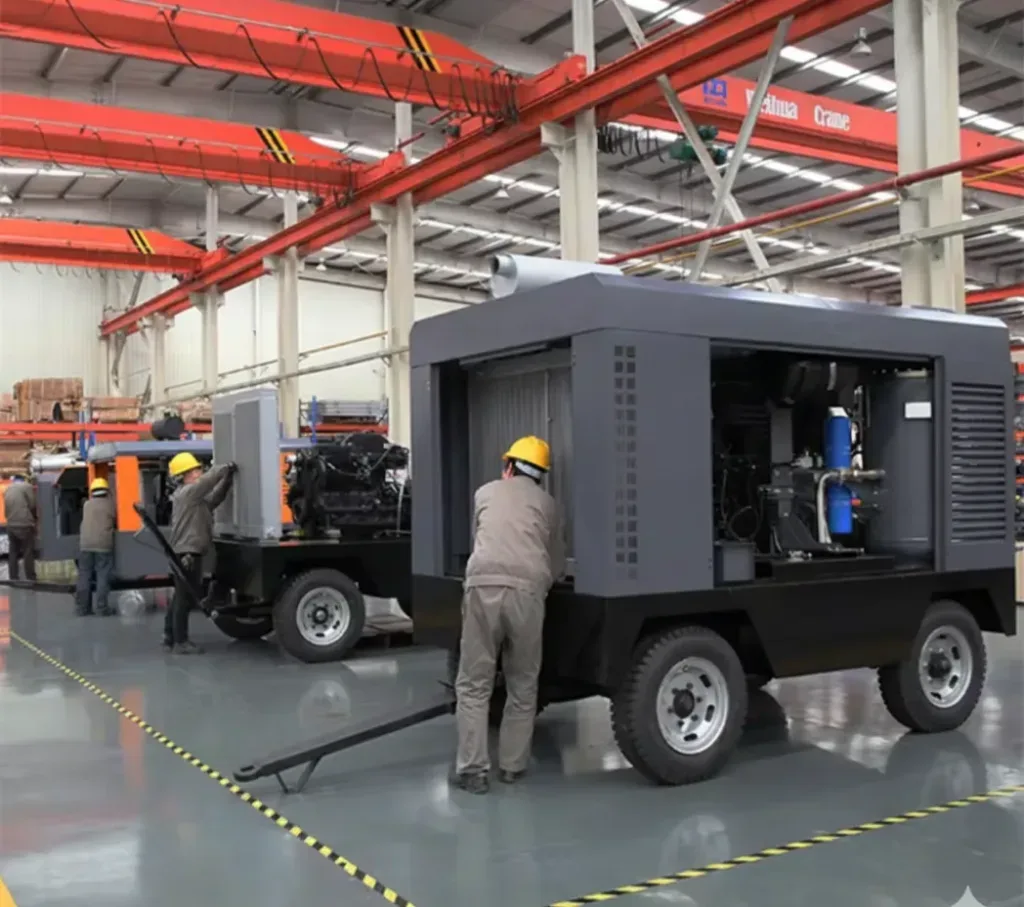
Portable Screw Compressor
Best for temporary steel plant maintenance, sandblasting, pipeline work, and emergency backup.
Buying Checklist
Before selecting a high flow centrifugal compressor for a steel plant, confirm:
| Question | Why It Matters |
|---|---|
| What is the total plant air demand? | Determines compressor capacity |
| Is demand stable or variable? | Determines centrifugal suitability and control strategy |
| What pressure is required? | Impacts energy cost and compressor selection |
| What air quality is needed? | Determines oil-free, dryer, and filter requirements |
| Is the compressor for central air or local use? | Determines fixed centrifugal vs portable screw |
| What cooling water is available? | Impacts reliability and installation |
| What redundancy is required? | Protects continuous production |
| Are leaks and pressure drops under control? | Prevents oversizing and wasted energy |
The selection should be based on a complete compressed air audit, not only a single compressor quotation.
Final Recommendation
A high flow centrifugal compressor for steel plants is best suited for central air stations that require large-volume, oil-free, stable compressed air for continuous production. It is especially suitable for plant utility air, instrument air, process air support, dust collection systems, and large steel manufacturing facilities with steady demand.
For blast furnaces, BOF, EAF, rolling mills, air separation support, and plant-wide utilities, the compressor should be selected based on flow, pressure, air quality, cooling, load profile, control strategy, and redundancy.
Centrifugal compressors are not the best solution for every steel plant task. For temporary maintenance, steel structure sandblasting, pipeline blowing, emergency backup, or mobile work inside the plant, portable screw compressors are often more flexible.
The best system is not simply the largest compressor. It is the combination of correct compressor type, proper air treatment, efficient control, good distribution piping, leak management, and reliable maintenance planning.
FAQ
1. What is a high flow centrifugal compressor for steel plants?
It is a fixed industrial compressor designed to supply large-volume compressed air for steel plant central air stations, instrument air, process air, utility air, dust collection, and continuous production support.
2. Why are centrifugal compressors used in steel plants?
They are used because they can deliver high airflow, oil-free compressed air, stable continuous operation, and good efficiency for large plant-wide air demand.
3. Are centrifugal compressors oil-free?
Many industrial centrifugal air compressors are oil-free in the compression chamber. Oil is used for bearings and gears but is kept separate from the compressed air path.
4. What steel plant applications use centrifugal compressors?
Common applications include central utility air, instrument air, pneumatic controls, dust collector cleaning, process air, air separation support, rolling mill systems, and auxiliary systems around blast furnaces, BOF, and EAF operations.
5. Is a centrifugal compressor better than a screw compressor for steel plants?
For high-flow, stable, continuous central air demand, a centrifugal compressor is often better. For smaller, variable, local, or mobile applications, a screw compressor may be more practical.
6. What pressure range is common for steel plant centrifugal air compressors?
Many plant air systems operate around 6–8 bar, but the exact pressure depends on the process, distribution system, instrument air requirements, and plant design.
7. Can Peakroc portable compressors replace a steel plant centrifugal compressor?
No. Peakroc portable screw compressors are not a replacement for a main high-flow centrifugal air station. They are better suited for temporary air supply, steel plant maintenance, sandblasting, pipeline blowing, emergency backup, and mobile jobsite work.
8. How should a steel plant choose a centrifugal compressor?
Start with an air audit. Confirm total flow demand, pressure, load profile, air quality, cooling water, redundancy, control strategy, piping pressure drop, and future expansion before selecting the compressor.
Author

Mark Chen – Senior Mechanical Engineer, Peakroc®
Mark Chen is a senior mechanical engineer at Peakroc®, specializing in compressed air systems and drilling equipment for mining and construction applications. With over 15 years of field experience, he has led multiple projects on optimizing air delivery efficiency, equipment durability, and energy consumption.