
Key Takeaways
An electric portable air compressor is a mobile compressed-air solution powered by an electric motor instead of a diesel engine. It is designed for jobsites where compressed air is needed, but diesel exhaust, high noise, fuel handling, or indoor ventilation problems are difficult to manage.
For modern construction, municipal work, tunneling, excavation, indoor repair, plant maintenance, and low-emission zones, electric-driven portable compressors are becoming more practical. They can supply clean jobsite air without local diesel emissions, while also reducing noise and simplifying maintenance.
The most important selection factors are:
- Airflow: CFM or m³/min must match the tools and application.
- Pressure: 7–12 bar is common for many construction and repair tasks.
- Power supply: voltage, amperage, cable length, and site electrical capacity must be confirmed.
- Mobility: the compressor must still be easy to tow, move, lift, and position on site.
Peakroc® provides portable air compressor solutions for industrial and construction applications. Buyers can also review electric rotary screw compressor guidance, compare portable diesel air compressor selection factors, or use the compressor selection support page to match airflow, pressure, power source, and working conditions.
What Is an Electric Portable Air Compressor?
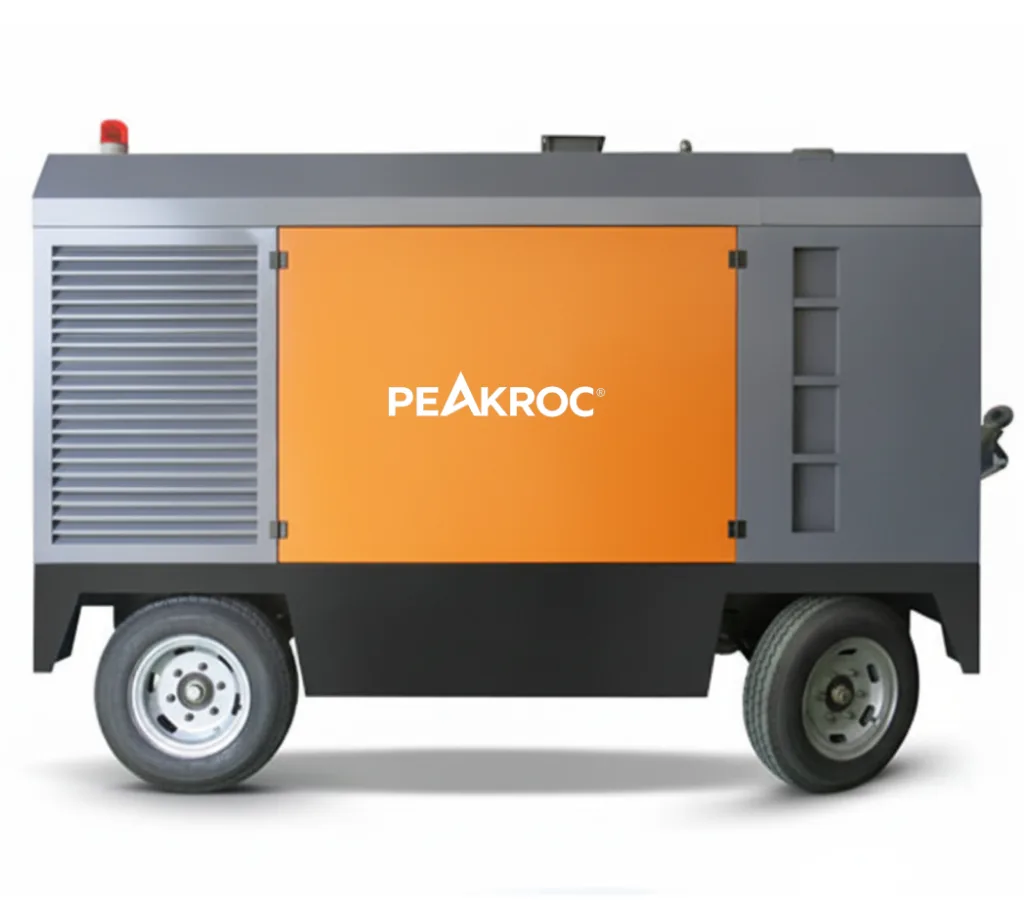
An electric portable air compressor is a movable compressor package powered by electricity. It may use a rotary screw air end, electric motor, controller, cooling system, canopy, wheels, trailer chassis, lifting points, and electrical connection system. Unlike a stationary factory compressor, it is designed to move between jobsites. Unlike a diesel portable compressor, it does not burn fuel at the machine.
This makes it different from small household inflators or garage pancake compressors. In construction and industrial use, “electric portable compressor” usually refers to a professional mobile compressor that can power pneumatic tools, breakers, chipping hammers, sandblasting equipment, drilling support tools, cleaning lines, and general jobsite air systems.
The compressor is still portable, but it depends on an external electric power source. That power may come from grid power, a site distribution panel, a temporary construction power supply, or in some cases a generator. The key advantage is that the compressor itself produces no local diesel exhaust and usually runs more quietly than a diesel unit.
Why Electric Portable Compressors Are Growing in Urban Jobsites
Cities are changing how construction equipment is used. Contractors often work near hospitals, schools, residential buildings, underground stations, commercial streets, and indoor renovation sites. In these locations, diesel exhaust and high equipment noise can create problems for permits, safety, public complaints, and worker comfort.
An electric portable air compressor helps solve several of these problems. Because the compressor is driven by an electric motor, there is no diesel combustion at the compressor. This is especially useful in tunnels, basements, underground parking areas, enclosed renovation zones, and low-emission urban districts.
Noise is another major factor. Diesel compressors include engine noise, exhaust noise, vibration, and cooling fan noise. Electric compressors still create mechanical and airflow noise, but removing the diesel engine can significantly reduce the sound level and make the machine easier to use in noise-sensitive areas.
In many projects, the benefit is not only environmental. It is practical. A quieter, cleaner compressor can work closer to the actual work zone, reduce hose length, improve pressure stability, and simplify site planning.
Common Applications
Urban Construction and Road Repair
Urban construction jobs often need compressed air for breakers, chipping tools, cleaning, road repair, concrete work, utility trenching, and temporary pneumatic equipment. Diesel compressors are widely used, but electric portable compressors are better suited when the project has access to reliable power and faces noise or emission restrictions.
For short-distance utility repair, sidewalk work, underground station maintenance, bridge repair, and city-center construction, a compact electric portable compressor can reduce fuel handling and improve public acceptance.
Tunneling and Underground Work
Tunnels and underground spaces are one of the strongest use cases for electric portable compressors. Diesel exhaust is difficult to manage in confined spaces, and ventilation systems can be expensive to operate. Electric compressors reduce local exhaust emissions and can make the compressed-air setup easier to control.
Compressed air may be used for drilling support, cleaning, pneumatic tools, shotcrete preparation, maintenance, and excavation support. The main requirement is stable site power and careful cable management.
Indoor Renovation and Plant Maintenance
Indoor construction, factory maintenance, shipyard repair, warehouse upgrades, and equipment installation often require compressed air, but diesel engines are not suitable indoors without major ventilation planning.
An electric portable compressor can support pneumatic tools, cleaning, painting preparation, bolting, and small blasting operations inside buildings or covered facilities. The compressor can be positioned near a power source while air hoses run to the work area.
Low-Emission and Noise-Sensitive Areas
Some projects are located in areas where diesel machines are discouraged or restricted. These may include hospitals, schools, urban redevelopment zones, airports, public transit projects, environmental protection areas, and night work near residential districts.
An electric portable compressor is a strong option when the site has enough power and the air demand falls within the compressor’s capacity.
Electric Portable Compressor vs. Diesel Portable Compressor
Electric and diesel portable compressors are not direct replacements in every situation. Each has advantages depending on jobsite conditions.
| Factor | Electric Portable Compressor | Diesel Portable Compressor |
|---|---|---|
| Power source | External electricity | Built-in diesel engine |
| Local emissions | No diesel exhaust at compressor | Diesel exhaust produced on site |
| Noise level | Usually lower | Usually higher |
| Indoor/tunnel use | Stronger option if power is available | Requires strict ventilation |
| Remote work | Limited by power access | Stronger for off-grid sites |
| Maintenance | No engine oil/fuel system maintenance | Requires diesel engine maintenance |
| Refueling | Not required | Required |
| Mobility | Mobile, but power cable dependent | Fully independent |
| Best fit | Urban, indoor, tunnel, low-emission zones | Remote drilling, mining, road, off-grid work |
The best choice depends on the site. If the project is remote, has no reliable electricity, and needs high airflow for drilling or mining, diesel may still be the better option. If the project is in a city center, tunnel, indoor facility, or low-emission zone with good electrical access, electric is often the better choice.
How to Choose the Right Airflow
Airflow is usually measured in CFM or m³/min. It tells you how much compressed air the compressor can deliver at a specific pressure. The most common mistake is choosing a compressor based only on pressure, while ignoring airflow.
Every pneumatic tool has an air consumption requirement. If several tools run at the same time, their air demand must be added together. You should also include allowance for hose loss, leakage, aging tools, and future demand.
A small compressor may run one tool well but fail when two tools operate together. A larger compressor may provide stable air, but if oversized too much, it can waste energy and cost more to transport.
A practical selection method is:
- List all tools and air users.
- Identify which tools run at the same time.
- Add their air consumption at the required pressure.
- Add a reserve margin for pressure loss and site variation.
For example, if an electric portable compressor is rated around 5 m³/min at 7 bar, it may be suitable for many construction, repair, and utility tasks. But for larger drilling, heavy sandblasting, or multiple high-demand tools, a higher-capacity unit may be required.
How to Choose the Right Pressure
Pressure is usually expressed in bar or psi. Many general pneumatic tools work around 7 bar, while some applications need higher pressure. Electric portable compressors in the 5–12 bar range can cover many construction, maintenance, and excavation needs.
However, pressure should not be increased casually. Raising the pressure increases power demand and system stress. It can also increase air leakage and energy consumption. If tools are underperforming, the real problem may be insufficient airflow, undersized hose, long hose distance, worn tool components, or blocked couplings—not simply low pressure.
| Pressure Range | Typical Use |
|---|---|
| 5–7 bar | General tools, cleaning, light-duty use |
| 7–10 bar | Breakers, chipping tools, construction work |
| 10–12 bar | Heavier tools, longer hose runs, specific industrial tasks |
| Above 12 bar | More specialized applications, often requiring different compressor class |
For urban construction and indoor projects, 7–12 bar is often enough. For deep drilling, high-pressure DTH work, or heavy-duty mining, diesel or larger specialized compressors may still be necessary.
Site Power Supply: The Most Important Question
The biggest difference between electric and diesel portable compressors is power supply. A diesel compressor brings its own engine. An electric compressor needs the jobsite to provide sufficient electrical power.
Before selecting an electric portable compressor, confirm:
- Available voltage and phase
- Maximum amperage
- Plug type and connection standard
- Cable length and voltage drop
- Grounding and electrical protection
Some modern electric portable compressors offer flexible power connection options, allowing operators to connect to different site power supplies. This is useful when projects move between locations with different electrical infrastructure.
Poor power planning can cause problems such as motor overload, voltage drop, tripping breakers, difficult startup, or unstable compressor operation. For rental fleets and contractors, power compatibility should be checked before delivery to site.
Mobility, Chassis, and Jobsite Handling
Electric compressors still need practical mobility. A good electric portable compressor should be compact enough for city streets, easy to tow or position, and safe to move in tight areas. Weight, trailer dimensions, lifting points, wheel size, braking system, and canopy access all matter.
For urban projects, smaller footprint is valuable because space is limited. For tunnel or indoor projects, height and width may be more important than road towing speed. For municipal repair crews, fast setup and easy connection may be more important than maximum airflow.
Operators should also consider cable routing. Unlike diesel compressors, electric compressors are linked to a power source. The cable must be protected from traffic, water, sharp edges, and damage. Air hose and power cable layout should be planned together.
Noise and Emission Benefits
Electric portable compressors are especially useful where noise and emissions are a concern. Removing the diesel engine means no exhaust gases at the compressor and usually lower sound levels.
This matters in:
- Night construction near residential areas
- Work near hospitals and schools
- Underground or enclosed spaces
- Indoor renovation and maintenance
- City-center utility repair
Lower noise can improve communication between workers and reduce disturbance to the surrounding area. No local diesel exhaust can improve working conditions in enclosed or partially enclosed sites.
However, “emission-free at the compressor” does not mean the entire project has zero emissions. The total environmental impact depends on how the electricity is generated. Still, from a jobsite air-quality perspective, electric compressors are a clear improvement over diesel machines in enclosed or urban environments.
Maintenance Advantages and Limits
Electric portable compressors remove many diesel-engine maintenance tasks. There is no diesel fuel system, engine oil, engine coolant, exhaust aftertreatment, fuel filter, or engine starting battery system in the same way as a diesel compressor.
This can reduce maintenance complexity. However, electric compressors still require regular service. The compressor air end, oil system, filters, belts or couplings, cooling system, controller, electrical cabinet, and safety devices must still be inspected.
Typical maintenance points include:
- Compressor oil and oil filter
- Air intake filter
- Separator element
- Cooler cleaning
- Electrical connections and safety devices
Because electric compressors are often used indoors or in tunnels, dust and heat still matter. A compressor without a diesel engine can still overheat if coolers are blocked, ventilation is poor, or filters are clogged.
Real-World Case Scenarios
City Utility Repair
A municipal crew repairs underground pipes near shops and apartments. A diesel compressor may create noise complaints and exhaust concerns. An electric portable compressor connected to site power can run pneumatic tools with less noise and no local exhaust.
The key is to confirm available power before mobilization and keep cable routing safe for pedestrians and vehicles.
Tunnel Excavation Support
A tunnel project needs compressed air for tools and cleaning. Ventilation is limited, so reducing diesel exhaust is valuable. An electric compressor allows compressed air to be supplied without adding engine fumes to the tunnel environment.
The main concerns are power supply, ventilation for compressor cooling, and protection of cables from water and traffic.
Indoor Factory Renovation
A contractor upgrades equipment inside a production facility. Diesel equipment is not suitable indoors, but compressed air is needed for tools and cleaning. An electric portable compressor can be moved close to the work area and connected to plant power.
The selection should consider noise, dust control, hose length, and whether the facility has enough electrical capacity.
Low-Emission Construction Zone
A construction site operates under strict emission requirements. Diesel equipment use is limited. Electric portable compressors help contractors continue pneumatic work while reducing local emissions.
In this case, electric compressors are not just a technical choice. They support project compliance and site access.
Common Selection Mistakes
The first mistake is choosing electric only because it is cleaner, without checking power supply. If the site cannot provide stable power, the compressor may not operate reliably.
The second mistake is confusing small consumer electric compressors with industrial electric portable screw compressors. A small tank compressor may be useful for inflation or light tools, but it cannot replace a construction compressor for continuous work.
The third mistake is selecting pressure without checking airflow. Tools need both pressure and flow. A compressor that reaches the pressure but cannot deliver enough CFM will still perform poorly.
The fourth mistake is ignoring cable management. Power cables must be protected, correctly sized, and positioned safely.
The fifth mistake is assuming electric compressors need no maintenance. They require less engine maintenance than diesel units, but the compressor system still needs routine service.
Buying Checklist
Before buying or renting an electric portable air compressor, confirm:
| Question | Why It Matters |
|---|---|
| What tools will run at the same time? | Determines airflow demand |
| What working pressure is required? | Determines compressor pressure class |
| What power supply is available? | Determines whether electric is practical |
| Is the jobsite indoors, underground, or urban? | Determines noise and emission benefits |
| How far is the compressor from the tools? | Affects hose size and pressure drop |
| How will cables be protected? | Affects safety and reliability |
| What maintenance support is available? | Reduces downtime |
| Is diesel backup needed? | Important for unstable power locations |
This checklist helps avoid the most common mismatch: selecting an electric compressor that looks suitable on paper but cannot be powered or positioned correctly on site.
Final Recommendation
An electric portable air compressor is a strong solution for urban jobsites, indoor construction, tunneling, excavation, municipal repair, and low-emission work zones. It provides compressed air without local diesel exhaust, often with lower noise, simpler maintenance, and better suitability for enclosed environments.
However, electric is not always the best answer. The site must have suitable electrical power, proper connection, safe cable routing, and enough capacity for the compressor’s motor. For remote mining, deep drilling, and off-grid work, diesel compressors may still be more practical.
The best approach is to choose based on the complete jobsite condition: airflow, pressure, power availability, mobility, noise limits, emission rules, maintenance support, and working environment. When those factors align, an electric portable compressor can be cleaner, quieter, efficient, and highly practical for modern construction work.
FAQ
1. What is an electric portable air compressor?
An electric portable air compressor is a movable compressor powered by an electric motor. It supplies compressed air for tools and jobsite applications without using a diesel engine at the compressor.
2. Where are electric portable compressors commonly used?
They are commonly used in urban construction, indoor renovation, tunneling, excavation, municipal repair, plant maintenance, low-emission zones, and noise-sensitive areas.
3. Is an electric portable compressor emission-free?
It produces no local diesel exhaust at the compressor. Total emissions depend on how the electricity is generated, but jobsite air quality is improved compared with diesel compressors.
4. Is an electric compressor quieter than a diesel compressor?
Usually yes. Removing the diesel engine reduces engine and exhaust noise, making electric compressors better suited for indoor, urban, and noise-sensitive jobsites.
5. What pressure range is common for electric portable compressors?
Many electric portable compressors are designed for general construction and industrial work in the 7–12 bar range, though exact pressure depends on the model and application.
6. Can an electric portable compressor replace a diesel compressor?
It can replace diesel in many urban, indoor, and low-emission applications if reliable power is available. For remote or off-grid work, diesel may still be more practical.
7. What should I check before choosing an electric portable compressor?
Check airflow demand, working pressure, voltage, phase, amperage, plug type, cable length, hose distance, mobility, ventilation, and maintenance support.
8. Does an electric portable compressor need maintenance?
Yes. It avoids diesel engine maintenance, but the compressor air end, oil system, filters, separator, cooler, electrical cabinet, and safety devices still require regular service.
Author

Mark Chen – Senior Mechanical Engineer, Peakroc®
Mark Chen is a senior mechanical engineer at Peakroc®, specializing in compressed air systems and drilling equipment for mining and construction applications. With over 15 years of field experience, he has led multiple projects on optimizing air delivery efficiency, equipment durability, and energy consumption.