
Key Takeaways
- 600 CFM is approximately 17 m³/min, but the capacity must always be evaluated at a stated working pressure.
- A 600 CFM compressor at 8 bar is designed for different work than a machine delivering similar airflow at 17 or 20 bar.
- Sandblasting usually prioritizes continuous airflow and dry air, while DTH drilling requires both sufficient pressure and hole-cleaning airflow.
- Hose size, fittings, filters, altitude, ambient temperature, nozzle wear, and drilling conditions can reduce the air available at the point of use.
- The best compressor should be selected by productive output and total operating cost, not by maximum CFM or purchase price alone.
The 600 CFM class is one of the most versatile capacity ranges in the portable compressor market. It can support high-production abrasive blasting, quarry maintenance, mining operations, pipeline blowing, medium-pressure drilling, and selected DTH applications.
However, the number “600 CFM” does not describe the compressor completely. Working pressure, Free Air Delivery, engine power, compression stages, air treatment, hose configuration, and site conditions determine whether the machine will perform correctly.
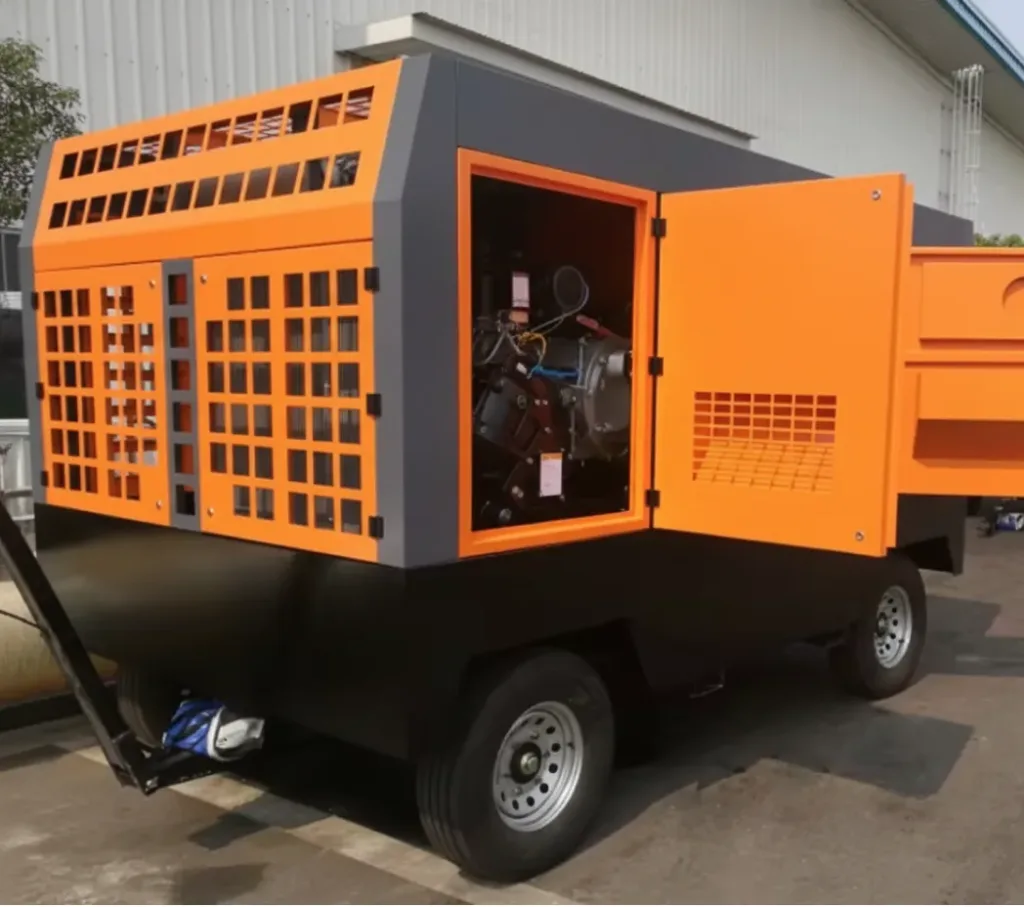
Peakroc® offers a broad range of portable diesel screw air compressors for construction, mining, drilling, pipeline, and sandblasting projects. Relevant configurations include the 17 m³/min, 8 bar portable diesel compressor for high-flow, lower-pressure work and the 15 m³/min, 18 bar compressor for drilling and pipeline applications when pressure is more important than achieving exactly 600 CFM.
What Does 600 CFM Mean?
CFM means cubic feet per minute and describes the volume of air delivered by the compressor. Using the common conversion of 1 m³/min being approximately 35.3 CFM, a 600 CFM compressor delivers close to 17 m³/min.
600 CFM ÷ 35.3 ≈ 17 m³/minThe airflow figure should normally refer to Free Air Delivery, or FAD, measured under stated reference conditions. FAD is more useful than theoretical airend displacement because it represents the air that can actually leave the compressor and enter the hose system.
A complete rating must therefore include both airflow and pressure. A specification of 17 m³/min at 8 bar is not equivalent to 17 m³/min at 17 bar, even though both machines may be described as 600 CFM compressors.
Atlas Copco, for example, publishes the XAXS 600 at approximately 587 CFM and 17 bar, while other machines within the same medium portable range provide more airflow at lower pressure. This demonstrates why buyers should compare FAD at the required working pressure instead of using the nominal model name alone.
Choosing the Correct Pressure Class
Pressure and airflow perform different functions. Airflow supplies pneumatic tools, carries abrasive through blasting equipment, moves air through a pipeline, and removes drill cuttings from a borehole. Pressure overcomes resistance in the tool, nozzle, hose, pipe, hammer, and borehole.
A compressor with high airflow but insufficient pressure may fail to operate a DTH hammer correctly. A high-pressure compressor used for a low-pressure blasting project may work, but it can introduce unnecessary capital cost, fuel consumption, weight, and maintenance complexity.
| Compressor configuration | Typical application direction | Main selection concern |
|---|---|---|
| About 600 CFM at 7–8 bar | Sandblasting, quarry tools, industrial cleaning and mining support | Continuous airflow, moisture removal and hose loss |
| About 600 CFM at 10–14 bar | Heavier quarry work, medium-pressure drilling and pipeline operations | Tool pressure, simultaneous demand and pressure drop |
| About 600 CFM at 17–20 bar | DTH drilling, boreholes, foundations and selected pipeline work | Hammer demand, depth, groundwater and engine load |
| About 600 CFM above 20 bar | Specialized high-pressure drilling | Hammer chart, compression stages and site conditions |
The pressure shown at the compressor outlet is also not necessarily the pressure available at the tool. Losses occur through hoses, fittings, filters, manifolds, air-treatment equipment, drill pipes, and the borehole itself.
Sandblasting Applications
Abrasive blasting is a continuous-air application. The compressor must maintain sufficient airflow and nozzle pressure throughout the blasting cycle rather than supplying only short bursts of air.
Industrial blasting normally favors rotary screw or diesel-powered compressors because they can deliver sustained high-volume airflow. Appropriate filtration, drying, and storage can further improve reliability and reduce interruptions caused by moisture.
Nozzle Size and Air Consumption
Nozzle diameter is one of the most important factors in compressor sizing. As the nozzle opening becomes larger, the air requirement rises sharply.
Sullair provides examples showing that a No. 5 nozzle with a 5/16-inch opening may consume approximately 140 CFM at 100 psi, while a No. 6 nozzle with a 3/8-inch opening may require approximately 200 CFM under the same pressure condition.
| Blasting nozzle | Approximate consumption at 100 psi | Practical 600 CFM consideration |
|---|---|---|
| No. 5, 5/16 inch | About 140 CFM | Several nozzles may be possible with a proper reserve |
| No. 6, 3/8 inch | About 200 CFM | Two nozzles are more realistic after allowing for losses |
| Worn No. 6 nozzle | Higher than the new-nozzle rating | Available reserve may disappear as the orifice enlarges |
A theoretical calculation might suggest that a 600 CFM compressor can operate three 200 CFM nozzles. In practice, such a setup leaves almost no reserve for hose losses, nozzle wear, blast-pot control air, leakage, altitude derating, or variations in compressor output.
For reliable operation, the total expected nozzle demand should remain below the compressor’s verified FAD. The design should also account for how the nozzles will perform after several hours of abrasive wear rather than only when they are new.
Dry Air and Surface Quality
Moisture in compressed air can cause abrasive media to bridge, clog hoses, and flow inconsistently. It can also interfere with surface preparation and increase the possibility of flash rust on freshly blasted steel.
An aftercooler and water separator may be sufficient for some outdoor blasting projects. More demanding coating work may require additional filtration, condensate drains, or drying equipment, depending on ambient humidity and the required surface condition.
Breathing air must be treated as a separate safety system. Air discharged from an oil-injected portable screw compressor should not be connected directly to a blasting helmet without equipment and controls designed to meet the applicable respiratory-air requirements. OSHA identifies airborne contaminants, rebound, noise, and respiratory exposure as major abrasive-blasting hazards.
Quarry and Mining Support
A 600 CFM compressor can serve as a flexible mobile utility in quarries and mines. It may power pneumatic tools, support drilling, clean equipment, provide temporary plant air, assist maintenance crews, or operate in areas beyond the reach of a fixed compressed-air network.
Atlas Copco lists quarrying, blast-hole drilling, rock excavation, sandblasting, pipeline work, and water-well drilling among established mobile-compressor applications. This broad application range explains why the 600 CFM class is frequently used by contractors that need one machine for several types of work.
Quarry Tools and Simultaneous Demand
A quarry may operate several pneumatic tools through one compressor. The correct capacity is therefore based on the combined demand of the tools that will run at the same time, not the sum of every tool owned by the company.
Long hose runs are common in quarry operations, particularly where the compressor remains on level ground while tools operate near a working face. In these conditions, hose diameter and coupling size can have as much influence on tool performance as compressor capacity.
If pressure falls at the tool, operators sometimes increase the compressor setting. This can increase fuel consumption without correcting the original restriction. Checking hose diameter, fittings, leaks, and tool condition is usually a better first step.
Drilling in Quarry Conditions
For quarry drilling, airflow removes rock cuttings and helps keep the borehole clean. Pressure supports hammer or tool performance, particularly when a pneumatic or DTH system is used.
The drilling contractor should confirm the drill type, hole diameter, depth, hammer model, drill-pipe internal diameter, and rock formation before selecting the compressor. A 17 m³/min, 8 bar compressor may provide substantial flushing air but still lack the pressure required by a particular DTH hammer.
Dust loading also affects reliability. Quarry dust can restrict intake filters and coat the coolers, increasing operating temperature and reducing output. A machine designed for high ambient temperatures still requires regular cooler cleaning and unrestricted ventilation.
Pipeline Blowing, Pigging, and Drying
Portable compressors are widely used for pipeline projects because they can move with the construction spread and operate without a permanent compressed-air system. Common duties include removing debris, supporting pigging, dewatering, drying after hydrotesting, purging, and supplying temporary pneumatic equipment.
Atlas Copco describes portable compressors, dryers, boosters, and nitrogen systems as part of complete pipeline-pigging packages. It notes that the required pressure varies with pipeline diameter, length, pig type, and operating objective, while air dryness is especially important after hydrotesting.
Pipeline Volume and Completion Time
Pipeline diameter alone does not determine the compressor size. Two pipelines with the same diameter may have very different air requirements if their lengths, internal conditions, elevation profiles, or target completion times differ.
A 600 CFM compressor may be suitable for many medium pipeline projects. Longer or larger systems may require several compressors connected in parallel, a larger machine, or a compressor-and-booster combination.
Parallel operation requires properly sized manifolds, check valves, pressure controls, and rated connecting equipment. Simply joining two compressor hoses without an engineered setup can create unstable control and safety problems.
Drying Requires More Than High Airflow
High airflow can move moisture through a pipeline, but it does not automatically provide a low dew point. Warm compressed air can retain significant water vapor and may introduce additional moisture if it is not cooled and treated correctly.
Depending on the pipeline specification, the package may require an aftercooler, bulk-water separator, coalescing filtration, and desiccant dryer. Atlas Copco’s portable air-treatment guidance identifies residual moisture after pipeline hydrotesting as a specific application for downstream drying equipment.
Pressure testing contains substantial stored energy and must follow the applicable project code and safety procedure. Compressor capacity does not define the allowable test pressure, exclusion area, inspection method, or relief arrangement.
DTH and Borehole Drilling
DTH drilling requires a balance between pressure and airflow. Pressure operates the hammer, while airflow carries cuttings upward and prevents them from accumulating around the bit.
A 600 CFM high-pressure compressor may be suitable for small- and medium-size DTH hammers, quarry blast holes, foundation drilling, and selected water-well projects. It may be too small for large hammers, deep boreholes, strong groundwater inflow, or wide hole diameters.
Atlas Copco reports an XAXS 600 configuration providing approximately 587 CFM at 17 bar in a water-well application involving rock drilling beyond 150 meters. This is a manufacturer case rather than a universal sizing rule, but it demonstrates that approximately 600 CFM can support meaningful borehole work when the pressure, hammer, geology, and depth are properly matched.
Matching the Compressor to the Hammer
The first technical reference should be the DTH hammer manufacturer’s airflow chart. The chart should show expected air consumption at the proposed working pressure.
The compressor must then provide enough additional capacity to cover hose losses, drill-pipe restrictions, borehole back pressure, leakage, altitude derating, and hole-cleaning requirements. The margin should be reasonable rather than excessive because unnecessary oversizing increases engine power, purchase cost, fuel use, and transport weight.
Groundwater changes the calculation because the compressor must overcome water-column pressure while maintaining sufficient upward velocity to remove cuttings. A compressor that works well in a dry, shallow quarry hole may perform very differently in a deep, water-producing borehole.
For larger or deeper drilling work, a 21 m³/min, 14 bar portable diesel compressor or a higher-pressure model may be more suitable than insisting on exactly 600 CFM.
Hose Size, Pressure Drop, and Site Conditions
Every compressed-air system experiences pressure drop between the compressor outlet and the point of use. Friction and resistance increase with longer hoses, smaller internal diameters, restrictive fittings, excessive bends, dirty filters, and high airflow velocity.
Leaks create an additional load. CAGI notes that leakage flow increases as the pressure difference between the compressed-air system and atmosphere rises, meaning that operating at unnecessary pressure can increase both leakage and operating cost.
For a 600 CFM system, the main discharge hose must be large enough for the required airflow. A hose that is adequate for a 185 CFM compressor may create unacceptable pressure drop when used with a 600 CFM machine.
Altitude and ambient temperature should also be included in sizing. At higher elevations, lower air density can reduce diesel-engine output and compressor mass flow. High temperatures increase the cooling load, while dust can reduce heat-transfer efficiency by coating the coolers.
Atlas Copco’s medium portable compressor range is designed for demanding conditions and lists an operating capability up to approximately 50°C for relevant configurations. This rating should not be interpreted as permission to operate with blocked coolers, closed ventilation paths, or neglected filters.
Fuel Efficiency and Total Operating Cost
Fuel consumption depends strongly on working pressure, load percentage, engine-airend matching, control strategy, air-filter restriction, separator pressure drop, and cooling performance.
A compressor may spend part of the shift at full load and another part unloaded while operators move equipment, change drill rods, refill abrasive, or reposition tools. Full-load fuel consumption alone therefore does not describe the complete operating cost.
The basic daily calculation is:
Daily fuel cost =
Average fuel consumption per hour
× Operating hours
× Local diesel price
For procurement decisions, a more useful metric is usually cost per productive unit. A blasting contractor may calculate compressor cost per square meter prepared, while a drilling contractor may calculate cost per meter drilled.
A larger compressor can consume more fuel per hour but still reduce total project cost if it increases productivity significantly. Conversely, an oversized high-pressure unit may burn more fuel without improving a low-pressure blasting or cleaning application.
Atlas Copco states that electronic pressure regulation and engine-speed control can match pressure and airflow more closely to application demand, helping improve utilization and partial-load fuel efficiency.
Maintenance in Dusty and Humid Environments
The 600 CFM compressor is often used in environments that are especially hard on cooling and filtration systems. Abrasive blasting creates fine dust, quarry work exposes the machine to rock particles, and pipeline or coastal projects may involve high humidity.
The intake filters should be inspected according to actual dust loading rather than only the normal calendar interval. A partially blocked filter increases intake restriction, reduces available airflow, and can increase fuel consumption.
Coolers should remain clean and unobstructed. Dust accumulation raises compressor-oil and engine-coolant temperatures, increasing the risk of alarms, shutdowns, lubricant degradation, and shortened component life.
The oil separator element also affects efficiency. As pressure drop increases across a contaminated separator, the engine must work harder to maintain outlet pressure. Regular inspection of filters, separator differential pressure, drains, hoses, clamps, and coolers can therefore influence both reliability and fuel cost.
Peakroc® Product Direction
Peakroc® provides several airflow and pressure combinations near the 600 CFM class. The correct model should be chosen according to the application rather than by trying to keep the airflow number exactly at 600 CFM.
| Peakroc® configuration | Approximate capacity | Suitable application direction |
|---|---|---|
| 17 m³/min at 8 bar | About 600 CFM | Sandblasting, quarry tools, mining support and lower-pressure drilling |
| 15 m³/min at 18 bar | About 530 CFM | Higher-pressure drilling and selected pipeline work |
| 21 m³/min at 14 bar | About 740 CFM | Larger quarry, mining and medium-pressure drilling demand |
| 13 m³/min at 20 bar | About 460 CFM | Lower-flow, high-pressure borehole applications |
A sandblasting contractor may obtain better productivity from the 17 m³/min, 8 bar configuration because the process requires continuous volume at moderate pressure. A DTH drilling contractor may achieve better results with 15 m³/min at 18 bar, even though its nominal CFM is lower.
Peakroc’s compressor selection support can review nozzle size, hammer model, pressure, airflow, hose length, altitude, temperature, and operating hours before recommending a configuration.
Common Selection Mistakes
The first mistake is comparing compressors only by maximum CFM. A quoted airflow has little meaning unless the working pressure and test basis are also stated.
The second mistake is buying more pressure than the application requires. A high-pressure compressor can often be adjusted downward, but that does not guarantee that it will be the most economical or transportable solution for low-pressure work.
Another frequent problem is ignoring nozzle wear or tool condition. A worn blasting nozzle may consume considerably more air than its original rating, while a damaged drilling hammer may create poor performance that is incorrectly blamed on the compressor.
Undersized hoses and restrictive couplings are also common. Raising compressor pressure to compensate for distribution losses increases fuel consumption and may mask the real cause of low tool pressure.
Finally, buyers sometimes order the compressor without considering air treatment, startup spares, or local service capability. The machine may deliver sufficient air, but the project can still stop because of wet blasting media, unavailable filters, or a small failed control component.
Practical Buying Checklist
| Information to confirm | Why it matters |
|---|---|
| Required FAD and working pressure | Defines the real compressor operating point |
| Nozzle, hammer, tool, or pipeline specification | Determines actual air demand |
| Number of simultaneous operators or tools | Prevents undersizing the total airflow |
| Hose diameter, length, and fittings | Identifies potential pressure loss |
| Site elevation and temperature range | Allows engine and airflow derating |
| Air-treatment requirement | Determines aftercooler, separator, filters, or dryer |
| Daily operating hours and duty cycle | Supports fuel and TCO calculations |
| Engine emissions and certification | Confirms destination-market compliance |
| Trailer, skid, or support configuration | Matches transport and installation needs |
| Spare parts and service plan | Reduces downtime on remote projects |
The final quotation should state verified FAD at the required pressure, engine model, fuel consumption, compression stages, ambient-temperature capability, included air-treatment equipment, service intervals, warranty, spare-parts scope, and delivery schedule.
Final Recommendation
A 600 CFM portable diesel screw air compressor can be an effective multipurpose machine for sandblasting, quarry support, mining, pipeline operations, and selected drilling work. Its suitability depends on the complete pressure-and-flow combination rather than the CFM number alone.
For industrial sandblasting, selection should begin with nozzle diameter, number of operators, required nozzle pressure, hose size, nozzle wear, and moisture-control requirements. A 17 m³/min, 8 bar compressor can be a practical direction for high-flow blasting where extreme pressure is unnecessary.
For quarry and mining support, calculate the air consumption of tools expected to operate simultaneously. Long hose runs, dust loading, and high ambient temperatures should be incorporated into the selection and maintenance plan.
For pipeline work, include internal volume, project length, target completion time, allowable pressure, air-treatment requirements, and whether the job involves blowing, pigging, drying, or testing. A compressor alone does not create a complete drying or testing system.
For DTH drilling, begin with the hammer manufacturer’s airflow and pressure chart. Hole diameter, depth, groundwater, drill-pipe size, geology, altitude, and hose losses determine whether a 600 CFM machine is sufficient.
The best compressor is the one that delivers the required FAD and pressure at the tool while maintaining reliable operation and a competitive cost per completed job.
FAQ
What is a 600 CFM portable compressor?
A 600 CFM portable compressor delivers approximately 17 m³/min of free air. Its complete specification must also state the working pressure because a 600 CFM compressor at 8 bar is designed for different applications than one operating at 17 or 20 bar.
Is a 600 CFM compressor suitable for sandblasting?
Yes. It can support high-production blasting or several smaller nozzles, depending on nozzle diameter, pressure, nozzle wear, auxiliary air demand, and hose loss. Drying and moisture separation should also be considered.
How many sandblasting nozzles can a 600 CFM compressor operate?
The answer depends on nozzle size and operating pressure. A No. 5 nozzle may consume approximately 140 CFM at 100 psi, while a No. 6 nozzle may require about 200 CFM. The system still needs reserve capacity for wear, leakage, controls, breathing-air equipment, and pressure loss.
Can a 600 CFM compressor be used for DTH drilling?
Yes, for selected hammers and borehole conditions. The hammer’s airflow requirement, working pressure, hole diameter, depth, groundwater, drill-pipe size, altitude, and expected pressure loss must be checked before selection.
What pressure should a 600 CFM compressor provide?
There is no universal pressure. Sandblasting and general pneumatic work may operate around 7–10 bar, while drilling and specialized pipeline duties may require approximately 14–20 bar or more.
Can a 600 CFM compressor be used for pipeline drying?
It can provide useful airflow, but successful drying also depends on pipeline volume, length, required dew point, aftercooling, water separation, filtration, and dryer capacity.
Why does pressure fall at the tool?
Common causes include undersized hoses, excessive hose length, restrictive fittings, dirty filters, moisture separators, leaks, worn nozzles, and higher-than-expected tool consumption. These items should be checked before increasing compressor pressure.
What information does Peakroc® need to recommend a 600 CFM compressor?
Peakroc® needs the application, required airflow and pressure, nozzle or hammer model, number of tools, hose size and length, site altitude, ambient temperature, daily operating hours, air-treatment requirements, chassis preference, and delivery location.
Author

Mark Chen – Senior Mechanical Engineer, Peakroc®
Mark Chen is a senior mechanical engineer at Peakroc®, specializing in compressed air systems and drilling equipment for mining and construction applications. With over 15 years of field experience, he has led multiple projects on optimizing air delivery efficiency, equipment durability, and energy consumption.