
Key Takeaways
A portable diesel screw air compressor should not be selected only by purchase price. For mining, quarrying, water well drilling, DTH drilling, sandblasting, pipeline work, and rental fleets, the real cost comes from fuel consumption, maintenance, downtime, spare parts, and jobsite productivity.
Fuel is often one of the largest lifetime cost drivers for mobile compressors. Atlas Copco’s mobile compressor TCO guide states that about 70–80% of compressed-air cost can come from fuel or electricity, and its broader industrial compressor TCO materials also emphasize that energy cost can dominate lifecycle cost.
A fuel-efficient compressor is not just a machine with a good engine. It is a complete system: airend efficiency, engine speed control, pressure setting, load profile, cooling design, filters, oil separator, hose size, and maintenance all affect fuel burn.
For serious buyers, the best comparison is not only purchase price. It is:
Cost per operating hour
Cost per m³/min delivered air
Cost per meter drilled
Cost per blasting shift
Cost per completed job
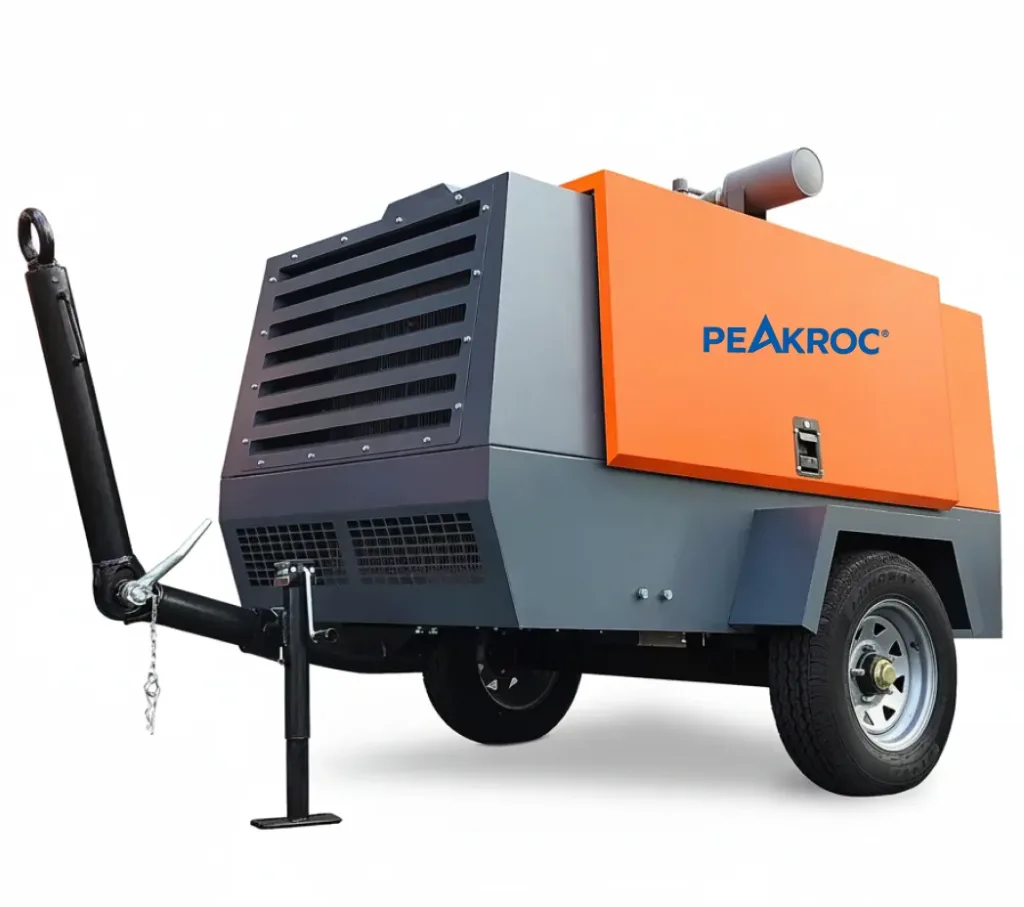
Peakroc® provides portable diesel screw air compressors for drilling, mining, quarrying, construction, sandblasting, and pipeline applications. Buyers can also review mining compressor applications, construction compressor applications, and use the compressor selection support page to match pressure, FAD, engine power, and jobsite conditions.
Why TCO Matters More Than Purchase Price
The purchase price is visible. Fuel cost is not always visible at the quotation stage, but it can become the largest long-term cost after the compressor enters service.
A portable diesel screw compressor may run for hundreds or thousands of hours per year. In drilling, mining, quarrying, sandblasting, and pipeline work, the compressor often runs at high load for long periods. A small difference in fuel consumption per hour can become a major cost difference after three to five years.
Atlas Copco explains that compressed air cost goes beyond the equipment price, and that fuel or electricity becomes the main contributor to cost over time for mobile compressors. The same logic applies directly to portable diesel screw compressors used in harsh field conditions.
A lower purchase price can be attractive, but it may not mean lower ownership cost if the machine:
- Burns more diesel per hour
- Loses pressure through inefficient control
- Requires frequent maintenance
- Has poor spare parts availability
- Overheats in dusty or hot jobsites
- Causes drilling or sandblasting delays
- Has lower resale value
For a contractor, the compressor is not just equipment. It is part of the production system. If the compressor stops, the drill rig, hammer, crew, truck, operator, and project schedule may also stop.
What Is Total Cost of Ownership?
Total Cost of Ownership, or TCO, means all costs related to owning and operating the compressor during its working life.
A simple TCO structure is:
Total Cost of Ownership =
Purchase Price
+ Fuel Cost
+ Maintenance Cost
+ Spare Parts Cost
+ Downtime Cost
+ Transport / Setup Cost
- Resale Value
For portable diesel screw air compressors, fuel cost is usually the most important daily cost, but downtime cost can be even more painful on remote jobsites. If a compressor fails during a water well drilling project, the cost is not only a repair bill. The customer may lose drilling time, crew time, truck time, fuel, and project progress.
Main Cost Drivers
| Cost Item | Why It Matters |
|---|---|
| Purchase price | Initial investment, but not the full ownership cost |
| Fuel consumption | Usually the largest daily operating cost in diesel compressor applications |
| Maintenance | Oil, filters, separator elements, coolant, belts, sensors, and labor |
| Downtime | Lost drilling, blasting, rental, or construction hours |
| Spare parts | Availability affects repair speed and project continuity |
| Transport and setup | Important for remote mining and drilling jobsites |
| Resale value | Important for rental companies and equipment distributors |
The correct buying decision should compare these cost drivers together.
What Makes a Diesel Screw Compressor Fuel Efficient?
Fuel efficiency is not determined by the diesel engine alone. It is the result of the complete compressor package.
A fuel-efficient portable diesel screw compressor usually has:
- Efficient rotary screw airend
- Correct engine-to-airend matching
- Stable pressure control
- Low separator pressure drop
- Good cooling system
- Clean air intake system
- Proper load/unload or variable regulating system
- Correct pressure setting for the application
- Suitable hose and outlet configuration
- Maintenance access that encourages regular service
Atlas Copco notes that modern diesel compressor controllers can match engine speed to air demand, improving fuel economy. Its mobile compressor materials also discuss systems that adjust pressure and flow to application needs, which helps reduce waste when the job does not require maximum output all the time.
The key point is simple:
Fuel efficiency is a system result, not only an engine-brand result.
A Cummins, Yuchai, Kubota, Yanmar, or other diesel engine can perform well only when the compressor package is properly designed, sized, cooled, controlled, and maintained.
Fuel Consumption: Full Load, Partial Load, and Real Jobsite Duty Cycle
Many buyers ask, “How much fuel does this compressor consume per hour?”
That is a good question, but it is incomplete.
A better question is:
How much fuel does the compressor consume at the real load profile of my jobsite?
Portable compressors do not always run at exactly 100% load. A compressor may run at full load during drilling or blasting preparation, then unload or partially load during rod changes, tool repositioning, operator delays, or pressure recovery.
Fuel consumption should be evaluated at:
- 100% load
- 75% load
- 50% load
- 25% load
- Unloaded condition
- Real jobsite duty cycle
The U.S. Department of Energy’s compressed air sourcebook emphasizes that compressed air system performance should be managed as a system, including controls, storage, pressure, leaks, and maintenance, because proper management can reduce energy use, maintenance, downtime, and production problems.
Simple Fuel Cost Formula
Daily Fuel Cost =
Fuel Consumption per Hour × Operating Hours per Day × Diesel Price
3-Year Fuel Cost =
Fuel Consumption per Hour × Annual Operating Hours × Diesel Price × 3
For example:
| Item | Compressor A | Compressor B |
|---|---|---|
| Purchase price | Lower | Higher |
| Fuel consumption | 32 L/h | 28 L/h |
| Operating hours per year | 1,500 h | 1,500 h |
| Diesel price | USD 1.20/L | USD 1.20/L |
| 3-year fuel cost | USD 172,800 | USD 151,200 |
In this example, Compressor B saves 4 L/h. Over three years, that difference becomes USD 21,600 in fuel savings.
If Compressor B costs USD 8,000 more at purchase, it is still cheaper to own over the same period.
This is why buyers should compare fuel cost over time, not only the invoice price.
Pressure Setting and Fuel Burn
Pressure has a direct impact on operating cost. Higher pressure usually means higher load, higher fuel consumption, and more stress on the compressor system.
Many buyers think higher pressure is always better. That is not true.
A 25 bar compressor is useful for DTH drilling and deep borehole work, but it is not necessary for normal jackhammers or general construction tools. A 13 bar compressor may be useful for heavier sandblasting or medium-duty drilling, but it may waste fuel if the job only needs 7 bar.
CAGI’s compressed air sizing materials emphasize that leak loads increase with higher pressure and that keeping pressure within the lowest acceptable band is desirable. This principle applies strongly to portable compressors as well: unnecessary pressure raises cost.
Pressure Class and TCO Risk
| Application | Typical Pressure Direction | TCO Risk |
|---|---|---|
| Jackhammer / road repair | 7–8 bar | Oversized compressor wastes fuel |
| General construction tools | 7–10 bar | Wrong hose size causes pressure drop |
| Sandblasting | 7–10 bar, sometimes 12–13 bar | Nozzle size and dry air affect productivity |
| Quarry drilling | 10–14 bar | Must match rig and hole conditions |
| DTH drilling | 18–25 bar | Too low pressure reduces penetration rate |
| Deep hard rock drilling | 25–35 bar | Wrong sizing causes slow drilling and high cost |
| Pipeline blowing / testing | Depends on line size and method | Long hose or manifold loss can waste air |
The most economical compressor is not always the highest-pressure compressor. It is the compressor that delivers the required FAD at the correct pressure with the lowest cost per job.
FAD, CFM, and Real Delivered Air
FAD means Free Air Delivery. It is the usable air delivery at a stated pressure. Buyers should compare FAD, not only theoretical displacement or marketing airflow.
Useful conversions:
| Unit | Approximate Conversion |
|---|---|
| 1 m³/min | 35.3 CFM |
| 1 bar | 14.5 PSI |
For example, a 17 m³/min compressor is approximately a 600 CFM class machine. But the real question is not only “600 CFM.” The real question is:
600 CFM at what pressure, through what hose size, at what temperature, and for what tool demand?
If the compressor cannot deliver enough FAD at working pressure, the result may be:
- Weak hammer impact
- Slow penetration rate
- Poor hole cleaning
- Low sandblasting productivity
- Longer job time
- Higher fuel per completed job
Hose Loss, Couplings, and Hidden Fuel Waste
A compressor can be efficient at the machine outlet but inefficient at the tool if the air distribution setup is poor.
Common causes of hidden loss include:
- Undersized hose
- Excessive hose length
- Too many bends
- Small couplings
- Leaking fittings
- Poor manifold design
- Dirty filters or water separators
- Pressure regulators set too high
When pressure drops at the tool, operators often raise compressor pressure to compensate. That may solve the symptom, but it increases fuel cost.
A better solution is to reduce pressure loss by improving hose diameter, coupling size, pipe layout, and leakage control. CAGI notes that compressed air leaks and pressure drop can create real energy cost, and gives examples of how even small leaks can waste significant airflow and money over time.
Application-Based TCO Differences
Mining and Quarrying
In mining and quarrying, compressor cost should be measured by cost per productive drilling hour or cost per meter drilled, not only fuel per hour.
Important TCO factors include:
- Rock hardness
- Hole diameter
- Drilling depth
- DTH hammer size
- Air flushing requirement
- Dust load
- Ambient temperature
- Compressor cooling capacity
- Filter service interval
- Spare parts availability
A compressor that saves fuel but slows drilling may not reduce total cost. In drilling, productivity matters as much as fuel consumption.
Water Well and DTH Drilling
For water well drilling, the compressor must support hammer impact, hole cleaning, and pressure stability. If pressure is too low, penetration slows. If airflow is too low, cuttings remain in the hole.
The true cost includes:
- Fuel per drilling day
- Penetration rate
- Time spent cleaning the hole
- Hammer and bit wear
- Stuck tool risk
- Crew and rig standby time
A cheaper compressor that delays a drilling project can become expensive very quickly.
Sandblasting and Painting
Sandblasting cost depends heavily on nozzle performance and air quality.
Important TCO factors include:
- Nozzle size
- Nozzle wear
- Pressure stability
- Air dryness
- Abrasive consumption
- Surface preparation quality
- Rework risk
- Compressor fuel burn
If pressure drops, blasting productivity falls. If air is wet, abrasive can clog and coating quality may suffer. In this application, the compressor, dryer, hose, nozzle, and abrasive system must be evaluated together.
Pipeline and Industrial Maintenance
Pipeline blowing, drying, testing, and maintenance often need continuous airflow. Job delays can be expensive because crews and equipment are waiting.
Important TCO factors include:
- Line size
- Required pressure
- Required airflow
- Job duration
- Safety controls
- Moisture control
- Hose and manifold pressure drop
- Compressor reliability
A high-flow compressor may reduce job time, but only if it is matched correctly to the pipeline and air treatment setup.
Maintenance Cost: Filters, Oil, Separator, Cooling, and Fuel Quality
Maintenance is not only a service expense. It directly affects fuel efficiency.
A dirty air filter increases intake restriction. A clogged oil separator increases pressure drop. A blocked cooler raises temperature. Poor fuel quality affects engine performance. Wrong oil or delayed oil changes can shorten airend life.
The DOE sourcebook highlights that proper compressed air system management can reduce maintenance and downtime while improving reliability and production performance.
Maintenance Items That Affect TCO
| Maintenance Item | TCO Impact |
|---|---|
| Air filter | Protects airend and reduces intake restriction |
| Oil filter | Protects lubrication system |
| Separator element | Reduces oil carryover and pressure drop |
| Compressor oil | Protects airend, bearings, and seals |
| Cooler cleaning | Prevents overheating and shutdown |
| Fuel filter | Protects diesel engine injection system |
| Coolant system | Maintains stable operating temperature |
| Hoses and couplings | Reduces leaks and pressure loss |
| Sensors and valves | Maintains safe and stable control |
On dusty jobsites, maintenance intervals may need to be shortened. A quarry, mine, desert drilling site, or road construction project is not the same as a clean factory.
Downtime Cost and Spare Parts Availability
Downtime cost is often underestimated.
If a compressor stops on a remote mine site, the cost is not just the replacement part. The real cost may include:
- Drilling crew waiting
- Rig idle time
- Fuel truck and service truck delay
- Missed blasting schedule
- Rental penalty
- Project delay
- Customer complaint
- Emergency freight cost
This is why spare parts availability matters.
For remote sites, contractors should keep a basic service kit ready, including:
- Air filter
- Oil filter
- Fuel filter
- Separator element
- Compressor oil
- Belts
- Hoses
- Common sensors
- Drain valve parts
- Safety valve or pressure-related spare parts
A compressor with a slightly higher purchase price but better parts support can have a lower real TCO.
How to Compare Two Portable Compressor Quotations
When comparing two quotations, do not stop at model name, pressure, and price.
Ask the supplier:
| Question | Why It Matters |
|---|---|
| What is the FAD at the required pressure? | Confirms usable air |
| What is fuel consumption at 100%, 75%, 50%, and unload? | Shows real operating cost |
| What engine brand is used? | Affects reliability and parts access |
| What airend design or brand is used? | Affects efficiency and lifetime |
| What is the normal working pressure? | Prevents oversizing |
| What is the maximum ambient temperature? | Important for hot mining sites |
| What is the service interval? | Affects maintenance planning |
| Are filters and separators available quickly? | Reduces downtime risk |
| What protection systems are included? | Prevents damage and unsafe operation |
| What warranty and technical support are included? | Reduces ownership risk |
A professional quotation should help the buyer understand operating cost, not only purchase cost.
Peakroc® Product Fit by Application and Cost Priority
Peakroc® portable diesel screw compressors cover a wide range of pressure and airflow requirements for construction, mining, drilling, quarrying, sandblasting, and heavy-duty industrial applications.
| Buyer Scenario | Recommended Peakroc® Direction |
|---|---|
| Road repair / jackhammer | 5–10 m³/min, 7–10 bar |
| General construction tools | 7–12 m³/min, 7–10 bar |
| Sandblasting and painting | 12–25 m³/min, 7–13 bar |
| Quarry drilling | 10–22 m³/min, 10–14 bar |
| Pipeline blowing or testing | 15–27 m³/min, 10–18 bar depending on job |
| DTH / water well drilling | 18–39 m³/min, 18–25 bar |
| Deep hard rock drilling | 25–35 bar high-pressure diesel compressor |
| Remote mining fleet | Cummins-powered high-pressure models with service kits |
The correct model depends on pressure, FAD, tool demand, duty cycle, site temperature, altitude, hose layout, and maintenance support.
For example, a quarry using pneumatic tools and shallow drilling may not need a 25 bar unit. A deep DTH drilling contractor may lose productivity if the compressor pressure and FAD are too low. A sandblasting contractor may need more attention to air dryness and nozzle demand than to maximum pressure.
Common Mistakes That Increase Ownership Cost
Choosing the Cheapest Compressor Only by Purchase Price
A low price is useful only if the machine can deliver reliable air at a low cost per hour. If it consumes more fuel, overheats, or lacks parts support, the low purchase price can disappear quickly.
Buying Too Much Pressure
Higher pressure is not automatically better. If the job needs 8 bar, buying a high-pressure compressor may increase fuel cost without improving productivity.
Ignoring FAD at Working Pressure
Always compare usable air at the actual working pressure. A compressor that looks large by model name may not deliver enough air for the tool at real working pressure.
Using Undersized Hoses and Couplings
Small hoses, long hose runs, and restrictive couplings cause pressure drop. Operators then raise pressure, increasing fuel cost.
Running With Dirty Filters and Blocked Coolers
Dusty jobsites require frequent inspection. Dirty filters and coolers can increase fuel use, reduce output, and cause overheating.
Delaying Separator Replacement
A blocked separator creates pressure drop and increases engine load. It can also cause oil carryover and system contamination.
Ignoring Fuel Quality
Poor diesel quality can damage fuel filters, injectors, and engine performance. Remote jobsites should plan fuel filtration and water separation carefully.
Not Keeping Spare Parts on Site
For remote mining and drilling, waiting for basic filters or sensors can be more expensive than the parts themselves.
Practical TCO Calculation Template
Buyers can use this simple template before choosing a compressor.
Total Cost of Ownership =
Purchase Price
+ Fuel Cost
+ Maintenance Cost
+ Spare Parts Cost
+ Downtime Cost
+ Transport / Setup Cost
- Resale Value
Fuel Cost =
Fuel Consumption per Hour × Operating Hours × Diesel Price
Maintenance Cost =
Service Parts Cost + Oil Cost + Labor Cost + Travel Cost
Downtime Cost =
Downtime Hours × Cost per Stopped Hour
Cost per Productive Hour =
Total Operating Cost / Productive Working Hours
Cost per Meter Drilled =
Total Drilling Compressor Cost / Total Meters Drilled
For drilling contractors, cost per meter drilled may be more meaningful than fuel per hour. A compressor that burns slightly more fuel but drills much faster may still reduce total drilling cost.
For rental companies, cost per rental hour and maintenance predictability may be more important.
For sandblasting contractors, cost per square meter prepared may be the most useful metric.
Final Recommendation
A portable diesel screw air compressor should be selected by total cost, not only purchase price.
For short-term, low-hour use, initial price may matter more. For mining, quarrying, water well drilling, DTH drilling, sandblasting, pipeline work, and rental fleets, TCO is usually more important.
The best compressor is the one that delivers:
- Correct pressure
- Correct FAD
- Stable air supply
- Reasonable fuel consumption
- Reliable engine and airend
- Easy maintenance
- Available spare parts
- Low downtime risk
- Good cost per job
A fuel-efficient compressor is not just a machine that burns less diesel per hour. It is a compressor that helps the contractor finish the job faster, with fewer failures, lower maintenance risk, and better long-term support.
When comparing quotations, always ask:
Which compressor gives the lowest cost per operating hour, cost per meter drilled, or cost per completed job?
That question leads to a better buying decision than asking only for the lowest price.
FAQ
1. What is the total cost of ownership of a portable diesel screw air compressor?
Total cost of ownership includes purchase price, fuel cost, maintenance cost, spare parts, downtime, transport, setup, and resale value. For high-hour applications, fuel and downtime can be more important than the initial price.
2. Why is fuel consumption important when choosing a diesel compressor?
Fuel consumption directly affects daily operating cost. A small difference in liters per hour can become a large cost difference after thousands of operating hours.
3. How do I calculate diesel compressor fuel cost?
Use this formula: fuel consumption per hour × operating hours × diesel price. For long-term comparison, calculate annual or three-year fuel cost instead of only daily fuel cost.
4. Does higher pressure always mean better performance?
No. Higher pressure is useful only when the tool or drilling method requires it. If the application only needs 7–10 bar, using a much higher-pressure compressor may waste fuel.
5. What is FAD and why does it matter?
FAD means Free Air Delivery. It represents usable air delivery at a stated pressure. Buyers should compare FAD at working pressure, not only theoretical displacement or marketing airflow.
6. How does maintenance affect compressor fuel efficiency?
Dirty air filters, clogged separator elements, blocked coolers, poor oil quality, and leaking hoses can increase engine load, reduce airflow, cause overheating, and increase fuel consumption.
7. Is a cheaper compressor always cheaper to own?
No. A cheaper compressor may cost more over time if it burns more fuel, has poor parts availability, requires frequent repairs, or causes jobsite downtime.
8. How should I choose a fuel-efficient portable compressor for drilling or mining?
Start with the drilling method, hole diameter, depth, rock condition, required pressure, required FAD, duty cycle, ambient temperature, altitude, fuel quality, and spare parts plan. Then compare fuel cost, maintenance cost, and downtime risk, not only purchase price.
Author

Mark Chen – Senior Mechanical Engineer, Peakroc®
Mark Chen is a senior mechanical engineer at Peakroc®, specializing in compressed air systems and drilling equipment for mining and construction applications. With over 15 years of field experience, he has led multiple projects on optimizing air delivery efficiency, equipment durability, and energy consumption.