
Key Takeaways
A mobile compressor for mining and quarrying is not a small workshop compressor. It is normally a heavy-duty portable or towable screw air compressor designed to supply reliable compressed air for drilling, blasting, pneumatic tools, quarry support, mineral exploration, RC drilling, and remote mine operations.
In mining and quarrying, compressed air is not just a utility. It directly affects drilling speed, hole cleaning, hammer performance, fuel consumption, tool life, and total cost per meter. A compressor that is too small will starve the drill. A compressor that is too large may waste fuel and increase operating cost.
For quarry operators, mining contractors, and drilling companies, the key selection factors are:
- Airflow: CFM or m³/min required by the drill, hammer, tools, or blasting support equipment
- Pressure: 7–10 bar for general tools and support work, higher pressure for DTH and deep drilling
- Power source: diesel for remote mining and quarrying, electric where stable power and low-emission operation are available
- Mobility: trailer-mounted, skid-mounted, or truck-mounted design based on site movement
Peakroc® supplies portable diesel screw air compressors for mining, quarrying, drilling, sandblasting, construction, and remote industrial work. Buyers can also review the Peakroc mining compressor case, compare portable diesel air compressor selection factors, and use the compressor selection service to match pressure, airflow, engine, and application.
What Is a Mobile Compressor for Mining and Quarrying?
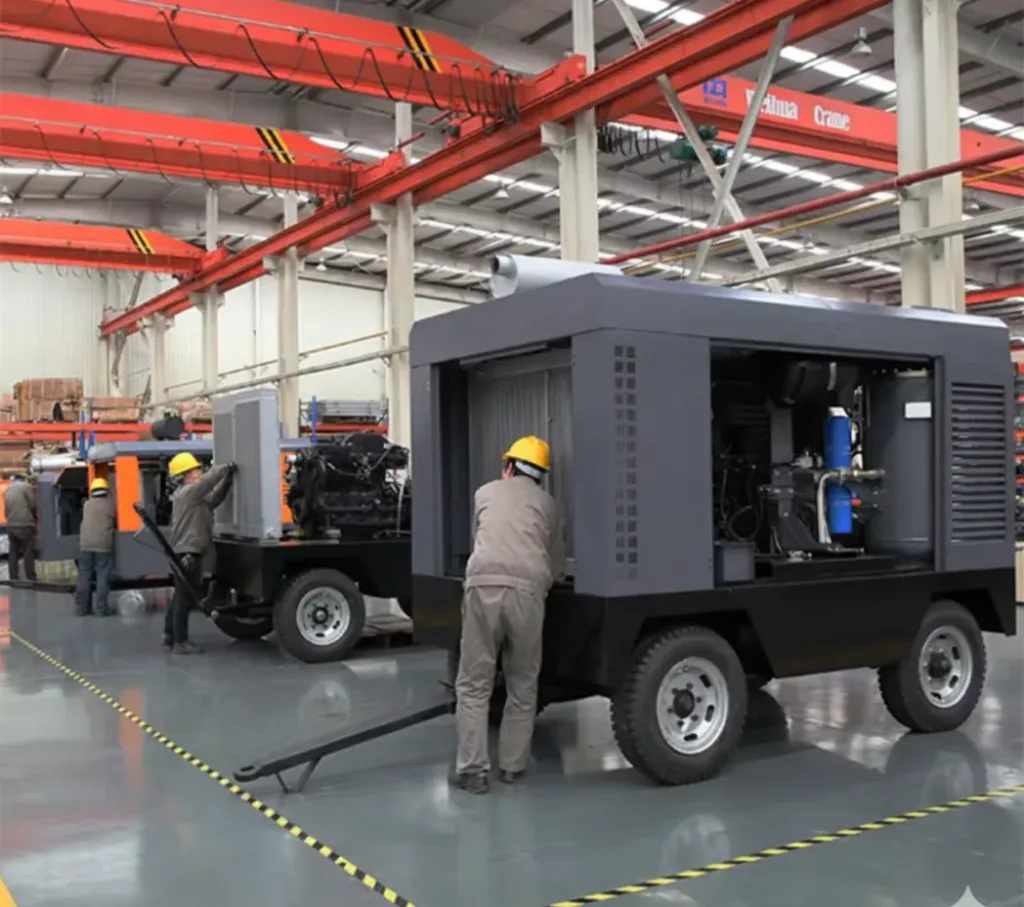
A mobile compressor is a transportable compressed-air system used where fixed compressor stations are not practical. In mining and quarrying, this usually means a portable diesel rotary screw compressor mounted on a trailer, skid, or carrier.
The compressor may move between quarry benches, blast-hole drilling areas, exploration sites, access roads, tunnels, crushing zones, and temporary work faces. It must handle dust, vibration, uneven ground, long duty cycles, high ambient temperature, and frequent relocation.
Common configurations include:
| Compressor Type | Typical Use |
|---|---|
| Trailer-mounted diesel compressor | Quarry benches, open-pit mining, road-access drilling |
| Skid-mounted compressor | Semi-fixed mine work areas, rigs, remote pads |
| Truck-mounted compressor | Fast movement between jobsites |
| Electric mobile compressor | Tunnels, underground areas, low-emission sites with stable power |
| Compressor + booster system | RC drilling, deep mineral exploration, high-pressure drilling |
For most open-pit mining and quarrying projects, diesel-powered mobile screw compressors are still the most practical choice because they do not depend on grid power and can relocate with the drilling crew.
Why Mining and Quarrying Need Mobile Compressed Air
Mining and quarrying sites are constantly changing. Drill rigs move from bench to bench. Blast patterns change. Haul roads shift. Exploration teams move between borehole locations. Utility work and maintenance happen far from fixed infrastructure.
A mobile compressor allows compressed air to follow the work.
Compressed air is used for:
- DTH drilling and blast-hole drilling
- Top hammer drilling support
- RC and mineral exploration drilling
- Pneumatic tools and breakers
- Air flushing and cuttings removal
- Sandblasting and surface preparation
- Pipeline testing, purging, and maintenance
- Ventilation support and cleaning operations
The compressor must provide enough pressure to power the tool and enough airflow to remove cuttings or sustain continuous tool operation. In drilling, pressure and flow must work together. Pressure drives the hammer. Flow cleans the hole and cools the bit.
Main Applications in Mining and Quarrying
DTH Drilling
Down-the-hole drilling is one of the most common reasons mining and quarrying contractors need high-pressure mobile compressors. In DTH drilling, compressed air drives the hammer piston inside the hole and also carries rock cuttings back to the surface.
If pressure is too low, hammer impact becomes weak. If airflow is too low, cuttings remain in the hole, causing regrinding, bit wear, slow penetration, stuck tools, and poor hole quality.
For shallow or medium quarry holes, a medium-pressure compressor may be enough. For deeper holes, harder rock, larger diameter holes, or higher groundwater pressure, a higher-pressure compressor is required.
Blast Hole Drilling
Quarry and mine blasting requires accurate, consistent holes. Poor air supply can reduce drilling speed and affect hole cleaning, which may influence explosive loading and blast quality.
For blast hole drilling, the compressor must be selected according to:
- Hole diameter
- Hole depth
- Rock hardness
- Drilling method
- Hammer size
- Required penetration rate
A compressor selected only by nominal pressure may fail in the field if airflow is insufficient for cuttings removal.
Top Hammer Drilling
Top hammer drilling is common in quarrying, tunneling, road cuts, and surface mining. Compared with DTH drilling, top hammer systems may not always require the same high compressor pressure, but they still need stable air for flushing, tool support, and auxiliary operations.
For top hammer drilling and quarry support, a 7–14 bar compressor can often be suitable, depending on the rig, hole depth, and site requirements.
Mineral Exploration and RC Drilling
Mineral exploration teams often work in remote areas where power and infrastructure are limited. Mobile compressors are used to support reverse circulation drilling, core drilling support, sample collection, and air flushing.
RC drilling requires reliable compressed air to return cuttings through the inner tube of the dual-wall drill pipe. Stable airflow helps improve sample return and reduce contamination risk.
For deeper RC drilling, a compressor alone may not be enough. A booster may be added to reach higher pressure and maintain sample return from greater depths.
Quarry Support and Pneumatic Tools
Not every mining or quarry compressor is used for high-pressure drilling. Many are used for general quarry support, including breakers, chipping tools, cleaning, shotcreting, surface preparation, and maintenance.
These applications usually need lower pressure than DTH drilling, but they may require continuous operation and reliable airflow. A smaller 7–10 bar compressor may be more efficient than a high-pressure drilling compressor for this kind of work.
Choosing the Right Pressure Class
Pressure selection depends on the application. A common mistake is buying the highest-pressure compressor available, assuming it will perform better in every situation. In reality, unnecessary pressure increases fuel consumption and equipment cost.
| Pressure Class | Typical Mining and Quarrying Use |
|---|---|
| 7–8 bar | Pneumatic tools, cleaning, light quarry support, shallow drilling support |
| 10–14 bar | Quarry drilling, medium-duty drilling, sandblasting, pipeline work |
| 18–25 bar | DTH drilling, blast holes, mineral exploration, deeper quarry holes |
| 30–35 bar | Deep drilling, large-diameter holes, hard rock, high groundwater or high backpressure |
| 35 bar+ with booster | RC drilling, deep exploration, specialized high-pressure applications |
For many quarry support tasks, 7–10 bar is enough. For DTH and production drilling, 18–25 bar is more common. For deep exploration or difficult geology, 25–35 bar or compressor-plus-booster systems may be required.
Choosing the Right Airflow
Airflow is just as important as pressure. It is usually measured in CFM or m³/min. In drilling, airflow must be high enough to remove cuttings from the borehole. In pneumatic tools, airflow must support all tools running at the same time.
Important airflow factors include:
- Hammer or drill tool air consumption
- Hole diameter and depth
- Annular velocity required for cuttings removal
- Hose length and pressure drop
- Altitude and ambient temperature
- Whether multiple tools operate together
A compressor with enough pressure but insufficient airflow may still perform poorly. The hammer may strike, but cuttings will not clear properly. This reduces penetration rate and increases tool wear.
For general quarry tools, smaller compressors may be enough. For DTH drilling and blast holes, the required airflow rises quickly with hole diameter and depth.
Diesel vs. Electric Mobile Compressors
Diesel mobile compressors are the standard choice for most mining and quarrying work because they are independent, rugged, and suitable for remote sites. They can move with the drill rig and operate where grid power is not available.
Electric compressors can be useful in underground mines, tunnels, fixed quarry areas, and low-emission zones where stable power is available. They produce no local diesel exhaust and may reduce noise, but they depend on electrical infrastructure.
| Factor | Diesel Mobile Compressor | Electric Mobile Compressor |
|---|---|---|
| Remote site use | Excellent | Limited by power access |
| Mobility | Strong | Cable and power dependent |
| Emissions at machine | Diesel exhaust | No local diesel exhaust |
| Noise | Higher | Usually lower |
| Maintenance | Engine + compressor service | Compressor + electrical service |
| Best use | Open-pit, quarry, drilling, exploration | Tunnels, underground, fixed power areas |
For most surface mining, quarrying, and exploration drilling, diesel remains the practical default. For underground or city-adjacent quarry work with power access, electric may be worth considering.
Chassis and Mobility Requirements
A mining compressor must not only produce air. It must survive movement across rough ground. Quarry roads, mine benches, exploration tracks, and temporary haul roads can damage weak trailer frames, axles, tires, and couplings.
A good mining mobile compressor should have:
- Heavy-duty frame
- Strong towing structure
- Suitable ground clearance
- Durable tires and suspension
- Easy lifting and service access
- Dust-resistant canopy and cooling design
For quarry benches with frequent relocation, trailer-mounted compressors are convenient. For drill rigs or semi-fixed pads, skid-mounted compressors may be better. For very remote exploration, compressors may be mounted on trucks, crawlers, or custom carriers.
Cooling and Dust Protection
Mining and quarrying sites are dusty, hot, and abrasive. Dust can block coolers, clog air filters, damage engine components, and reduce compressor performance.
A compressor for quarry and mining work should have strong intake filtration, accessible filters, efficient cooling, and a canopy designed for dusty environments. Operators should inspect air filters and coolers frequently, especially near drilling dust, crusher dust, haul roads, and blasting areas.
Overheating is common when coolers are blocked or airflow is restricted. In hot regions, high-capacity radiators and oil coolers are important for continuous duty.
Maintenance planning should include:
- Daily oil and coolant checks
- Frequent air filter inspection
- Cooler cleaning
- Separator and oil filter replacement
- Hose and coupling inspection
- Drain and condensate checks
In mining, preventive maintenance is cheaper than losing a drilling shift.
Peakroc Mobile Compressor Solutions for Mining and Quarrying
Peakroc® offers a wide range of portable diesel screw compressors suitable for mining, quarrying, drilling, sandblasting, pipeline work, and heavy-duty industrial use. The PRMD series covers a broad range of airflow and pressure classes, allowing buyers to match the machine to the job instead of overbuying.
Low and Medium Pressure Quarry Support
For pneumatic tools, surface preparation, cleaning, small quarry work, and general site support, lower-pressure compressors are usually more efficient.
Examples include:
| Peakroc Model Direction | Typical Parameter | Suitable Use |
|---|---|---|
| Low-pressure portable diesel compressor | 5 m³/min, 7 bar | Tools, cleaning, light support |
| Medium-duty compressor | 10 m³/min, 10 bar | Mining support, quarry work, pipeline, medium drilling |
| Medium-pressure compressor | 10 m³/min, 13 bar | Quarry drilling, sandblasting, heavier tools |
These machines are suitable when the main requirement is stable compressed air, not deep high-pressure drilling.
Large-Flow Quarry and Mining Compressors
For sites that need larger air volume, Peakroc offers higher-flow models such as 25 m³/min at 8 bar and 27 m³/min at 12 bar. These are useful for large pneumatic demand, sandblasting, tunnel support, mine maintenance, and quarry production support.
A 27 m³/min 12 bar compressor can support mining and quarrying applications where both airflow and moderate pressure are required, such as DTH drilling, blasthole drilling, and pneumatic tools.
High-Pressure DTH and Blast Hole Compressors
For DTH drilling, blast holes, deep boreholes, quarry pre-splitting, mineral exploration, and hard rock applications, Peakroc high-pressure compressors in the 18–25 bar class are more suitable.
Typical applications include:
- DTH drilling
- Blast hole drilling
- Deep quarry drilling
- Mineral exploration
- Water well drilling
- Hard rock drilling
Peakroc 25 bar portable diesel compressors are designed for the pressure and airflow required by DTH hammers and deeper drilling work.
35 Bar High-Pressure Applications
For more demanding drilling conditions, such as larger hole diameters, deeper holes, hard formations, high altitude, or high backpressure, 35 bar compressors may be required.
These are not necessary for every quarry. They are selected when the drilling method and geological conditions justify the higher pressure and engine power.
Practical Selection Guide by Application
| Application | Recommended Compressor Direction |
|---|---|
| Quarry air tools and cleaning | 7–10 bar portable diesel compressor |
| General quarry drilling | 10–14 bar medium-pressure compressor |
| Sandblasting and surface preparation | High-flow 8–12 bar compressor |
| DTH drilling and blast holes | 18–25 bar high-pressure compressor |
| Mineral exploration and RC support | 25 bar compressor, sometimes with booster |
| Deep hard rock drilling | 25–35 bar high-pressure compressor |
| Underground or low-emission mining | Electric compressor if stable power is available |
| Remote exploration | Diesel towable or skid-mounted compressor |
The best compressor is not always the biggest unit. It is the machine that matches the drill, hole depth, rock condition, air demand, and mobility requirement.
Common Buying Mistakes
Choosing Pressure Without Airflow
A 25 bar compressor may still fail if airflow is too low for the hammer and hole diameter. Pressure drives the hammer, but airflow cleans the hole. Both must be matched.
Using a Drilling Compressor for Light Tools
High-pressure drilling compressors are expensive to run if the job only requires 7–10 bar air tools. A lower-pressure compressor may be more fuel-efficient.
Ignoring Altitude and Temperature
High altitude reduces air density. Hot weather increases cooling demand. Both can reduce compressor performance. Mines in mountains, deserts, and tropical areas should allow extra capacity.
Underestimating Dust
Dust is one of the biggest compressor killers in quarrying. Poor filtration and dirty coolers lead to overheating, high fuel use, and early component failure.
Forgetting Service Access
A compressor that is difficult to service will not be maintained properly. Mining compressors should have accessible filters, coolers, drains, and routine service points.
Maintenance Tips for Mining and Quarrying Compressors
A mobile compressor in mining works harder than a compressor in a clean factory. Maintenance intervals should be adjusted to real site conditions.
Recommended daily checks include:
- Engine oil and compressor oil level
- Coolant level
- Fuel and water separator
- Air filter restriction indicator
- Cooler and radiator blockage
- Hoses, clamps, valves, and couplings
Weekly checks should include cooler cleaning, drain inspection, belt or coupling inspection, battery checks, and air-end temperature review.
For high-pressure drilling compressors, also monitor discharge temperature, separator pressure drop, oil carryover, and engine load behavior.
Field Example: Quarry DTH Drilling
A quarry drilling contractor may need to drill blast holes in granite or basalt. The holes are deeper than general construction holes, and the formation is hard. A 7 bar compressor can run some tools, but it cannot efficiently power the DTH hammer.
In this case, the contractor should look at 18–25 bar compressors with enough airflow for the hammer and hole diameter. If the quarry uses medium-diameter holes and moves between benches, a towable 25 bar diesel screw compressor may be a practical solution.
The result is faster penetration, better hole cleaning, less bit wear, and fewer stuck tools.
Field Example: Open-Pit Mine Support
An open-pit mine may not use one compressor for all work. It may need lower-pressure compressors for tools and maintenance, high-flow compressors for cleaning or surface preparation, and high-pressure compressors for drilling.
A mixed compressor fleet is often more efficient than using one oversized unit for every task. Peakroc can support different pressure classes so the mine can match each compressor to the correct duty.
Field Example: Mineral Exploration
Exploration teams often move between remote drilling locations. They need mobile compressed air without waiting for fixed infrastructure. A diesel compressor provides independence, while a booster may be added for deeper RC drilling.
The compressor must be easy to tow, reliable in remote terrain, and supported by spare parts. Fuel consumption and service intervals become important because downtime in remote exploration can be expensive.
Final Recommendation
A mobile compressor for mining and quarrying should be selected based on application, not only catalog size. For general quarry support and tools, 7–10 bar may be enough. For quarry drilling and heavier support work, 10–14 bar is often more suitable. For DTH drilling, blast holes, mineral exploration, and hard rock drilling, 18–25 bar or even 35 bar may be required.
Diesel mobile screw compressors remain the most practical choice for remote mines and quarries because they are independent and easy to relocate. Electric compressors are useful where stable power is available and low-emission operation is required.
Peakroc® offers a broad mobile compressor range for mining and quarrying, including low-pressure support compressors, medium-pressure quarry compressors, high-flow mining compressors, and high-pressure DTH drilling compressors. The right choice depends on pressure, airflow, hole depth, drilling method, rock condition, mobility, and maintenance support.
FAQ
1. What is a mobile compressor for mining and quarrying?
A mobile compressor for mining and quarrying is a portable or towable air compressor used to supply compressed air for drilling, blasting, pneumatic tools, quarry support, mineral exploration, and remote mine operations.
2. What type of compressor is commonly used in mines and quarries?
The most common type is a portable diesel rotary screw compressor because it provides continuous airflow, strong mobility, and independent operation in remote locations.
3. What pressure is needed for quarry drilling?
General quarry support may only need 7–10 bar, while DTH drilling and blast hole drilling often require 18–25 bar or higher depending on hole depth, diameter, and rock hardness.
4. Why is airflow important for DTH drilling?
Airflow removes rock cuttings from the hole and cools the hammer and bit. Insufficient airflow can cause slow penetration, regrinding, tool wear, and stuck drilling tools.
5. Can one compressor serve all mining applications?
Sometimes, but not always. A mine may need different compressors for pneumatic tools, sandblasting, DTH drilling, RC drilling, and general maintenance because each application has different pressure and airflow requirements.
6. Is diesel or electric better for mining compressors?
Diesel is better for remote and mobile work without grid power. Electric compressors are useful for underground mines, tunnels, fixed work areas, and low-emission sites where reliable power is available.
7. What Peakroc compressor models are suitable for mining and quarrying?
Peakroc offers portable diesel screw compressors from low-pressure 7 bar units to high-pressure 25 bar and 35 bar models. Suitable options include 10 m³/min 10 bar, 25 m³/min 8 bar, 27 m³/min 12 bar, 39 m³/min 25 bar, and 33 m³/min 35 bar configurations.
8. How do I choose the right mobile compressor for a quarry?
Start with the application, drilling method, hole depth, hole diameter, rock hardness, required pressure, required airflow, mobility needs, site temperature, altitude, and maintenance support. Then match the compressor to the actual duty instead of choosing only by price or size.
Author

Mark Chen – Senior Mechanical Engineer, Peakroc®
Mark Chen is a senior mechanical engineer at Peakroc®, specializing in compressed air systems and drilling equipment for mining and construction applications. With over 15 years of field experience, he has led multiple projects on optimizing air delivery efficiency, equipment durability, and energy consumption.