
Key Takeaways
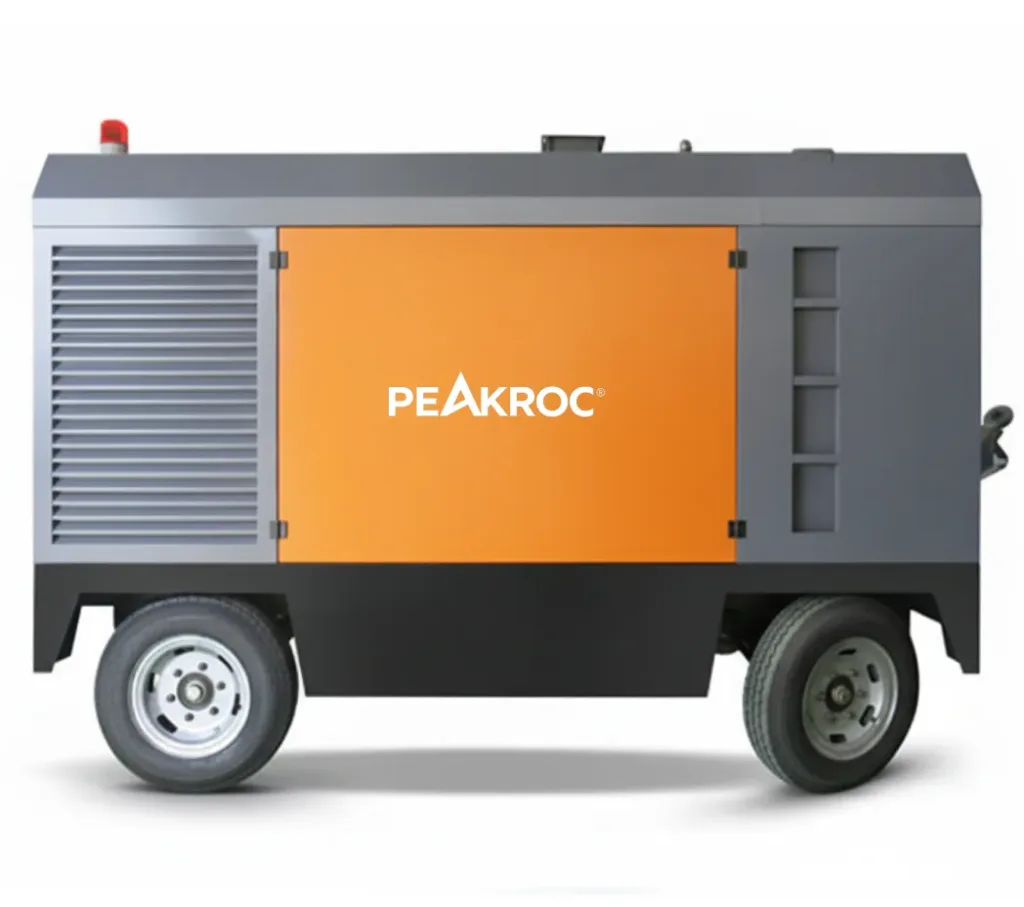
- An aftercooler removes heat, not all moisture. Cooling compressed air causes water vapor to condense into liquid, which must then be collected and discharged through a water separator and drain. For portable diesel applications, the Peakroc® 10 m³/min, 10 bar air compressor illustrates a compressor class where moisture-control accessories may be considered.
- A water separator cannot replace a proper air dryer. It removes condensed liquid droplets but does not significantly reduce the remaining water vapor. Applications requiring a specified pressure dew point need additional drying equipment.
- Pressure drop matters as much as water removal. An undersized aftercooler, restrictive separator or blocked filter can reduce the pressure available at the blasting nozzle or pipeline connection. The 25 m³/min, 8 bar portable diesel compressor demonstrates why high-flow applications must consider the entire air-delivery path.
- Sandblasting and pipeline drying require different levels of air treatment. Removing bulk liquid water may help prevent abrasive clumping, while pipeline drying to a specified low dew point often requires desiccant drying and verification. The Peakroc® pipeline blowing, pigging and drying guide explains these separate pipeline duties.
- Select the complete compressed-air treatment package. Actual FAD, operating pressure, inlet temperature, ambient conditions, condensate drainage and acceptable pressure loss must be evaluated together. The Peakroc® 20 m³/min, 13 bar portable diesel compressor represents another airflow and pressure class for evaluating optional moisture-treatment configurations.
Portable diesel air compressors are widely used for abrasive blasting, surface preparation, pipeline construction and temporary industrial applications.
These machines can provide continuous compressed air under demanding outdoor conditions. However, a compressor that delivers sufficient pressure and airflow may still create operational problems if the air contains excessive moisture.
Abrasive blasting contractors may experience clumping inside the blast pot, inconsistent abrasive delivery, blocked metering valves or delays in surface preparation.
Pipeline contractors may struggle to meet moisture limits during commissioning, even when their compressor can deliver the required airflow.
In both situations, the problem is not necessarily insufficient compressor capacity.
It may be inadequate cooling, ineffective condensate separation, poor drainage or a mismatch between the air-treatment equipment and the actual application.
The solution begins by understanding the distinct functions of an aftercooler, water separator and air dryer.
The objective is not simply to produce cooler air. It is to deliver the required airflow, pressure and moisture condition at the actual point of use.
Why Does a Portable Air Compressor Produce Water?
All atmospheric air contains some water vapor.
The amount depends on ambient temperature, relative humidity and atmospheric pressure.
When air enters a compressor, its pressure increases. Compression also generates heat.
The hot compressed air can retain substantial water vapor, but its ability to hold that vapor decreases as it cools.
Consequently, when compressed air passes through a cooler, receiver or downstream pipeline, part of its water vapor may condense into liquid water.
Why Warm, Humid Jobsites Create More Condensate
Consider a portable compressor operating in a coastal environment.
At approximately 30°C and 70% relative humidity, the incoming atmosphere contains roughly 21 grams of water vapor per cubic meter.
If the compressor takes in approximately 20 m³/min of ambient air under those conditions, the incoming moisture load is approximately:
20 m³/min × 21 g/m³ × 60 min/h = 25.2 kg/h of water vapor
This is an illustrative psychrometric calculation, not a measured compressor test.
It represents the water vapor entering with the air, not the amount of liquid water that the separator will collect.
The actual condensate quantity depends on the aftercooler outlet temperature, operating pressure, downstream conditions and the performance of the separation system.
Nevertheless, the example shows why a relatively large compressor operating in humid weather may require substantial condensate-handling capacity.
Even a small fraction of that water reaching the blast pot or downstream process can create operational problems.
How an Aftercooler Controls Compressor Outlet Temperature
An air compressor aftercooler is a heat exchanger that reduces the temperature of compressed air after compression.
In many portable applications, an air-cooled aftercooler transfers heat from the compressed air to the surrounding atmosphere through a radiator and fan.
Some industrial systems use water-cooled designs.
As the air temperature falls, water vapor can condense into liquid droplets.
The cooling stage therefore makes bulk moisture removal possible.
However, the aftercooler itself is not a complete air dryer.
Understanding Aftercooler Approach Temperature
One useful performance measurement is the difference between aftercooler outlet-air temperature and the temperature of the cooling medium.
For an air-cooled unit:
Temperature Approach = Aftercooler Air Outlet Temperature − Ambient Cooling-Air Temperature
For example, if the cooling air is 35°C and the compressed air leaves the aftercooler at 45°C, the temperature approach is 10°C.
A 10°C approach can be a useful preliminary reference for some designs, but it is not a universal performance guarantee.
Actual performance depends on airflow, heat-exchanger capacity, air inlet temperature, cooling airflow, ambient conditions and equipment cleanliness.
A model operating satisfactorily in moderate weather may deliver a much higher outlet temperature during a hot afternoon.
Likewise, a cooler designed for a smaller compressor may be unable to achieve its intended outlet temperature when installed on a higher-flow machine.
Why Outlet Temperature Matters
If compressed air leaves the aftercooler at an elevated temperature, much of its moisture may remain in vapor form.
As the air travels through cooler hoses or piping, additional condensation can occur downstream.
For abrasive blasting, this water may form close to the blast pot.
For pipeline work, the water can enter the system being cleaned or commissioned.
In both cases, the air-treatment system has failed to control where condensation occurs.
The aftercooler’s function is to remove enough heat so that substantial condensation occurs at a location where liquid water can be separated and drained safely.
Water Separator vs Air Dryer: What Is the Difference?
A moisture separator, also called a water separator, is designed to remove liquid droplets from compressed air.
Common designs use centrifugal force, changes in airflow direction, demister media or combinations of these mechanisms.
Liquid collects in a chamber and must be removed through a suitable drain.
Well-sized separators can remove a high proportion of incoming free-liquid droplets under their rated operating conditions.
However, their effectiveness depends on droplet size, operating flow, pressure and separator design.
A water separator does not substantially remove water that remains in the gas phase.
Why a Separator Needs an Effective Condensate Drain
A separator is only as useful as its ability to discharge collected water.
A blocked drain can allow liquid to accumulate until water is carried downstream.
An improperly operating drain can also waste compressed air.
For portable construction equipment, condensate drainage deserves particular attention because operating conditions may change throughout the day.
Manual drains require regular operator attention.
Automatic drains reduce reliance on manual intervention, but their operation still needs periodic verification.
The drain and collection system must be suitable for the operating pressure, potential oil contamination and local disposal requirements.
Condensate from an oil-injected compressor may contain lubricating oil and should not automatically be discharged onto the ground or into stormwater drains.
Understanding the Complete Air-Treatment Sequence
A typical portable moisture-control arrangement follows this functional sequence:
Compressor → Aftercooler → Water Separator & Drain → Required Filtration → Optional Dryer → Point of Use
The exact arrangement depends on the dryer technology and equipment manufacturer’s installation requirements.
For example, some dryers require specific upstream filtration, while other treatment packages incorporate additional separation stages.
The air-treatment components must be compatible with one another.
An aftercooler reduces temperature, a separator removes bulk liquid and a dryer reduces the remaining water vapor to the required moisture level.
They solve related but different problems.
How to Size an Aftercooler and Moisture Separator for a Portable Compressor
The most common selection mistake is choosing an aftercooler by connection diameter or product appearance alone.
An aftercooler must be capable of processing the compressor’s actual airflow while removing the required heat under the expected operating conditions.
A water separator must handle the resulting liquid load without excessive pressure loss.
Five Essential Aftercooler Sizing Parameters
- Compressor FAD: Confirm the actual air delivery in m³/min or CFM at the specified working pressure. The treatment system must handle the maximum relevant flow.
- Operating pressure: Verify that the aftercooler, separator, drains, hoses and fittings are rated for the compressor’s working pressure and foreseeable pressure conditions.
- Compressor discharge temperature: Obtain the expected compressed-air temperature entering the aftercooler, including high-load and high-ambient operating conditions.
- Maximum ambient temperature and humidity: Design for the hottest and most humid relevant conditions, not simply a mild reference day.
- Required outlet condition and pressure loss: Define the intended aftercooler outlet temperature, acceptable pressure drop, condensate drainage capacity and any downstream dew-point requirement.
Why FAD Must Be Checked at the Same Operating Point
Suppose a portable compressor delivers 20 m³/min, approximately 706 CFM, at its specified working pressure.
Pairing it with a nominal 500 CFM aftercooler is not automatically acceptable.
The aftercooler may have been rated under different pressure, temperature or environmental conditions.
Actual performance must be checked using the manufacturer’s correction factors and pressure-loss data.
A unit advertised with sufficient nominal flow capacity can still be unsuitable when inlet temperature is higher than its reference rating or ambient cooling conditions are severe.
For procurement, request performance data at the actual compressor operating point rather than relying only on product labels.
Pressure Drop: Why Moisture Control Must Not Restrict Air Supply
Every component in a compressed-air system creates some resistance to flow.
Aftercoolers, separators, filters, fittings, valves and hoses can all contribute to pressure loss.
Pressure drop becomes particularly important in abrasive blasting because blasting productivity depends on maintaining adequate pressure and airflow at the nozzle.
A compressor may indicate satisfactory outlet pressure while the blast nozzle receives significantly less.
How Pressure Drop Accumulates
The total pressure loss is the sum of the losses through the relevant components at the actual airflow.
For a simplified example:
Pressure at Point of Use = Compressor Discharge Pressure − Total System Pressure Loss
If the compressor discharge pressure is 7 bar and the aftercooler, separator, hose and fittings together cause 0.5 bar of pressure loss, approximately 6.5 bar remains at the point of use before any other downstream restrictions.
This is an illustrative calculation.
It is not a specification for any particular compressor or aftercooler.
The correct pressure allowance must be based on actual system measurements or reliable pressure-drop calculations.
Why a Small Moisture Separator Can Become a Major Restriction
A separator designed for a low-flow pneumatic line may be unsuitable for a high-CFM blasting compressor.
If a small filter element is installed in a high-flow line, it can become restrictive even when clean.
Contamination and blocked elements may increase the loss further.
The problem may be incorrectly diagnosed as inadequate compressor pressure.
Increasing the compressor pressure without identifying the restriction can waste fuel and may push equipment outside its intended operating conditions.
A better approach is to compare pressure at several points under the same loaded operating conditions.
Portable Compressor Moisture Control Troubleshooting Table
| Symptom | Possible Cause | Recommended Check | Corrective Direction |
|---|---|---|---|
| High aftercooler outlet temperature | Dirty cooler, fan malfunction, excessive inlet temperature or undersized heat exchanger | Measure inlet, outlet and ambient temperatures under load | Restore cooling performance or reassess cooler capacity |
| Water reaching the blast pot | Ineffective cooling, overloaded separator or failed drain | Inspect condensate discharge and measure outlet conditions | Correct drainage and separation; evaluate additional drying |
| Excessive pressure drop | Undersized separator, blocked filter, restrictive fittings | Measure differential pressure at actual operating flow | Service or correctly size the restrictive component |
| Little condensate collected despite downstream water | Drain blockage, bypass, inadequate cooling or incorrect installation | Check cooling performance, drain function and piping arrangement | Restore intended cooling and separation path |
| Moisture reappears in downstream hose | Remaining water vapor condenses as the air cools | Compare local air temperature with pressure dew point | Add suitable drying or change the treatment arrangement |
| Dryer cannot achieve required dew point | Excessive inlet temperature, overloaded flow, poor regeneration or other dryer fault | Verify inlet conditions, corrected capacity and dryer status | Correct operating conditions or resize dryer |
A troubleshooting table can narrow the investigation, but it cannot establish exact performance limits without equipment-specific data.
Five Practical Field Checks for Moisture and Pressure Loss
- Measure actual compressor flow and pressure. Confirm the machine is operating under the intended loaded condition rather than diagnosing from an unloaded pressure reading.
- Record temperatures before and after the aftercooler. Compare these values with ambient cooling-air temperature and the equipment’s design expectations.
- Check the separator drain. Verify that collected condensate is actually discharged and that the drain does not leak excessive compressed air.
- Measure pressure differential. Compare pressures upstream and downstream of treatment components under load, and measure pressure at the actual blasting or process connection.
- Verify air quality at the point of use. Check for liquid water, oil contamination and, where specified, the actual pressure dew point.
These measurements help distinguish a compressor-capacity problem from an air-treatment restriction.
For abrasive blasting, nozzle pressure measurement can be particularly informative.
A compressor pressure gauge alone does not show how much pressure is lost through downstream accessories.
Moisture Control for Sandblasting and Surface Preparation
Abrasive blasting requires a stable supply of compressed air to transport abrasive material and provide sufficient kinetic energy at the nozzle.
Moisture can interfere with that process.
When liquid water enters the blast pot, some abrasive materials may absorb moisture or begin to clump.
This can cause inconsistent media flow, blocked metering components and repeated operator adjustments.
Moisture-related interruptions can reduce productive blasting time.
In coating-preparation work, uncontrolled moisture can also contribute to undesirable surface conditions.
When Is an Aftercooler and Separator Enough?
For some blasting operations, a properly sized aftercooler and separator may provide sufficient bulk-water control.
That depends on site humidity, temperature changes, hose configuration, abrasive characteristics and the surface-preparation specification.
The correct objective is to prevent unacceptable moisture from reaching the abrasive delivery system.
A properly functioning moisture-treatment package can reduce the likelihood of wet abrasive problems without requiring every blasting project to use an extremely low-dew-point dryer.
However, the aftercooler outlet temperature must be evaluated against the temperature that air will experience farther downstream.
If the air cools significantly in the hose, further condensation may occur even after bulk liquid has been removed.
When Is Additional Drying Necessary?
More demanding blasting and coating operations may need additional drying.
This can be particularly relevant when environmental conditions are highly humid, the blast hose is exposed to substantial temperature changes or the surface-preparation specification requires stricter moisture control.
A refrigerated or desiccant dryer may be appropriate, depending on the actual pressure dew point required.
The selection should be based on measurable air-quality requirements rather than a general assumption that all blasting needs the same dryer type.
An important distinction is that a dry-process blasting air system is not the same as a certified breathing-air system.
Compressed air from an ordinary oil-injected construction compressor must not be assumed safe for respiratory use. Operator breathing-air equipment requires separate compliant treatment, monitoring and verification.
Moisture Control for Pipeline Blowing, Drying and Commissioning
Pipeline applications introduce a different air-treatment objective.
The purpose may be cleaning, dewatering, drying, testing or another commissioning operation.
Each requires a specific definition of acceptable air quality.
For pipeline blowing, air pressure and airflow may be the primary requirements.
For pipeline drying after hydrotesting, the remaining moisture level becomes critical.
A compressor equipped only with an aftercooler and separator can still deliver air containing substantial water vapor.
That vapor may condense as the air cools inside the pipeline.
Consequently, high compressor airflow does not guarantee that the pipeline will reach its drying specification.
Why Pipeline Drying Requires a Dew-Point Target
Pressure dew point describes the temperature at which water vapor begins to condense while the air remains at a specified pressure.
The required dew point should come from the approved pipeline commissioning specification.
Some projects may require moderately dry air, while others need much lower dew points.
A requirement of −40°C pressure dew point, for example, generally calls for a suitable desiccant drying system rather than an aftercooler and water separator alone.
The air dryer must also have sufficient corrected capacity for the compressor’s flow, pressure, inlet temperature and ambient conditions.
If the compressor delivers more air than the dryer can process, the dryer becomes the limiting component.
For regenerative desiccant dryers, purge-air consumption must also be considered when calculating the available downstream airflow.
Why Pipeline Drying Is Different From Dewatering
Dewatering removes bulk liquid water from the pipeline.
Drying reduces the remaining moisture to the specified acceptance condition.
These are different stages.
A pipeline may appear free of standing water but still contain moisture on internal surfaces or water vapor in the air.
Conversely, supplying very dry air without adequately removing trapped liquid may result in unnecessarily long drying times.
A complete procedure may therefore combine dewatering, suitable pigging methods, dry-air circulation and dew-point measurement.
The commissioning engineer must establish the appropriate acceptance criteria.
Compressed air should not automatically be used for every purging or testing operation. Inerting may require nitrogen or another approved medium, and pneumatic testing requires specific stored-energy safety controls.
Refrigerated vs Desiccant Dryer: How to Choose
An aftercooler and water separator provide bulk moisture removal.
The next question is whether the application requires further reduction of vapor-phase moisture.
Refrigerated Air Dryers
A refrigerated dryer cools compressed air to condense additional water and then separates and drains that liquid.
Under suitable rated conditions, a common pressure-dew-point target is around +3°C.
This may be appropriate for many general industrial applications.
However, a refrigerated dryer with a +3°C pressure dew point does not guarantee condensation-free operation if the downstream air piping falls below that temperature.
A dryer must also be suitable for outdoor ambient conditions, maximum inlet temperature and the expected airflow.
Desiccant Air Dryers
A desiccant dryer removes water vapor using a moisture-adsorbing material.
Regenerative desiccant designs are commonly used when much lower pressure dew points are required.
Applications may specify −20°C, −40°C or another target according to the process requirements.
Desiccant dryers can be appropriate for demanding pipeline drying and other moisture-sensitive work.
However, they introduce additional considerations such as regeneration energy or purge-air consumption, filtration requirements and maintenance.
The correct choice is therefore not simply the driest available dryer.
It is the system that reliably achieves the required pressure dew point with acceptable operating cost and available downstream airflow.
Five Maintenance Practices for Portable Aftercoolers and Separators
- Inspect cooling surfaces and fan operation. Dust and debris can reduce heat-transfer performance, especially on construction and blasting sites.
- Verify condensate drains regularly. Blocked drains allow water accumulation, while leaking drains can waste compressed air.
- Monitor differential pressure. Increasing pressure loss may indicate contamination, incorrect component sizing or internal restrictions.
- Inspect seals, connections and discharge hoses. Leaks, damaged fittings and unsuitable hose sizes can reduce effective airflow.
- Manage collected condensate correctly. Follow site procedures for handling oil-contaminated water and ensure collection equipment has adequate capacity.
Service intervals and operating limits should follow the component manufacturer’s instructions.
Internal maintenance must be performed only after shutdown, isolation, cooling and verified depressurization.
Technical Field References
The following documented industry examples illustrate how moisture-control equipment affects blasting productivity and pipeline commissioning.
They are external technical references, not Peakroc® customer projects. Results from specific installations should not be treated as universal performance guarantees.
Field Reference 1: Restrictive Moisture Separator in Abrasive Blasting
An industrial blasting equipment supplier published a field-service report describing blast-pot moisture separators that produced excessive pressure loss when their filter elements became restrictive.
The supplier reported measurements of pressure loss reaching 18 PSI in some cases.
The report emphasized checking pressure at the blasting equipment rather than assuming that the compressor’s outlet gauge represented the pressure available at the nozzle.
Engineering lesson: A moisture separator can become a significant airflow restriction if its design, condition or flow capacity is unsuitable.
The 18 PSI figure was a supplier-reported field observation, not a universal value for water separators or a controlled comparison of all aftercooler designs.
It should prompt pressure measurement, not the assumption that every separator causes that level of loss.
Field Reference 2: 1,600 CFM Dry-Air Package for Natural Gas Pipeline Commissioning in Canada
A documented pipeline drying project at a natural gas metering station in Scarborough, Ontario, required hot, dry and oil-free compressed air under winter conditions.
The temporary system included a 1,600 CFM compressor, a matching 1,600 CFM desiccant dryer and an additional heat exchanger.
The project required a dew point of approximately −40°C/−40°F.
Operating challenges included low ambient temperatures, heat retention and the risk of dryer components freezing.
The project team adjusted the air-treatment and heating arrangement, including insulation and protection for critical components.
According to the published project report, the required drying condition was achieved in less than 54 hours, compared with an initial estimated duration of approximately two weeks.
Engineering lesson: A pipeline drying system must coordinate airflow, dryer capacity, temperature management and environmental protection.
An aftercooler and basic water separator alone would not establish the required low dew point.
The completion result reflects the complete temporary system and should not be attributed solely to one individual component.
Field Reference 3: Multi-Stage Pipeline Drying and Commissioning Project
Another documented pipeline project involved different phases of compressed-air supply, including pre-testing, dewatering, inspection and final drying.
The service requirements included two 1,600 CFM compressor-and-dryer units for an early project phase, followed by larger temporary equipment arrangements during subsequent operations.
For a later inspection stage, the published plan included five 1,600 CFM compressors with dryers.
The project also specified a final dew-point requirement, and the service provider reported on-time completion.
Engineering lesson: Pipeline operations can require different combinations of compressors and dryers at different stages.
The compressor used for dewatering is not necessarily the same capacity or configuration needed for final drying.
The published report does not provide a complete independent dataset isolating aftercooler performance, pressure loss or condensate volume. It is best used to illustrate system-level planning.
Five Details to Include in an Air-Treatment RFQ
When requesting an aftercooler, moisture separator or complete portable compressed-air package, provide:
- Compressor specifications: Manufacturer, model, actual FAD, working pressure and maximum expected compressor discharge temperature.
- Jobsite conditions: Maximum and minimum ambient temperature, relative humidity, altitude, dust exposure and expected operating hours.
- Application requirements: Sandblasting, surface preparation, pipeline blowing, pipeline drying or another defined operation, including required air quality.
- Air-treatment targets: Desired aftercooler outlet temperature, maximum pressure drop, condensate-drain requirements and pressure dew point where applicable.
- Installation and commercial details: Connection sizes, hose configuration, mounting arrangement, electrical or pneumatic fan supply, condensate disposal method and delivery requirements.
An inquiry stating only “We need an air dryer for a 700 CFM compressor” is insufficient.
A more useful request identifies the actual compressor operating conditions and the required air quality at the point of use.
Final Recommendation
Portable air compressor moisture control should be treated as a complete engineering system rather than a collection of optional accessories.
An aftercooler reduces compressed-air temperature and allows part of the water vapor to condense.
A water separator removes much of the resulting liquid, provided the separator is correctly sized and its condensate drain operates effectively.
A dryer is required when the application demands further reduction of water vapor to a specified pressure dew point.
For abrasive blasting, the objective is to control moisture without sacrificing the airflow and nozzle pressure needed for efficient surface preparation.
For pipeline drying, the objective is to achieve the required final moisture condition while maintaining adequate dry-air flow throughout the commissioning process.
In both applications, oversized equipment may waste capital and operating energy, while undersized treatment equipment can create restrictions and fail to control moisture.
The best portable air-treatment package is the one that delivers adequate FAD, working pressure, outlet temperature and moisture quality under actual jobsite conditions—with acceptable pressure loss and reliable condensate removal.
FAQ
What does an aftercooler do on a portable air compressor?
An aftercooler reduces the temperature of hot compressed air after compression. This causes part of the water vapor to condense into liquid water, which can then be removed by a suitable moisture separator and condensate drain. An aftercooler alone does not guarantee a low pressure dew point.
Is a moisture separator the same as an air dryer?
No. A moisture separator removes condensed liquid droplets from compressed air, while an air dryer reduces the water vapor remaining in the air. Applications requiring a specified low pressure dew point generally need a suitable dryer.
How hot should the compressed air be after an aftercooler?
The outlet temperature depends on ambient conditions, cooling-medium temperature, compressor flow, inlet temperature and aftercooler design. Some systems are designed for an approach temperature around 10°C above cooling-air temperature, but actual performance must be verified against manufacturer specifications.
Why is water still reaching my sandblasting pot after installing a separator?
Possible causes include insufficient cooling, an overloaded separator, a blocked drain or additional condensation inside downstream hoses. Verify aftercooler outlet temperature, drain operation, actual airflow and pressure dew point before changing components.
How much pressure drop is acceptable through an aftercooler and water separator?
There is no universal allowable pressure drop. It depends on the compressor, airflow, treatment components and required pressure at the point of use. Compare manufacturer pressure-loss data and measure differential pressure under actual loaded conditions.
Is an aftercooler and water separator enough for sandblasting?
They may provide sufficient bulk-liquid moisture control for some blasting applications. However, humid conditions, temperature changes or strict surface-preparation requirements may justify additional air drying. The required treatment should be based on actual operating conditions.
Do I need a desiccant dryer for pipeline drying?
A desiccant dryer is often appropriate when pipeline commissioning requires a very low pressure dew point, such as −40°C. The exact dryer type and capacity depend on the project specification, compressor airflow, operating pressure, inlet temperature and environmental conditions.
What information is needed to size a portable compressor aftercooler?
Provide the compressor’s actual FAD, working pressure, discharge temperature, site ambient conditions, required outlet-air condition, allowable pressure drop, installation configuration and condensate-management requirements. Add the required pressure dew point if the application also needs a dryer.
Author

Mark Chen – Senior Mechanical Engineer, Peakroc®
Mark Chen is a senior mechanical engineer at Peakroc®, specializing in compressed air systems and drilling equipment for mining and construction applications. With over 15 years of field experience, he has led multiple projects on optimizing air delivery efficiency, equipment durability, and energy consumption.