
Key Takeaways
- Start with the DTH hammer model, not the compressor size. A 3″, 4″, 5″ or 6″ hammer has its own recommended bit diameter, operating-pressure range and air-consumption curve. The DTH rig and compressor matching guide explains how these requirements affect drilling performance.
- Pressure and airflow perform different jobs. Pressure supports hammer operation, while adequate FAD is necessary for hammer cycling and cuttings removal. Understanding CFM, FAD and compressor flow ratings helps prevent mismatched specifications.
- Hole diameter, drill-pipe diameter and formation matter together. Larger annular clearance increases the airflow needed to maintain a given flushing velocity. The quarry compressor sizing guide covers related production-drilling considerations.
- Depth does not determine compressor pressure by itself. Groundwater, backpressure, pipe restrictions and rock conditions can change the air requirement. The 25-bar high-pressure compressor guide explains when higher-pressure equipment may be justified.
- Match the complete drilling system. A correctly sized compressor must work with the hammer, bit, drill pipes, rig controls and actual site conditions. Peakroc’s 22 m³/min at 20 bar portable compressor illustrates one possible pressure-flow class, subject to the hammer manufacturer’s requirements.
A down-the-hole (DTH) hammer is powered by compressed air delivered through the drill string. The hammer’s internal piston repeatedly strikes the drill bit, while exhaust air helps transport rock cuttings out of the borehole. Because these functions depend on the available air supply, compressor selection directly affects penetration rate, hole cleaning, fuel consumption and drilling reliability.
A common purchasing mistake is to request a compressor based only on hammer diameter: for example, “We need an air compressor for a 5-inch DTH hammer.” This is not enough information for accurate sizing. Two hammers of the same nominal diameter may have different internal designs, pressure ratings and air-consumption requirements.
A more reliable approach is to match the specific hammer model, bit diameter, operating pressure, required FAD, hole depth and rock formation, then verify that the compressor can deliver the necessary air at the hammer under real jobsite conditions.
How DTH Hammer Size Relates to Hole Diameter
The nominal size of a DTH hammer describes its general body diameter class, not the exact diameter of the hole it drills. The hole diameter is determined primarily by the selected drill bit, which is normally larger than the hammer body to provide clearance.
The correct bit range depends on the hammer design and manufacturer. The following ranges are broad starting references for common DTH drilling configurations, not interchangeable specifications for every hammer.
| DTH Hammer Class | Illustrative Hole Diameter | Common Applications |
|---|---|---|
| 3″ | Approximately 85–105 mm | Small blast holes, shallow quarry drilling, rock anchoring |
| 4″ | Approximately 105–130 mm | Quarry blast holes, construction drilling, medium rock holes |
| 5″ | Approximately 130–165 mm | Production blast holes, water wells, hard-rock drilling |
| 6″ | Approximately 152–203 mm | Larger blast holes, water wells, demanding rock drilling |
The ranges overlap because hammer designs and bit compatibility vary. Some specialized hammers operate outside these examples. Always use the manufacturer’s bit-size chart when selecting a hammer.
Hole diameter affects compressor selection in two ways. Larger hammers often require more air to operate their percussion mechanism, while larger boreholes may also need greater airflow to remove cuttings. However, the relationship is not simply proportional to nominal hammer size because operating pressure, internal air passages and drill-pipe dimensions also influence performance.
For example, a 4″ hammer drilling a 115 mm hole and a 5″ hammer drilling a 152 mm hole may require different pressure-flow combinations even when the drilling depth is identical. The correct comparison must come from the individual hammer performance curves.
How Much CFM/FAD Does a 3″, 4″, 5″ or 6″ DTH Hammer Need?
Free Air Delivery (FAD) describes the amount of air a compressor actually delivers, expressed relative to defined inlet conditions. For DTH drilling, the compressor must supply enough air at the required pressure to operate the hammer and maintain effective cuttings removal.
The important distinction is that air consumption is not a fixed value for each hammer diameter. It changes with hammer design and operating pressure, and some manufacturers provide separate consumption data for different pressure points.
The table below shows a broad preliminary planning framework based on common drilling-air classes. These are not universal hammer consumption ratings and should not be used to finalize a compressor purchase.
| Hammer Class | Illustrative Airflow Planning Range | Approximate CFM | Selection Consideration |
|---|---|---|---|
| 3″ | 8–14 m³/min | 280–495 CFM | Smaller holes; verify low- or medium-pressure hammer requirements |
| 4″ | 12–20 m³/min | 425–705 CFM | Common quarry and construction drilling class |
| 5″ | 16–26 m³/min | 565–920 CFM | Higher flow often required for larger holes and flushing |
| 6″ | 22–35+ m³/min | 775–1,235+ CFM | Larger hammer, greater hole-cleaning demand and possible higher-pressure duty |
These ranges illustrate the scale of air systems that may be encountered. A particular hammer can require less or more air depending on its model and operating pressure.
When checking a compressor quotation, confirm whether the quoted CFM represents actual FAD at the proposed working pressure or another flow rating. A compressor advertised as 850 CFM at 10 bar cannot automatically be assumed to deliver 850 CFM at 25 bar.
For preliminary sizing, the following relationship is useful:
Required Compressor FAD ≥ Hammer Air Consumption at Operating Pressure + Other Simultaneous Air Demand + Justified Operating Margin
The margin should account for real system losses, leakage, changing operating conditions and uncertainty in the duty cycle. It should not be an arbitrary percentage added without considering the equipment’s actual performance.
Working Pressure: Why More Bar Is Not Always Better
DTH hammer pressure influences piston operation and impact performance, but every hammer has a recommended working range. Some designs are intended for relatively moderate-pressure quarry drilling, while high-pressure hammers may operate at 20–25 bar or higher.
Pressure requirements must therefore be selected from the hammer specification rather than inferred only from rock hardness.
A useful way to classify portable drilling compressors is:
| Compressor Pressure Class | Approximate PSI | General DTH Application Direction |
|---|---|---|
| 7–10 bar | 100–145 PSI | Compatible lower-pressure hammer systems and shallower drilling |
| 10–15 bar | 145–218 PSI | Medium-pressure quarry, construction and selected borehole applications |
| 18–20 bar | 261–290 PSI | Higher-pressure hammer systems and more demanding drilling |
| 25 bar | 363 PSI | High-pressure DTH drilling where the hammer and site conditions require it |
| 30–35 bar | 435–508 PSI | Specialized high-pressure drilling and demanding borehole conditions |
These classes describe available compressor pressure, not the pressure that should automatically be applied to the hammer.
Hard granite or basalt may require a more capable drilling system than soft limestone, but that does not mean every hard-rock project must use 25 bar. Bit design, hammer impact energy, rotation, feed force and flushing conditions also affect penetration.
If the hammer is designed for 12 bar operation, increasing the compressor pressure to 25 bar does not automatically improve drilling. Operating outside the manufacturer’s approved range can damage equipment or reduce reliability.
The correct objective is to maintain the recommended hammer pressure under load, with enough capacity to compensate for actual distribution losses and borehole conditions.
Hole Diameter, Drill Pipe and Cuttings Removal
Airflow must do more than operate the DTH hammer. It also needs to carry drilled cuttings from the bottom of the hole toward the surface.
For a simplified dry-hole calculation, the annular cross-sectional area between the borehole and drill pipe is:
A = π × (D² − d²) / 4
Where:
- D = borehole diameter
- d = outside diameter of the drill pipe
- A = annular area
The relationship between actual volumetric airflow and average annular velocity is:
v = Q / A
Here, Q must represent the actual air volume at the relevant downhole pressure and temperature, not the compressor’s standard-condition FAD used without conversion.
Consider two holes drilled with the same 76 mm outside-diameter drill pipe:
| Parameter | Hole A | Hole B |
|---|---|---|
| Hole diameter | 115 mm | 152 mm |
| Drill-pipe OD | 76 mm | 76 mm |
| Annular area | 0.00585 m² | 0.01361 m² |
| Relative annular area | 1.00 | 2.33 |
The 152 mm hole has approximately 2.33 times the annular area of the 115 mm hole. At the same local air volume flow, average upward air velocity would therefore be substantially lower.
This example explains why increasing hole diameter without considering flushing capacity can create cuttings-removal problems. Actual hole-cleaning performance also depends on pressure, temperature, cuttings size, drilling rate, groundwater and formation characteristics.
An incorrectly matched air system may cause cuttings to accumulate near the bit, leading to repeated grinding, slower penetration, increased wear and greater risk of tool sticking.
How Depth, Groundwater and Rock Formation Change Compressor Requirements
Hole depth affects the drilling system, but it should not be converted into compressor pressure using a fixed rule such as adding a certain number of bar for every ten meters drilled.
In a dry hole, additional drill-string length introduces flow resistance and potential leakage at connections. In a wet hole, water creates backpressure that may become a major part of the pressure requirement. Fractured formations can also produce air losses into the surrounding rock, while unstable ground may interfere with cuttings removal.
The principal variables are:
- Depth and drill-string length: Longer air passages can increase frictional losses, depending on pipe diameter, airflow and internal restrictions.
- Groundwater: Water inflow and water-column pressure can increase the pressure needed to maintain effective drilling and flushing.
- Rock formation: Granite, basalt, limestone and fractured rock respond differently to percussion, rotation and flushing.
- Air losses: Leaking connections and permeable formations can reduce the useful air reaching the bit and returning through the annulus.
- Altitude and ambient temperature: These conditions can reduce available engine or compressor performance and affect the delivered air supply.
Rock hardness should be evaluated together with abrasiveness, fracturing and groundwater. For example, competent granite may require different bit and hammer settings from highly fractured limestone, even if both holes have the same diameter.
The hammer’s pressure-flow chart remains the primary equipment reference. Depth and geology then determine whether the complete drilling system can maintain the required performance.
Field Experience & Engineering Lessons
Published field studies and manufacturer project reports provide useful evidence of how compressor matching affects drilling productivity. The following examples illustrate specific operating principles; they should not be treated as universal performance guarantees for different hammer models or rock conditions.
Field Experience 1: High-Pressure DTH Drilling and Fuel per Meter
A manufacturer-published drilling comparison evaluated high-pressure portable compressors by recording drilled distance, operating time and diesel consumption.
Two configurations completed 400 meters of drilling. One consumed 587 liters in eight hours, while the other used 529 liters in 7.5 hours.
The corresponding fuel consumption was approximately 1.47 L/m and 1.32 L/m.
Engineering lesson: A compressor should not be evaluated only by maximum pressure, nominal airflow or hourly fuel consumption. Its ability to support the hammer and maintain productive drilling affects the total fuel used per meter. The published comparison involved different compressor configurations, so the results do not isolate the effect of pressure or airflow alone.
Field Experience 2: Matching the Operating Cycle to Geotechnical Drilling
Spanish geotechnical contractor Cimentaciones Abando tested a replacement high-pressure portable compressor over several weeks before purchasing equipment.
The evaluation considered fuel consumption, performance, operating behavior and maintenance accessibility. According to the published customer account, the contractor reported fuel savings exceeding 20% across its operating cycle compared with the equipment being evaluated, with additional benefits at partial load.
Engineering lesson: The best compressor selection depends on the actual drilling cycle, not a single rated-pressure or rated-flow figure. Real operating time includes drilling, flushing, pauses and changes in air demand. Testing under representative conditions gives a more meaningful comparison than choosing equipment solely from a specification sheet.
These cases demonstrate the importance of field validation, although neither provides a universal CFM requirement for a particular 3″–6″ hammer. Final hammer matching still requires model-specific air-consumption data.
Matching Peakroc Portable Compressors to DTH Drilling Requirements
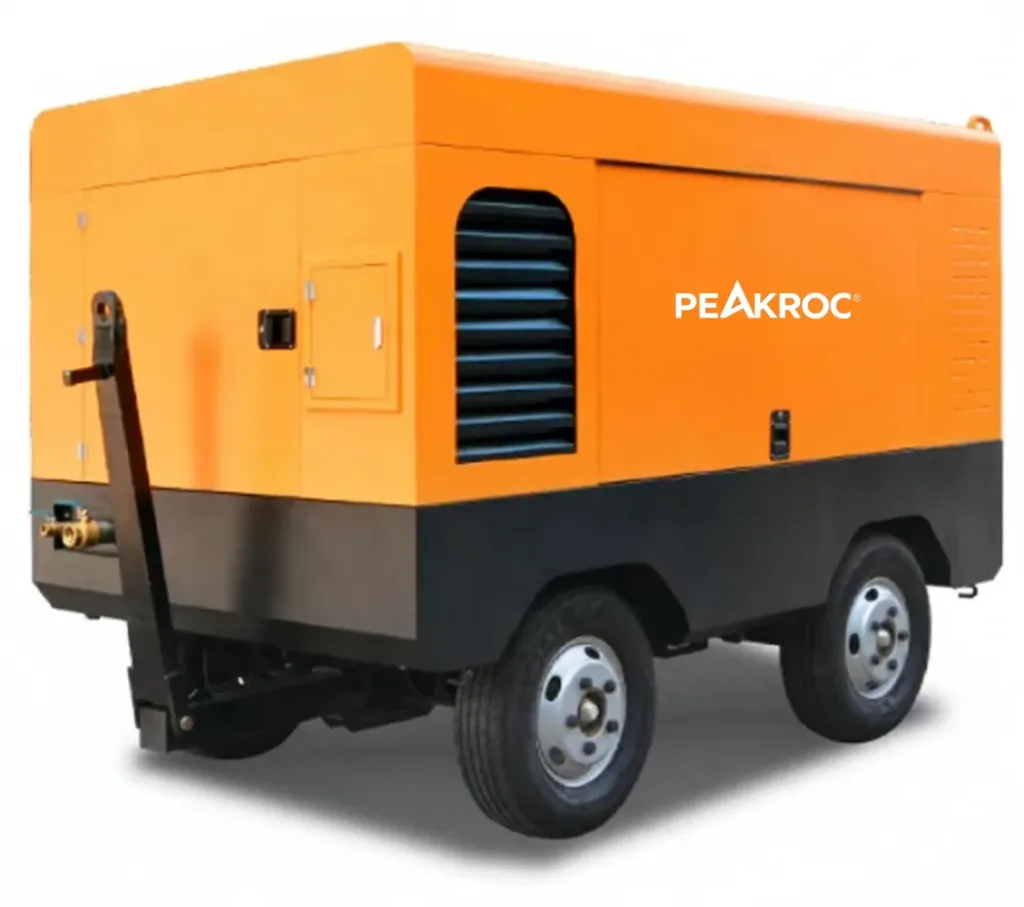
Peakroc’s portable diesel compressor range includes several pressure-flow classes that can be considered when selecting equipment for DTH drilling.
The table below illustrates how compressor capacity can progress as air demand and pressure requirements increase. It is not a guaranteed hammer compatibility chart.
| Peakroc Compressor Class | Approximate FAD | Working Pressure | Potential Selection Direction |
|---|---|---|---|
| 10 m³/min / 13 bar | 353 CFM | 13 bar | Smaller compatible hammer systems |
| 20 m³/min / 13 bar | 706 CFM | 13 bar | Medium-pressure drilling with greater air demand |
| 22 m³/min / 20 bar | 777 CFM | 20 bar | Higher-pressure DTH applications |
| 24 m³/min / 25 bar | 848 CFM | 25 bar | High-pressure medium-flow drilling |
| 34 m³/min / 25 bar | 1,201 CFM | 25 bar | Larger air demand and high-pressure drilling |
| 39 m³/min / 25 bar | 1,377 CFM | 25 bar | High-flow high-pressure drilling systems |
For example, a contractor using a 4″ hammer should not automatically choose the 20 m³/min / 13 bar model because its nominal flow appears sufficient. The hammer may require a different operating pressure, and its actual air consumption must be checked at that pressure.
Similarly, a 6″ hammer does not automatically require 34 m³/min at 25 bar. Some designs and applications may use different pressure-flow combinations.
For each model, the relevant compressor FAD, rated working pressure and performance under site conditions must be verified before confirming compatibility.
Common Mistakes When Matching a DTH Hammer and Compressor
- Selecting by hammer diameter alone: Two 5″ hammers can have different operating-pressure ranges and air-consumption curves.
- Comparing pressure without FAD: A 25-bar compressor with insufficient airflow cannot reliably support a hammer that requires greater air delivery.
- Ignoring hole cleaning: A compressor may operate the hammer while still failing to remove cuttings effectively from a larger borehole.
- Using nominal compressor ratings as downhole conditions: Hose losses, drill-pipe restrictions, leakage and groundwater can change what reaches the hammer.
- Oversizing without checking the duty cycle: Excess compressor capacity can increase purchase cost, fuel consumption and transport requirements without improving drilling productivity.
What Information Is Needed to Match the Compressor?
Before requesting a quotation, prepare the following information:
- DTH hammer: Manufacturer, model, nominal diameter and recommended pressure range.
- Drill bit: Diameter, design and compatible hammer shank.
- Drilling depth: Typical and maximum target depth.
- Rock formation: Limestone, granite, basalt, sandstone, fractured rock or mixed ground.
- Groundwater: Dry-hole conditions, expected water inflow or known water-column pressure.
- Drill string: Drill-pipe outside and inside diameters, length and connection type.
- Air system: Hose diameter, hose length, lubricator, fittings and other simultaneous air users.
- Jobsite conditions: Altitude, ambient temperature and expected working hours.
- Productivity target: Required drilling output and acceptable operating-cost range.
A practical request might read:
We are using a 4″ DTH hammer with a 115 mm bit and 76 mm drill rods. The target hole depth is 30–50 meters in basalt, with possible groundwater. Please recommend a portable diesel compressor based on the hammer’s required FAD and working pressure, including hose and drilling-system losses.
The hammer’s exact manufacturer and model should also be supplied so its performance chart can be checked.
Final Recommendation
Matching a DTH hammer to a portable air compressor is not a matter of choosing the highest pressure or the largest CFM rating.
The hammer’s air-consumption curve establishes the basic operating requirement. Hole diameter and drill-pipe dimensions influence flushing performance, while depth, groundwater, rock formation and air-distribution losses determine whether that requirement can be maintained at the drilling tool.
The correct selection sequence is:
DTH Hammer Model → Bit & Hole Diameter → Operating Pressure → Hammer Air Consumption → Hole Cleaning → Depth & Formation → System Losses → Compressor FAD & Pressure
For 3″–6″ hammers, broad airflow and pressure classes are useful during preliminary planning, but they cannot replace manufacturer-specific specifications.
The best matched compressor is the one that delivers sufficient air at the hammer’s recommended working pressure while maintaining reliable cuttings removal and productive drilling under the actual site conditions.
FAQ
What size air compressor do I need for a 4-inch DTH hammer?
A 4″ DTH hammer may operate with a compressor in a medium-flow class, but the exact requirement depends on the hammer model and pressure. An illustrative planning range is 12–20 m³/min, although individual hammers may fall outside this range. Confirm the manufacturer’s air-consumption chart before selecting a compressor.
How much CFM does a 5-inch DTH hammer need?
An approximate preliminary planning range is 565–920 CFM, but this is not a universal 5″ hammer specification. Actual consumption depends on the hammer design and operating pressure, and the compressor must also provide adequate flushing capacity.
Is a 13-bar compressor enough for DTH drilling?
Yes, for hammer models designed to operate within that pressure range. Other DTH hammers require 18, 20, 25 bar or higher. The correct pressure must follow the hammer specification and drilling conditions.
Does a deeper borehole always require higher compressor pressure?
No. Depth increases the importance of drill-string losses, hole cleaning and groundwater conditions, but there is no universal pressure increase per meter. Dry and wet holes of the same depth may have very different requirements.
Why is my DTH hammer drilling slowly even with enough pressure?
Possible causes include insufficient FAD, poor cuttings removal, incorrect feed force or rotation, worn bits, inadequate lubrication, restrictive drill pipes, air leaks or unsuitable hammer settings. Compressor pressure alone does not determine penetration rate.
Can a 25-bar compressor operate a 10–13 bar DTH hammer?
Only if the compressor can regulate its delivery to the hammer’s approved operating pressure and supply the required airflow at that setting. A 25-bar rating does not mean the hammer should receive 25 bar.
Contact Peakroc® Machinery
For DTH hammer and compressor matching, provide your hammer model, bit diameter, drill-pipe size, target depth, rock formation, groundwater conditions and required working pressure.
Peakroc can then help compare suitable portable diesel compressor pressure-flow classes against the drilling equipment’s requirements.
A detailed quotation request should include the hammer manufacturer’s air-consumption chart whenever available. This helps ensure that the proposed compressor provides sufficient FAD and pressure for both hammer operation and effective hole cleaning.
Author

Mark Chen – Senior Mechanical Engineer, Peakroc®
Mark Chen is a senior mechanical engineer at Peakroc®, specializing in compressed air systems and drilling equipment for mining and construction applications. With over 15 years of field experience, he has led multiple projects on optimizing air delivery efficiency, equipment durability, and energy consumption.