
Key Takeaways
- Start with FAD/CFM and working pressure, not voltage. A 400V compressor is only useful if it can deliver the amount of air your equipment needs at the required pressure.
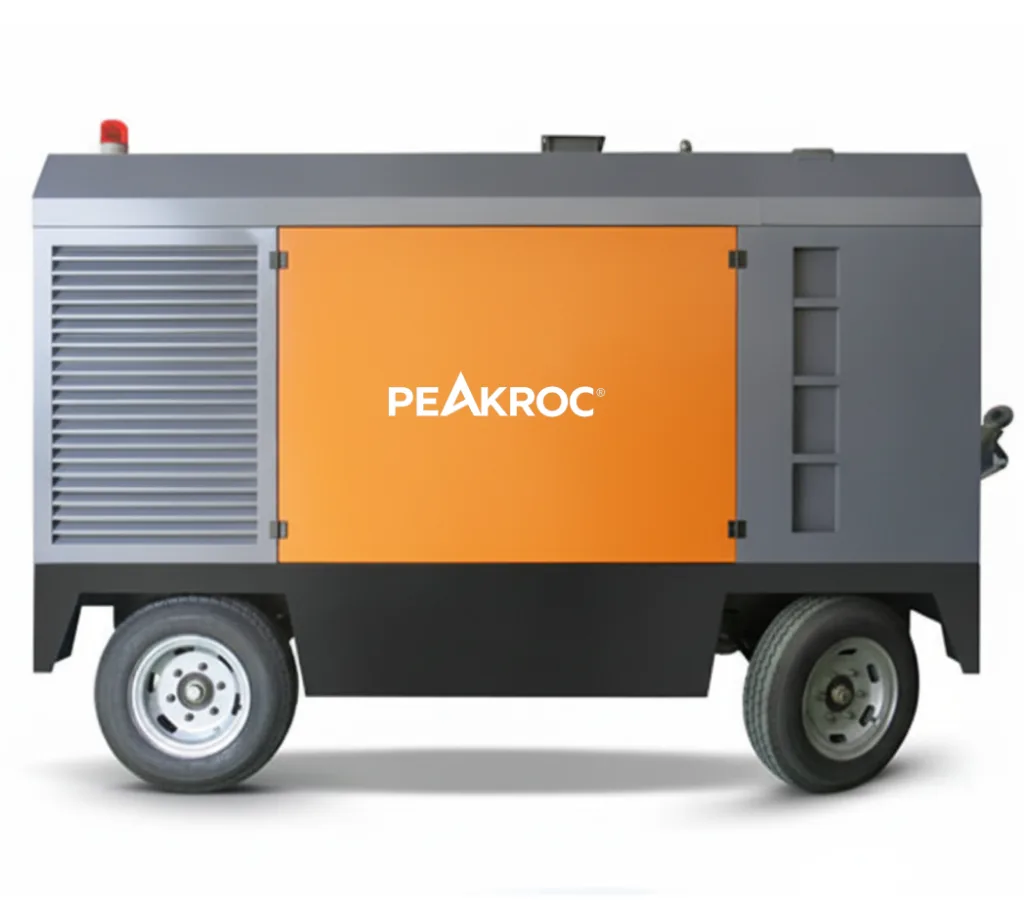
- Peakroc’s 6.2–22.5 m³/min, 7–18 bar Portable Electric Air Compressor covers approximately 219–795 CFM, 7–18 bar and 37–185 kW for tunneling, industrial plants, sandblasting, pipeline work and other grid-connected applications.
- Always confirm Voltage + Phase + Frequency together. Peakroc’s current PRME public specification lists three-phase 380V/400V and 50/60Hz. If your project requires 440V or another voltage, confirm the electrical configuration before ordering rather than assuming compatibility.
- If you are still deciding whether electric is suitable for your site, read the Electric vs Diesel Portable Air Compressor Guide. For changing air demand, see the VSD Portable Compressor Guide.
- Cable size and generator capacity should not be guessed from motor kW alone. Cable length, current, voltage drop, starting method and local electrical requirements all matter.
- If you already know the required airflow and pressure, use the Peakroc Compressor Finder to narrow down suitable compressor sizes.
A customer asking for an electric portable compressor may say:
“I need a 400V compressor.”
That is a useful starting point, but it is not enough to select the machine.
The supplier still needs to know:
How much air do you need?
What working pressure is required?
Is the supply 50Hz or 60Hz?
Is it three-phase?
How much electrical capacity is available?
How far is the compressor from the power source?
Will it run from grid power or a generator?
A simple selection sequence is:
FAD/CFM → Working Pressure → Voltage/Hz/Phase → Motor Power → Cable/Power Supply → VSD or Fixed Speed → Generator if Required
Once you follow this order, choosing a portable electric compressor becomes much easier.
Start With CFM/FAD and Working Pressure
Voltage tells you whether a compressor can connect to the site.
It does not tell you whether the compressor can do the job.
For that, you need two specifications:
FAD / CFM — how much compressed air the machine delivers
and:
Working Pressure — how many bar or PSI it delivers that air at
Suppose your equipment requires:
12 m³/min at 10 bar
A compressor supplying 12 m³/min at only 7 bar may not have enough pressure.
A compressor reaching 10 bar but supplying only 8 m³/min may not provide enough airflow.
The correct requirement is:
Required FAD at the required working pressure.
Peakroc’s current PRME portable electric range covers approximately 6.2–22.5 m³/min (219–795 CFM), 7–18 bar (102–261 PSI) and 37–185 kW. The product is trailer-mounted and intended for applications including tunneling, mining support, sandblasting, pipeline testing and industrial utility air.
So motor power should not be the first question either.
A request such as:
“I need a 110 kW compressor.”
still does not tell the supplier how much air or pressure the process requires.
The better request is:
“We need approximately 12 m³/min at 10 bar, and our site power is 400V / 50Hz / 3-phase.”
That is already enough information to begin a meaningful selection.
380V, 400V and 440V: What Do You Actually Need to Check?
For larger portable electric screw compressors, industrial three-phase power is normally used.
Depending on the country and project, you may encounter systems such as:
| Site Power | What to Confirm |
|---|---|
| 380V | Voltage + frequency + 3-phase |
| 400V | Voltage + frequency + 3-phase |
| 440V | Voltage + frequency + 3-phase |
| Other voltage | Confirm manufacturer configuration |
| Generator supply | Confirm output voltage, frequency and capacity |
The important point is:
Do not treat 380V, 400V and 440V as automatically interchangeable.
Peakroc’s current PRME public page specifies a three-phase 380V/400V, 50/60Hz power requirement.
Other industrial portable compressors show why voltage and frequency need to be considered together. For example, a current 75 kW industrial electric portable compressor is offered in configurations including 380/440V at 60Hz and 400V at 50Hz; broader regional specifications also list 460V and 575V options.
This does not mean every 380V machine can simply be connected to 400V, or every 440V machine can run on 400V.
It means industrial equipment can be designed for different electrical markets.
Before placing an order, give the supplier the complete information:
400V / 50Hz / 3 Phase
rather than simply:
400V
Why 50Hz vs 60Hz Matters
Frequency affects AC motor speed and electrical equipment operation.
On a conventional fixed-speed compressor, a motor designed for one frequency should not simply be assumed to work identically at another frequency.
You do not need to calculate the motor RPM yourself.
The practical rule is simple:
Tell the compressor manufacturer the actual site voltage, frequency and phase before production.
For example:
380V / 50Hz / 3Ph
or:
440V / 60Hz / 3Ph
The manufacturer can then confirm whether the motor, VSD, cooling fan and electrical components are suitable for that supply.
Motor kW, VSD, Cable and Generator: Keep the Electrical Side Simple
Once FAD, pressure and site voltage are clear, there are four remaining electrical questions.
Motor kW
Motor kW tells you the approximate drive power of the compressor.
It is useful for checking whether the site electrical system has enough capacity, but it should not be used by itself to select the compressor.
Peakroc’s PRME range currently spans approximately 37–185 kW, depending on required airflow and pressure.
Always choose:
Airflow + Pressure first
then confirm:
Motor Power + Electrical Supply
VSD or Fixed Speed?
A VSD, or Variable Speed Drive, allows the compressor to reduce motor speed when compressed-air demand falls and increase it again when demand rises.
For example, if demand changes during the day:
100% → 70% → 50% → 80%
a VSD compressor can follow those changes more closely.
This is particularly useful for factories, tunneling, maintenance work and multiple-tool applications where air consumption varies.
Peakroc’s VSD guidance also notes that variable-speed electric compressors can reduce starting current compared with conventional direct motor starting and are especially useful where load changes significantly.
However, VSD is not automatically necessary.
If the compressor operates close to full load for most of every shift, a properly sized fixed-speed compressor may also be a practical choice.
The simple rule is:
Variable air demand → consider VSD.
Stable full-load demand → compare VSD and fixed-speed before choosing.
Cable Size
Cable selection deserves attention because a large compressor can draw substantial current.
A cable that is too small or too long can cause excessive voltage drop, heating or unreliable operation.
The Mi-T-M electric compressor manual provided as a reference makes the same basic point: it warns against unnecessarily long or undersized extension cords because they can cause voltage-related motor overheating, and stresses correct grounding and matching the equipment to the proper electrical circuit.
That manual covers much smaller portable equipment, so its cable-size table should not be copied directly for a 37–185 kW industrial screw compressor.
For an industrial machine, cable sizing depends on:
Current + Cable Length + Installation Method + Ambient Temperature + Allowable Voltage Drop + Local Electrical Code
You do not need to calculate all of this before contacting a supplier.
Simply provide the approximate distance:
“Main distribution panel to compressor: 80 meters.”
Then the project electrician and equipment supplier can determine the appropriate cable and protection.
Can You Use a Generator?
Yes, an electric portable compressor can potentially run from a suitable generator.
But do not assume:
110 kW compressor = 110 kW generator
Generator sizing also depends on starting behavior, continuous current, voltage regulation, frequency stability and whether the compressor uses VSD or another starting method.
If a generator is required, tell both suppliers:
Compressor Model + Motor kW + Voltage + Frequency + Starting/VSD Type
and ask them to confirm compatibility.
The important rule is:
Size the generator for the complete electrical load and starting behavior—not only the motor nameplate kW.
Where Does a Portable Electric Compressor Make the Most Sense?
Electric portable compressors are most attractive when a project needs mobility but still has reliable access to electrical power.
“Portable” does not always mean the compressor moves every hour.
It may mean the machine can be easily transported to a tunnel, factory, batching plant or industrial project and then remain there for several weeks or months.
For example:
Tunneling and underground construction: Electric drive avoids local diesel-engine exhaust at the compressor and can reduce noise and fuel handling.
Factory and maintenance air: An electric portable compressor can temporarily support production during maintenance, expansion or compressor-room shutdowns when sufficient electrical capacity is available.
Concrete batching and semi-fixed construction: Projects that already have industrial three-phase power can often operate an electric compressor without continually transporting diesel fuel.
Sandblasting and pipeline work: Electric can also be practical where sufficient site power exists and the required airflow and pressure fall within the machine’s range.
Peakroc’s PRME product page specifically positions the electric range for tunneling, underground engineering, mining support, sandblasting, pipeline testing and industrial utility air.
A useful industry example comes from a major tunnel project on the Mumbai–Pune Expressway, where electric portable compressors were used continuously for tunnel shotcreting. The project reported benefits from avoiding local engine exhaust and reducing noise inside the tunnel. This is a good example of why electric compression becomes attractive when substantial site power is already available underground.
Peakroc Engineering Experience: Matching Power Supply with Stable Air Delivery
Peakroc’s industrial compressed-air projects show why selecting an electric compressor should consider more than the compressor itself.
For grid-connected construction and industrial applications, Peakroc provides electric screw compressor solutions for applications such as batching plants, tunnels, industrial facilities and other sites with established electrical infrastructure.
One Peakroc cement-plant customer provides a useful example.
The plant operates in a demanding environment with high dust and elevated temperatures, where reliable compressed air is important for production.
Peakroc supplied the compressed-air equipment and also worked with the customer to optimize the plant’s compressed-air pipeline system.
The customer later highlighted both:
stable Peakroc compressor operation
and:
the pipeline optimization support provided by Peakroc.
This experience is directly relevant when selecting a portable electric compressor.
A good electric compressor installation needs two parts to work together:
Electrical Supply → Compressor → Air Distribution → Production Equipment
On the electrical side, confirm:
Voltage + Frequency + Phase + Available Power + Cable Distance
On the compressed-air side, confirm:
FAD/CFM + Working Pressure + Hose/Piping Size + Pressure Loss
For example, a project may require:
400V / 50Hz / 3-phase
and:
12 m³/min at 10 bar
Both sides of that specification are important.
Peakroc’s engineering approach is therefore to look at the complete system rather than treating the compressor as an isolated machine.
For a portable electric compressor, this means matching:
the site’s electrical supply with the airflow and pressure required at the actual point of use.
That approach is especially useful for factories, batching plants, tunneling projects and other long-running grid-connected applications, where the compressor, electrical supply and air-distribution system operate together for extended periods.
What Information Should You Send When Requesting a Quote?
You do not need to prepare a complicated technical specification.
For most projects, these details are enough:
| Information | Example |
|---|---|
| Application | Tunnel construction |
| Required FAD | 12 m³/min |
| Working Pressure | 10 bar |
| Site Voltage | 400V |
| Frequency | 50Hz |
| Phase | 3-phase |
| Power Source | Grid |
| Power Distance | 60 m |
| Operating Time | 10 hours/day |
| Demand | Variable |
| Mobility | Trailer-mounted |
With this information, the supplier can determine the appropriate compressor capacity and discuss the motor, VSD, cable and electrical connection.
If you do not know the exact FAD yet, start with the equipment being powered:
What tool or machine?
How many operate at the same time?
What pressure do they require?
That is usually enough to begin sizing.
Final Recommendation
Choosing a 380V, 400V or 440V portable electric compressor does not need to become an electrical-engineering exercise.
Remember three steps.
First: size the air.
Confirm:
CFM/FAD + Working Pressure
Second: match the site power.
Confirm:
Voltage + Frequency + Phase
Third: check the installation.
Confirm:
Motor Power + VSD/Fixed Speed + Cable Distance + Grid/Generator
So the final selection process is:
Airflow → Pressure → Voltage → Frequency → Motor Power → VSD → Cable → Generator → Jobsite
Do not select a compressor simply because it says:
380V
400V
or:
440V
on a quotation.
The correct portable electric compressor is:
the machine that delivers the airflow and pressure your application needs while matching the electrical system actually available at the jobsite.
FAQ
Is a 380V compressor the same as a 400V compressor?
Not automatically. Some industrial motors or VSD systems may support more than one supply voltage, while others require a specific configuration. Always confirm the manufacturer’s approved voltage, frequency and phase.
Can a 440V compressor run on 400V?
Do not assume it can. The motor, VSD, fan motors and control system must be approved for the actual input supply.
Is 400V normally 50Hz?
400V is commonly associated with many 50Hz industrial systems, but voltage and frequency should never be assumed from one another. Always confirm both.
How much CFM does a portable electric compressor provide?
It depends on the model and pressure. Peakroc’s current PRME range is approximately 219–795 CFM (6.2–22.5 m³/min) at 7–18 bar.
How do I choose cable size for an electric compressor?
Cable size depends on full-load current, cable length, installation method, ambient conditions, allowable voltage drop and local electrical rules. Large industrial compressors should be checked by a qualified electrical professional.
Can I run an electric portable compressor from a generator?
Yes, if the generator provides the correct voltage, frequency, continuous capacity and starting performance. Generator and compressor suppliers should confirm compatibility before installation.
Should I choose VSD?
Consider VSD when air demand changes significantly. If the compressor normally operates near full load for long periods, compare both VSD and fixed-speed options.
Author

Mark Chen – Senior Mechanical Engineer, Peakroc®
Mark Chen is a senior mechanical engineer at Peakroc®, specializing in compressed air systems and drilling equipment for mining and construction applications. With over 15 years of field experience, he has led multiple projects on optimizing air delivery efficiency, equipment durability, and energy consumption.