
Key Takeaways
- Shotcrete compressor sizing is mainly about airflow rather than very high pressure. Typical compressor discharge pressure is around 100–120 PSI / 7–8.3 bar, while required CFM/FAD varies greatly between wet-mix and dry-mix systems.
- Conventional wet-mix shotcrete commonly requires approximately 200–400 CFM / 5.7–11.3 m³/min at 100 PSI / 7 bar. The Peakroc 10 m³/min, 8 bar PRMD-1008 Portable Diesel Air Compressor is therefore a useful capacity reference for many standard wet-mix jobs.
- Dry-mix shotcrete or gunite needs more airflow because compressed air also transports the dry material through the hose. Peakroc’s 20 m³/min, 13 bar PRMD-2013 is already positioned for shotcrete/gunite, tunnel lining, slope protection and structural repair.
- For tunnel projects with reliable site power, Peakroc’s 6.2–22.5 m³/min, 7–18 bar Portable Electric Air Compressor can cover many shotcrete airflow ranges while avoiding local diesel-engine exhaust.
- Hose diameter, hose length, elevation and simultaneous users such as a blowpipe must be included. A blowpipe alone may add around 100–200 CFM / 2.8–5.7 m³/min.
Shotcrete is widely used for tunnel lining, slope stabilization, mine support and concrete repair because concrete can be sprayed directly onto rock, reinforcement or an existing structure.
The compressor has one simple job:
Deliver enough stable airflow and pressure to maintain the required material velocity at the nozzle.
The first question is therefore not:
“How many bar should the compressor have?”
It is:
“Are we using wet-mix or dry-mix, and how much airflow does that spraying system require?”
Wet-Mix vs Dry-Mix: Why CFM Is Different
In wet-mix shotcrete, water is already mixed into the concrete before it enters the delivery hose. A concrete pump moves the material toward the nozzle, and compressed air is introduced near the nozzle to accelerate it onto the surface.
Compressed air mainly provides:
nozzle velocity + spraying energy
rather than moving the concrete through the complete hose.
ACI guidance published by the American Shotcrete Association recommends approximately:
200–400 CFM
or:
5.7–11.3 m³/min
at around:
100 PSI / 7 bar
for conventional wet-mix shotcrete.
Dry-mix, often called gunite, works differently.
Dry material enters the hose first, and compressed air carries the material through the hose. Water is added closer to the nozzle.
The compressor therefore performs two jobs:
material transport + nozzle acceleration
which explains why dry-mix normally requires considerably more airflow.
For dry-mix, hose diameter provides a useful starting point:
| Material Hose ID | Approx. Compressor Capacity at 100 PSI / 7 Bar |
|---|---|
| 1 in / 25 mm | 350 CFM / 10 m³/min |
| 1¼ in / 32 mm | 450 CFM / 13 m³/min |
| 1½ in / 38 mm | 600 CFM / 17 m³/min |
| 2 in / 50 mm | 750 CFM / 21 m³/min |
| 2½ in / 64 mm | 1,000 CFM / 28 m³/min |
These are experience-based values published by ASA from ACI shotcrete guidance.
This immediately explains why the same compressor cannot be recommended for every shotcrete job.
A compressor suitable for a conventional wet-mix nozzle may be significantly undersized for a 1½-inch or 2-inch dry-mix hose.
CFM Usually Matters More Than Maximum Pressure
Shotcrete is sometimes misunderstood as a high-pressure compressed-air application.
In reality, most portable compressors used for shotcrete operate around:
100–120 PSI
or approximately:
7–8.3 bar.
ASA also notes that properly sized shotcrete equipment creates material velocity around 60–80 mph / 95–130 km/h, and that adequate airflow is essential to achieve proper consolidation and compaction.
So a 13-bar compressor is not automatically better than an 8-bar compressor.
For example:
10 m³/min @ 8 bar
may be a better match for a conventional wet-mix process than a higher-pressure machine that cannot provide enough airflow.
A useful rule is:
Choose CFM/FAD first, then confirm enough working pressure remains at the nozzle.
Higher maximum pressure may provide operating reserve for difficult hose layouts or other tools, but it should not replace correct airflow sizing.
Hose Length, Hose Size and Blowpipe Demand
The pressure shown on the compressor gauge is not necessarily the pressure available at the nozzle.
Air must travel through hoses, couplings, valves and bends before reaching the spraying equipment.
Pressure loss becomes more important with:
longer hoses
smaller hose diameter
more bends
greater vertical elevation
ASA notes that long, small-diameter air lines can restrict airflow even when the compressor itself has adequate capacity. It also recommends increasing operating pressure as dry-mix hose length and vertical elevation increase.
Auxiliary air should also be counted.
A blowpipe used to remove rebound or clean the working area can require approximately:
100–200 CFM / 2.8–5.7 m³/min.
Suppose:
Shotcrete nozzle = 300 CFM
and:
Blowpipe = 150 CFM
If both operate simultaneously, the compressor must support approximately:
450 CFM
before considering other air users.
That is why shotcrete compressors should be sized from:
peak simultaneous airflow
rather than the nozzle alone.
Practical Compressor Size for Shotcrete and Gunite
For basic planning, the following ranges are useful:
| Application | Approx. Air Requirement | Practical Compressor Class |
|---|---|---|
| Conventional wet-mix | 200–400 CFM | 6–11 m³/min |
| Wet-mix + auxiliary air | 300–600+ CFM | 9–17+ m³/min |
| Large robotic wet-mix | 600+ CFM | 17+ m³/min |
| Dry-mix, 1¼ in hose | ~450 CFM | ~13 m³/min |
| Dry-mix, 1½ in hose | ~600 CFM | ~17 m³/min |
| Dry-mix, 2 in hose | ~750 CFM | ~21 m³/min |
These are starting points rather than universal specifications. Final sizing should follow the shotcrete machine, nozzle, material hose and jobsite conditions.
For many conventional wet-mix projects, Peakroc’s PRMD-1008 provides:
10 m³/min / approximately 350–375 CFM
at:
8 bar / 116 PSI
which places it close to the typical wet-mix airflow range.
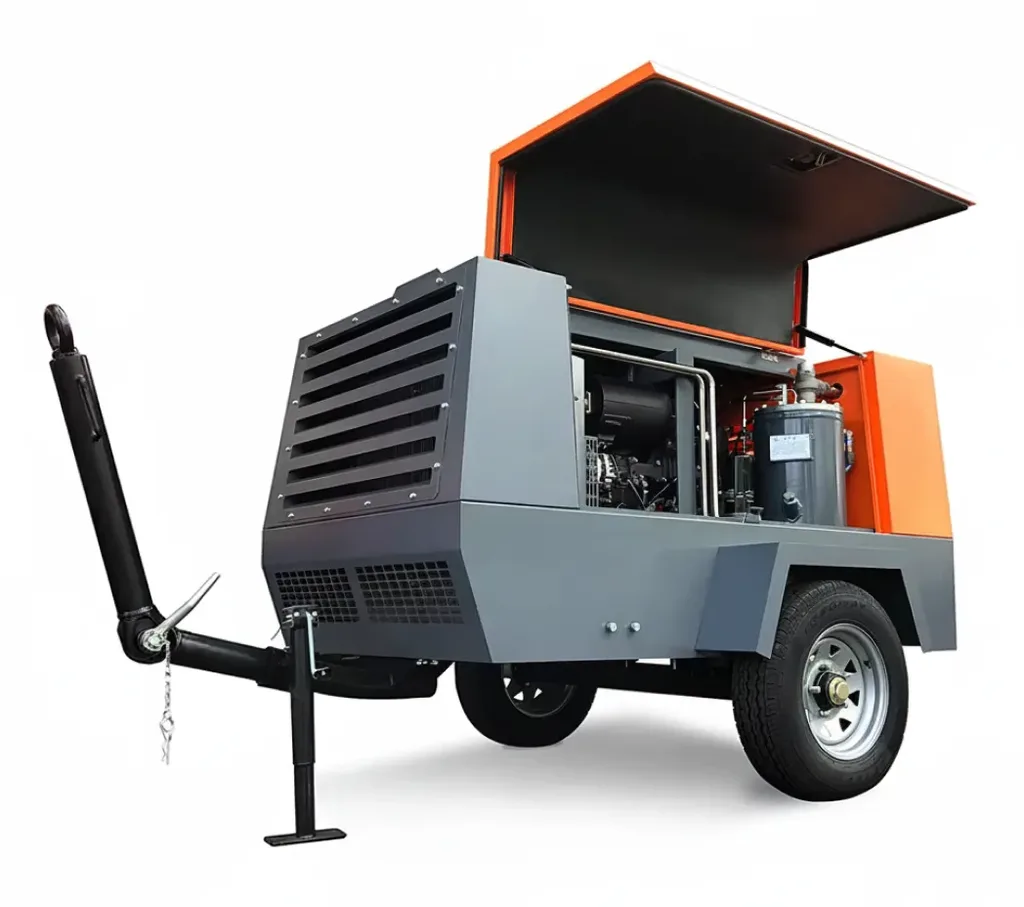
For higher-output spraying or larger dry-mix work, Peakroc’s PRMD-2013 provides:
20 m³/min / approximately 700 CFM
with maximum pressure up to:
13 bar / 189 PSI.
That airflow is closer to the requirement of larger dry-mix hoses and high-output shotcrete operations.
The current Peakroc product page specifically includes shotcrete/gunite, tunnel lining, slope protection and structural repair among its applications.
The important principle remains:
Match the compressor to the spraying system, not simply to the word “shotcrete.”
Industry Case: Mumbai–Pune Expressway Tunnel Shotcreting
A real tunnel project provides a useful example of how this works in practice.
On the Mumbai–Pune Expressway project in India, contractor RVR Projects used two electric portable air compressors to support shotcreting of the tunnel’s hanging and side walls.
The working conditions were demanding.
The project involved approximately 10 km of tunnel, with dusty and muddy underground conditions and temperatures reportedly reaching around 45°C.
Construction was running 24/7, so the shotcrete operation required a reliable and continuous compressed-air supply.
The contractor selected electric portable compressors for the underground work. According to the published project account, the electric machines supported continuous shotcreting while reducing local engine exhaust and noise inside the tunnel.
This case illustrates three practical lessons.
First, airflow stability matters.
Shotcrete production cannot remain consistent if air supply repeatedly drops during spraying.
Second, the power source should suit the site.
For an underground project with established electrical infrastructure, electric compressors can avoid running a diesel engine inside the tunnel.
Third, the compressor should be selected as part of the shotcrete system.
The correct solution depends on:
spraying method + airflow demand + working pressure + site conditions + power availability
rather than compressor pressure alone.
That same principle applies to Peakroc shotcrete projects.
Peakroc’s construction solutions already cover shotcreting/grout injection, tunnel and metro construction, concrete works, portable diesel compressors and VSD electric screw systems.
Diesel or Electric for Tunnel and Slope Shotcrete?
Once airflow and pressure are clear, the power source is usually straightforward.
For outdoor slope stabilization or remote civil work, a diesel portable compressor is often convenient because it brings its own power source and can move easily with the spraying crew.
For long tunnel projects with reliable electricity, electric deserves serious consideration.
A simple starting point is:
Remote slope / frequently moving job → Diesel
Long tunnel / established electrical power → Electric
Peakroc’s portable electric range covers approximately 6.2–22.5 m³/min and 7–18 bar, which overlaps much of the airflow range used in wet-mix and larger shotcrete applications.
For projects requiring several air users at once—such as shotcrete plus pneumatic tools or cleaning air—a larger compressor may be needed.
Peakroc’s construction range also includes higher-flow machines such as the 45 m³/min, 10 bar PRMD-4510 for demanding tunnel and construction applications.
Again, the correct size comes from:
total simultaneous CFM/FAD
not from one tool in isolation.
What Information Should You Send for a Quote?
A shotcrete compressor RFQ can stay simple:
Shotcrete Method: Wet-Mix / Dry-Mix
Shotcrete Machine: Model if known
Material Hose ID: ___ mm / inch
Hose Length: ___ m
Required Airflow: ___ CFM / m³/min
Required Pressure: ___ bar / PSI
Blowpipe: Yes / No
Other Air Tools: ___
Application: Tunnel / Slope / Mine / Concrete Repair
Power: Diesel / Electricity available
With these details, compressor sizing becomes much more reliable.
Final Recommendation
For shotcrete and gunite, remember three points.
First: identify wet-mix or dry-mix.
Wet-mix generally requires less air because the concrete is mechanically pumped.
Dry-mix needs more CFM because compressed air also transports the material through the hose.
Second: size airflow before chasing higher pressure.
Typical compressor pressure is approximately:
100–120 PSI / 7–8.3 bar
while airflow may vary from roughly:
200 CFM to 1,000 CFM
depending on the spraying process and hose size.
Third: include the complete jobsite.
Count:
hose size + hose length + elevation + blowpipe + other simultaneous air users
The practical selection path is:
Wet or Dry → CFM/FAD → Pressure → Hose → Auxiliary Air → Compressor Size → Diesel/Electric → Jobsite
The right shotcrete compressor is not simply the machine with the highest pressure rating.
It is:
the compressor that provides enough stable airflow and pressure at the nozzle to keep the shotcrete process consistent and productive.
FAQ
How many CFM does wet-mix shotcrete need?
Conventional wet-mix shotcrete generally requires around 200–400 CFM / 5.7–11.3 m³/min at 100 PSI / 7 bar. Larger robotic systems may require considerably more airflow.
How many CFM does dry-mix gunite need?
It depends mainly on material hose diameter. Typical guidance is about 450 CFM for a 1¼-inch hose, 600 CFM for a 1½-inch hose and 750 CFM for a 2-inch hose.
What pressure is normally used for shotcrete?
Most compressors used for shotcrete operate around 100–120 PSI / 7–8.3 bar at the compressor. Hose length, elevation and pressure loss can change actual site requirements.
Is a 10 m³/min compressor enough for shotcrete?
It can be suitable for many conventional wet-mix applications. Final sizing should include nozzle requirement, blowpipe demand and other simultaneous air users.
Is a 20 m³/min compressor suitable for gunite?
It can be a practical size for higher-airflow dry-mix and larger shotcrete applications. The exact requirement should follow hose diameter and the shotcrete machine specification.
Do I need a 13-bar compressor for shotcrete?
Not necessarily. Many shotcrete systems work around 7–8 bar. Higher-pressure capability can provide reserve, but adequate airflow is usually the first sizing priority.
Is an electric compressor suitable for tunnel shotcrete?
Yes. The Mumbai–Pune Expressway project is a documented example of electric portable compressors being used continuously for underground shotcreting where site power was available.
Author

Mark Chen – Senior Mechanical Engineer, Peakroc®
Mark Chen is a senior mechanical engineer at Peakroc®, specializing in compressed air systems and drilling equipment for mining and construction applications. With over 15 years of field experience, he has led multiple projects on optimizing air delivery efficiency, equipment durability, and energy consumption.