
Key Takeaways
- High altitude reduces atmospheric pressure and air density. Hot weather lowers intake-air density further and reduces the temperature difference available for cooling.
- A compressor may still display the requested outlet pressure while delivering less usable FAD or requiring more engine load to maintain that pressure.
- The same gauge pressure produces a higher compression ratio at altitude because the compressor starts with lower absolute inlet pressure.
- Diesel-engine power, compressor airflow, cooling capacity, aftercooler performance, and emissions systems must be evaluated together.
- Never apply one universal altitude correction percentage. Request model-specific derating curves for the exact engine, pressure setting, compressor airend, and ambient temperature.
- Clean coolers, unrestricted canopy airflow, correct fluid levels, suitable lubricants, and frequent filter inspection are especially important on hot, dusty, high-altitude sites.
A portable diesel compressor selected at sea level may behave differently after it reaches a mountain mine, highland road project, geothermal site, or elevated water-well drilling location. Operators may notice weaker tool performance, lower drilling speed, rising fuel consumption, high discharge temperature, or repeated shutdown alarms even though the machine appears correctly sized on paper.
The problem is rarely explained by altitude or temperature alone. The useful output of a portable compressor depends on the interaction between atmospheric pressure, air density, diesel-engine power, pressure ratio, cooling capacity, air-filter restriction, control strategy, hose losses, and the actual connected tool.
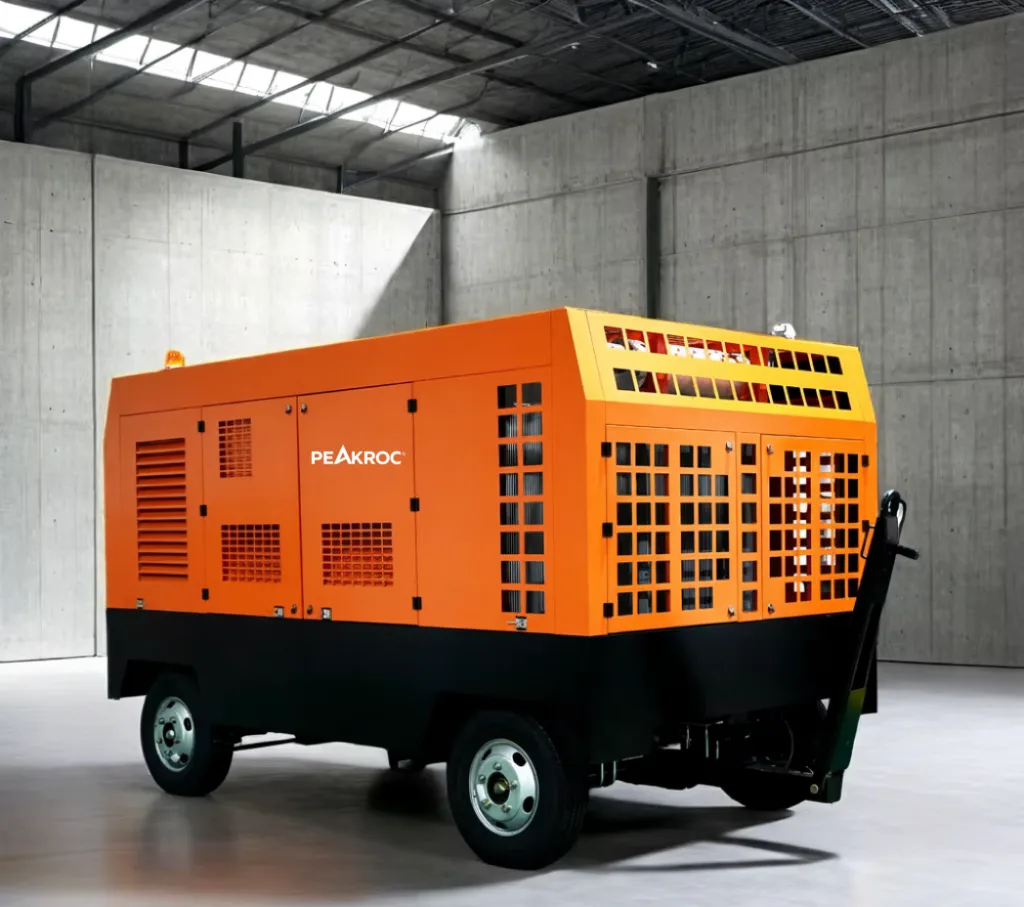
Peakroc® provides portable diesel screw air compressors for mining, drilling, quarrying, pipeline work, and construction. Buyers should also review the portable compressor overheating troubleshooting guide and the broader portable diesel compressor selection guide when evaluating equipment for extreme environments.
Why High Altitude Changes Compressor Performance
Atmospheric pressure and air density decrease as elevation increases. NASA’s standard-atmosphere model relates pressure, temperature, and density to altitude and confirms that less-dense air is available at the compressor inlet as the machine moves higher above sea level. Hot conditions can reduce density further because air density depends on both temperature and pressure.
The following values illustrate standard atmospheric conditions. They are not compressor derating percentages and should not replace the manufacturer’s performance curves.
| Site elevation | Approximate atmospheric pressure | Approximate air density | Density relative to sea level |
|---|---|---|---|
| Sea level | 101.4 kPa | 1.227 kg/m³ | 100% |
| 1,500 m | 84.6 kPa | 1.060 kg/m³ | About 86% |
| 3,000 m | 70.2 kPa | 0.911 kg/m³ | About 74% |
| 4,000 m | 61.7 kPa | 0.821 kg/m³ | About 67% |
A rotary screw airend may continue to displace a similar geometric volume, but each cubic meter of inlet air contains less mass at altitude. The diesel engine also receives less oxygen unless turbocharging and engine controls compensate adequately. At the same time, thinner cooling air removes heat less effectively from the radiator, compressor-oil cooler, charge-air cooler, and aftercooler.
Atlas Copco identifies three common high-altitude challenges for portable compressors: reduced engine performance, lower air density, and greater cooling-system stress. Its guidance notes that thinner cooling air can result in higher engine temperature, increased component wear, and overheating shutdowns.
Gauge Pressure Creates a Higher Compression Ratio at Altitude
The pressure displayed on a portable compressor is normally gauge pressure. Gauge pressure is measured above the local atmospheric pressure, but the airend operates according to absolute pressure.
A simplified compression-ratio calculation is:
Compression ratio =
(Required gauge pressure + Local atmospheric pressure)
÷ Local atmospheric pressure
Consider a compressor required to supply 10 bar gauge pressure.
At sea level, where atmospheric pressure is approximately 1.01 bar absolute, the pressure ratio is about:
(10 + 1.01) ÷ 1.01 ≈ 10.9At approximately 3,000 meters, where standard atmospheric pressure is close to 0.70 bar absolute, it becomes:
(10 + 0.70) ÷ 0.70 ≈ 15.3The outlet gauge pressure has not changed, but the compressor must work across a much higher absolute pressure ratio. At 25 or 35 bar, the difference becomes even more important, particularly for high-pressure DTH, water-well, geothermal, and mineral-exploration applications.
This is one reason a compressor that performs reliably at sea level may run hotter, consume more fuel, or fail to maintain rated flow at a high-altitude drilling site. The actual result depends on the airend, number of compression stages, engine reserve, control logic, and cooling system.
Rated FAD Is Not Automatically the Jobsite FAD
FAD, or Free Air Delivery, is the usable airflow stated under defined reference conditions. Buyers should confirm the measurement standard, pressure setting, ambient reference conditions, and whether an altitude-temperature correction has already been applied.
Even before altitude is considered, one compressor can deliver different FAD at different pressure settings. Atlas Copco’s XAS 950 reference sheet, for example, lists approximately 950 CFM at 100 psi, 900 CFM at 150 psi, and 754 CFM at 200 psi. The same document specifies a model-dependent maximum altitude of about 3,048 meters and a maximum ambient temperature of approximately 49.4°C at sea level, while instructing operators to request derating guidance beyond stated limits.
These published figures illustrate three important principles.
First, a model name containing “950” does not guarantee 950 CFM at every pressure. Second, maximum ambient temperature and maximum altitude must not automatically be treated as simultaneous operating limits. Third, a machine rated for operation at elevation may still have an adjusted flow, pressure, or engine-power envelope.
For mining and drilling equipment, the relevant number is not only compressor-outlet FAD. It is the airflow and pressure that reach the hammer, nozzle, pneumatic tool, or pipeline connection after site derating and distribution losses.
How Heat Affects the Compressor and Diesel Engine
Hot ambient air affects a portable compressor in two ways. It reduces inlet-air density, and it reduces the temperature difference between hot machine components and the surrounding cooling air.
When ambient temperature rises, the radiator and oil cooler must reject heat into air that is already warm. A cooler that was adequate at 25°C may have less thermal margin at 45°C, particularly when its fins are coated with drilling dust or abrasive-blasting debris.
Cummins service guidance explicitly notes that high altitude and high ambient temperature decrease engine cooling capacity. Although the exact derating data in any Cummins manual applies only to the engine and equipment covered by that document, the principle remains important: altitude and heat must be evaluated together, not as separate isolated conditions.
Sullair’s hot-weather maintenance guidance recommends frequent cooler cleaning, daily fluid-level checks, verification of thermal-valve operation, and adequate ventilation. It warns that dirty coolers and poor installation airflow can cause overheating and unplanned downtime.
How to Size a Portable Compressor for Altitude and Heat
A correct selection should use the actual site conditions and manufacturer data rather than a universal correction factor.
- Define the operating site. Record minimum and maximum elevation, daytime temperature, humidity, dust loading, expected wind conditions, and whether the compressor will operate in direct sunlight or near heat-producing equipment.
- Confirm the tool demand. Obtain required pressure and airflow from the DTH hammer, pneumatic tool, sandblasting nozzle, pipeline procedure, or drilling-rig manufacturer. Use the demand at the most difficult operating condition rather than the easiest part of the project.
- Request corrected performance data. The supplier should provide available FAD, engine power, fuel consumption, cooling capability, and pressure range at the required altitude and temperature.
- Account for downstream loss. Include hose length, hose diameter, couplings, manifolds, filters, aftercoolers, dryers, lubricators, drill pipe, borehole back pressure, and leakage.
- Add a justified operating reserve. The margin should cover real variation in tool demand, filter restriction, nozzle wear, groundwater, and project conditions. It should not be an arbitrary reason to purchase the largest available compressor.
Atlas Copco cautions that simply oversizing a compressor for altitude can increase fuel consumption, emissions, transport weight, and inefficiency when the machine later works at lower elevations. Equipment designed or configured for altitude is generally a better solution than uncontrolled oversizing.
An Illustrative High-Altitude DTH Drilling Example
Consider a contractor selecting a portable compressor for a DTH rig that requires stable airflow and approximately 25 bar at the hammer.
At sea level, the compressor begins with about 1.01 bar absolute inlet pressure. At 3,000 meters, it begins with approximately 0.70 bar under standard-atmosphere conditions. To maintain 25 bar gauge pressure, the idealized overall compression ratio rises from roughly 25.7 at sea level to about 36.7 at 3,000 meters.
That does not mean compressor power or fuel consumption rises in the same proportion. It means the airend and engine are operating under a more demanding pressure relationship, while the inlet air carries less mass and the cooling air is less effective.
The supplier should therefore confirm:
- FAD available at 25 bar and 3,000 meters
- Maximum ambient temperature at that elevation
- Engine power and torque after derating
- Whether the compressor is single-stage or two-stage
- Compressor-oil and engine-coolant temperatures at full load
- Recommended hose and drill-pipe internal diameter
- Additional restrictions caused by groundwater and hole depth
A contractor should not assume that a larger sea-level CFM label solves the problem. The exact high-altitude operating point must be verified.
Cooling-System Features That Matter
A portable diesel compressor may contain an engine radiator, charge-air cooler, compressor-oil cooler, intercooler, and optional aftercooler. Each component performs a different function, and one clean cooler cannot compensate for a restriction elsewhere in the cooling pack.
A suitable hot-weather configuration may use a larger heat-exchange area, high-capacity fan, optimized canopy ventilation, high-temperature coolant, correctly selected thermostatic valves, and controls that monitor both engine coolant and compressor-oil temperature.
The enclosure design is particularly important. Cooling air must enter, pass through the heat exchangers, and leave without being drawn back into the intake. Operating beside a wall, inside a partially enclosed shed, or close to another diesel engine can create hot-air recirculation even when the radiator is clean.
Some purpose-designed portable compressors publish high ambient and altitude capabilities. The Atlas Copco XAS 950 reference sheet, for example, describes continuous operation up to approximately 49.4°C at sea level and lists a maximum altitude of about 3,048 meters for the referenced configuration. These limits remain model-specific and require separate confirmation when heat and altitude occur together.
High-Altitude Mining and Quarry Operations
Mountain mines and elevated quarries combine several difficult conditions: reduced air density, long full-load shifts, abrasive dust, steep transport routes, and limited access to service support.
A compressor that supplies several pneumatic tools should be sized for the simultaneous peak demand at the most distant working point. Long hoses and restrictive couplings can create a performance problem that operators incorrectly blame on altitude.
For production drilling, both hammer pressure and hole-cleaning airflow must remain adequate. Reduced output can cause slower penetration, cuttings accumulation, repeated regrinding, increased bit wear, and higher risk of stuck drilling tools.
The machine should be positioned where it can draw clean, relatively cool air. Locating the compressor directly behind a drill rig’s exhaust, beside a dusty crusher discharge, or inside a poorly ventilated bench area can create avoidable thermal and filtration problems.
The off-road diesel compressor guide for remote sites provides additional guidance on chassis, mobility, service access, and remote-project planning.
Water-Well, Geothermal, and DTH Drilling
High-altitude drilling requires more than maintaining a pressure number on the compressor display. The air must travel through hoses, swivels, lubricators, drill pipe, the hammer, and the borehole before it can remove cuttings.
As the hole becomes deeper, pressure loss and back pressure increase. Groundwater may add further resistance, while a wider hole needs enough airflow to maintain upward cuttings velocity.
If altitude or heat reduces available FAD, the compressor may still operate the hammer but fail to clean the hole efficiently. The operator may then see declining penetration, unstable cuttings return, increased compressor load, and greater fuel consumption per meter.
High-pressure drilling compressors should be evaluated at the actual pressure setting. A model advertised with a high maximum CFM measured at a lower pressure may deliver considerably less airflow when set to 25 or 35 bar.
Construction, Sandblasting, and Pipeline Work
General construction tools often operate at lower pressure than DTH drilling, but high-altitude output still matters when several breakers, rock drills, or pneumatic pumps run simultaneously.
Sandblasting is particularly sensitive to airflow loss. A reduced mass flow or pressure drop at the nozzle can lower abrasive velocity and surface-cleaning productivity. Hot, humid compressed air also places greater demand on aftercoolers, separators, drains, and dryers.
Pipeline blowing and drying require sustained airflow over long periods. Site elevation, ambient temperature, pipe volume, allowable pressure, target velocity, and air-treatment requirements must all be included in the package design.
For these applications, the cost of derating may appear as additional operating time rather than an obvious machine alarm. A compressor that completes a task in eight hours at sea level may require more time at elevation when available airflow falls or the machine unloads to protect temperature limits.
Fuel Consumption and Cost per Productive Unit
Fuel consumption per hour does not provide a complete performance comparison.
A compressor may consume a similar amount of diesel while producing less usable FAD at altitude. Alternatively, the engine may operate closer to full load for longer periods, raising fuel consumption and exhaust-system temperature.
A more useful calculation is:
Cost per productive unit =
Fuel cost
+ scheduled maintenance
+ wear parts
+ ownership cost
+ downtime cost
÷ completed productive output
For drilling, use cost per meter or completed borehole. For sandblasting, use cost per square meter prepared. For pipeline work, use cost per completed section or drying hour at the required dew point.
A purpose-built high-altitude configuration may have a higher purchase price but produce a lower project cost if it maintains airflow, avoids overheating shutdowns, and reduces wasted crew time.
Hot-Weather and High-Altitude Maintenance Schedule
| Inspection frequency | Recommended checks | Why it matters |
|---|---|---|
| Before each shift | Engine oil, compressor oil, coolant, fuel, filter indicators, leaks, belts, hoses, controller alarms and cooler condition | Detects low fluids, restrictions and damage before full-load operation |
| During operation | Engine-coolant temperature, compressor-oil temperature, outlet pressure, engine speed, fuel use and unusual cycling | Identifies progressive heat rise and output loss |
| End of shift | Cooler dust accumulation, condensate drains, fuel-water separator, hose condition and recorded alarm history | Prevents contamination and repeated faults |
| Weekly or condition-based | Thorough cooler cleaning, fan and belt inspection, battery condition, intake-system sealing and canopy airflow | Restores cooling performance and prevents hot-air recirculation |
| Scheduled service | Engine and compressor filters, lubricants, separator element, coolant condition, thermostatic valves and sensors | Maintains flow, heat transfer and pressure control |
Dirty coolers require special attention. Blowing only from the visible side may push contamination deeper between stacked heat exchangers. Cleaning should follow the compressor manual, using pressure that will not bend fins or damage seals.
Filter maintenance should be condition-aware. A filter may look clean while already showing high restriction, while aggressive compressed-air cleaning can damage media and allow dust to reach the engine or airend.
Fluid levels should be checked according to the manufacturer’s procedure. Compressor lubricant must normally be checked after the machine is stopped, depressurized, and allowed to settle. A hot separator vessel must never be opened under pressure.
Warning Signs That Derating or Cooling Is Inadequate
High engine speed without expected tool performance may indicate reduced available airflow, incorrect pressure settings, excessive hose loss, or engine derating.
A machine that operates normally in the morning but overheats in the afternoon probably has insufficient thermal margin. Dirty coolers, hot-air recirculation, low fluid level, restricted filters, or an undersized cooling package can make the temperature rise progressively as the day becomes hotter.
Repeated unloading or unstable pressure can occur when the engine cannot provide enough power for the requested pressure-and-flow point. The controller may reduce airflow or engine load to protect the system.
Excessive black smoke, unusual exhaust temperature, repeated engine fault codes, or aftertreatment problems require engine-specific diagnosis. Do not increase fueling or modify electronic controls to compensate for altitude without authorization from the engine and compressor manufacturers.
Standard Package or High-Ambient/High-Altitude Configuration?
A standard portable compressor may be adequate when the elevation and temperature remain within its published operating envelope and the corrected FAD still exceeds the application demand.
A high-altitude or high-ambient package becomes more relevant when the machine will work near its maximum pressure, run continuously at full load, operate above the standard altitude limit, or face temperatures close to its published ambient rating.
The supplier should confirm whether the configuration includes changes to the engine rating, turbocharging, radiator, fan, coolers, canopy airflow, coolant, starting system, software calibration, filtration, or aftertreatment.
Do not accept a quotation that lists only sea-level CFM and maximum pressure. For a high-altitude project, request a written performance statement at the actual site conditions.
Practical RFQ Information for Extreme-Environment Projects
| Information to provide | Why the supplier needs it |
|---|---|
| Minimum and maximum elevation | Determines atmospheric pressure and engine/compressor derating |
| Maximum daytime temperature | Determines cooling-system and high-ambient requirements |
| Application and connected equipment | Defines actual pressure and airflow demand |
| DTH hammer, nozzle, tool, or pipeline data | Supports accurate FAD matching |
| Hose and drill-pipe dimensions | Identifies downstream pressure loss |
| Duty cycle and hours per shift | Determines thermal load and fuel consumption |
| Dust and humidity conditions | Influences filtration, cooling and air treatment |
| Required emissions standard | Affects engine, software and aftertreatment configuration |
| Fuel and service availability | Supports remote-site maintenance planning |
| Delivery location and chassis type | Determines transport, mobility and installation requirements |
Peakroc’s compressor selection service can review these parameters before a specific model is recommended.
Common Selection and Operating Mistakes
Using Sea-Level Specifications Without Correction
A catalog FAD rating is not proof of output at 3,000 or 4,000 meters. The supplier must confirm corrected performance at the required pressure.
Oversizing Without Checking the Performance Curve
A physically larger compressor can still have an unsuitable altitude limit, cooling package, or engine configuration. Uncontrolled oversizing also increases transport and fuel costs.
Raising Pressure to Compensate for Low Tool Performance
Higher compressor pressure increases engine and airend load. Hose restriction, leakage, dirty filters, worn nozzles, or insufficient FAD should be investigated first.
Ignoring the Combined Heat-and-Altitude Condition
A machine may tolerate high elevation in cool weather or high temperature at sea level without being approved for both simultaneously.
Treating Overheating as a Normal High-Altitude Condition
Altitude reduces the cooling margin, but repeated shutdowns still require investigation. Blocked coolers, poor ventilation, incorrect fluids, loose belts, sensor faults, and excessive load should not be dismissed as unavoidable.
Final Recommendation
Portable diesel screw compressor performance at high altitude and in hot weather must be evaluated as a complete system.
Altitude reduces atmospheric pressure and air density. Hot weather further reduces inlet density and cooling effectiveness. The diesel engine may lose available power, the airend may face a higher compression ratio, the cooling system must reject heat into warmer and thinner air, and the actual FAD at the tool may fall.
Begin with the required pressure and airflow at the point of use. Then request corrected engine power, compressor FAD, cooling capability, fuel consumption, and operating limits at the real site elevation and maximum temperature.
Do not rely on one universal derating percentage, and do not solve every problem by purchasing the largest compressor available. Select a machine with verified altitude-temperature performance, suitable cooling capacity, correct filtration, and enough—but not excessive—operating reserve.
Once the machine reaches the site, maintain clean coolers, correct fluids, low filter restriction, unrestricted canopy airflow, and accurate operating records. These measures are often the difference between stable production and repeated midday shutdowns.
FAQ
Does high altitude reduce portable compressor CFM?
It can reduce usable FAD because the inlet air is less dense, the engine may produce less power, and the compressor operates across a higher pressure ratio. The exact reduction must be confirmed from the model-specific altitude and temperature performance data.
Does hot weather reduce compressor performance?
Yes. Hot intake air is less dense, while high ambient temperature reduces the cooling margin of the radiator, oil cooler, charge-air cooler, and aftercooler. The machine may run hotter or reduce output to protect itself.
How much should a portable compressor be derated at 3,000 meters?
There is no universal correction percentage. Derating depends on the diesel engine, turbocharging, airend, pressure setting, cooling system, ambient temperature, and control software. Request a corrected performance curve from the supplier.
Why does the pressure ratio increase at altitude?
The compressor starts with lower absolute inlet pressure. To produce the same gauge outlet pressure, it must compress the air across a larger ratio between inlet and discharge absolute pressure.
Is a turbocharged engine suitable for high-altitude compressor operation?
Turbocharging can improve altitude performance by increasing the mass of air supplied to the engine, but it does not guarantee zero derating. The exact engine rating and altitude limit must still be verified.
Can a larger compressor solve altitude-related performance loss?
Not automatically. A larger machine may still have unsuitable derating or cooling limits and can increase fuel, emissions, weight, and transport cost. A properly configured high-altitude model is usually more appropriate.
How can operators prevent overheating in hot, high-altitude conditions?
Keep all coolers clean, maintain correct engine and compressor fluid levels, inspect filters and belts, avoid hot-air recirculation, monitor temperatures, and operate within the manufacturer’s corrected pressure-and-flow limits.
What information does Peakroc® need to select a compressor for altitude and heat?
Provide the site elevation, maximum temperature, application, required pressure and airflow, connected tool or hammer model, hose dimensions, operating hours, dust conditions, emissions requirement, and delivery location.
Author

Mark Chen – Senior Mechanical Engineer, Peakroc®
Mark Chen is a senior mechanical engineer at Peakroc®, specializing in compressed air systems and drilling equipment for mining and construction applications. With over 15 years of field experience, he has led multiple projects on optimizing air delivery efficiency, equipment durability, and energy consumption.