
Key Takeaways
- For roadwork, demolition, and pneumatic tools in standard-pressure applications, begin with the Peakroc 10 m³/min, 8 bar portable diesel compressor and then specify the required winter package.
- Projects requiring additional pressure for mining, pipeline work, or heavier tools can review the Peakroc 10 m³/min, 10 bar portable diesel compressor.
- Cold-climate mining and borehole projects with higher airflow demand may require the Peakroc 20 m³/min, 13 bar portable diesel compressor with block heating, battery protection, and approved low-temperature fluids.
- Deep drilling in severe winter conditions requires a complete cold-weather package around the high-pressure system, such as the configuration available for the Peakroc 39 m³/min, 25 bar drilling compressor.
- Confirm the machine’s storage, starting, and continuous operating temperatures separately. A compressor that can be preheated and started at a low temperature may still have a different minimum continuous operating limit.
- Winter reliability depends on the complete system: fuel, engine oil, compressor fluid, coolant, battery, heaters, drains, controls, hoses, tools, operating procedures, and spare-parts support.
A portable diesel screw compressor may spend the night beside a frozen road project, quarry, mine, pipeline, drilling rig, or utility installation.
When the temperature falls, the diesel engine is not the only component affected. Lubricants become more viscous, battery performance decreases, diesel fuel can lose cold-flow performance, and trapped condensate can freeze inside drains, filters, hoses, and control lines.
The correct winter operating sequence is:
Preparation → preheating → unloaded starting → controlled warm-up → gradual loading → condensate management → proper shutdown → overnight protection
Why Cold Weather Changes Compressor Operation
Engine and Airend Lubrication
A portable diesel screw compressor contains separate lubrication systems for the engine and rotary-screw airend.
Low temperature increases lubricant viscosity. This raises starting resistance and can delay oil circulation after the engine begins turning. However, choosing an unapproved thin oil can reduce protection when the machine reaches normal operating temperature.
Always confirm:
- Engine-oil viscosity for the expected temperature
- Approved rotary-screw compressor fluid
- Minimum starting temperature for both lubricants
- Filter compatibility and service interval
- Warranty requirements for replacement fluids
Engine oil and compressor fluid are not interchangeable.
The selected fluids must protect the machine during both the cold start and the loaded operating cycle.
Diesel Fuel and Filter Restriction
Diesel cold-flow performance depends on the fuel grade, regional blend, storage conditions, and additives.
In freezing weather, wax crystals can restrict a fuel filter even when liquid fuel remains visible in the tank. Official fuel guidance recognises both No. 1 diesel and cold-flow improver additives as available strategies for low-temperature operation. Treatment must be selected and added before the filter has already become blocked.
Before winter:
- Confirm the local winter diesel specification.
- Use only an approved additive at the correct dosage.
- Drain water from the fuel-water separator.
- Replace a filter already close to its service limit.
- Keep spare filters at remote jobsites.
- Fill the tank after the shift to reduce condensation space.
Never use gasoline, open flames, or an improvised heater to thin diesel or thaw a fuel filter.
Battery and Starting System
Low temperatures reduce available battery power while simultaneously increasing the effort needed to crank a cold diesel engine.
Winter vehicle guidance confirms that battery power falls as temperature drops and recommends checking the battery and charging system before cold operation.
A compressor winterisation inspection should cover:
- Battery state of charge and Cold Cranking Amps
- Terminals, ground cables, and starter connections
- Alternator output
- Battery warmer or maintainer
- Block, coolant, or oil heater
- Preheat controls and warning indicators
A battery that starts the compressor easily in summer may fail after one exposed winter night.
Coolant Protection
Coolant must resist freezing while providing heat transfer, corrosion protection, and compatibility with the engine and cooler materials.
Check the freeze-protection level with the correct measuring instrument. Do not judge coolant condition only by colour.
Also inspect the radiator, expansion tank, hoses, clamps, thermostat, heater connections, and cooler cores. A block heater that is installed but disconnected or connected to an inadequate power source does not provide reliable protection.
Confirm Three Separate Temperature Limits
“Suitable for –20°C” is not a complete technical specification.
The compressor supplier should state:
| Temperature item | What it confirms |
|---|---|
| Minimum storage temperature | Lowest temperature the parked package can safely experience |
| Minimum starting temperature | Lowest temperature at which it can start with the specified heaters and fluids |
| Minimum operating temperature | Lowest temperature for continuous loaded operation |
| Preheating requirement | Heater type, voltage, power, and operating sequence |
| Fluid specification | Required engine oil, compressor fluid, coolant, and fuel |
| Mandatory winter options | Battery, insulated lines, heated drains, controls, or enclosure changes |
A heater may improve engine starting without protecting every drain, control line, battery, separator, or downstream hose.
For this reason, the purchase specification should describe the complete winter configuration rather than simply requesting a “cold-start kit.”
Pre-Season Winterisation
Complete winter preparation before the first severe freeze.
Fluids and Fuel
Confirm the expected minimum temperature and compare it with the approved ranges for the engine oil, compressor fluid, coolant, and diesel fuel.
Change any fluid that is overdue, contaminated, incorrectly graded, or unsuitable for winter operation.
Battery and Heaters
Load-test the battery and verify the complete charging system.
Test every heater before the machine is moved to the project. Confirm the available voltage and inspect extension cables, connectors, plugs, insulation, and protective devices.
Condensate Drains
Locate every air-system low point.
Check drains on the separator vessel, aftercooler, moisture separator, filters, external receivers, manifolds, and hoses. Automatic drains must be tested rather than assumed to work.
Hoses and Pneumatic Tools
Inspect hoses for cracking, stiffness, damaged couplings, and low sections where water can collect.
Store tools in a dry location and use only the tool manufacturer’s approved low-temperature lubricant.
Spare Parts
A basic winter kit should contain the most likely cold-weather failure items:
- Fuel filters
- Engine and compressor oil filters
- Approved lubricants and coolant
- Battery cables or starting support
- Heater cables and connectors
- Drain-valve and control-line components
Remote projects should also have a clear recovery plan for a failed battery, gelled fuel system, damaged heater, or frozen control circuit.
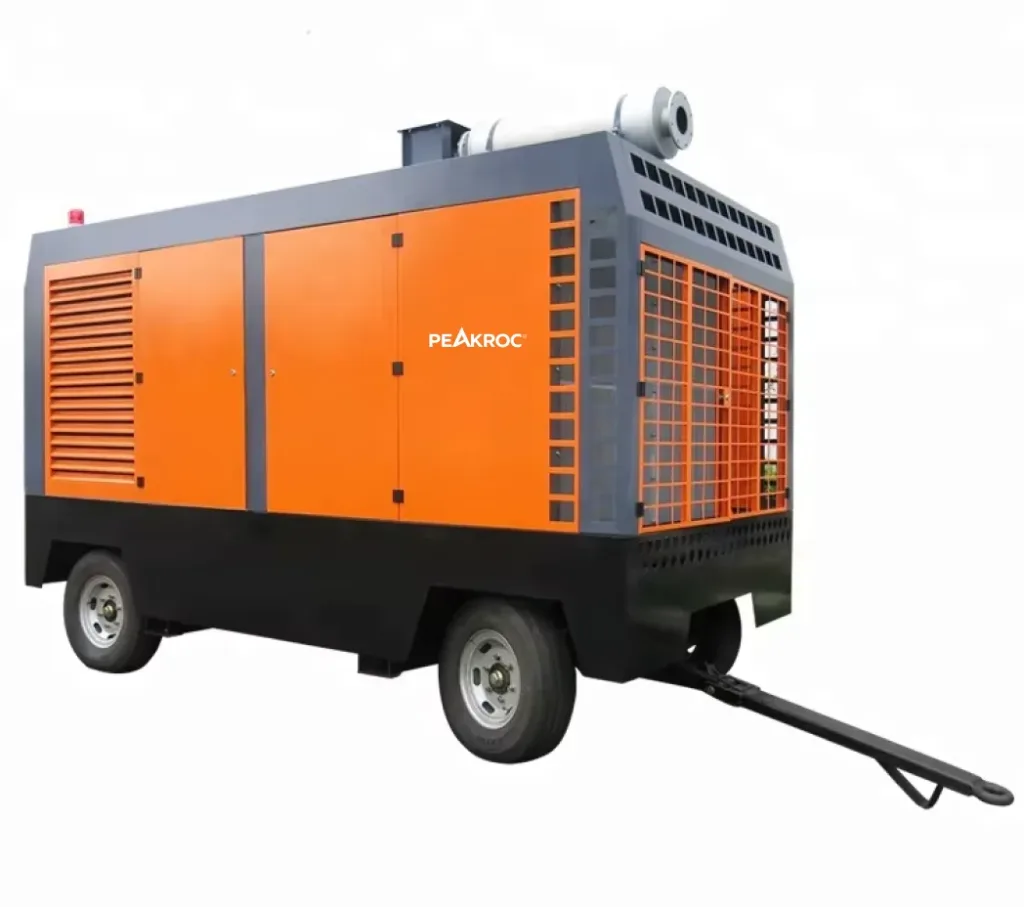
Correct Cold-Start and Warm-Up Procedure
Always follow the exact machine manual. The following process is a general field framework.
1. Inspect the Compressor
Remove snow and ice from air intakes, cooler openings, exhaust outlets, controller areas, and service access points.
Check for leaks, damaged wiring, frozen drains, loose battery connections, and trapped pressure from the previous shift.
2. Confirm Fuel and Fluid Condition
Check engine oil, compressor fluid, coolant, fuel level, and the fuel-water separator.
Do not overfill the oil because the machine is parked on uneven or frozen ground.
3. Preheat the Package
Use the installed block heater, coolant heater, oil heater, intake heater, or battery warmer according to the approved procedure.
Do not use a torch, open flame, charcoal heater, or unapproved electrical heater inside the canopy.
4. Start Without Immediate Air Demand
Where the compressor design permits, keep the outlet valves closed and start the package in its unloaded condition.
This allows oil pressure, compressor-fluid circulation, battery charging, and controller diagnostics to stabilise before the airend is placed under full demand.
5. Warm Up Under Supervision
Monitor:
- Engine-oil pressure
- Coolant and compressor temperature
- Charging voltage
- Discharge pressure
- Alarm indicators
- Leaks or unusual sounds
There is no universal warm-up time. The correct duration depends on the temperature, heater use, lubricant, engine, airend, and controller logic.
6. Apply Load Gradually
Introduce airflow demand gradually.
Confirm that pressure remains stable, the inlet and control valves respond correctly, and no frozen drain, hose, filter, or control line restricts the system.
Avoid Excessive Cold Idling
Warm-up and prolonged idling are not the same.
Extended low-load idling wastes fuel and can prevent the engine and exhaust system from reaching a suitable operating temperature. Federal fleet guidance cites recommendations of only several minutes of unnecessary idling for many modern heavy-duty diesel engines, while the exact compressor-engine manual remains controlling.
A compressor that cannot reach normal operating temperature may have:
- Excessively low air demand
- A thermostat problem
- Incorrect cooling modifications
- An oversized compressor for the application
- Missing winter-control equipment
- Doors or panels installed incorrectly
Do not cover the radiator or block ventilation openings with improvised material unless a winter front is specifically approved for that model.
Frozen Condensate and Air-Tool Icing
Compression concentrates water vapour. When compressed air cools, liquid water can collect throughout the delivery system.
In freezing conditions, this water may become ice inside:
- Control lines
- Separator and filter drains
- Aftercoolers and moisture separators
- Hose low points
- Regulators and lubricators
- Pneumatic tools
The result may be unstable pressure, blocked airflow, damaged housings, controls that fail to move, or tools that operate slowly and then stop.
Drain the complete system—not only the compressor outlet.
Pneumatic tools are especially vulnerable because air cools further as it expands through the tool. Effective water separation, suitable tool lubrication, proper hose routing, and a compressor operating at its intended temperature all help reduce icing.
Increasing compressor pressure is not a reliable solution to wet air or a frozen tool.
Operating During the Winter Shift
During operation:
- Keep snow away from the engine intake, compressor intake, cooler, and exhaust.
- Monitor engine, compressor, and discharge temperatures rather than relying only on ambient temperature.
- Drain separators and low points at intervals appropriate to humidity and duty cycle.
- Watch for pressure instability, slow tools, blocked filters, or unusual control behaviour.
- Avoid placing hoses directly in standing water or deep snow.
- Record cold-start time, alarms, drain condition, and battery behaviour.
A compressor that starts successfully may still develop problems later as moisture moves through colder downstream hoses and tools.
Combustion-powered equipment must also remain outdoors and away from building air intakes. Carbon monoxide can accumulate rapidly in enclosed or partly enclosed work areas, so only the compressed-air hose—not the diesel compressor—should be routed indoors.
Peakroc Cold-Climate Application Notes
Peakroc product documentation for the 20 m³/min, 13 bar compressor describes a high-altitude mining configuration in which engine block heaters were added for winter morning starts around –5°C. The same product range lists a more complete Arctic package with battery warming, approved synthetic fluids, insulated fuel lines, and additional cold-start preparation for more severe conditions.
For the 39 m³/min, 25 bar high-pressure drilling platform, Peakroc publishes a standard operating range extending into sub-zero conditions and an optional Arctic package for more severe temperatures. That package is described as including engine heating, low-temperature fluids, insulated fuel lines, and battery protection. These are manufacturer-published configuration examples rather than independent performance tests, so the final temperature rating must still be confirmed in the sales contract for the exact engine, serial number, and options supplied.
The transferable lesson is that winter capability comes from a coordinated package—not from one block heater added after production.
End-of-Shift Shutdown and Storage
A rushed shutdown can create the next morning’s failure.
At the end of the shift:
- Remove tool demand and follow the normal unloading sequence.
- Allow pressure and temperature to stabilise before shutdown.
- Drain the fuel-water separator and specified air-system low points.
- Fill the tank with suitable winter diesel.
- Connect approved heaters and battery support.
- Park out of wind and blowing snow where practical.
Drain water while the machine is still warm enough for liquid to escape.
Never open a drain, hose, filter, or separator while unsafe pressure remains in the system.
Cold-Weather Troubleshooting
| Symptom | Areas to inspect |
|---|---|
| Engine will not crank | Battery charge, CCA, cables, ground, starter, oil viscosity |
| Engine cranks but will not start | Fuel filter, fuel cold-flow condition, water separator, preheat system |
| Starts and then stalls | Restricted fuel supply, frozen controls, inadequate warm-up |
| Low or unstable airflow | Control-line ice, frozen filter, downstream blockage, thick compressor fluid |
| Pneumatic tool freezes | Wet air, failed drain, hose low points, incorrect tool lubrication |
| Machine will not warm up | Excessive idling, thermostat problem, very low load, incorrect winter setup |
Stop the machine and obtain qualified technical support when the fault involves abnormal pressure, fuel leakage, damaged heaters, electrical faults, frozen safety components, or a drain that cannot be opened safely.
Cold-Weather RFQ Checklist
Provide these details when requesting a quotation:
| Project information | Why it matters |
|---|---|
| Lowest storage temperature | Defines parked-machine protection |
| Lowest starting temperature | Defines heaters, battery, fuel, and fluids |
| Lowest operating temperature | Defines continuous-duty capability |
| Required FAD and pressure | Determines engine and airend load |
| Heater power available | Determines electric or fuel-fired preheating |
| Application and shift length | Determines condensate, loading, and spare-parts needs |
Peakroc’s compressor selection service can review airflow, pressure, temperature, altitude, heater power, chassis, application, and delivery destination before the winter configuration is finalised.
Final Recommendation
Cold-weather compressor operation starts before the engine is cranked.
Confirm the exact storage, starting, and operating limits. Prepare the fuel system, approved lubricants, coolant, battery, heaters, drains, control lines, hoses, and tools.
Start with air demand isolated, supervise the warm-up, and apply load gradually. During operation, maintain normal temperature, remove condensate, protect downstream tools, and keep snow away from airflow paths.
After the shift, unload correctly, drain water before it freezes, fill the fuel tank, connect the heaters, and shelter the compressor where practical.
The most important specification principle is:
“Cold-weather capable” is not a complete equipment description.
A reliable winter compressor is a documented combination of machine design, fluids, battery capacity, heaters, fuel preparation, moisture management, operating procedures, and service support.
FAQ
Can a standard portable diesel compressor operate at –20°C?
Not automatically. It may require a model-specific cold-weather package, approved low-temperature fluids, engine heating, battery protection, insulated fuel lines, and protected drains.
How long should a portable compressor warm up?
There is no universal time. Follow the machine manual and wait for stable oil pressure, temperature, charging voltage, controller response, and absence of alarms before applying full load.
Why does diesel fuel cause problems in freezing weather?
Low temperature can reduce the fuel’s cold-flow performance and allow wax crystals to restrict the fuel filter. Use a suitable winter blend or approved cold-flow treatment before blockage occurs.
Why do pneumatic tools freeze?
Moisture can freeze as compressed air expands and cools inside the tool. Water separation, correct compressor temperature, approved tool oil, and dry hoses reduce the risk.
Does a block heater protect the complete compressor?
Usually not. It mainly supports the engine or coolant. The airend, battery, fuel lines, control system, drains, separator, hoses, and tools may require separate protection.
What should be drained after a winter shift?
Drain every point identified by the manufacturer, including the fuel-water separator, moisture separators, filters, hose low points, manifolds, receivers, and external air-treatment equipment.
Author

Mark Chen – Senior Mechanical Engineer, Peakroc®
Mark Chen is a senior mechanical engineer at Peakroc®, specializing in compressed air systems and drilling equipment for mining and construction applications. With over 15 years of field experience, he has led multiple projects on optimizing air delivery efficiency, equipment durability, and energy consumption.